



12V DC Power Supply Explained: Architecture, Working Principles, Applications, and Engineering Selection Guide
A 12V DC power supply is one of the most widely used low-voltage power systems in modern electronics. It converts AC mains power into regulated 12-volt direct current, providing stable energy for devices such as LED lighting, networking equipment, security systems, automotive electronics, and embedded hardware.
From an engineering perspective, the popularity of the 12V power standard is not accidental. It represents an optimal balance between electrical safety, transmission efficiency, component availability, and battery compatibility. This article explains the electrical architecture of 12V power supplies, their internal conversion mechanisms, major power supply topologies, real-world engineering applications, selection criteria, and testing methods.
Table of Contents
- 1. What Is a 12V DC Power Supply?
- 2. Why 12V Became an Industry Power Standard
- 3. Internal Architecture of a 12V Power Supply
- 4. Main Types of 12V Power Supplies
- 5. Engineering Applications of 12V DC Power
- 6. How to Select the Right 12V Power Supply
- 7. Installation and Maintenance Considerations
- 8. How to Test a 12V Power Supply
- 9. Advantages and Limitations of 12V Systems
- 10. FAQ
1. What Is a 12V DC Power Supply?
A 12V DC power supply is an electrical device that converts alternating current (AC) from the utility grid into a regulated 12-volt direct current (DC) output used by electronic equipment.
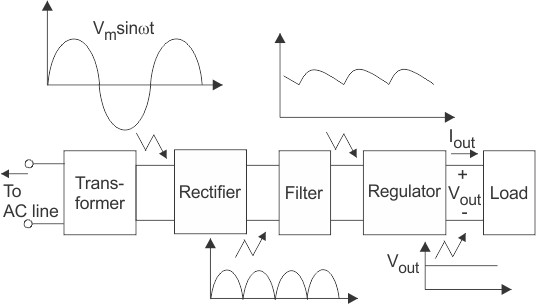
Typical conversion stages include:
- AC input stage
- Rectification
- Filtering
- Voltage regulation
- Output stabilization
These stages ensure the output voltage remains close to 12V ± tolerance even when load current changes.
From a systems engineering perspective, the goal of the power supply is to provide:
- Voltage stability
- Low ripple noise
- High efficiency
- Electrical isolation
- Protection against abnormal conditions
2. Why 12V Became an Industry Power Standard
The 12-volt standard emerged historically from automotive electrical systems. Early vehicles adopted 12V lead-acid batteries, and the ecosystem of components, accessories, and power electronics grew around this voltage.
Several technical reasons explain its continued popularity.
Electrical Safety
12V falls within the extra-low voltage (ELV) category in most electrical safety standards. The risk of dangerous electric shock is significantly lower compared with 110V or 230V systems.
Compatibility With Battery Technologies
Many energy storage systems operate near 12V:
- Lead-acid batteries
- LiFePO4 battery packs
- Portable power stations
This makes 12V ideal for mobile and off-grid electronics.
Efficient for Low-Power Electronics
Many devices consume 10W–100W, which fits well within the current capacity of 12V systems.
Example:
Power = Voltage × Current
P = 12V × 5A = 60W
This range covers:
- routers
- cameras
- LED drivers
- small motors
Mature Component Ecosystem
A huge number of components are designed for 12V systems:
- DC motors
- fans
- controllers
- LED strips
- relays
This widespread compatibility simplifies system design.
3. Internal Architecture of a 12V Power Supply
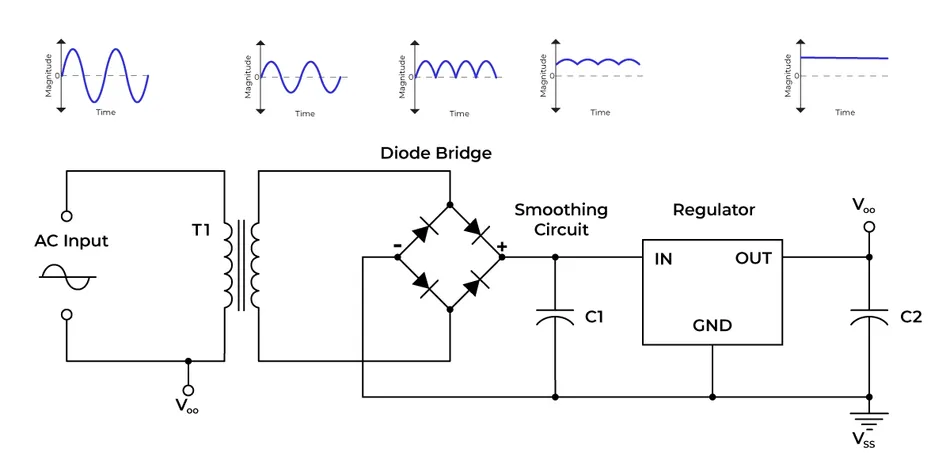
A modern AC-DC power supply follows a multi-stage energy conversion process.
1. AC Input and EMI Filtering
The AC mains first passes through:
- fuse
- EMI filter
- surge suppression
These circuits reduce electrical noise and protect the system from voltage spikes.
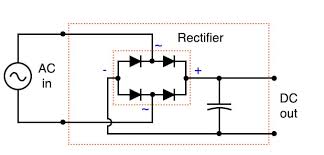
2. Rectification
A bridge rectifier converts AC voltage into pulsating DC.
AC → Bridge Rectifier → Pulsating DC
3. Filtering
Large electrolytic capacitors smooth the waveform to reduce ripple voltage.
4. Voltage Conversion
Depending on the design, the circuit may use:
- high-frequency switching
- transformer isolation
- linear voltage regulation
5. Output Stabilization
Feedback control circuits regulate the output to maintain stable 12V under varying loads.
4. Main Types of 12V Power Supplies
Two primary power supply topologies dominate the market.
Switch Mode Power Supply (SMPS)
A switching power supply uses high-frequency switching transistors to convert power efficiently.
Key characteristics:
- efficiency often 80–95%
- compact size
- lightweight
- wide input voltage range
Because switching frequencies may reach 50 kHz – 500 kHz, transformers and inductors can be significantly smaller than those used in linear supplies.
Typical applications include:
- laptop adapters
- LED drivers
- routers
- CCTV systems
Linear Power Supply
A linear regulator power supply operates by dropping excess voltage across a regulating transistor.
Architecture:
AC → Transformer → Rectifier → Filter → Linear Regulator
Advantages:
- extremely low noise
- minimal ripple
- excellent voltage stability
However, they suffer from:
- low efficiency
- large transformers
- high heat dissipation
These supplies are often used in:
- laboratory instruments
- audio equipment
- RF testing systems
5. Engineering Applications of 12V DC Power
Because of its balance between safety and power capability, 12V DC is used in many industries.
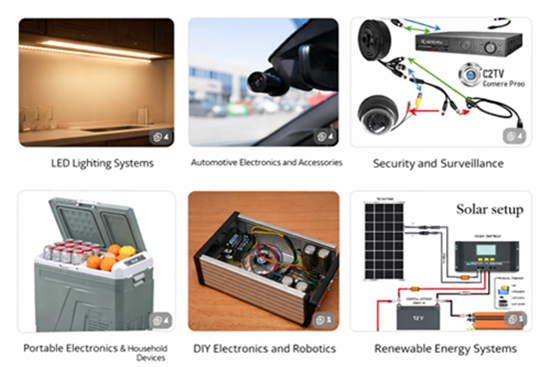
LED Lighting Systems
Most LED strips and lighting modules operate on 12V because LEDs require constant current or low-voltage DC.
Typical installations include architectural lighting, cabinet lighting, decorative lighting, and signage illumination.
Automotive Electronics
Automotive electrical systems operate entirely on 12V DC bus architecture.
Examples include dash cameras, navigation systems, car refrigerators, charging ports, and infotainment systems.
Security and Surveillance Systems
12V adapters power many surveillance devices such as CCTV cameras, NVR/DVR recorders, alarm systems, and motion detectors. These devices require stable 24/7 power.
Networking and Communication Equipment
Home and office networking devices commonly run on 12V including routers, modems, network switches, and VoIP phones.
Renewable Energy Systems
Small solar systems frequently use 12V battery banks.
Typical architecture:
Solar panel → charge controller → 12V battery → DC load
These systems are used in RV solar systems, remote cabins, marine electronics, and emergency backup power solutions.
6. How to Select the Right 12V Power Supply
Choosing the correct power supply is essential for reliability and safety.
1. Match Output Voltage
The output voltage must exactly match the device requirement.
Example:
Device rating: 12V
Power supply output: 12V
Using higher voltage may damage the device.
2. Provide Adequate Current
The power supply current rating should be equal or higher than the device requirement.
Example device requirement:
12V 3A
Recommended adapter:
12V 4A or 12V 5A
3. Calculate Required Power
Use the basic formula:
Power (W) = Voltage × Current
Example:
12V × 5A = 60W
4. Verify Connector Type
Common connector:
5.5 mm × 2.1 mm DC barrel plug
However polarity must also be checked.
Most adapters use:
Center Positive
5. Check Protection Features
A reliable power supply includes:
- over-current protection (OCP)
- over-voltage protection (OVP)
- short-circuit protection (SCP)
- thermal shutdown
These circuits prevent device damage.
7. Installation and Maintenance Considerations
Installation Best Practices
- Ensure adequate ventilation
- Avoid high humidity environments
- Use wires rated for the required current
- Verify polarity before connection
Maintenance Recommendations
- inspect connectors regularly
- clean dust from ventilation slots
- avoid operating near maximum load continuously
Proper maintenance significantly improves power supply lifespan.
8. How to Test a 12V Power Supply
Testing is typically performed using a digital multimeter.
Required Tools
- digital multimeter
- AC outlet
- power adapter
Test Procedure
- Connect the adapter to AC power
- Set the multimeter to DC voltage mode
- Place the red probe on the center pin
- Place the black probe on the outer barrel
- Read the output voltage
Typical output range:
11.5V – 12.5V
9. Advantages and Limitations of 12V Systems
Advantages
Electrical Safety
Low voltage reduces risk of electrical shock.
Wide Compatibility
Many consumer electronics are designed for 12V systems.
Battery Integration
Works well with solar and portable battery systems.
Energy Efficiency for Small Loads
Efficient for devices below ~100W.
Limitations
Voltage Drop Over Distance
Low voltage means higher current.
Vdrop = I × R
Long cables may cause noticeable voltage loss.
Limited Power Capacity
Large appliances require higher voltage systems such as:
- 24V
- 48V
- AC mains
Higher Current Requirements
Delivering large power at low voltage requires thicker wires.
10. FAQ
What devices commonly use a 12V DC power supply?
Common devices include LED lighting, routers, CCTV cameras, automotive accessories, and small appliances.
Can I use a higher current power supply?
Yes. The device will only draw the current it requires, as long as the voltage is correct.
What happens if polarity is reversed?
Reverse polarity can damage sensitive electronics or destroy input protection circuits.
Is a switching power supply better than a linear one?
For most consumer electronics, SMPS is preferred due to higher efficiency and smaller size. Linear supplies are mainly used in low-noise laboratory or audio applications.
What voltage should a 12V adapter actually output?
Most adapters output 11.5V to 12.5V depending on load conditions and design tolerance.
Conclusion
The 12V DC power supply remains one of the most practical and widely adopted low-voltage power solutions in modern electronic systems. Its success comes from a combination of electrical safety, strong ecosystem compatibility, and suitability for battery-powered environments. From LED lighting and network equipment to automotive electronics and renewable energy systems, 12V power provides a stable and efficient operating platform for a broad range of devices.
For engineers and system designers, understanding the internal architecture, power conversion principles, and correct selection criteria is essential for ensuring long-term reliability and safe operation. By choosing an appropriate power supply with sufficient current capacity, proper protection features, and high efficiency, users can significantly improve system stability while reducing energy loss and thermal stress. As low-voltage electronics and distributed power systems continue to expand, the 12V standard will remain a critical foundation for many electronic designs and applications.