



Rocker Switch Engineering Guide: Structure, Working Principle, Types and Selection
A rocker switch is a widely used electromechanical switch designed to control electrical circuits through a simple rocking motion. Unlike toggle switches that use a lever mechanism, rocker switches employ a pivoted actuator that alternately opens or closes internal contacts. Because of their compact structure, clear ON/OFF indication, and reliable switching performance, rocker switches are commonly used in household appliances, industrial equipment, vehicles, and electronic systems.
This article explains the internal structure of rocker switches, their operating mechanism, common switch configurations such as SPST, SPDT, DPST, and DPDT, and the engineering considerations required when selecting the correct switch. It also compares rocker switches with toggle switches and discusses their advantages, limitations, and practical applications.
Catalog
- 1. What Is a Rocker Switch
- 2. Internal Structure of a Rocker Switch
- 3. Working Principle of a Rocker Switch
- 4. Types of Rocker Switches
- 5. Typical Applications
- 6. Engineering Considerations When Selecting a Rocker Switch
- 7. Rocker Switch vs Toggle Switch
- 8. Advantages and Limitations
- 9. FAQ
- 10. Conclusion
1. What Is a Rocker Switch
A rocker switch is an electromechanical switching device used to control the flow of electrical current by mechanically opening or closing contacts within a circuit.
The name "rocker" originates from the rocking motion of the actuator. When one side of the switch is pressed, the opposite side rises, causing the internal mechanism to pivot and change the electrical connection state. This motion allows the switch to toggle between ON and OFF positions.
Compared with other switch designs, rocker switches offer simple operation, clear tactile feedback, and compact panel mounting. These characteristics make them suitable for many electrical systems and consumer products.
Typical applications include power supplies, control panels, consumer electronics, automotive systems, and industrial equipment.
2. Internal Structure of a Rocker Switch
The internal design of a rocker switch combines mechanical movement and electrical contact switching. Although the exact construction differs between manufacturers, most rocker switches contain several fundamental components.
These include an actuator or rocker cap that the user presses, a pivot mechanism that allows the actuator to tilt, a spring mechanism that ensures stable switching positions, moving contacts that change position during actuation, fixed contacts connected to the circuit terminals, and an insulating housing that holds all parts together.
When the actuator is pressed, mechanical force is transferred through the pivot mechanism to the internal contact bridge. The moving contact then connects or separates from the fixed contact, completing or interrupting the electrical circuit.
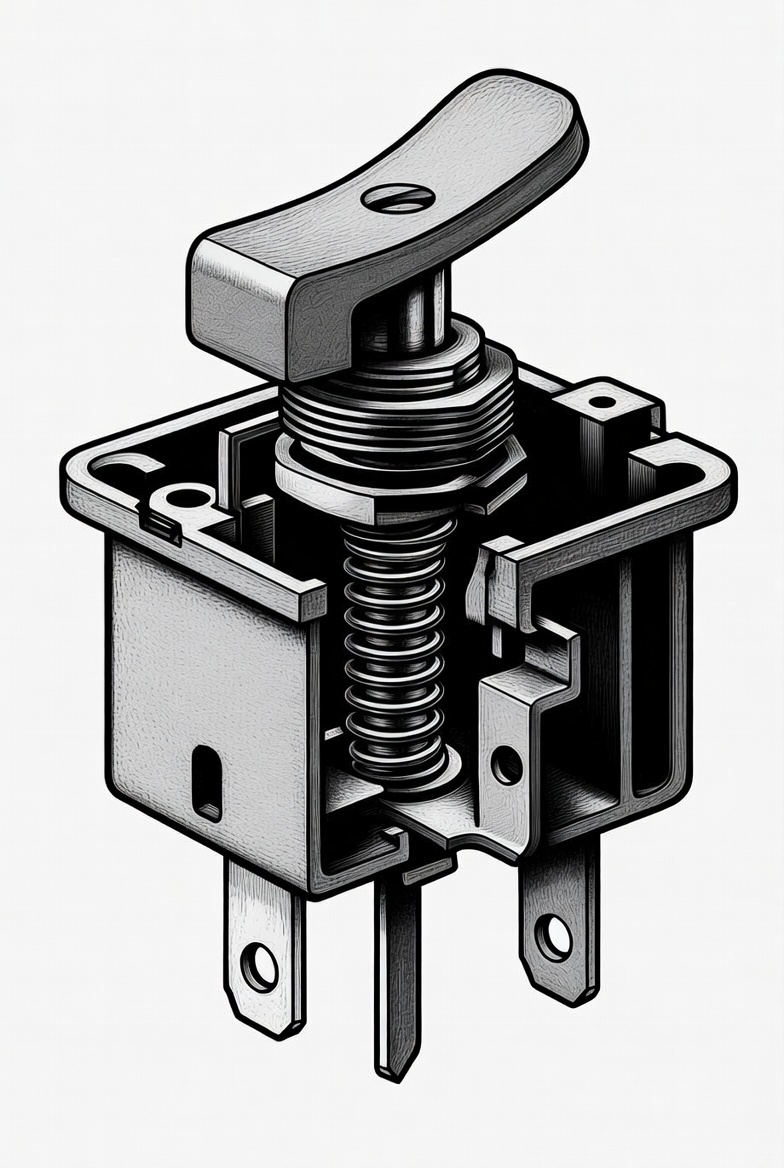
Figure 1. Rocker Switch Internal Structure
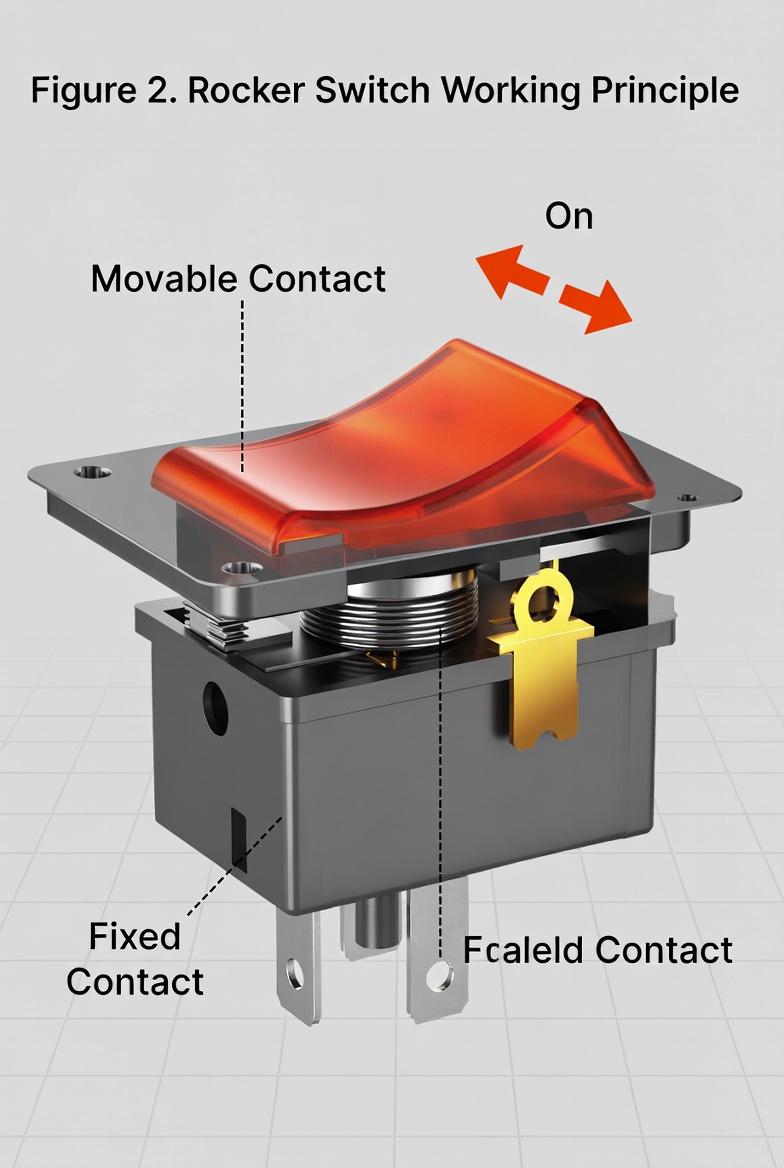
3. Working Principle of a Rocker Switch
A rocker switch operates by controlling the electrical circuit through mechanical contact movement.
When a user presses one side of the rocker actuator, the actuator rotates around a central pivot. This motion pushes the internal contact bridge toward the fixed contact. Once the contacts touch, the electrical path is completed and current begins to flow through the circuit.
Pressing the opposite side of the rocker reverses this motion. The internal contact bridge moves away from the fixed contact, breaking the electrical connection and stopping current flow.
Inside the switch, a spring-loaded mechanism ensures the actuator snaps firmly into position. This mechanism provides tactile feedback to the user and keeps the switch stable in either the ON or OFF position.
Contact materials are usually made from copper alloys or silver alloys because these materials provide low electrical resistance, good conductivity, and high durability under repeated switching cycles.
4. Types of Rocker Switches
Rocker switches are categorized based on pole and throw configuration. These terms describe how many circuits the switch controls and how electrical connections are routed.
4.1 Single-Pole Single-Throw (SPST)
The SPST rocker switch is the most basic configuration. It contains one input terminal and one output terminal and functions as a simple ON/OFF control for a single circuit.
When the switch is turned ON, the internal contacts close and current flows through the circuit. When the switch is turned OFF, the contacts separate and current flow stops.
SPST rocker switches are widely used in power strips, small appliances, and simple electronic equipment.
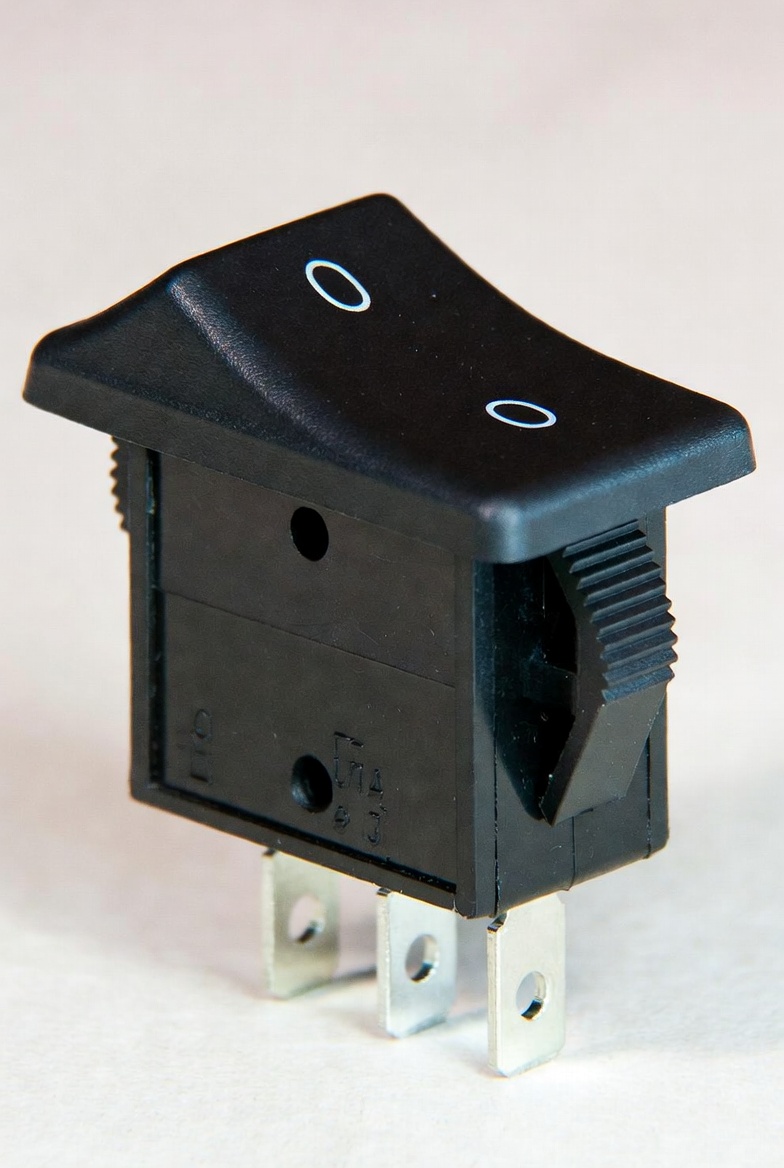
Figure 3. SPST Rocker Switch
4.2 Single-Pole Double-Throw (SPDT)
An SPDT rocker switch includes one common terminal and two output terminals. This configuration allows the switch to route an input signal to one of two different circuits.
SPDT switches are useful in situations where a device must alternate between two operating modes or power sources.
4.3 Double-Pole Single-Throw (DPST)
A DPST rocker switch controls two independent circuits simultaneously using a single actuator. When the switch is activated, both circuits are connected at the same time.
This configuration is commonly used in AC systems where both the live and neutral lines must be switched together for safety.
4.4 Double-Pole Double-Throw (DPDT)
DPDT rocker switches provide the most flexible switching capability among common rocker switch types.
They contain two input terminals and four output terminals, allowing each circuit to switch between two outputs. This design is frequently used in applications such as motor direction control or signal routing.
4.5 Illuminated Rocker Switch
An illuminated rocker switch integrates an LED or neon indicator inside the switch body. The indicator light can show the power state of the circuit or the position of the switch.
This type of switch is commonly found in power supplies, computer systems, vehicles, and industrial control panels where visual feedback is important.

Figure 4. Illuminated Rocker Switch
5. Typical Applications
Rocker switches are widely used in many types of electrical and electronic equipment.
In household appliances, rocker switches are commonly found in electric kettles, coffee machines, fans, and power strips. Their simple operation allows users to quickly turn devices on or off.
Consumer electronic products such as monitors, audio equipment, and lighting systems also rely on rocker switches for power control.
Automotive systems frequently use rocker switches for accessory controls including auxiliary lighting, cabin ventilation, and seat heaters.
In industrial environments, rocker switches appear in machine control panels, equipment start and stop systems, and power management circuits.
6. Engineering Considerations When Selecting a Rocker Switch
Choosing the correct rocker switch requires evaluating both electrical and mechanical parameters.
Electrical ratings are one of the most important considerations. The switch must support the voltage and current required by the circuit. Typical rocker switch ratings range from 3A to 20A and from 125V to 250V AC.
Switch lifespan is also important. Mechanical switches are usually rated by the number of switching cycles they can withstand. Standard rocker switches may support around 10,000 cycles, while higher quality industrial switches may exceed 100,000 cycles.
Mounting requirements must also be considered. Rocker switches typically require a rectangular panel cutout, and the dimensions must match the switch design.
Environmental protection is another factor in harsh environments. Some rocker switches offer protection ratings such as IP65 or IP67 to resist dust and moisture.
Finally, the terminal type should match the wiring method used in the system. Common terminal types include solder terminals, quick-connect terminals, and screw terminals.
7. Rocker Switch vs Toggle Switch
| Feature | Rocker Switch | Toggle Switch |
|---|---|---|
| Actuation | Rocking motion | Lever movement |
| Appearance | Flat and modern | Mechanical lever design |
| Mounting | Flush panel mounting | Lever protrudes from panel |
| Ease of Operation | Press surface | Flip lever |
| Indicator Option | LED indicators available | Indicator lights are uncommon |
| Typical Applications | Appliances, electronics | Industrial equipment, automotive systems |
8. Advantages and Limitations
Advantages
Rocker switches provide very simple and intuitive operation. Users only need to press one side of the actuator to change the switch state.
Their compact and flat design makes them suitable for modern electronic devices where panel space is limited.
Illuminated versions provide visual confirmation of the device’s power state.
Limitations
Most rocker switches are designed for relatively simple switching tasks and may not provide complex multi-position control.
Like all electromechanical switches, their internal contacts may eventually wear out due to mechanical stress or electrical arcing after long-term use.
9. FAQ
What is the difference between SPST and SPDT rocker switches?
SPST switches control a single circuit with a simple ON/OFF function, while SPDT switches can route a single input to two different outputs.
Can rocker switches handle high current loads?
Yes, but the switch must be rated for the required current. Industrial rocker switches can support loads up to 20A or higher depending on design.
Why do some rocker switches include indicator lights?
Indicator lights allow users to quickly determine whether a device is powered or whether the switch is in the ON position.
What is the typical lifespan of a rocker switch?
Most rocker switches are rated between 10,000 and 100,000 switching cycles depending on the switch quality and operating conditions.
10. Conclusion
Rocker switches are reliable and widely used electromechanical components that control electrical circuits through a simple rocking motion. Their compact structure, intuitive operation, and broad range of configurations make them suitable for many consumer, automotive, and industrial applications.
Understanding the internal mechanism, switching configurations, and engineering parameters allows designers and engineers to select the appropriate rocker switch for a given system. Careful attention to electrical ratings, mounting dimensions, environmental protection, and switching life ensures stable and long-term performance.