



Air Circuit Breaker (ACB): Working Principle, Construction, and Industrial Applications
Air Circuit Breakers (ACBs) are critical protection devices used in low-voltage power distribution systems to safely interrupt fault currents. By using air as the arc-extinguishing medium, ACBs provide reliable protection against overloads, short circuits, and operational faults. This article presents a detailed engineering-level analysis of ACB working principles, internal construction, arc control mechanisms, types, performance characteristics, and real-world applications, helping engineers design safe and efficient electrical systems.
Table of Contents
- 1. What Is an Air Circuit Breaker (ACB)?
- 2. Working Principle of ACB
- 3. Internal Construction and Components
- 4. Arc Control and Interruption Mechanism
- 5. Types of Air Circuit Breakers
- 6. Key Features and Protection Functions
- 7. Applications of ACB
- 8. Advantages and Limitations
- 9. ACB vs Other Circuit Breakers
- 10. Maintenance and Testing
- 11. FAQ
- 12. Conclusion
1. What Is an Air Circuit Breaker (ACB)?
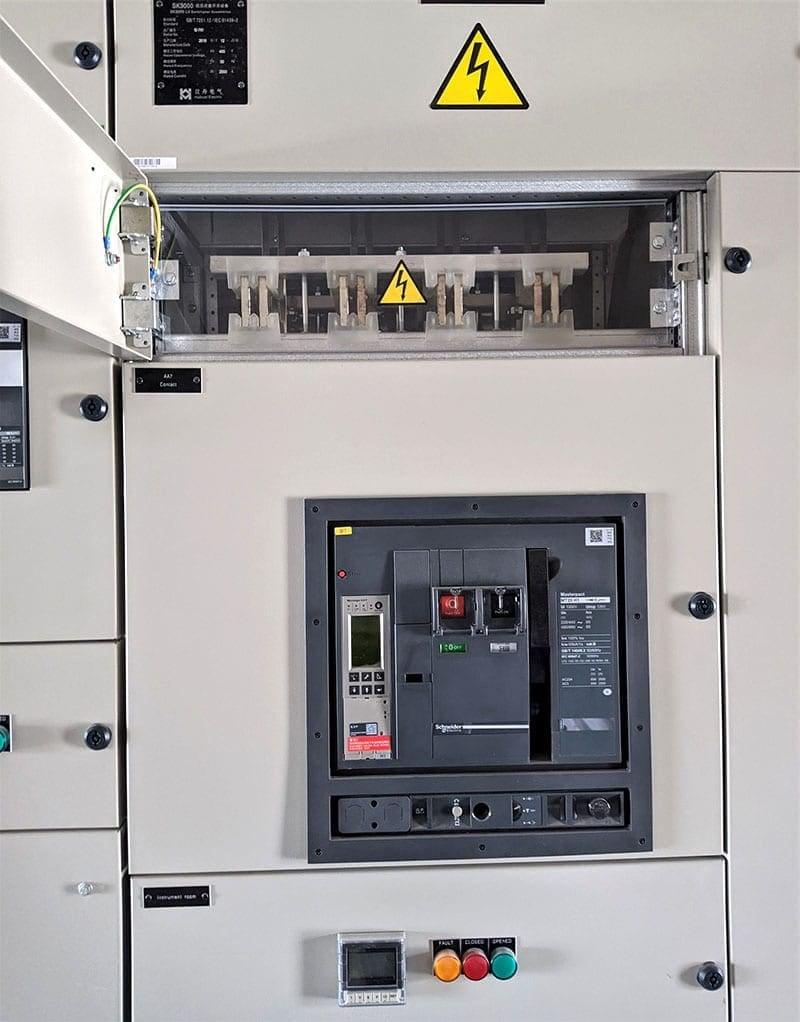
An Air Circuit Breaker (ACB) is a low-voltage protective switching device that uses air at atmospheric pressure to extinguish the arc formed during current interruption.
Engineering Definition
An ACB is a mechanical switching device capable of:
- Making current
- Carrying current
- Breaking current under normal and fault conditions
Typical Voltage Range
- Up to 690V / 1000V (low-voltage systems)
Current Range
- Typically 630A to 6300A or higher
2. Working Principle of ACB
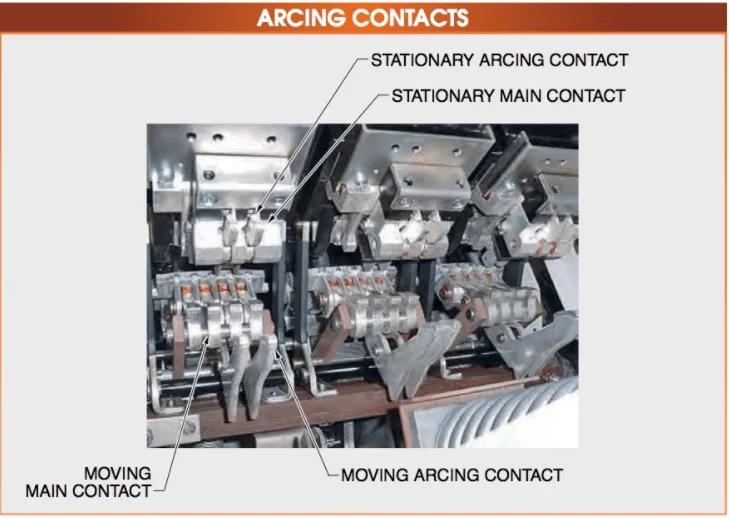
2.1 Normal Operation
- Main contacts remain closed
- Current flows with minimal resistance
2.2 Fault Detection
The trip unit detects abnormal conditions:
- Thermal trip → overload (inverse time delay)
- Magnetic trip → short circuit (instantaneous)
2.3 Contact Separation
- Trip signal activates the operating mechanism
- Contacts open rapidly
2.4 Arc Formation and Extinction
- Arc forms between separating contacts
- Arc is driven into the arc chute
- Split into smaller arcs
- Cooled and extinguished by air
3. Internal Construction and Components
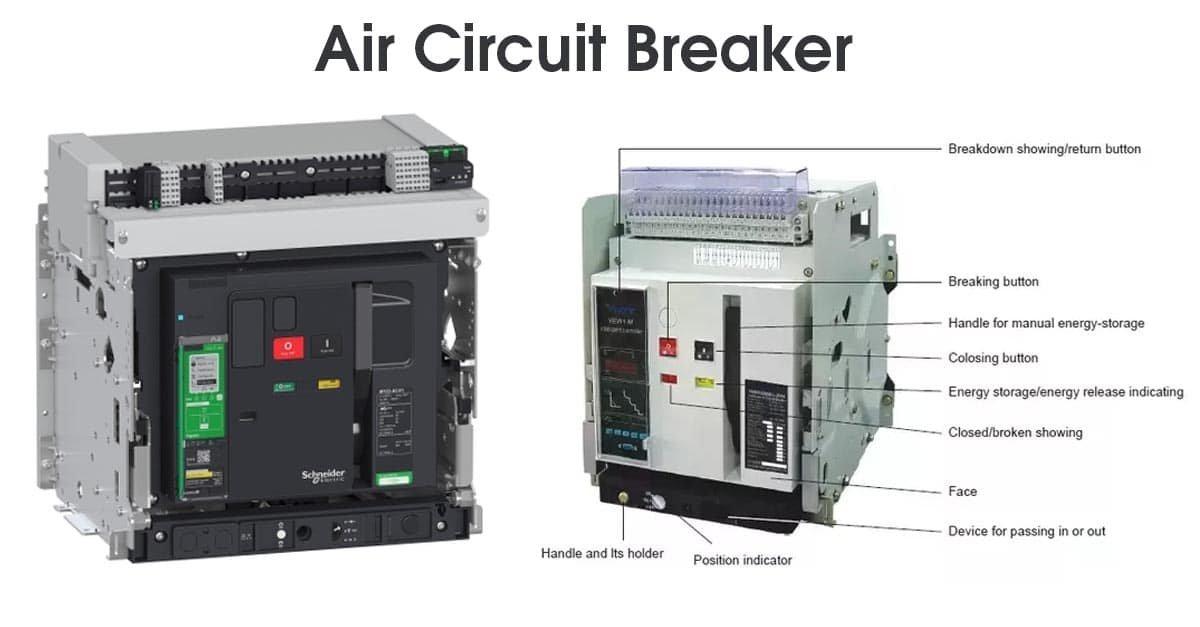
3.1 Main Components
- Main contacts → carry load current
- Arcing contacts → protect main contacts
- Arc chute → extinguishes arc
- Trip unit → detects faults
- Operating mechanism → controls switching
3.2 Supporting Systems
- Arc runners → guide arc
- Air flow path → enhances cooling
- Control unit → enables monitoring
- Insulated frame → ensures safety
4. Arc Control and Interruption Mechanism
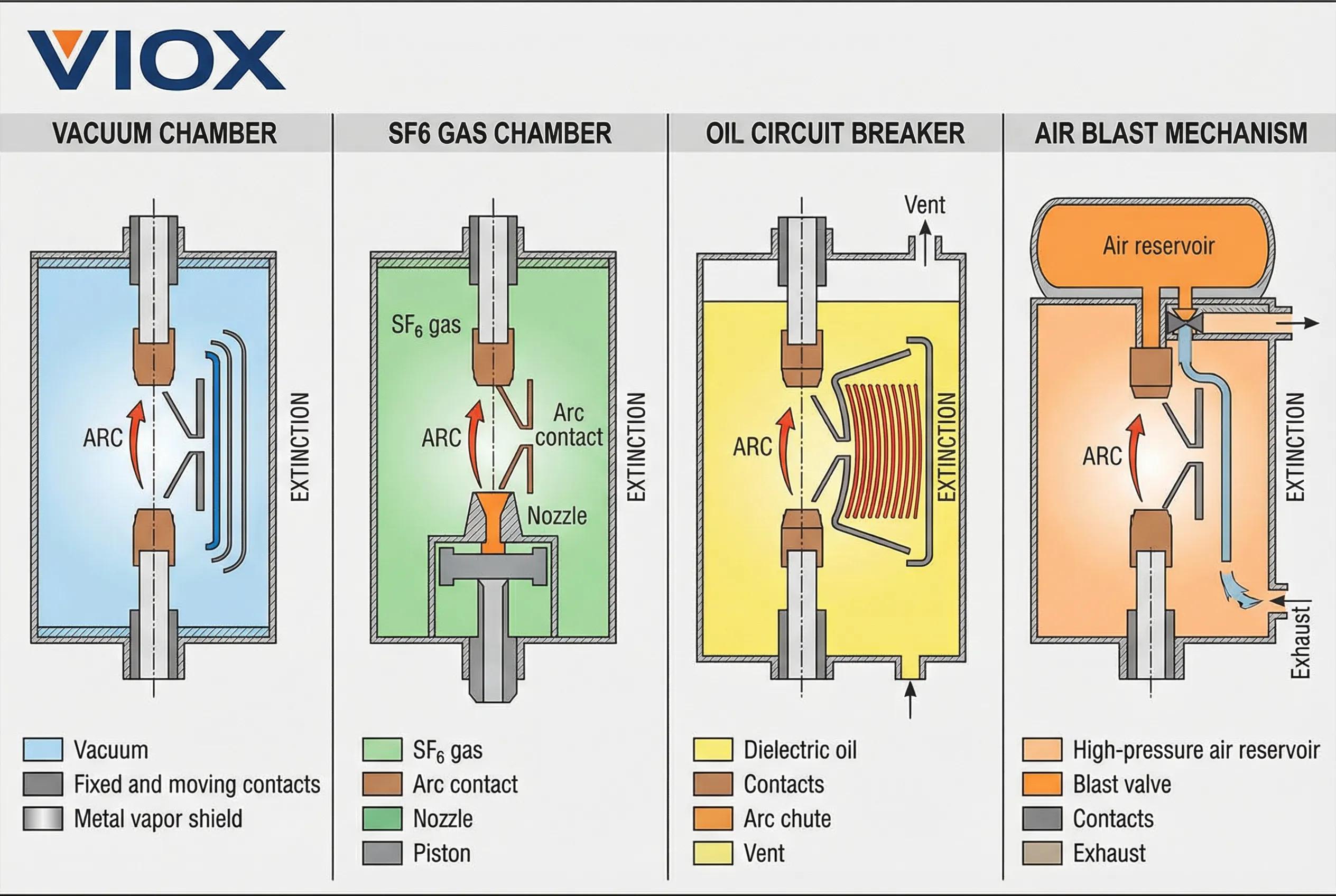
4.1 Arc Behavior
- Arc forms when contacts separate
- High temperature ionized air conducts current
4.2 Arc Control Techniques
- Arc elongation increases resistance
- Arc splitting reduces energy concentration
- Cooling lowers ionization
4.3 Arc Chute Function
- Metal plates divide arc into segments
- Rapid cooling extinguishes arc
- Current interruption occurs safely
5. Types of Air Circuit Breakers
5.1 Based on Arc Control
- Plain Break ACB
- Magnetic Blowout ACB
- Air Chute ACB
- Air Blast Circuit Breaker
5.2 Based on Installation
- Fixed Type
- Drawout Type
6. Key Features and Protection Functions
| Category | Feature | Description |
|---|---|---|
| Protection | Overload protection | Thermal trip prevents overheating |
| Protection | Short circuit protection | Instantaneous magnetic trip |
| Control | Remote operation | Allows safe remote control |
| Safety | Interlocking system | Prevents unsafe switching |
| Monitoring | Status indication | Displays breaker condition |
| Maintenance | Isolation positions | Enables safe testing |
7. Applications of ACB
7.1 Industrial Systems
- Motor control centers
- Power distribution systems
- Heavy machinery protection
7.2 Commercial Systems
- Office buildings
- Data centers
- Shopping complexes
7.3 Critical Infrastructure
- Hospitals
- Airports
- Backup power systems
8. Advantages and Limitations
Advantages
- Suitable for high current applications
- Resettable and reusable
- Reliable under frequent operation
- Supports automation
Limitations
- Larger size
- Higher cost
- Less efficient at low fault currents
- Slower arc movement under weak faults
9. ACB vs Other Circuit Breakers
| Feature | ACB | Oil CB | SF₆ CB | Vacuum CB |
|---|---|---|---|---|
| Arc Medium | Air | Oil | SF₆ Gas | Vacuum |
| Voltage Range | Low | Medium | Medium–High | Medium |
| Fire Risk | Low | High | Low | Low |
| Maintenance | Moderate | High | Specialized | Low |
| Environmental Impact | Eco-friendly | Oil disposal issues | Gas concerns | Low |
10. Maintenance and Testing
10.1 Routine Maintenance
- Inspect for dust, corrosion, overheating
- Lubricate mechanical parts
- Check contact condition
10.2 Electrical Testing
- Insulation resistance testing
- Contact resistance testing
- Trip function verification
10.3 Advanced Testing
- Primary injection testing
- Breaker timing analysis
- Mechanical endurance testing
11. FAQ
Q1: Why is air used in ACB?
Air is safe, eco-friendly, and effective for low-voltage arc extinction.
Q2: What is the main advantage of ACB?
It provides reliable high-current protection with reset capability.
Q3: Where are ACBs commonly used?
In industrial and commercial power distribution systems.
Q4: What is a drawout ACB?
A removable breaker that allows easy maintenance and replacement.
Q5: How often should ACBs be maintained?
Typically once a year or based on operating conditions.
12. Conclusion
Air Circuit Breakers are essential for protecting low-voltage power systems. Their ability to interrupt high currents, combined with reliable arc control and advanced protection features, makes them ideal for industrial and commercial applications. Proper maintenance and correct selection ensure long-term safety and operational stability.