



MOSFET Replacement Guide: How to Find the Perfect Alternative Without Blowing Up Your Board
Facing a supply chain crisis? When your go-to Infineon or Vishay MOSFET is out of stock (OOS) or End-of-Life (EOL), the pressure is on to find a "drop-in" replacement. But in power electronics, "similar" isn't good enough. This guide provides a data-driven framework for hardware engineers and procurement specialists to select reliable Power MOSFET alternatives that maintain circuit integrity and thermal performance.
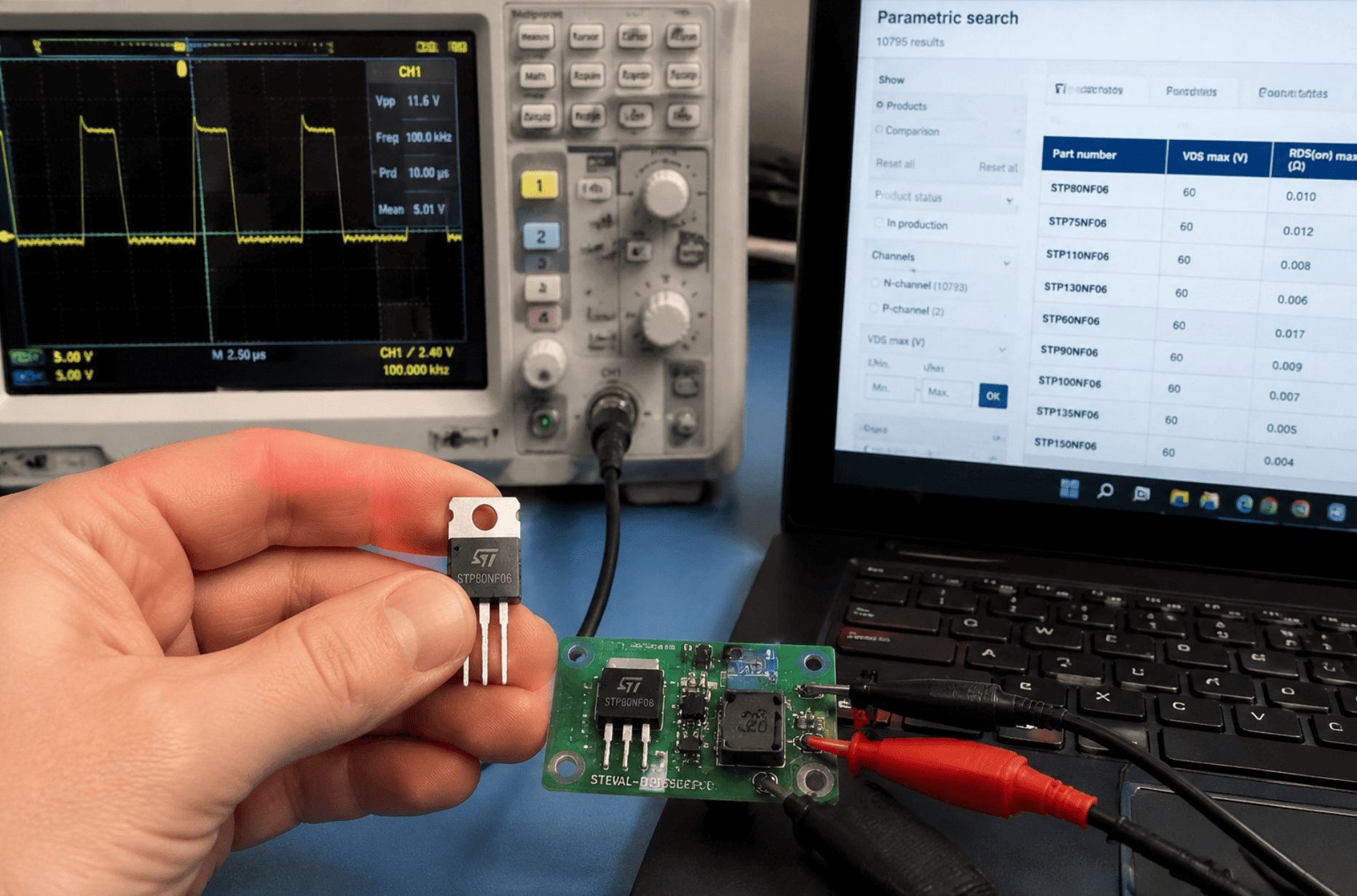
Table of Contents
- 1. Understanding MOSFET Substitution: Why It's More Than Just a Part Number
- 2. Core Concepts Simplified: The "Water Pipe" Analogy
- 3. Step-by-Step Guide to MOSFET Cross-Referencing
- 4. Expert Tips & Common Pitfalls to Avoid
- 5. Conclusion & Final Thoughts
1. Understanding MOSFET Substitution: Why It's More Than Just a Part Number
In the current global semiconductor landscape, relying on a single-source BOM is a recipe for production delays. However, the "Buy what's available" strategy often leads to catastrophic field failures if the technical nuances are ignored.
For overseas hardware engineers, the goal isn't just to find a part that fits the footprint; it's to ensure the electrical behavior remains consistent under stress. Whether you are designing for high-frequency SMPS (Switched-Mode Power Supplies) or rugged motor controllers, a substitution is a calculated risk. This guide deconstructs that risk into manageable parameters, helping you secure Technical Support when the cross-reference math gets complicated.
2. Core Concepts Simplified: The "Water Pipe" Analogy
If you're explaining MOSFET specs to a procurement colleague or a junior maker, use the water pipe analogy. It strips away the complex physics and focuses on what matters for survival.
- Vds (The Burst Pressure): Think of $V_{DS}$ as the maximum water pressure the pipe can handle when the valve is closed. If the pressure exceeds this, the pipe bursts. Rule: $V_{DS}$ of the replacement $\ge$ Original.
- Id (The Flow Rate): This is how much water can flow through the pipe when fully open. Rule: $I_D$ of the replacement $\ge$ Original.
- RDS(on) (The Pipe Friction): This is the internal resistance of the pipe. A rougher inner surface (higher resistance) creates heat as water flows through. Rule: $R_{DS(on)}$ of the replacement $\le$ Original.
- Qg (The Valve Weight): $Q_g$ (Gate Charge) is how much effort it takes to push the valve open or closed. If the new valve is too heavy (High $Q_g$), your "hand" (the Driver IC) might not be strong enough to flip it fast enough, causing the valve to leak heat during the transition.
| Parameter | Symbol | Criticality | Replacement Rule | Impact of Mismatch |
|---|---|---|---|---|
| Drain-Source Voltage | $V_{DS}$ | High | $\ge$ Original | Immediate catastrophic breakdown |
| Continuous Drain Current | $I_D$ | High | $\ge$ Original | Overheating and bond-wire failure |
| Static Drain-Source On-Resistance | $R_{DS(on)}$ | High | $\le$ Original | Increased thermal load/Efficiency drop |
| Total Gate Charge | $Q_g$ | Medium/High | Close to Original | Switching losses, Driver IC overheating |
| Threshold Voltage | $V_{GS(th)}$ | Medium | Match Logic Level | MOSFET may never fully turn on |
3. Step-by-Step Guide to MOSFET Cross-Referencing
When the "Exact Match" is gone, follow these steps to validate an alternative Semiconductor Component
3.1 Step 1: Thermal and Package Validation
Don't be fooled by the "look-alike" package. A TO-220 from Brand A might have a significantly different $R_{thJC}$ (Thermal Resistance, Junction-to-Case) than Brand B.
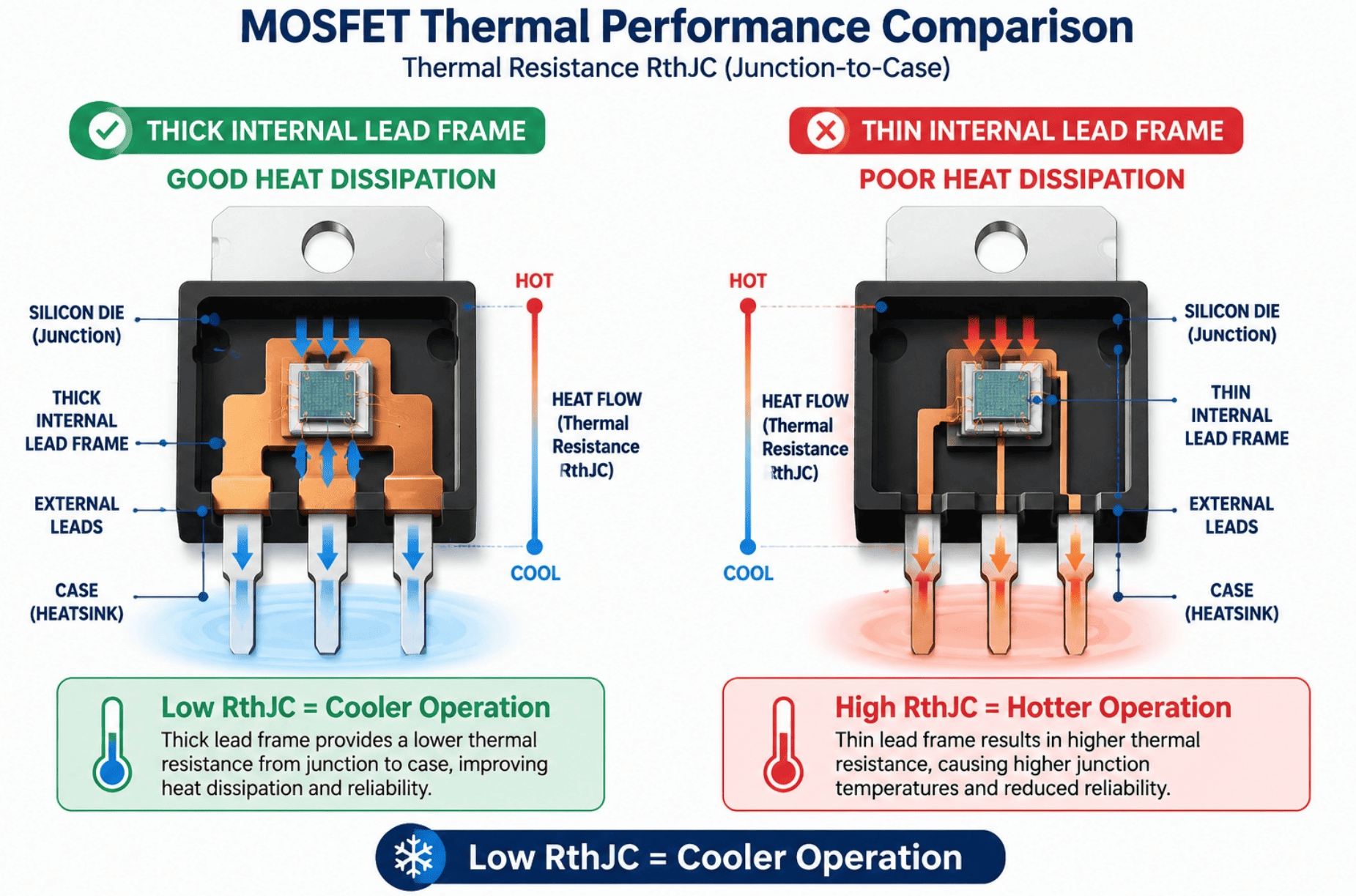
If your replacement has a higher $R_{thJC}$, even if the $R_{DS(on)}$ is the same, the junction temperature ($T_j$) will rise faster. In high-power applications, this is the difference between a 10-year lifespan and a 10-minute one. Always verify the Safe Operating Area (SOA) curve in the datasheet to ensure the new part can handle your specific pulse loads.
3.2 Step 2: Switching Dynamics (The "Hidden" Killer)
In high-speed switching (like DC-DC converters), the static parameters ($V_{DS}$, $I_D$) are only half the story. On Reddit's r/AskElectronics, the most common cause of "unexplained" MOSFET explosions after a substitution is Gate Charge ($Q_g$) mismatch.
3.3 Step 3: Logic Level Compatibility
If your MOSFET is driven directly by a Microcontroller (MCU) at 3.3V or 5V, you must ensure you are using a Logic Level MOSFET. Check the $V_{GS(th)}$. If the original part had a threshold of 1.5V and your replacement has a threshold of 3V, your MCU might only "half-open" the MOSFET, causing it to operate in the linear region and burn up instantly.
4. Expert Tips & Common Pitfalls to Avoid
Based on years of Quality Assurance and field feedback, here are the "Gotchas" that don't show up in basic parametric filters:
- The "Body Diode" Trap: In motor control (H-bridges), the reverse recovery time ($t_{rr}$) of the internal body diode is vital. If the replacement has a "slow" diode ($high\ t_{rr}$), you will see massive current spikes during commutation, leading to EMI issues or failure.
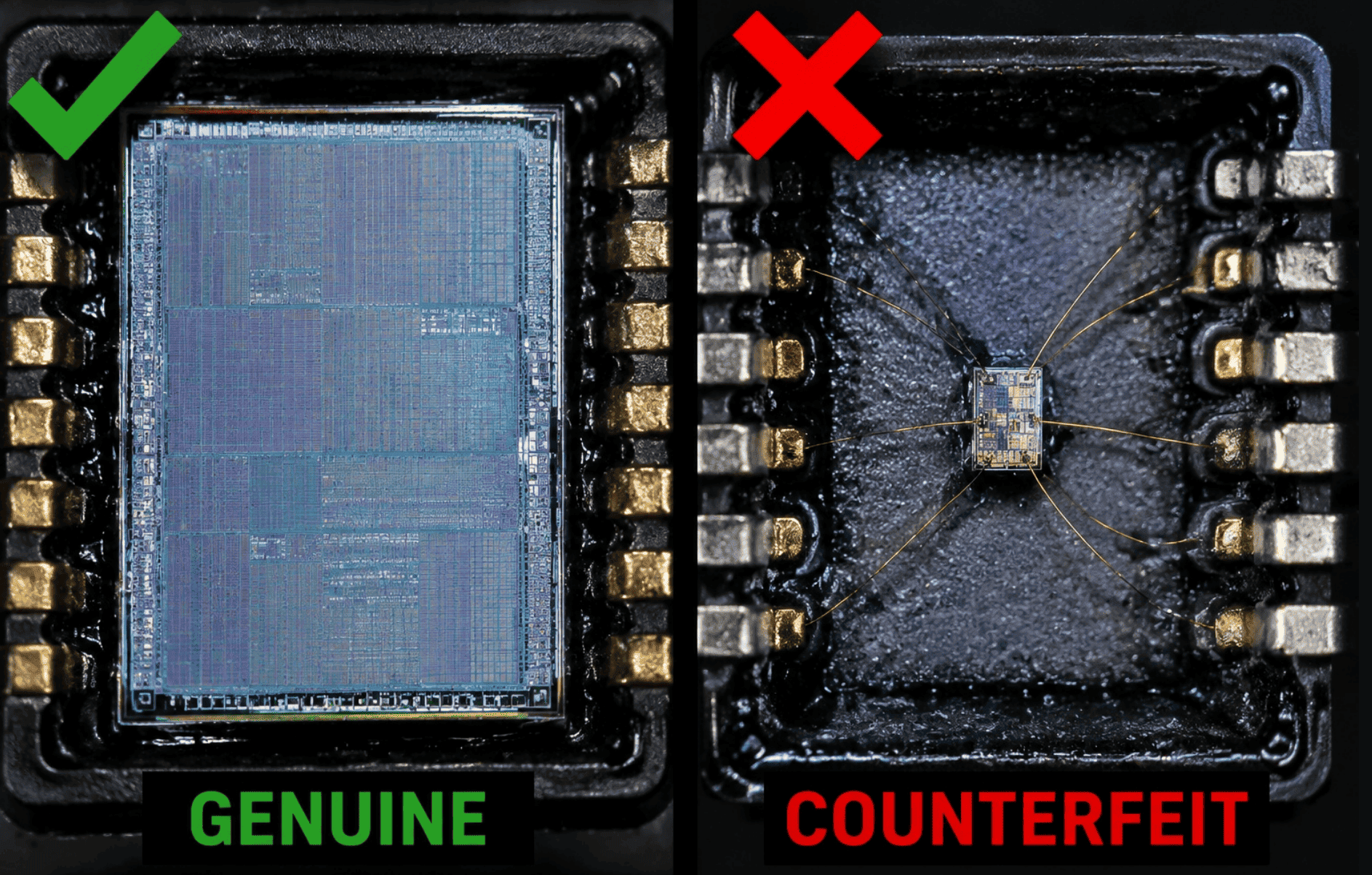
- The "Counterfeit" Risk: When stock is low, "gray market" parts appear. A fake MOSFET might have the correct markings but a much smaller silicon die inside. Always source from verified partners who provide full Quality Assurance documentation.
- Package Parasitics: Even if the footprint is the same (e.g., DFN 5x6), the internal wire bonding vs. copper clip technology can change the source inductance ($L_s$). This affects ringing and voltage spikes at high frequencies.
5. Conclusion & Final Thoughts
Replacing a MOSFET is a balancing act between availability and reliability. To summarize:
- Match or exceed $V_{DS}$ and $I_D$.
- Match or lower $R_{DS(on)}$.
- Keep $Q_g$ and $V_{GS(th)}$ as close as possible to avoid driver and switching issues.
- Validate the thermal resistance ($R_{thJC}$) if the application is heat-sensitive.
If you are dealing with a complex Bill of Materials (BOM) and cannot find a suitable cross-reference, don't guess. Reach out for Contact for Cross-Reference assistance. Expert engineers can often suggest modern alternatives that are not only in stock but offer better efficiency than your legacy components.
Quick Summary Table for Decision Makers
| If your problem is... | Look for this spec in the replacement... |
|---|---|
| Component is running too hot | Lower $R_{DS(on)}$ or Lower $R_{thJC}$ |
| MOSFET fails at startup | Higher $V_{DS}$ or check $V_{GS(th)}$ |
| Driver IC is getting hot | Lower Total Gate Charge ($Q_g$) |
| High-frequency noise/EMI | Lower $C_{iss}$ and $Q_{rr}$ |
| Supply chain instability | Contact About Hitop for multi-source options |
Note for SEO: The following JSON-LD Schema is provided to enhance Search Engine visibility and is not part of the article body.