



The Ultimate Guide to BAV99 Equivalents: Drop-In Replacements & Cross-Reference
If you are designing a high-speed switching circuit, repairing a legacy printed circuit board (PCB), or managing an electronic manufacturing supply chain, you have likely encountered the BAV99. It is one of the industry's most ubiquitous "jellybean" components. But what happens when lead times stretch into months, prices spike, or your regular distributor simply runs out of stock? You need a reliable, drop-in replacement—fast.
In this comprehensive guide, we will break down exactly what makes a BAV99 tick, how to identify a true equivalent without risking circuit failure, and the exact cross-reference data you need to make an informed decision. You will learn how to match footprints, decode electrical specifications, and avoid the most common layout traps that plague hardware engineers.
Table of Contents
- 1. Understanding the BAV99 Diode: Why It's Ubiquitous
- 2. Core Concepts Simplified: What Makes a True Drop-In Replacement?
- 3. Top BAV99 Equivalent Options: The Cross-Reference Guide
- 4. Step-by-Step Guide: How to Verify and Test Your Replacement
- 5. Expert Tips & Common Pitfalls to Avoid
- 6. Conclusion & Final Thoughts
1. Understanding the BAV99 Diode: Why It’s Ubiquitous
Before you can confidently select an equivalent, you must understand why the BAV99 was chosen for your Bill of Materials (BOM) in the first place.
The BAV99 is not just a single diode; it is a dual series switching diode housed in a tiny, three-pin surface-mount package. Electrically, it is essentially two of the legendary 1N4148 through-hole diodes wired in series and crammed into a single plastic body.
Hardware engineers and PCB designers love the BAV99 for three main reasons:
- High-Speed Performance: It can switch states in mere nanoseconds, making it perfect for digital logic circuits, signal processing, and high-speed data line protection.
- Space Efficiency: By putting two diodes in one package, it saves precious PCB real estate.
- Versatility: Because the two diodes are wired in series (pin 1 is an anode, pin 2 is a cathode, and pin 3 is the common connection), it can be used for signal steering, voltage clamping, or as a simple logic gate.
When sourcing a replacement, your primary goal is to find a component that mimics these exact characteristics. A mismatched equivalent can lead to signal distortion, overheating, or catastrophic board failure. If you are struggling to navigate component shortages, leveraging professional Electronic Components Sourcing can save you weeks of datasheet hunting and ensure you get authentic, verified equivalents.
2. Core Concepts Simplified: What Makes a True Drop-In Replacement?
To the untrained eye, many SOT-23 diodes look identical. However, the internal wiring and electrical limits vary wildly. Let's translate the dense technical jargon found on manufacturer datasheets into plain English.
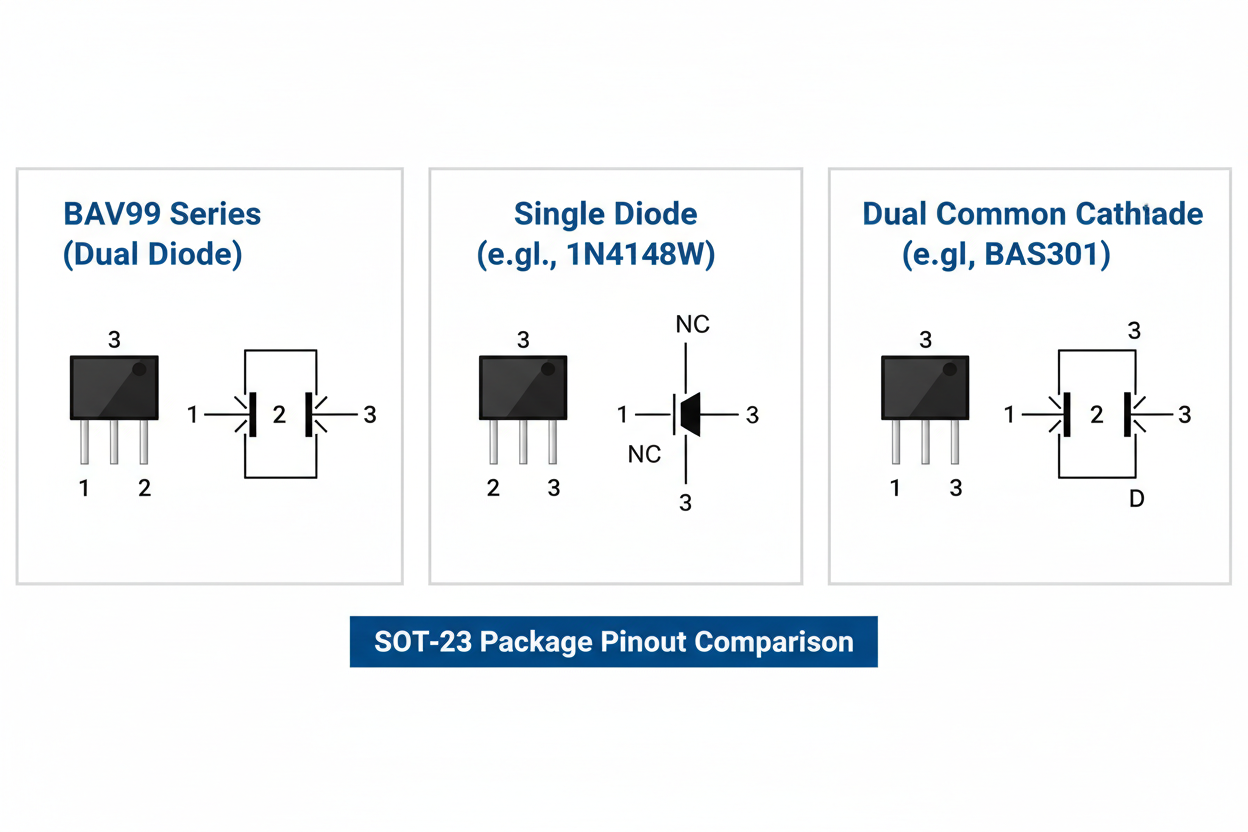
The "SOT-23" Package: The Physical Footprint
"SOT" stands for Small Outline Transistor. This refers purely to the physical plastic body and the metal legs of the chip. A true "drop-in replacement" must have the exact same SOT-23 footprint. If you buy a replacement in a SOT-323 package, it will be too small to reach the solder pads on your PCB, forcing a costly board redesign.
Reverse Recovery Time ($t_{rr}$): The Braking Distance
Think of Reverse Recovery Time ($t_{rr}$) as the diode's "braking distance." It measures how quickly the diode stops letting electricity flow backwards when the voltage suddenly flips.
- The BAV99 is incredibly fast, typically boasting a $t_{rr}$ of under 6 nanoseconds (ns).
- The Rule: If your circuit handles high-speed digital signals, the replacement diode must react just as fast. If you use a slower equivalent (e.g., $t_{rr}$ = 50ns), your signals will distort, lag, or "smear," causing data errors.
Forward Voltage Drop ($V_f$): The Toll Fee
Every time electricity passes through a diode, the diode consumes a small amount of voltage. Think of this as a "toll fee" for using the road.
- For a BAV99, this fee is usually around 1.0V to 1.25V (at 150mA).
- The Rule: If your equivalent diode charges a significantly higher "toll fee," it will leave less voltage for the rest of your circuit to operate, potentially starving your microcontrollers or sensors of the power they need. It will also generate more heat.
Configuration Comparison: The Ultimate Trap
The most common mistake engineers make is buying a dual diode with the wrong internal wiring. A BAV99 is a Series Pair. It cannot be replaced by a Common Anode or Common Cathode diode without physically cutting traces on your PCB.
Core Concept Comparison Table: SOT-23 Dual Diodes
| Part Number | Internal Configuration | Pin 1 | Pin 2 | Pin 3 | Drop-In for BAV99? |
|---|---|---|---|---|---|
| BAV99 | Series Pair | Anode (D1) | Cathode (D2) | Cathode (D1) + Anode (D2) | Original Part |
| BAW56 | Common Anode | Cathode (D1) | Cathode (D2) | Common Anode | ❌ NO (Will short circuit) |
| BAV70 | Common Cathode | Anode (D1) | Anode (D2) | Common Cathode | ❌ NO (Will block signals) |
3. Top BAV99 Equivalent Options: The Cross-Reference Guide
When the BAV99 is unavailable, procurement managers and DIY repair technicians need immediate, data-backed alternatives. Below is the ultimate cross-reference guide featuring the most reliable equivalents on the market.
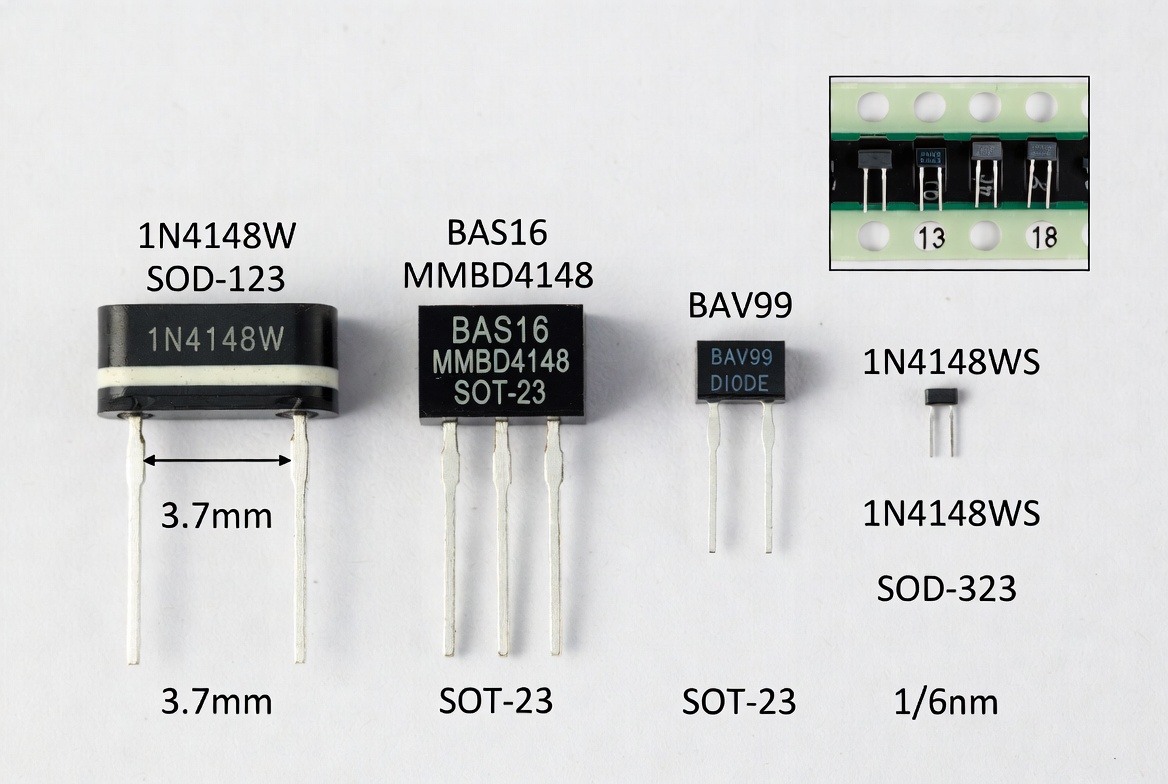
Option A: The MMBD1501 (The Closest Match)
The MMBD1501 is widely considered one of the best drop-in replacements for the BAV99. It shares the exact same SOT-23 package and series configuration. Its reverse recovery time is nearly identical, making it perfectly safe for high-speed signal routing and voltage clamping applications.
Option B: The MMBD914 (Configuration Dependent)
The MMBD914 is another excellent high-speed switching diode. However, caution is required. The standard MMBD914 is often sold as a single diode in a SOT-23 package (leaving one pin unconnected). To replace a BAV99, you must specifically source the dual-series version of the 914 family. Always check the manufacturer's datasheet for the internal schematic before purchasing.
Option C: The 1N4148 (The Breadboard/DIY Workaround)
If you are repairing a board at home and don't care about aesthetics, you can theoretically replace a single BAV99 with two 1N4148 through-hole diodes soldered in series.
- Electrically: They are identical.
- Physically: It will look messy and will not fit the SOT-23 footprint. This is strictly a temporary hack for prototyping or emergency repairs, not for production runs.
Replacement Specification Data Table
| Specification | BAV99 (Original) | MMBD1501 (Equivalent) | MMBD914 (Equivalent) | 2x 1N4148 (Workaround) |
|---|---|---|---|---|
| Package | SOT-23 | SOT-23 | SOT-23 | DO-35 (Through-Hole) |
| Configuration | Dual Series | Dual Series | Single / Dual Series* | Discrete (Must wire 2) |
| Max Reverse Voltage ($V_r$) | 85V | 85V | 100V | 100V |
| Max Forward Current ($I_f$) | 215mA | 200mA | 200mA | 300mA |
| Recovery Time ($t_{rr}$) | < 6 ns | < 6 ns | < 4 ns | < 4 ns |
| Suitability | N/A | Excellent | Good (Verify Pinout) | Emergency Only |
(Note: Always verify the exact suffix of the MMBD914 to ensure dual-series configuration).
4. Step-by-Step Guide: How to Verify and Test Your Replacement
Swapping a component on a schematic is easy; ensuring it works flawlessly in the real world requires diligence. If you are updating a BOM for mass production, follow this step-by-step verification process.
Step 1: Validate the Footprint in Your CAD Software
Before ordering reels of a new component, open your PCB design software (Altium, KiCad, Eagle).
- Open the footprint manager.
- Overlay the SOT-23 dimensions of the BAV99 with your chosen equivalent.
- Ensure the pad pitch (distance between the legs) is exactly 1.90mm and the total width is roughly 2.90mm.
Step 2: Update Your Bill of Materials (BOM)
When specifying an equivalent for your assembly house, clarity is critical. Use a standardized BOM format to prevent purchasing errors.
Step 3: Prototype and Test Switching Speed
Once you have the physical board, you must test it. If you are utilizing Turnkey PCB Assembly services, request a "first article" prototype before authorizing the full production run.
- Connect an oscilloscope to the signal line passing through the diode.
- Inject a high-frequency square wave.
- Observe the rising and falling edges. If the edges are sharp and crisp, your equivalent is fast enough. If the edges look rounded or sloped, the $t_{rr}$ of your replacement is too slow.
5. Expert Tips & Common Pitfalls to Avoid
Drawing from decades of experience and countless troubleshooting threads on forums like EEVblog and Reddit's r/AskElectronics, here are the most common pitfalls engineers face when replacing the BAV99.
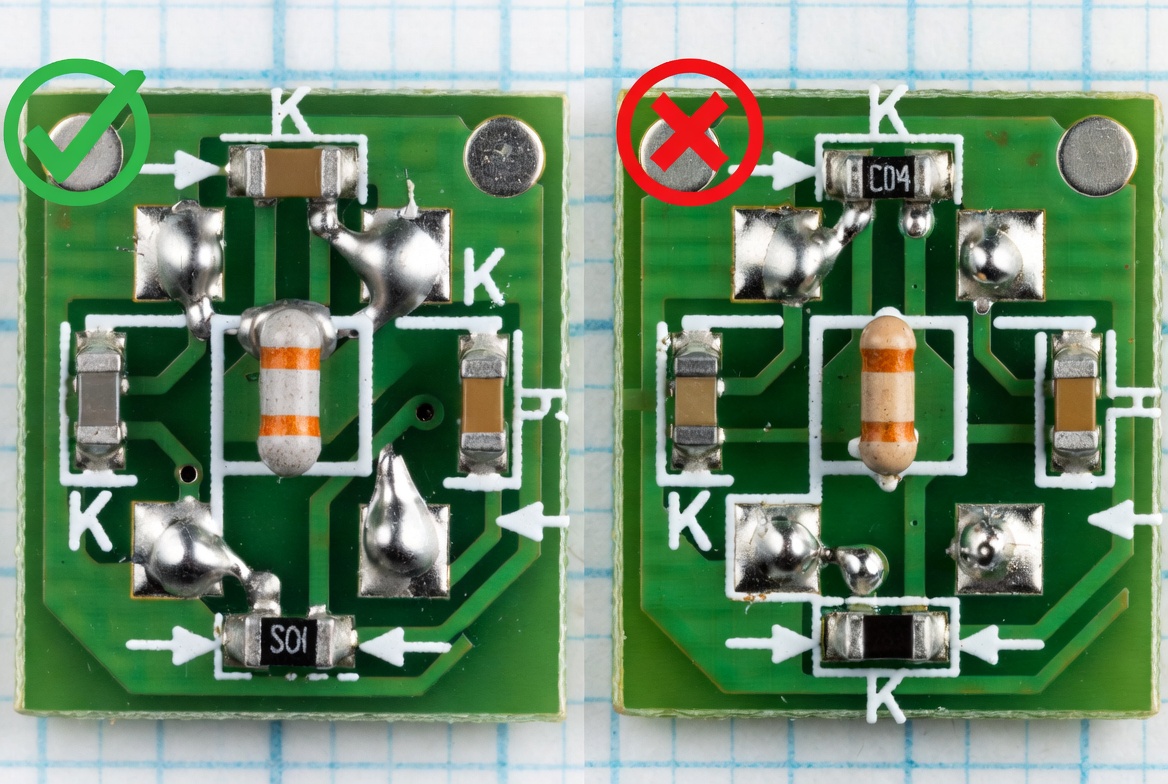
Pitfall 1: Ignoring the "W" and "T" Suffixes
Component manufacturers love adding letters to the end of part numbers, and these letters change everything.
- A BAV99W is housed in a SOT-323 package. It is significantly smaller than the standard SOT-23.
- A BAV99T is housed in an ultra-tiny SOT-416 package. If your BOM specifies a BAV99, and purchasing buys a BAV99W because it was cheaper, the parts will literally fall off the solder pads during the reflow process. Always match the suffix.
Pitfall 2: Assuming Power Dissipation is Identical
While the voltage and speed might match, the thermal characteristics might not. The standard BAV99 can dissipate about 250mW to 350mW of heat. If your equivalent is rated for only 150mW, it could burn out under heavy load. Always check the $P_d$ (Power Dissipation) spec on the datasheet, especially if your circuit operates in high-temperature environments.
Pitfall 3: Failing to Leverage Supply Chain Expertise
Engineers often waste hours trying to find a perfect match on retail distributor websites when bulk inventory is hidden in wholesale channels. If you are facing a severe shortage and need thousands of units, don't guess. Instead, Request a BOM Quote from a dedicated sourcing partner who can cross-reference manufacturer databases and secure authentic parts with zero lead time.
6. Conclusion & Final Thoughts
Finding a BAV99 equivalent doesn't have to be a supply chain nightmare. By understanding the core electrical requirements—specifically the dual-series configuration, the SOT-23 footprint, and the crucial <6ns reverse recovery time—you can safely substitute parts without compromising your circuit's integrity.
Quick Summary Table: BAV99 Replacement Checklist
| Verification Step | What to Check | Why It Matters |
|---|---|---|
| 1. Package Size | Must be exactly SOT-23 (Avoid W or T suffixes unless specified). | Ensures physical fit on existing PCB solder pads. |
| 2. Configuration | Must be Dual Series (Pin 3 is Anode+Cathode). | Prevents short circuits and signal blocking. |
| 3. Switching Speed | $t_{rr}$ must be < 6 ns. | Prevents data corruption in high-speed digital lines. |
| 4. Voltage & Current | $V_r \ge 85V$, $I_f \ge 200mA$. | Ensures the diode survives the circuit's power demands. |
Whether you opt for the MMBD1501 for a direct production swap or use two 1N4148s for a quick bench repair, always let the datasheet be your ultimate guide. If you found this guide helpful, bookmark it for your next BOM scrub, and ensure your procurement team understands the critical difference between a series pair and a common anode!