



Top AMS1117 Alternatives: Best LDO Voltage Regulators for IoT & Battery Projects
You have just spent weeks perfecting your new ESP32 or Arduino-based IoT sensor. The code is flawless, the deep sleep mode is activated, and you expect the battery to last for months. But when you deploy it, the battery is completely dead in less than three days. Sound familiar? If you used the classic AMS1117 voltage regulator, you have just found your culprit. While the AMS1117 has been a staple in hobbyist electronics for decades, it is an absolute "battery killer" for modern, low-power IoT devices. In this comprehensive guide, we will break down exactly why the AMS1117 is failing your designs and provide the best, data-backed AMS1117 alternative LDOs to dramatically extend your battery life and ensure rock-solid stability.
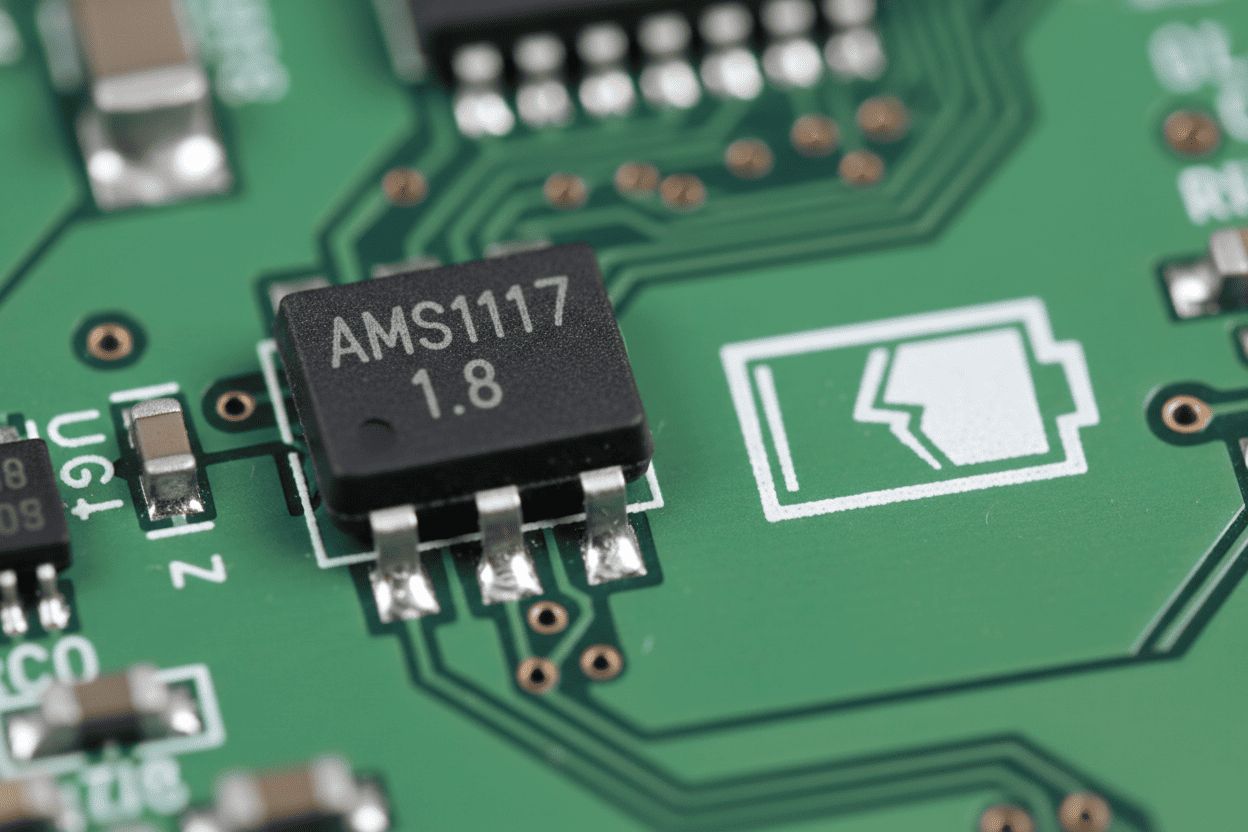
Table of Contents
- 1. Understanding the AMS1117 Problem: Why It's Obsolete for IoT
- 2. Core Concepts Simplified: What Makes a Good LDO?
- 3. Step-by-Step Guide: Choosing the Best AMS1117 Alternative
- 4. Expert Tips & Common Pitfalls to Avoid
- 5. Conclusion & Final Thoughts
1. Understanding the AMS1117 Problem: Why It’s Obsolete for IoT
If you browse through hardware engineering communities like EEVblog or Reddit's r/PrintedCircuitBoard, you will quickly notice a recurring theme: experienced engineers actively advise against using the AMS1117 in modern battery-powered designs. But why?
The "Battery Killer" (Massive Quiescent Current)
The AMS1117 has a typical quiescent current (Iq) of around 5mA (5000µA). This is the power the regulator consumes just to stay awake, even when your microcontroller is in deep sleep drawing almost nothing. Imagine leaving a faucet dripping 24/7; over time, the waste is enormous. A 5mA continuous drain will completely kill a standard 1000mAh LiPo battery in just over a week—even if your device literally does nothing.
The High Dropout Voltage (Vdo)
Dropout voltage is the minimum difference required between the input voltage and the output voltage. The AMS1117 has a dropout of approximately 1.1V to 1.3V. If you want a stable 3.3V output for your ESP32, you need an input of at least 4.5V. Standard Lithium-Polymer (LiPo) batteries operate between 3.7V and 4.2V. If you connect a LiPo to an AMS1117-3.3, it will immediately fail to regulate properly, causing your microcontroller to brownout and reset.
The Capacitor Stability Trap
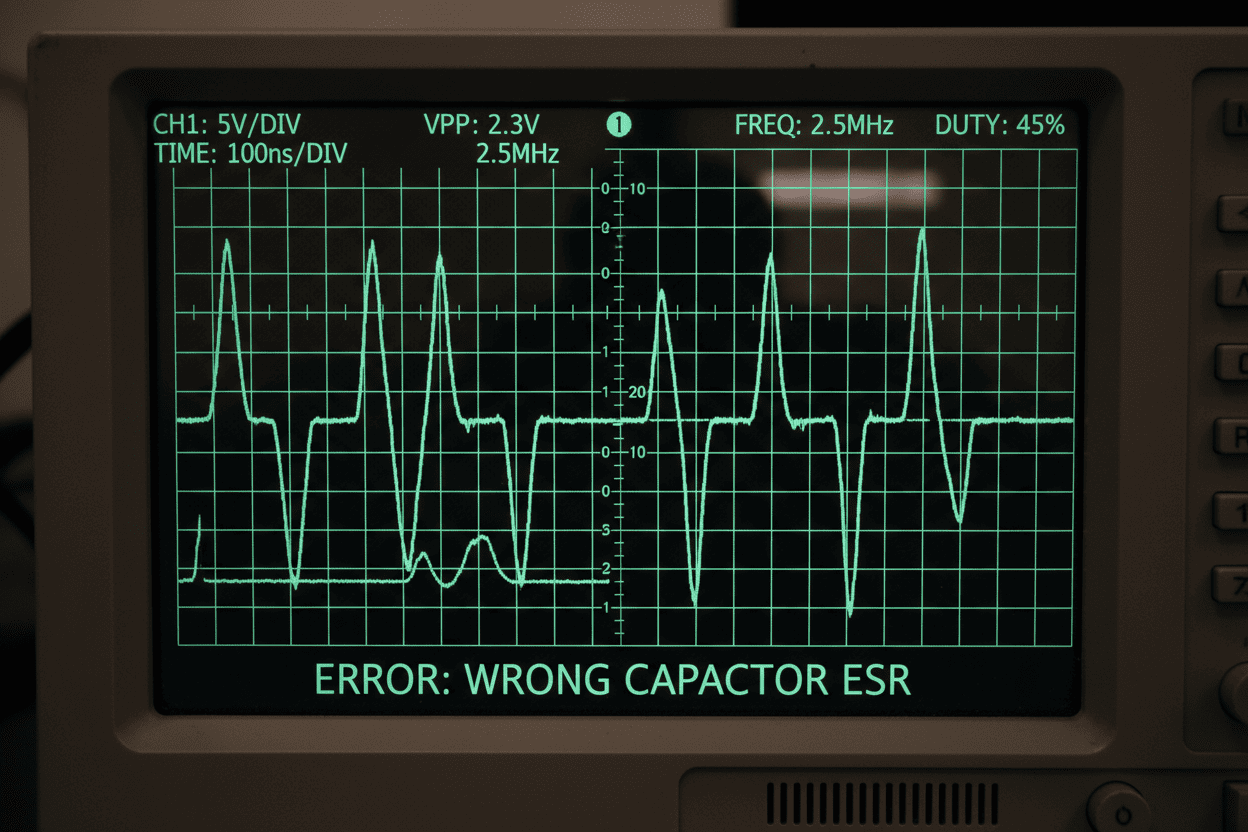
Older regulators like the AMS1117 were designed in an era where Tantalum capacitors were the standard. They actually rely on a specific amount of Equivalent Series Resistance (ESR) to maintain stability. Modern, cheap Multi-Layer Ceramic Capacitors (MLCCs) have an ESR that is "too low" for the AMS1117. If you pair an AMS1117 with standard ceramic capacitors, the chip will throw a tantrum and start oscillating, sending a noisy, fluctuating voltage straight into your sensitive electronics.
2. Core Concepts Simplified: What Makes a Good LDO?
Before choosing an alternative, you need to understand the three pillars of a modern Low Dropout (LDO) regulator. Let's translate the datasheet jargon into plain English.
- Quiescent Current (Iq): Think of this as a car engine idling at a red light. The car isn't moving (your circuit isn't doing any heavy lifting), but it is still burning gas. Modern LDOs have an Iq measured in microamps (µA), meaning they "idle" using almost zero power.
- Dropout Voltage (Vdo): Think of this as a toll booth on a highway. To pass through and get 3.3V on the other side, the toll booth demands a payment of a certain voltage. A modern LDO only demands a "toll" of 0.1V to 0.3V, allowing you to use almost the entire capacity of a 3.7V battery.
- Equivalent Series Resistance (ESR): This is a tiny internal friction inside a capacitor. Modern LDOs are specifically engineered to be stable with the ultra-low friction (low ESR) of cheap ceramic capacitors.
Concept Comparison: Legacy vs. Modern LDO
| Feature | Legacy AMS1117 | Modern Ideal IoT LDO | Real-World Impact |
|---|---|---|---|
| Quiescent Current (Iq) | ~5,000 µA (5mA) | 1 µA - 50 µA | Battery lasts months/years instead of days. |
| Dropout Voltage (Vdo) | 1.1V - 1.3V | 0.1V - 0.3V | Allows direct use of 3.7V LiPo/Li-ion batteries. |
| Capacitor Requirement | Tantalum (High ESR) | Ceramic MLCC (Low ESR) | Cheaper, smaller, and vastly more reliable BOM. |
| Output Current Limits | Up to 1A | 250mA - 600mA | Modern LDOs trade max current for better efficiency. |
3. Step-by-Step Guide: Choosing the Best AMS1117 Alternative
The "best" alternative depends entirely on what stage of design you are in. Are you trying to fix a PCB that has already been manufactured, or are you designing a brand new, ultra-compact board?
3.1 Scenario A: The Drop-in Replacement (SOT-223 Footprint)
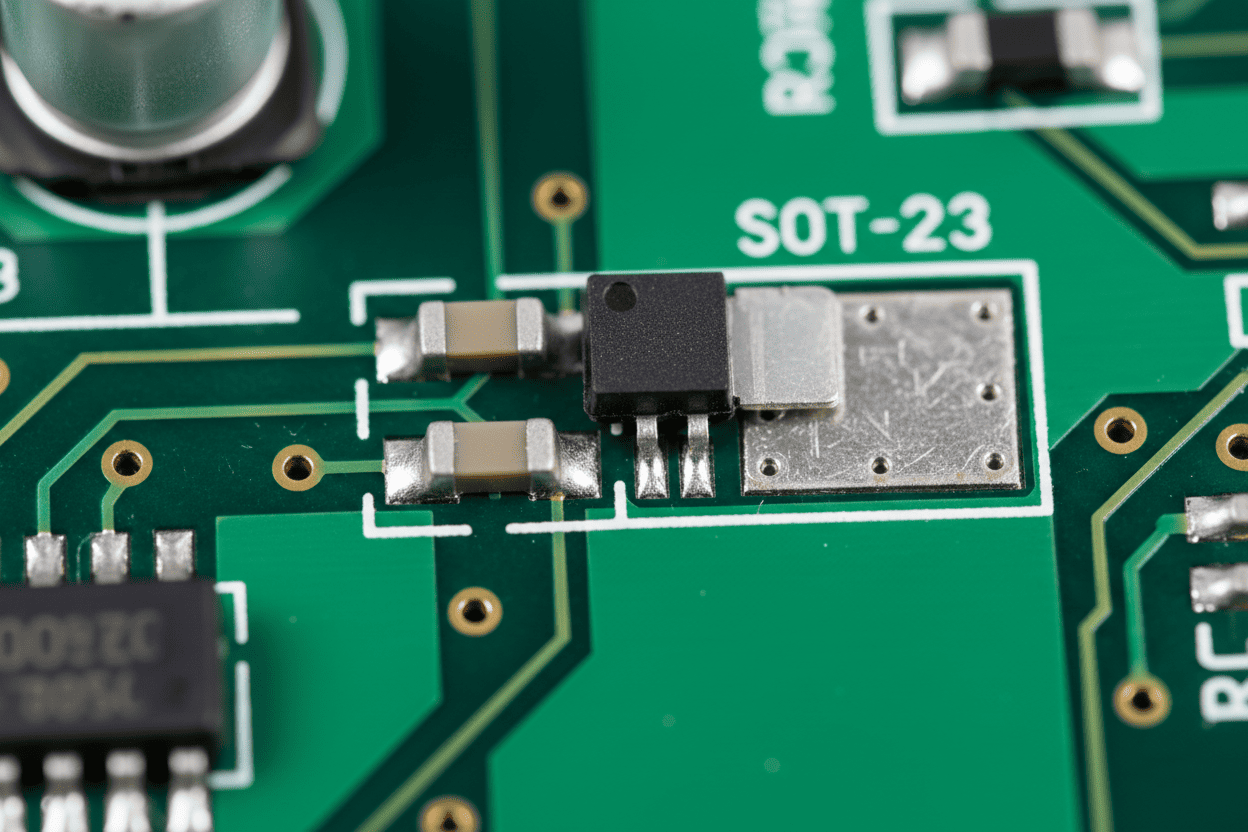
If you have already designed your PCB for the AMS1117's SOT-223 package and just realized the battery drain issue, you need a pin-to-pin compatible drop-in replacement. You simply desolder the AMS1117 and solder the new chip in its exact place.
- NCP1117 (ON Semiconductor): While technically very similar to the AMS, the NCP series often offers slightly better thermal performance and tighter tolerances. However, it still has a high dropout.
- ZLDO1117 (Diodes Inc): This is an excellent pin-compatible alternative. It features a lower dropout voltage and better stability characteristics compared to generic AMS1117 clones.
- LM1117 (Texas Instruments): The gold standard of this footprint. While not strictly an ultra-low-power LDO, it guarantees datasheet accuracy and won't suffer from the unpredictable behavior of cheap clone chips.
Pro Tip: If your current board design is fundamentally flawed due to footprint constraints, it might be more cost-effective to redesign the power delivery section. If you need rapid prototyping for the revised board, utilizing High-quality PCB Manufacturing services ensures your new traces and thermal vias are fabricated precisely to spec.
3.2 Scenario B: Space-Saving & Ultra-Low Power for New Designs (SOT-23)
If you are designing a new PCB from scratch, stop using the SOT-223 footprint for low-power IoT. Move to the much smaller SOT-23-5 or SOT-89 packages. Here are the community-consensus favorites for ESP32 and Arduino battery projects:
- The ESP32 Champion: AP2112K-3.3 (Diodes Inc.)
- Why it’s great: The ESP32 is notorious for drawing massive 500mA current spikes when the Wi-Fi radio turns on. Many tiny LDOs will choke and reset the chip. The AP2112K handles up to 600mA, has a low dropout of just 250mV, and an Iq of only 55µA.
- Best for: Wi-Fi enabled IoT devices running on standard LiPo batteries.
- The Micro-Power King: HT7333-A (Holtek)
- Why it’s great: If battery life is your absolute highest priority, the HT7333 is legendary. It boasts an insanely low quiescent current of 4µA (0.004mA). Furthermore, it can accept input voltages up to 24V!
- The Catch: It only outputs 250mA. If you use it with an ESP32, you must place a massive capacitor (e.g., 470µF to 1000µF) on the output to act as a temporary power reservoir for Wi-Fi spikes.
- Best for: LoRaWAN nodes, BLE sensors (nRF52), and long-term remote data loggers.
- The Balanced All-Rounder: ME6211 (Microne)
- Why it’s great: Highly popular in the maker community, offering 500mA output, excellent stability with cheap ceramic caps, and a very respectable Iq of around 40µA.
LDO Alternative Specification Comparison
| LDO Model | Package | Max Input (Vin) | Dropout (Vdo) | Quiescent Current (Iq) | Max Output (Iout) | Best Use Case |
|---|---|---|---|---|---|---|
| AMS1117 (Baseline) | SOT-223 | 15V | 1.2V | 5,000 µA | 1000mA | Wall-powered projects only. |
| AP2112K-3.3 | SOT-23-5 | 6.0V | 0.25V | 55 µA | 600mA | ESP32 LiPo battery projects. |
| HT7333-A | SOT-89 / 23 | 24V | 0.09V | 4 µA | 250mA | Ultra-low power BLE/LoRa sensors. |
| ME6211 | SOT-23-5 | 6.5V | 0.1V | 40 µA | 500mA | General purpose 3.3V logic. |
4. Expert Tips & Common Pitfalls to Avoid
When transitioning from the old-school AMS1117 to modern LDOs, hardware engineers frequently stumble into a few specific traps. Here is how to avoid them.
Pitfall 1: Ignoring Thermal Dissipation
The AMS1117 is physically large (SOT-223) and features a massive copper tab designed to act as a heatsink. When you switch to a tiny SOT-23 LDO, you lose that thermal mass.
If you step down 12V to 3.3V while drawing 300mA, the LDO has to burn off the excess voltage as heat (12V - 3.3V) * 0.3A = 2.61 Watts. A tiny SOT-23 chip trying to dissipate 2.6 Watts will literally melt off your PCB in seconds. Rule of thumb: Only use tiny LDOs when the voltage difference (Vin - Vout) is small, such as stepping down 5V or 4.2V to 3.3V.
Pitfall 2: Poor Capacitor Layout
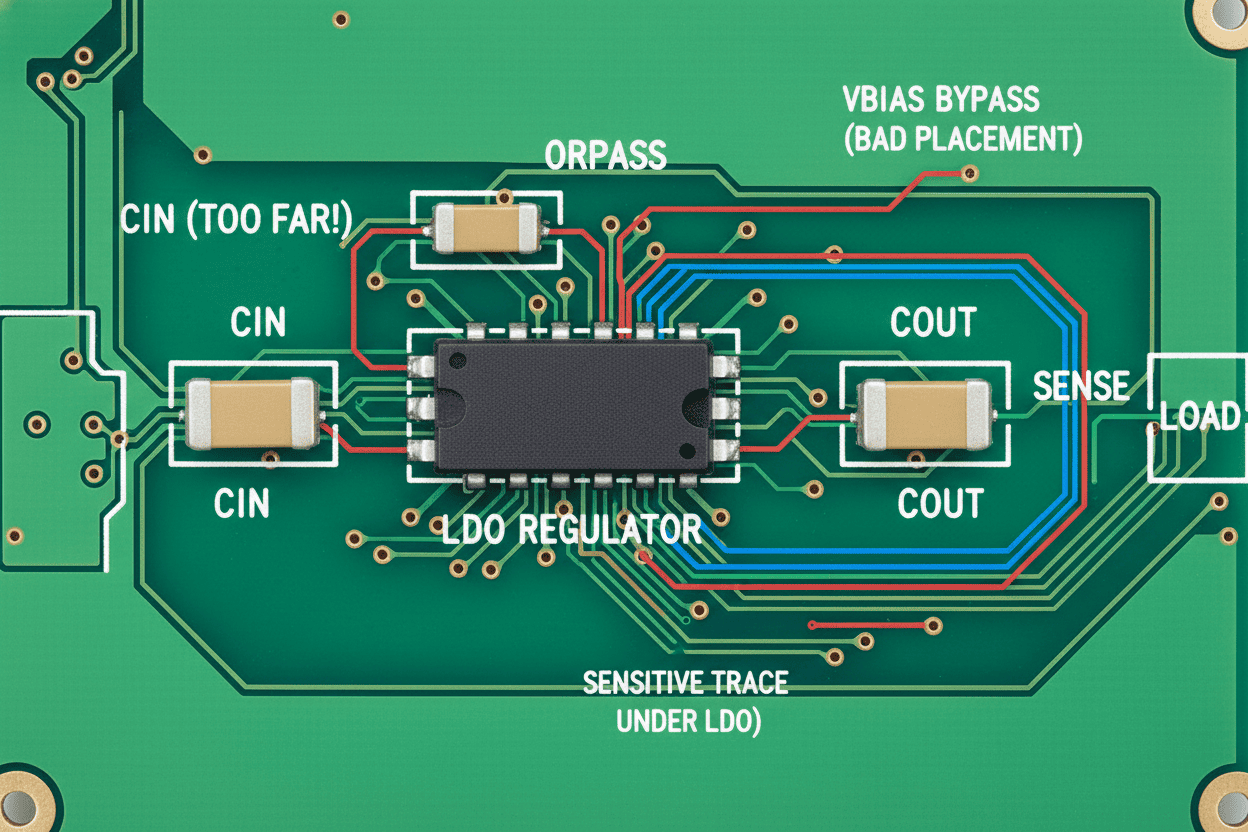
Modern LDOs are stable with ceramic capacitors, but placement matters immensely. If you place your 1µF or 10µF MLCCs far away from the LDO pins, the microscopic inductance of the long PCB traces will negate the benefits of the capacitor, leading to high-frequency ringing and instability.
Pitfall 3: Buying Counterfeit Components
Because chips like the HT7333 and AP2112K are so popular, the market is flooded with fakes. A counterfeit LDO might look identical but will secretly draw 2mA of quiescent current, completely defeating the purpose of your upgrade. To guarantee your IoT devices perform exactly as simulated, always rely on professional Electronic Components Sourcing to procure traceable, genuine silicon from authorized distributors.
5. Conclusion & Final Thoughts
The AMS1117 is not a "bad" component—it simply belongs to a different era. It is perfectly fine for a simple Arduino plugged into a wall adapter. However, the moment you introduce a battery into your design, the AMS1117 becomes an unacceptable liability due to its massive 5mA quiescent current and high dropout voltage.
By switching to modern AMS1117 alternatives:
- Use the AP2112K for heavy-lifting Wi-Fi microcontrollers like the ESP32.
- Use the HT7333 for ultra-low-power, long-term sensor deployments.
- Use the ZLDO1117 if you are forced to use an existing SOT-223 footprint layout.
Quick Summary Checklist
| Action Item | Recommendation | Why it Matters |
|---|---|---|
| Assess Power Needs | Check if your MCU has high current spikes (e.g., Wi-Fi). | Prevents brownouts and random resets during operation. |
| Select New LDO | AP2112K (High Current) or HT7333 (Ultra-Low Iq). | Extends battery life from days to months/years. |
| Update Capacitors | Use low-ESR Ceramic MLCCs placed close to pins. | Ensures smooth, non-oscillating voltage output. |
| Manage Thermals | Calculate (Vin - Vout) * Current. |
Prevents thermal shutdown of tiny SOT-23 packages. |
Designing high-efficiency, battery-powered PCBs requires meticulous attention to detail, from component selection to thermal trace routing. If you are ready to scale your prototype into a commercial product, partnering with experts for PCB Assembly Services ensures your boards are populated with genuine components and soldered to perfection, eliminating the headaches of manual assembly.
Upgrade your power delivery today, and watch your battery life soar!