


COB vs SMD LED Strip Lights: Technical Comparison Guide for Lighting Designers (2026)
When specifying LED strip lighting, the choice between COB (Chip on Board) and SMD (Surface Mounted Device) impacts light quality, installation complexity, and total project cost. This guide breaks down the technical differences to help lighting designers, electrical engineers, and procurement managers make informed decisions based on real application requirements.
Table of Contents
- Key Technical Parameters Explained
- How to Choose the Right LED Strip Technology
- Performance Comparison Table
- Design Considerations and Common Pitfalls
- Supply Chain and Sourcing
- FAQ
- Conclusion
Key Technical Parameters Explained
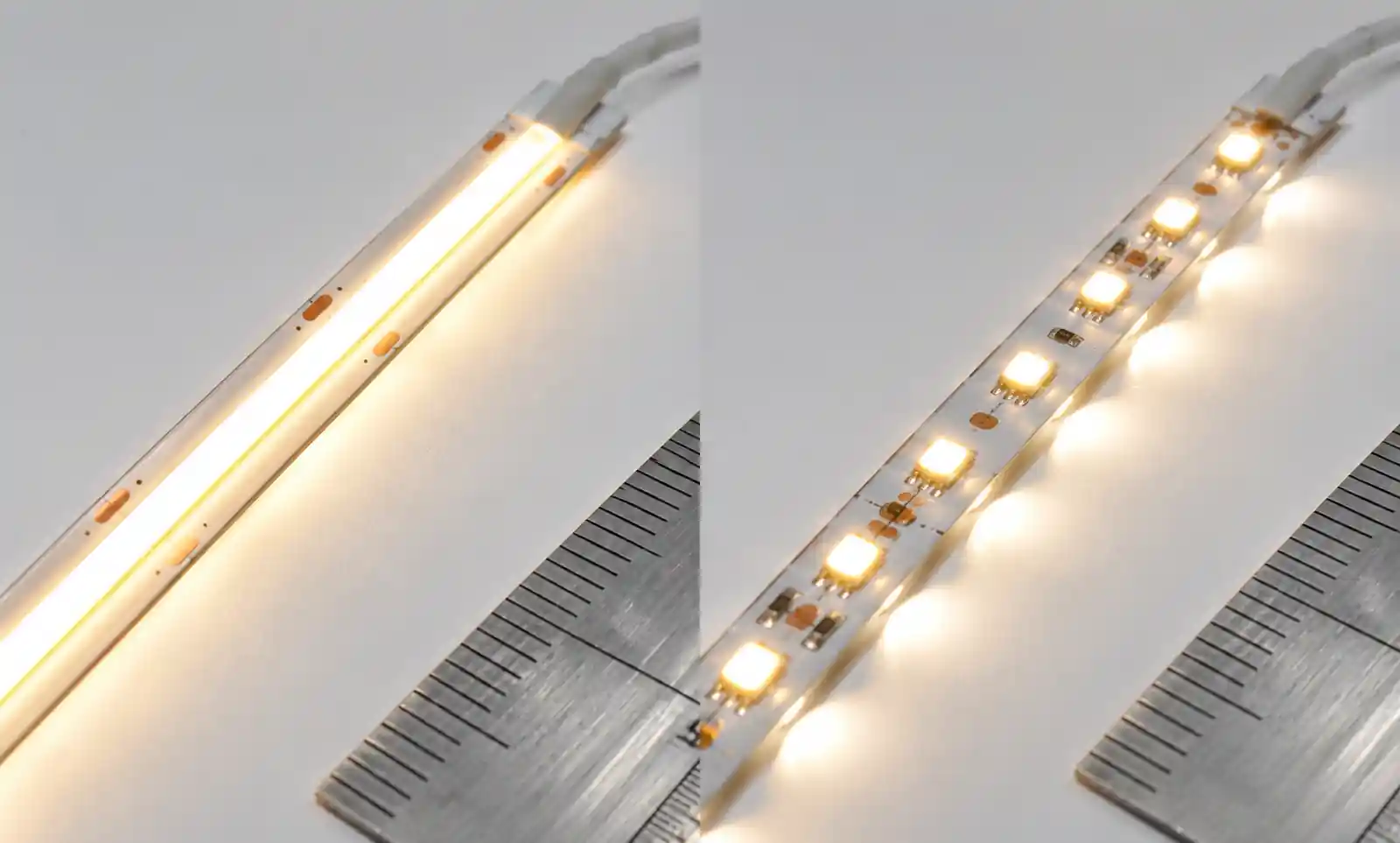
LED Density and Light Distribution: COB strips pack 512-840 chips per meter versus SMD's 60-120 LEDs per meter. This density creates a continuous light source—spacing is 1.2-2.5mm, below the eye's resolution threshold at distances over 0.5m. No hotspots, no dark zones. SMD strips space individual components roughly 8mm apart, creating visible "dotting" at close distances or on reflective surfaces.
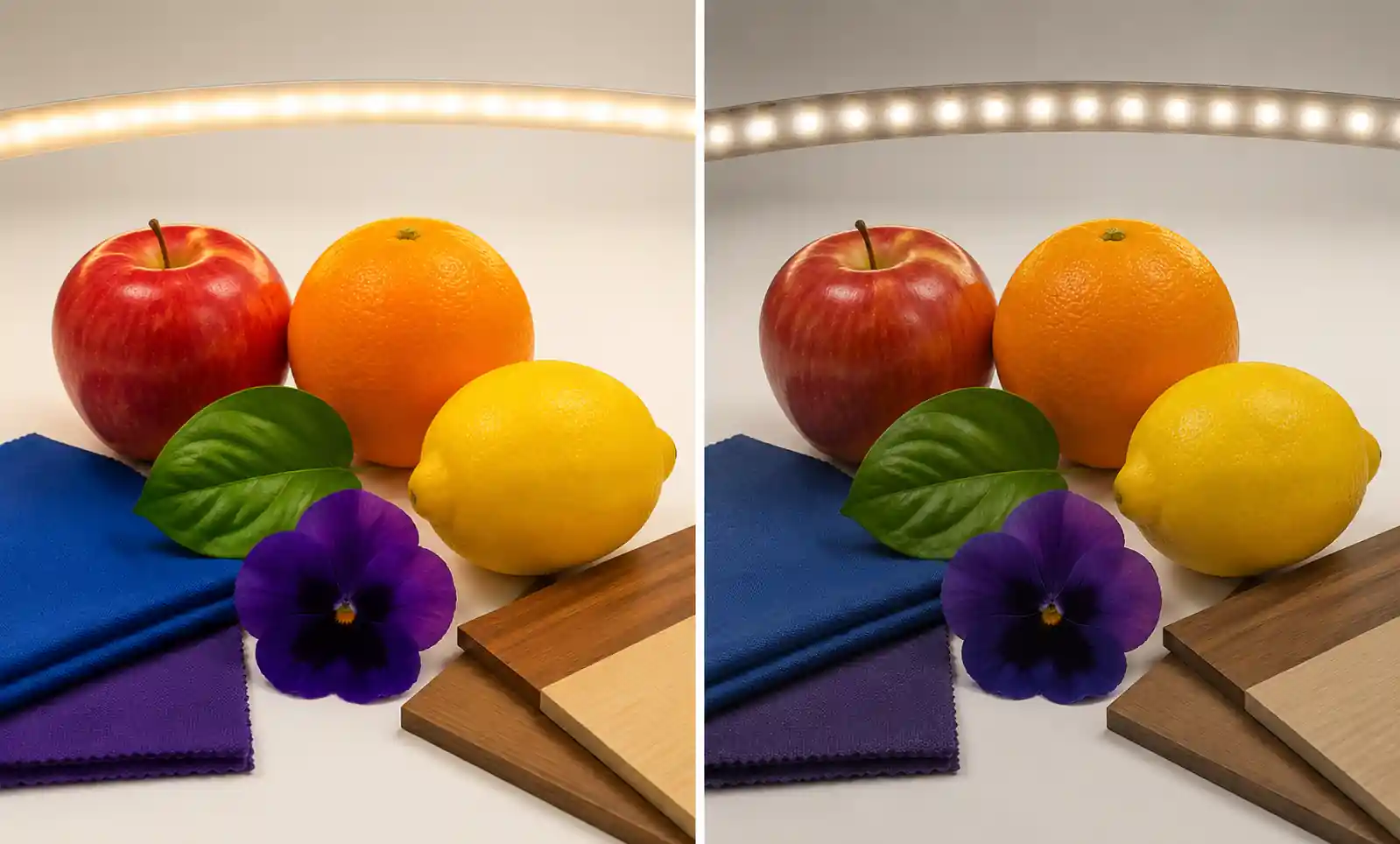
Color Rendering Index (CRI): COB strips achieve CRI 90-95+ through uniform multi-phosphor coating across the chip array. R9 values (red rendering) hit 50-90—critical for skin tones, wood finishes, and warm textiles. SMD strips typically run CRI 80-85, with premium versions reaching 90 at significantly higher cost.
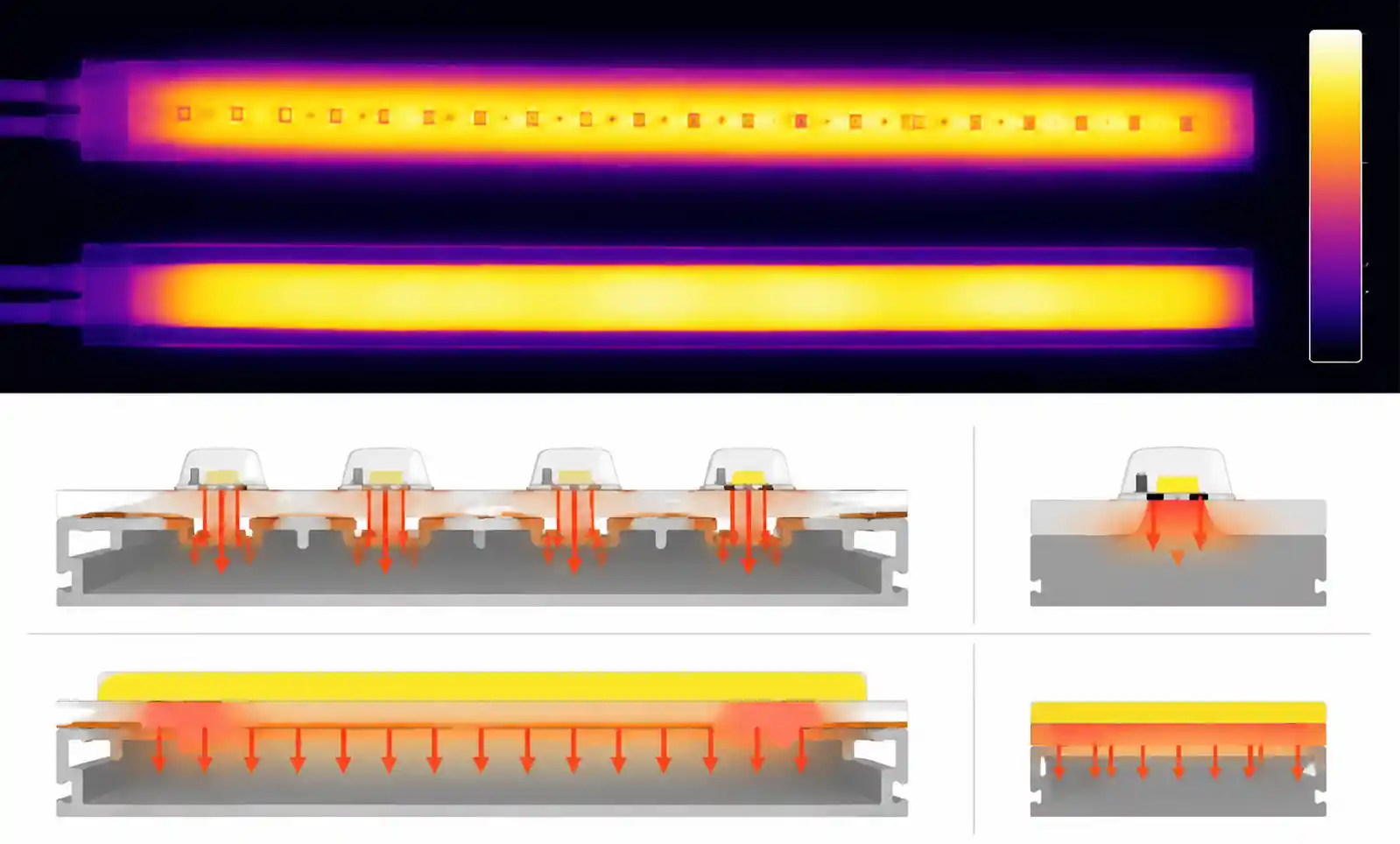
Thermal Management: COB mounts bare chips directly to the PCB substrate. This direct thermal path keeps junction temperatures 10-15°C lower than equivalent SMD strips at the same output. SMD's plastic housing adds thermal resistance, creating localized heat concentration points that stress solder joints in high-power designs.
Luminous Efficacy: Current COB strips achieve 120-140 lm/W; SMD ranges from 80-120 lm/W. A 5m installation needing 10,000 lumens: COB at 130 lm/W draws ~77W; SMD at 100 lm/W draws 100W. The 23W difference reduces heat, simplifies power supply sizing, and extends maximum run length before voltage drop becomes problematic.
How to Choose the Right LED Strip Technology
Choose COB when:
- The light source is directly visible or reflects off polished surfaces
- Application requires uniform, diffused lighting without visible points
- Color rendering accuracy is critical (retail, galleries, hospitality)
- Installation has limited ventilation or challenging heat dissipation
- Project specifies CRI 90+ or high R9 values
- Linear lighting must appear as a continuous line
- Budget accommodates 20-40% premium for superior quality
Choose SMD when:
- Budget constraints prioritize initial cost over long-term performance
- Application uses diffusers or indirect lighting that masks individual LEDs
- Project needs RGB, RGBW, or dynamic color-changing capabilities
- Installation requires easy field repair or component-level serviceability
- Specification allows CRI 80-85 for non-color-critical applications
- Existing infrastructure is designed for standard SMD strips
| Application Type | COB Priority | SMD Alternative | Key Decision Factor |
|---|---|---|---|
| Architectural cove lighting | High | Acceptable with diffuser | Direct visibility, uniformity |
| Under-cabinet task lighting | High | Acceptable with frosted cover | Close viewing distance |
| Retail product display | High | Not recommended | Color accuracy (CRI 90+) |
| Restaurant & hospitality | High | Acceptable for indirect | Ambiance, skin tone rendering |
| Commercial office indirect | Medium | Preferred | Cost sensitivity |
| Warehouse & industrial | Low | Preferred | Cost priority |
| Residential accent lighting | Medium | Preferred | Budget, DIY installation |
| Automotive interior | High | Acceptable | Heat sensitivity, uniformity |
Performance Comparison Table
| Parameter | COB LED Strip | SMD LED Strip (2835/5050) | Engineering Impact |
|---|---|---|---|
| LED density | 512-840 chips/m | 60-120 LEDs/m | Uniformity, viewing distance |
| Light uniformity | Continuous linear | Point sources with spacing | Diffuser necessity |
| CRI (typical) | 90-95+ | 80-85 (90 available) | Color-critical application suitability |
| R9 value | 50-90 | 20-50 | Skin tones, warm colors, food |
| Luminous efficacy | 120-140 lm/W | 80-120 lm/W | Operating cost, heat generation |
| Beam angle | 180° continuous | 120-140° per LED | Light distribution, coverage |
| Heat dissipation | Superior | Moderate | Heatsink requirements, lifespan |
| Lifespan (L70) | 50,000-60,000 hrs | 40,000-50,000 hrs | Maintenance frequency |
| Cut intervals | 25-50mm | 50-100mm | Installation flexibility |
| Cost (relative) | 1.3-1.8× baseline | 1.0× baseline | Budget allocation |
| Color temp consistency | ±50K | ±100K | Visual appearance in long runs |
| Dimming performance | Smooth to 1-5% | Smooth to 5-10% | Low-light scene control |
5-Year Cost Analysis (10m, 12h/day):
| Cost Factor | COB LED Strip | SMD LED Strip | Difference |
|---|---|---|---|
| Initial material | $320 | $200 | +$120 |
| Installation labor | $180 | $180 | $0 |
| Power supply & controls | $85 | $110 | -$25 |
| Aluminum extrusion | $150 | $150 | $0 |
| Total initial | $735 | $640 | +$95 |
| Annual energy ($0.12/kWh) | $40.50 | $52.80 | -$12.30 |
| 5-year energy | $202.50 | $264.00 | -$61.50 |
| Replacement (if needed) | $0 | $80 (Year 4) | -$80 |
| 5-year total | $937.50 | $984.00 | -$46.50 (4.7% savings) |
The 15% initial premium for COB delivers 5% total cost savings over five years. For 24/7 commercial operation, payback shortens significantly.
Design Considerations and Common Pitfalls
Thermal Management:
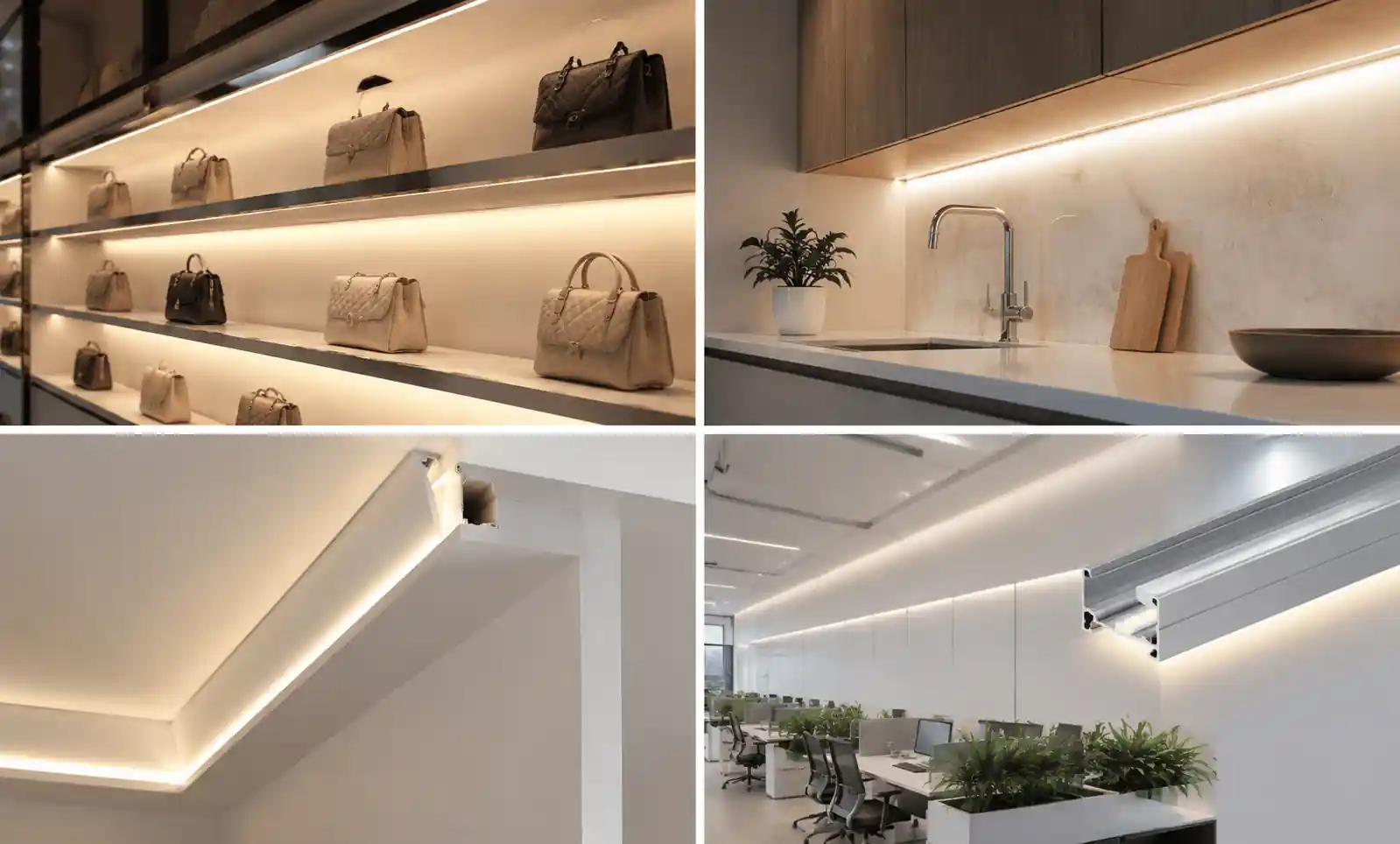
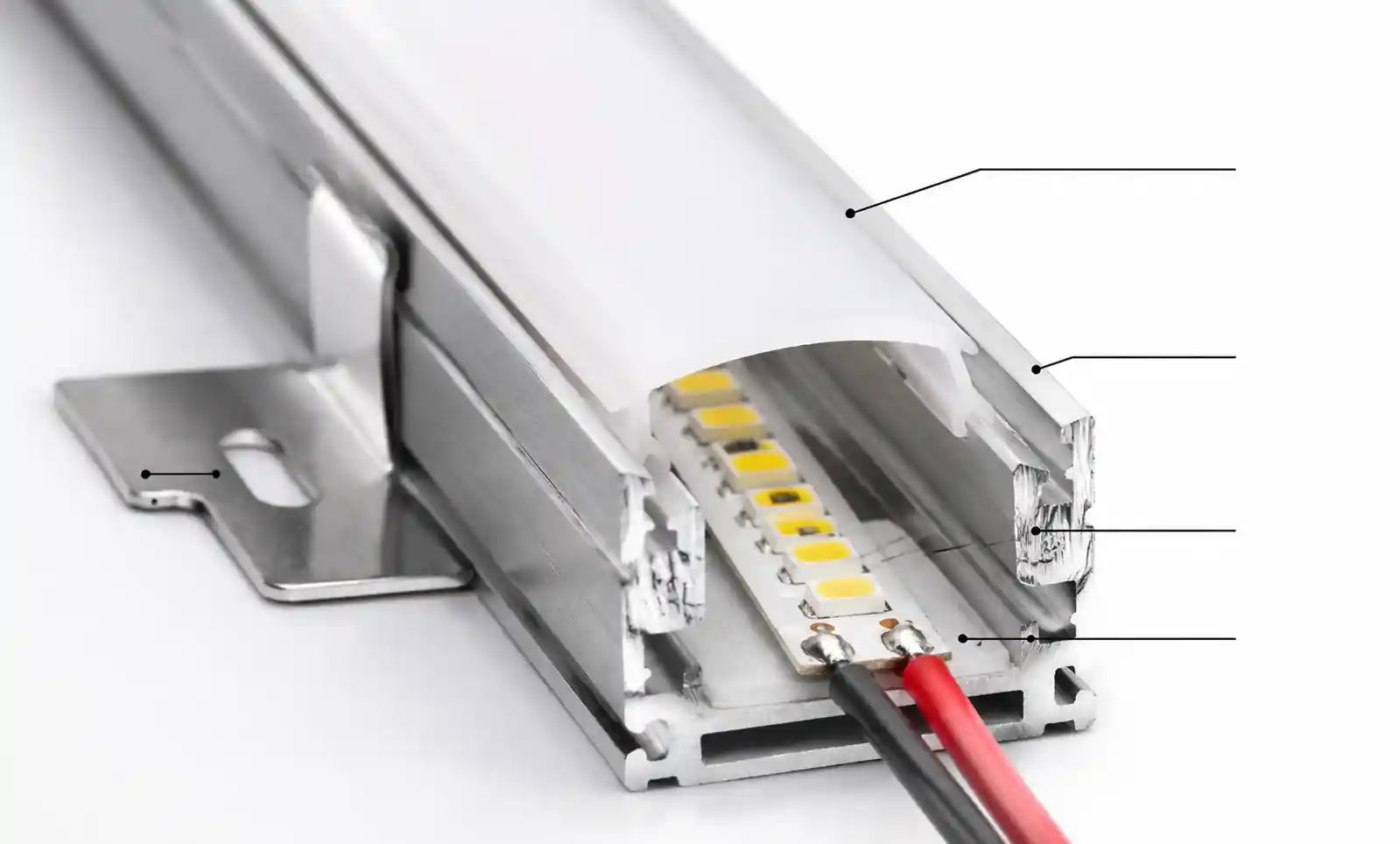
COB strips still need heat sinking. Don't mount directly to wood or drywall without thermal backing. Always use aluminum channels. Enclosed cove installations need ventilation. Ambient temperature ratings matter—45°C max means attic or kitchen installations need derating.
SMD strips: low-power (3-5W/m) may tolerate non-conductive surfaces, but high-output (>15W/m) requires aluminum backing. Multiple parallel strips need 15mm minimum spacing.
Voltage Drop:
COB strips draw more current per meter. A 15W/m COB strip at 24V draws 0.625A/m. Over 5m, voltage drop can reach 1.5-2V. Solutions: power injection at both ends for runs over 3-4m, use 24V instead of 12V, spec heavier copper (2oz vs 1oz). SMD strips have similar concerns but extend to 5-6m before injection.
Color Temperature Consistency:
COB holds ±50K across production batches; SMD varies ±100-300K depending on quality. For multi-phase projects, purchase from single production lots and specify tight binning tolerances.
Dimming:
COB dims smoother to 1-5% versus SMD's 5-10% minimum. But dimming performance depends equally on the driver. Premium 0-10V or DALI dimmers beat basic phase-cut or PWM dimmers regardless of strip technology. For video production or photosensitive spaces, specify PWM >2kHz or use constant current reduction dimming.
Supply Chain and Sourcing
Quality Tiers:
- Tier 1 (premium): LM-80 testing, binning docs, 5-year warranty, ISO 9001. Cost 1.5-2× tier 3.
- Tier 2 (mid-range): Basic testing, 2-3 year warranty. Cost 1.2-1.4× tier 3.
- Tier 3 (budget): Minimal documentation, short/no warranty, inconsistent binning. Fine for non-critical short-term installs.
Critical Supplier Questions:
Get IES/LDT files, LM-80 reports from accredited labs (not internal), SPD curves, actual CRI and R1-R15 values, lumen maintenance curves (L70/L80), forward voltage/current specs, PCB copper weight, thermal resistance data, IP certification, binning methodology, production batch traceability, and RoHS/REACH compliance docs. Reluctance to provide technical data is a red flag.
Lead Time Mitigation:
Qualify multiple suppliers. Purchase critical items early. For multi-phase projects, buy complete quantities from single production batches to ensure color consistency. Lock pricing and reserve inventory at project award.
FAQ
Can I cut COB LED strips at any point like SMD strips?
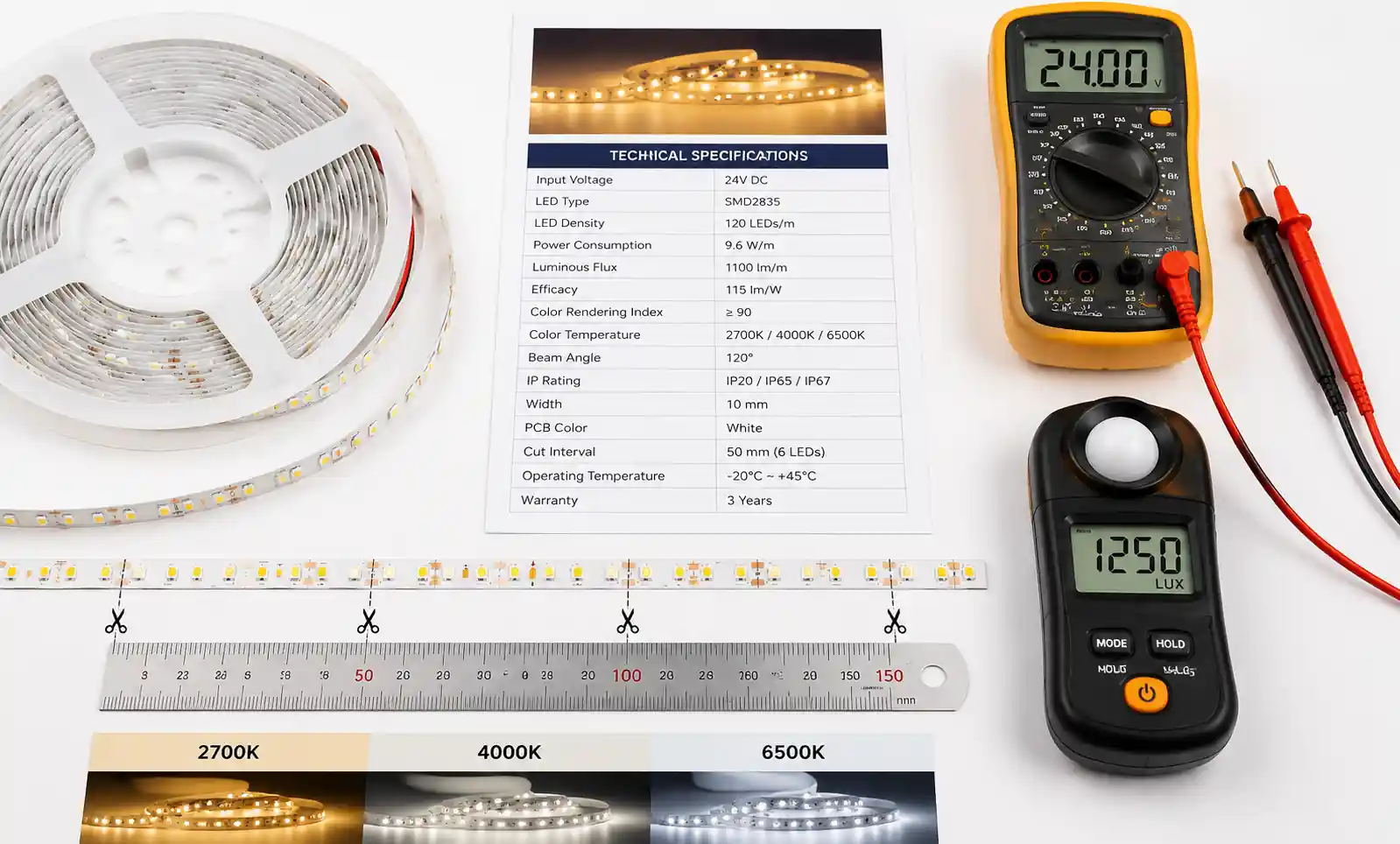
No. COB strips have designated cut lines every 25-50mm. Cut only at marked locations. Cutting between designated points destroys the circuit. Check cut interval specs before purchasing to ensure compatibility with your installation dimensions.
Do COB LED strips require special diffusers?
COB's continuous distribution eliminates the need to hide individual LED points. In most architectural applications, they can be directly visible. Diffusers still serve purposes: physical protection, glare control, or aesthetic softening. If you previously used diffusers only to hide dotting, COB allows exposed installation.
How do I calculate power supply capacity?
Multiply wattage per meter by total length, then add 20% safety margin. Example: 15W/m × 10m × 1.2 = 180W minimum. Account for efficiency losses in PWM dimmers or controllers (add another 5-10%). Verify the supply can deliver required current at the selected voltage.
Why does CRI matter more for COB strips?
It doesn't—CRI is a function of phosphor, not packaging. But COB is typically manufactured with high-CRI phosphors (90-95+) as standard because it targets premium applications. SMD spans wider quality range, from CRI 80 budget to CRI 90 premium. Specify minimum CRI values regardless of technology.
Can I dim COB and SMD strips to the same minimum level?
COB generally dims smoother to 1-5%, SMD to 5-10%. But dimming performance depends equally on the driver. High-quality 0-10V or DALI dimmers outperform basic phase-cut or PWM dimmers regardless of technology. For deep dimming applications, specify both quality COB strips and premium drivers.
What are common failure modes?
Both technologies: thermal stress from inadequate heat sinking causes lumen depreciation and color shift. COB: adhesive failure between PCB and mounting surface from thermal cycling. SMD: individual LED failures creating dark spots. Both vulnerable to voltage spikes and mechanical damage. Proper installation and quality power supplies prevent most failures.
Are COB strips suitable for outdoor/wet locations?
Yes, both are available with IP65, IP67, and IP68 ratings using silicone or polyurethane encapsulation. For IP-rated strips, verify the entire assembly—including connectors and end caps—meets the required rating. Specify UV-stabilized silicone for long-term exterior installations.
How do I handle power injection for COB strips?
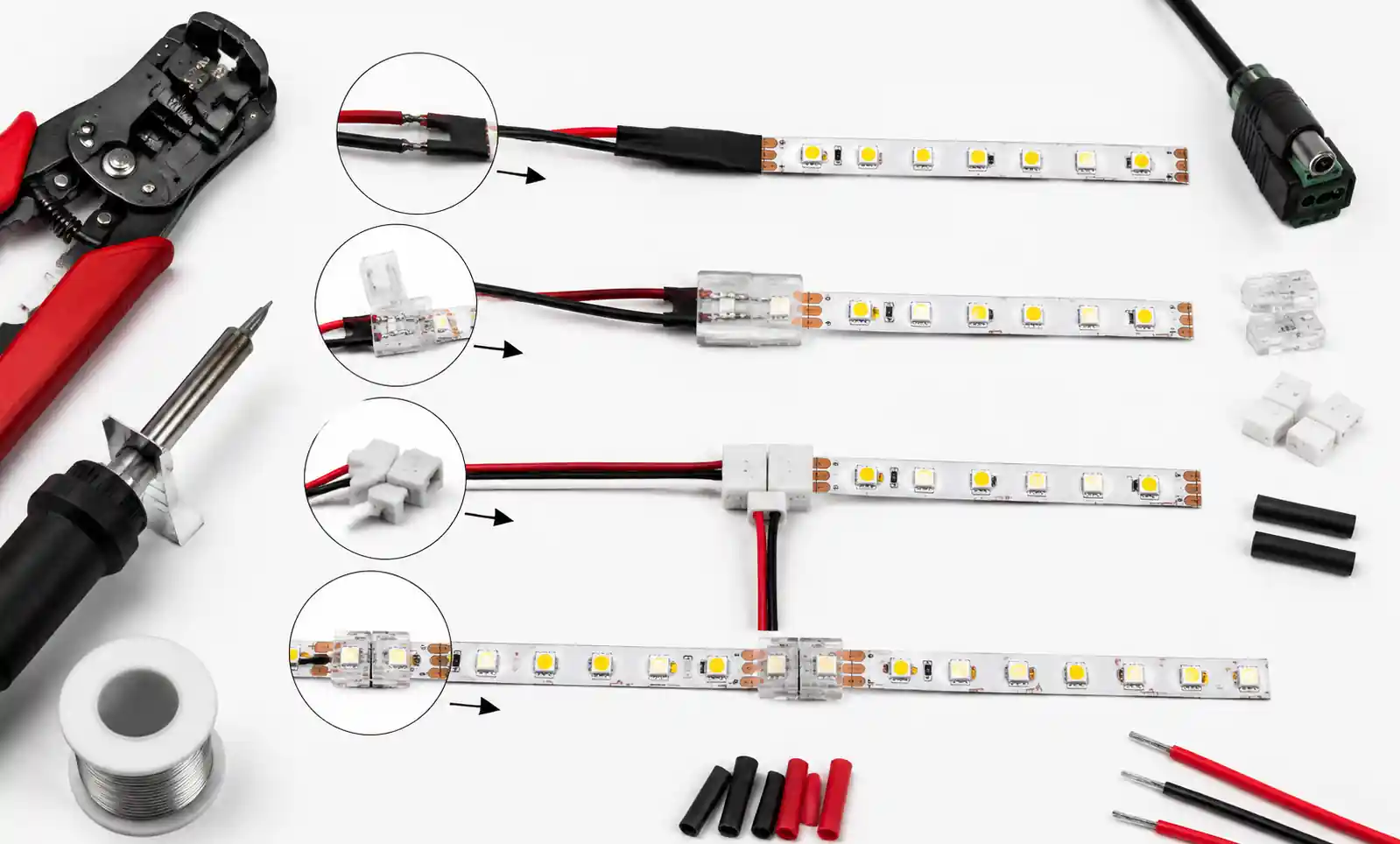
Identify positive/negative traces on the PCB and solder AWG 18-20 wire with strain relief. Some manufacturers provide dedicated connection points at intervals. For professional installations, soldered connections with heat-shrink insulation provide the best long-term reliability.
Conclusion
COB delivers continuous uniform distribution, CRI 90-95+, high R9 values, and efficient thermal management. The 30-60% premium is justified where light quality directly impacts user experience—retail, hospitality, architectural installations, and color-critical workspaces.
SMD remains the practical choice for cost-sensitive applications, installations behind diffusers, projects requiring RGB or dynamic color, and general commercial lighting where CRI 80-85 meets requirements. The mature SMD supply chain offers broad availability and competitive pricing.