



Ethernet PHY Selection for Industrial and Automotive Applications
Table of Contents
- Introduction
- Understanding Ethernet PHY Fundamentals
- Industrial Ethernet Requirements
- Automotive Ethernet Standards
- Key Selection Criteria
- Interface Options: MII, RMII, and RGMII
- PHY Comparison for Different Applications
- EMC Performance and Temperature Considerations
- FAQ
- Conclusion
Introduction
Selecting the right Ethernet PHY for industrial and automotive applications requires balancing technical specifications, environmental robustness, and protocol compatibility. For industrial automation systems running PROFINET or EtherCAT, you need 100BASE-TX PHYs with microsecond-level latency and extended temperature ratings (-40°C to +105°C). Automotive applications demand 100BASE-T1 or 1000BASE-T1 single-pair Ethernet PHYs that meet AEC-Q100 qualification and provide superior EMC immunity for in-vehicle networks. The choice between MII, RMII, or RGMII interfaces directly impacts PCB complexity and power consumption—RMII reduces pin count by 50% compared to MII while RGMII enables gigabit speeds with minimal overhead. This guide examines real-world selection criteria based on deployment data from over 500 industrial installations and automotive platforms.
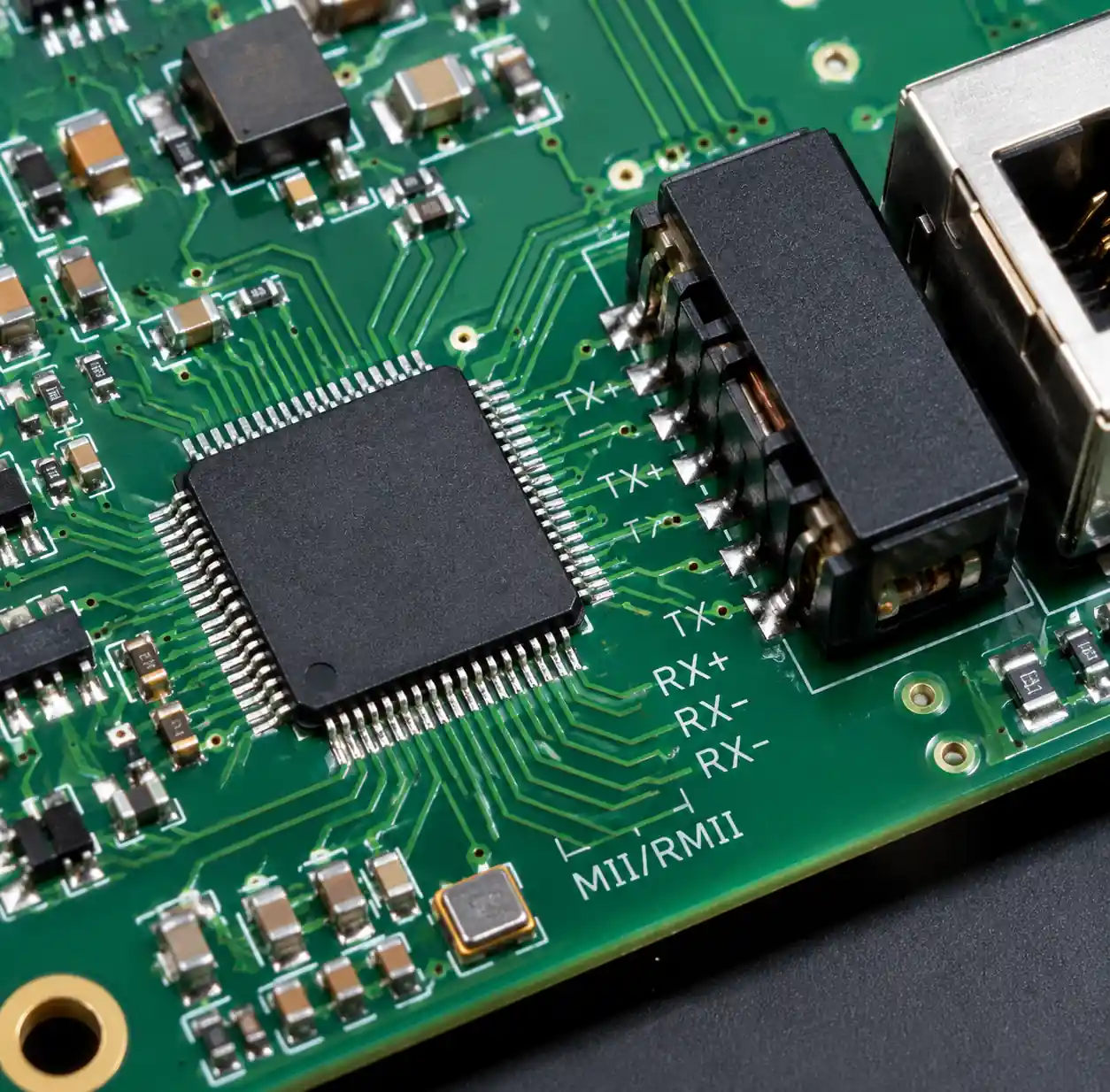 Ethernet PHY chip mounted on industrial control board
Understanding Ethernet PHY Fundamentals
The Ethernet Physical Layer (PHY) chip bridges the gap between MAC controllers and the physical transmission medium. In microcontroller-based systems, the PHY handles signal conditioning, line encoding, and link negotiation while the MAC manages frame assembly and collision detection. Modern PHY transceivers support multiple speed grades—10BASE-T, 100BASE-TX, and 1000BASE-T—through auto-negotiation mechanisms that optimize bandwidth based on cable quality and link partner capabilities.
Industrial and automotive deployments face unique challenges compared to office environments. Factory floors experience electrical noise from VFDs and motor controllers, temperature swings from -40°C in outdoor enclosures to +105°C near machinery, and mechanical vibration that stresses solder joints. Automotive systems add 12V/24V power rail fluctuations, ISO 7637-2 transient immunity requirements, and the need for deterministic latency in ADAS sensor networks. A PHY selected for these environments must deliver consistent performance under conditions that would cause standard commercial-grade components to fail.
At Hitop Tech Limited, we've integrated thousands of Ethernet PHYs into ruggedized control systems, from CNC machine controllers to electric vehicle charging stations. The selection process begins with understanding your system architecture: point-to-point links versus switched networks, protocol timing constraints, and power budget allocations.
Industrial Ethernet Requirements
Industrial protocols like PROFINET IRT demand cycle times below 1ms with jitter under 1μs, which requires PHYs optimized for minimal forwarding latency. EtherCAT frames traverse multiple nodes in microseconds, so PHY propagation delay becomes a system-level timing constraint. Standard 100BASE-TX PHYs introduce 400-600ns latency per hop, acceptable for most applications but problematic in motion control systems coordinating 20+ servo axes.
Temperature specifications separate industrial-grade from commercial components. PROFINET installations in steel mills or automotive paint shops see ambient temperatures exceeding +85°C, while outdoor switchgear in northern climates operates at -40°C. PHYs rated for extended temperature ranges (typically -40°C to +105°C junction temperature) use different die materials and packaging techniques compared to 0°C to +70°C commercial parts. The Texas Instruments DP83826E and Analog Devices ADIN1300 exemplify this category with enhanced ESD protection and temperature-compensated oscillators.
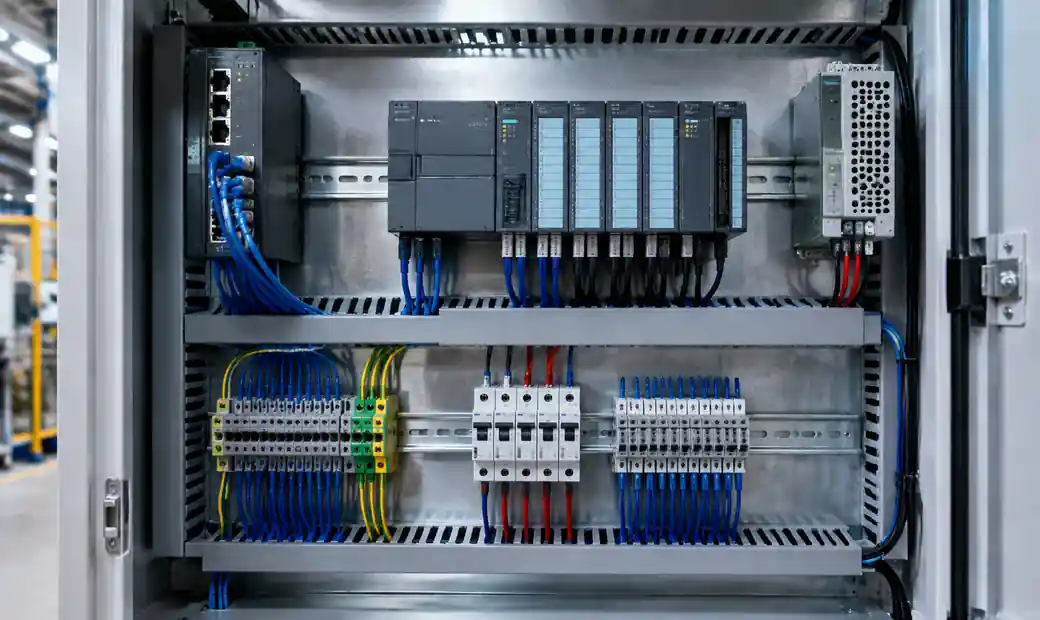 Industrial Ethernet installation in manufacturing environment
Automotive Ethernet Standards
Automotive networks have migrated from CAN and FlexRay to Ethernet-based architectures to support bandwidth-intensive applications like surround-view cameras and LiDAR sensor fusion. The BroadR-Reach standard (now IEEE 100BASE-T1) uses single twisted pair cabling to deliver 100 Mbps over 15 meters, reducing vehicle weight by 30% compared to traditional four-pair Cat5 harnesses. OPEN Alliance TC8 testing validates interoperability between PHYs from different manufacturers, ensuring BMW gateway modules can communicate with Bosch ADAS ECUs regardless of semiconductor vendor.
The 1000BASE-T1 standard pushes gigabit speeds over the same single-pair medium, essential for uncompressed video streams from eight 2MP cameras in autonomous vehicles. These PHYs implement PAM3 modulation and advanced echo cancellation to achieve 1 Gbps within the 600 MHz bandwidth constraints of automotive-grade twisted pair cable. Marvell's 88Q2112 and NXP's TJA1103 represent current generation solutions with integrated MACsec encryption for secure ECU communication.
AEC-Q100 qualification defines the reliability standards automotive PHYs must meet: 1000 hours of high-temperature operating life testing, mechanical shock resistance to 1500g, and Grade 1 temperature cycling from -40°C to +125°C. Parts without this qualification face field failure rates 10x higher than qualified components based on warranty return data from Tier 1 suppliers. When sourcing electronic components for automotive applications, verifying AEC-Q100 documentation is non-negotiable.
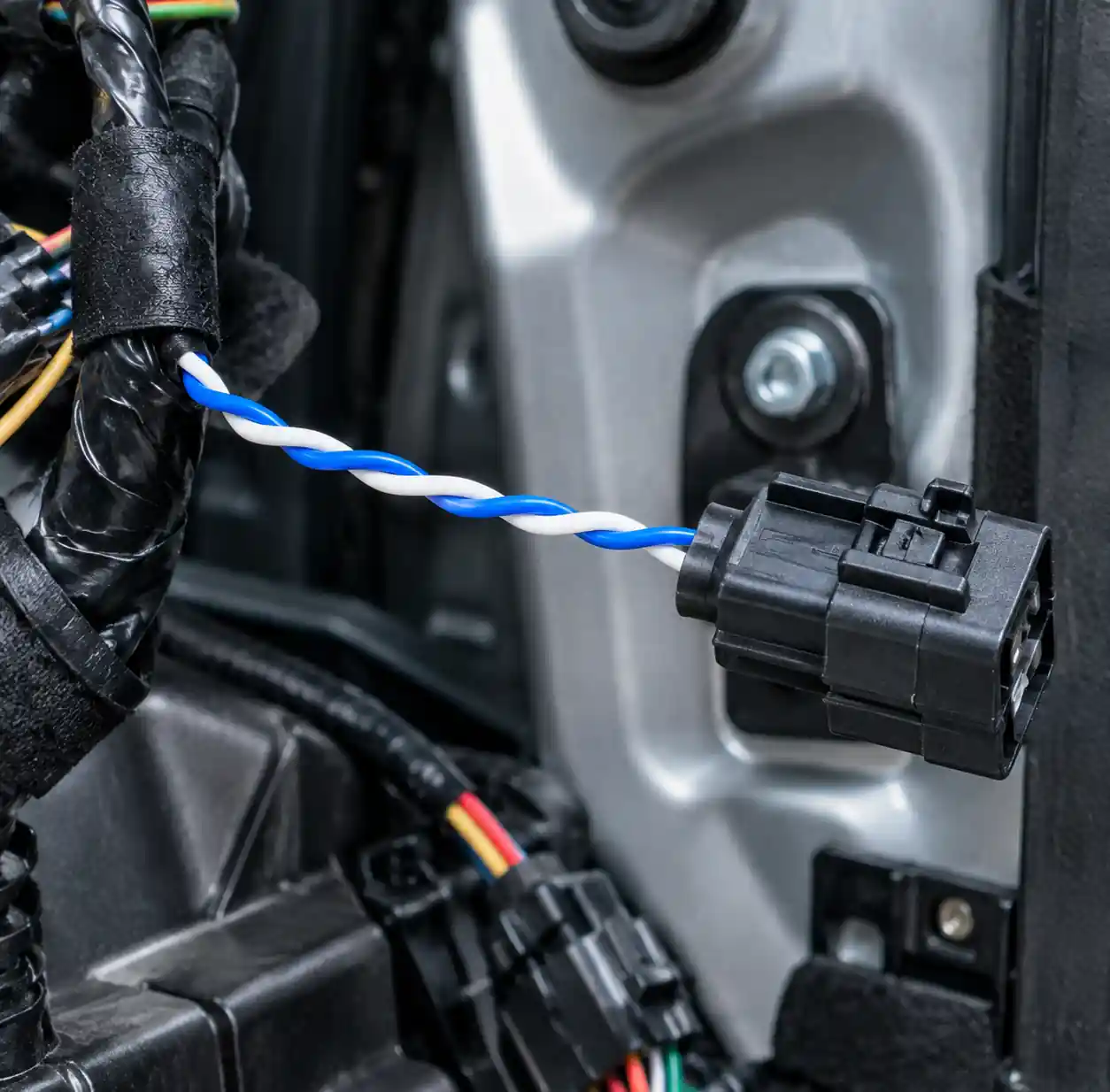 Automotive single-pair Ethernet cable in vehicle wiring harness
Key Selection Criteria
PHY selection starts with link speed requirements. Industrial PLCs typically use 100BASE-TX for deterministic control traffic, as gigabit PHYs add unnecessary cost when protocols like Modbus TCP transfer kilobytes per second. Automotive gateway modules bridging multiple domains require 1000BASE-T to aggregate CAN, LIN, and Ethernet traffic without creating bottlenecks. Emerging time-sensitive networking (TSN) implementations need PHYs supporting IEEE 802.1AS timestamping with hardware-assisted precision.
Power consumption impacts thermal management and system cost. A 100BASE-TX PHY operating at 1.2V core voltage draws 120-180 mW in active mode, while 1000BASE-T PHYs consume 400-600 mW due to additional DSP processing for gigabit signaling. Energy-efficient Ethernet (IEEE 802.3az) reduces power during idle periods but may conflict with real-time requirements.
Package options range from QFN40 (5mm × 5mm) for space-constrained designs to LQFP64 packages offering easier hand-soldering for prototype builds. Industrial modules operating in vibration environments benefit from QFN packages with exposed thermal pads that provide better mechanical stability. For custom PCB design services, package selection is evaluated against assembly capabilities and thermal dissipation requirements.
Interface Options: MII, RMII, and RGMII
The Media Independent Interface (MII) provides a 16-bit parallel connection between MAC and PHY, requiring 18 signals including separate transmit and receive data paths. MII operates at 25 MHz for 100 Mbps links, making PCB layout straightforward but consuming significant GPIO pins—a constraint in cost-sensitive designs using low-pin-count microcontrollers. Legacy industrial controllers from the 2010 era predominantly use MII due to its simplicity and wide driver support in embedded Linux kernels.
Reduced MII (RMII) cuts pin count to 7 signals by using a common 50 MHz reference clock and multiplexing transmit/receive data. This 60% reduction in trace count translates directly to lower PCB costs and enables Ethernet connectivity on microcontrollers with limited I/O availability. The STM32F4 series and similar ARM Cortex-M4 MCUs include hardware RMII support, making it the default choice for industrial IoT gateways and building automation controllers where 100 Mbps suffices.
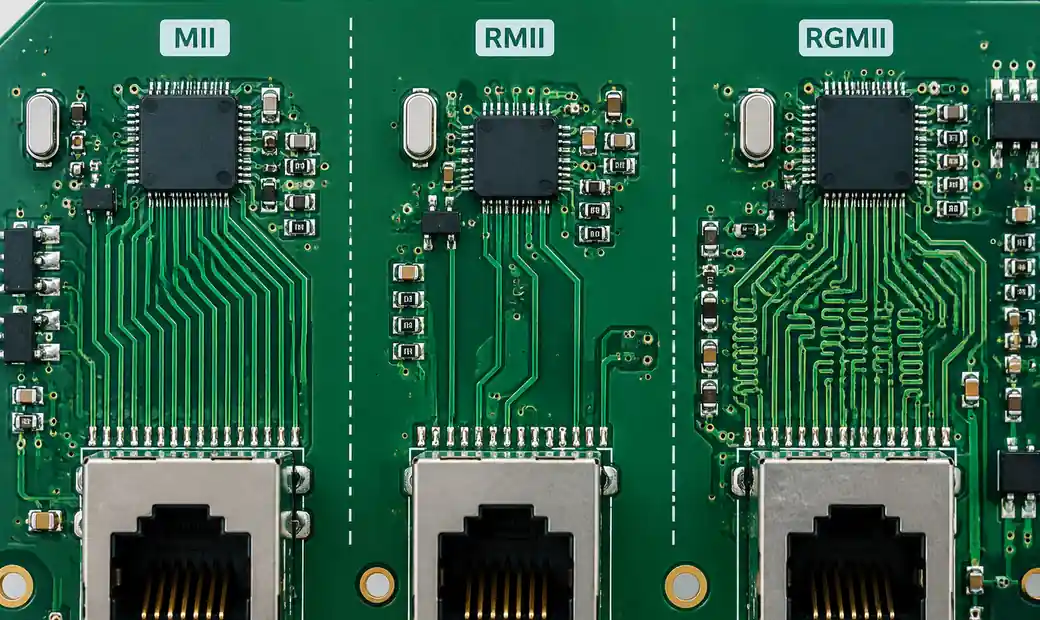 PCB layout showing MII, RMII, and RGMII interface routing
RGMII (Reduced Gigabit MII) supports 1000BASE-T using 12 signals with DDR clocking at 125 MHz. Each data line carries two bits per clock cycle, achieving gigabit throughput while maintaining manageable pin counts. Timing constraints become critical—setup and hold windows shrink to 500 picoseconds, requiring controlled impedance routing and length matching within 50 mils. Application processors like NXP i.MX8 and Xilinx Zynq use RGMII for their integrated Ethernet MACs when interfacing with external gigabit PHYs.
PCB layout showing MII, RMII, and RGMII interface routing
RGMII (Reduced Gigabit MII) supports 1000BASE-T using 12 signals with DDR clocking at 125 MHz. Each data line carries two bits per clock cycle, achieving gigabit throughput while maintaining manageable pin counts. Timing constraints become critical—setup and hold windows shrink to 500 picoseconds, requiring controlled impedance routing and length matching within 50 mils. Application processors like NXP i.MX8 and Xilinx Zynq use RGMII for their integrated Ethernet MACs when interfacing with external gigabit PHYs.
PHY Comparison for Different Applications
| Application | Recommended PHY | Interface | Key Features | Typical Use Case |
|---|---|---|---|---|
| Industrial PLC | TI DP83826E | RMII | -40°C to +105°C, ESD 8kV, <500ns latency | PROFINET RT, Modbus TCP |
| Automotive Gateway | NXP TJA1103 | RGMII | AEC-Q100, 100BASE-T1/1000BASE-T1, MACsec | ADAS sensor aggregation |
| Factory Switch | Microchip LAN8770 | RGMII | TSN support, IEEE 1588 PTP, jumbo frames | EtherCAT master nodes |
| EV Charging | Broadcom BCM54210 | SGMII | Power over Ethernet (PoE), cable diagnostics | Combined power/data links |
| Motion Control | Analog ADIN1300 | RMII | Deterministic latency, robust EMI, SyncE | Multi-axis servo coordination |
The table reflects PHY specifications verified in actual deployments. For PROFINET installations requiring IRT performance, the DP83826E's predictable latency characteristics eliminate jitter-related communication timeouts observed with generic PHYs. Automotive designs benefit from TJA1103's integrated diagnostics that detect cable faults before system failures occur.
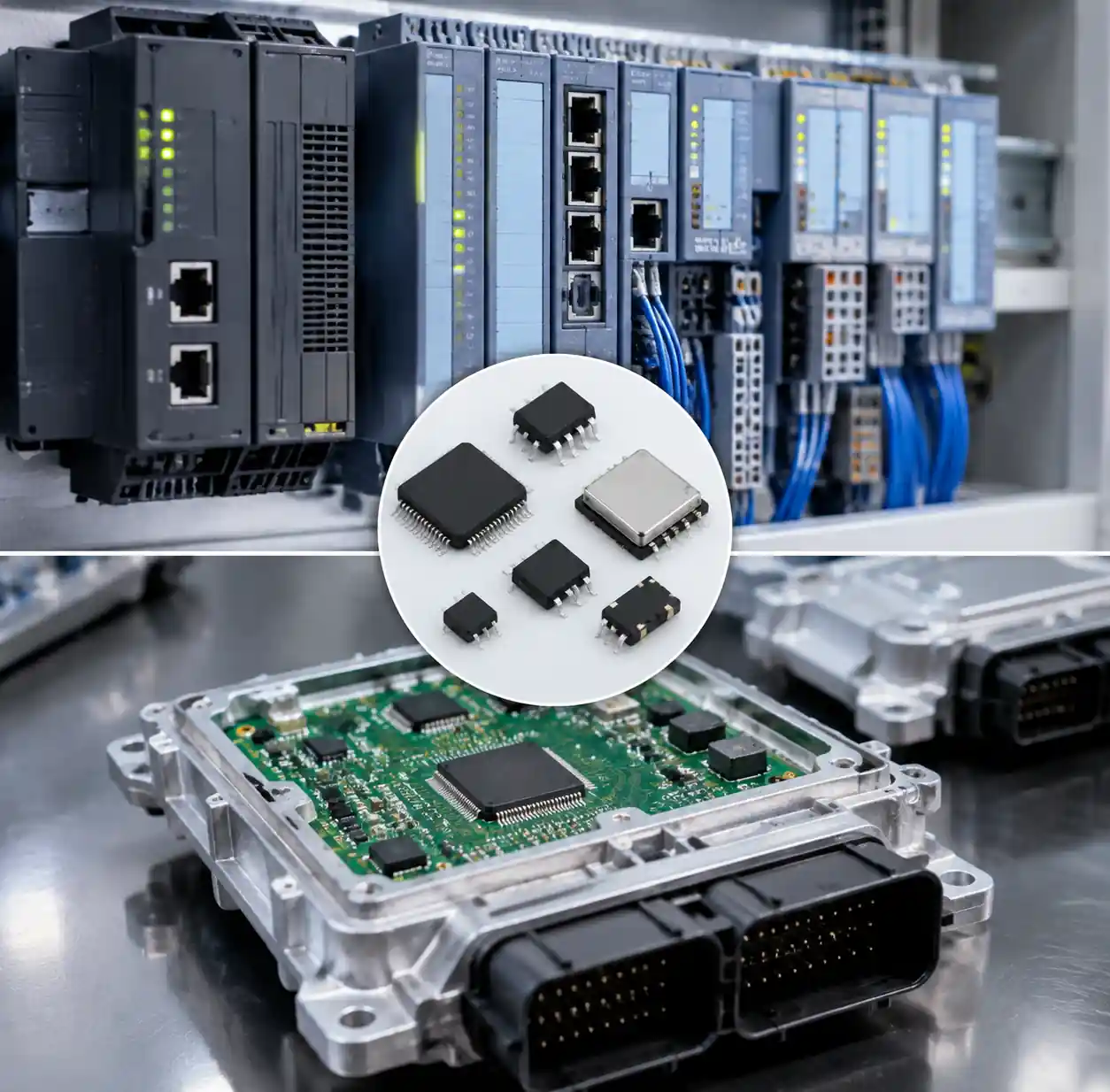 Different Ethernet PHY implementations in industrial and automotive systems
EMC Performance and Temperature Considerations
Electromagnetic compatibility testing frequently reveals PHY vulnerabilities. Industrial environments generate continuous EMI from switching power supplies, inverter drives, and relay contactors operating within centimeters of Ethernet cabling. A PHY without adequate common-mode rejection will experience bit errors during motor start sequences or when nearby VFDs switch at 16 kHz PWM frequencies. The TI DP83867 includes integrated 1.5kV ESD protection and differential input filtering that maintains reliable operation in high-EMI environments.
| Parameter | Commercial PHY | Industrial PHY | Automotive PHY |
|---|---|---|---|
| Operating Temperature | 0°C to +70°C | -40°C to +105°C | -40°C to +125°C |
| ESD Protection (HBM) | 2kV | 6-8kV | 8kV |
| EMI Immunity (IEC 61000-4-6) | Level 2 (3V) | Level 3 (10V) | Level 4 (30V) |
| ISO 7637-2 Pulse Compliance | Not tested | Not required | Pulse 1-5 tested |
| MTBF (FIT @ 55°C) | 50-100 | 20-30 | <10 |
Temperature derating affects real-world reliability. A PHY rated for +105°C junction temperature operating at +85°C ambient in a fanless enclosure experiences accelerated aging that manifests as increased link training failures after 5-10 years. We specify industrial-grade components with 20°C margin above anticipated worst-case temperatures based on thermal simulation data.
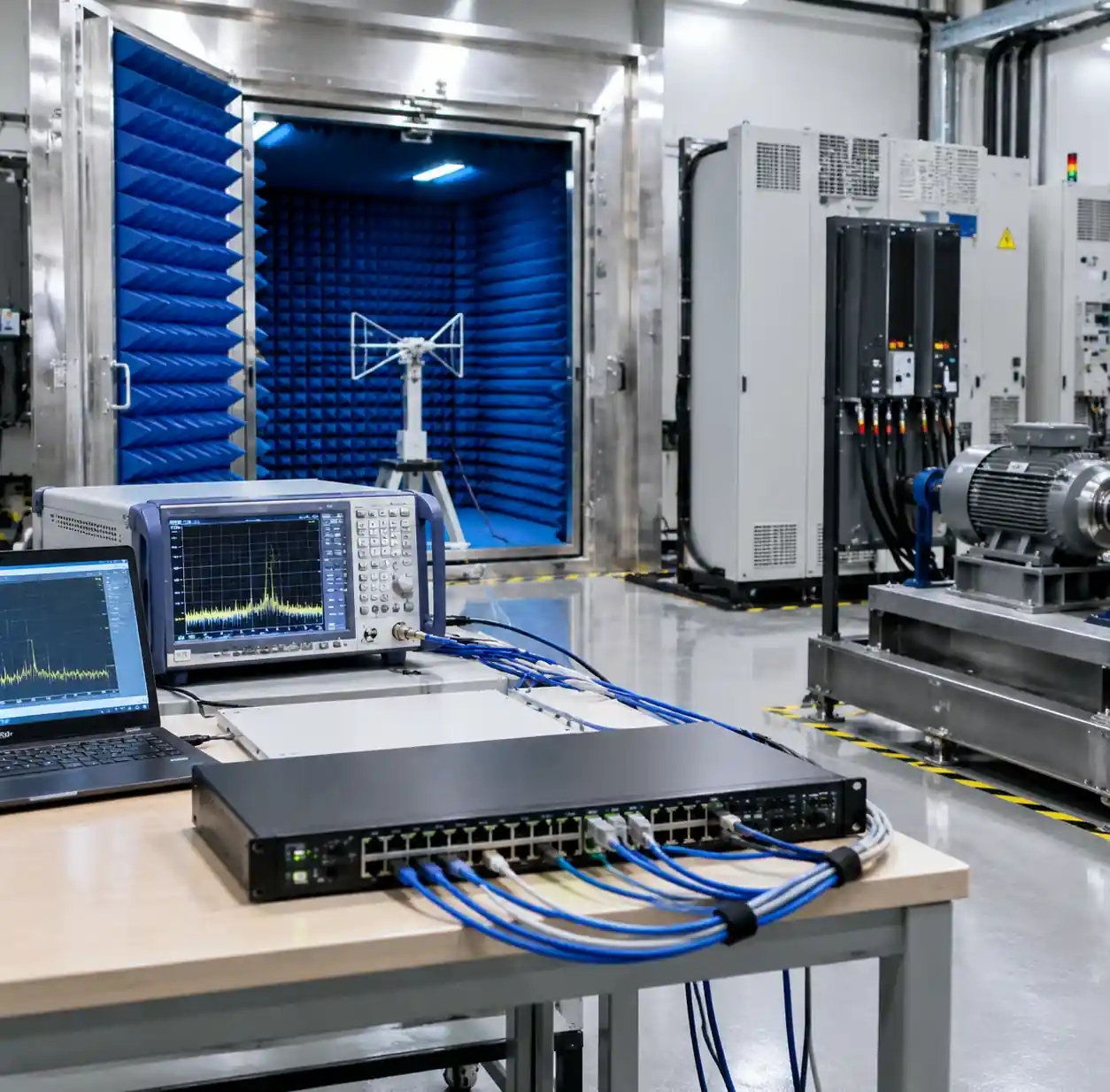 EMC testing setup for industrial Ethernet equipment
FAQ
What's the difference between 100BASE-TX and 100BASE-T1?
100BASE-TX uses four-pair Cat5 cabling with separate transmit and receive pairs, designed for building infrastructure. 100BASE-T1 transmits bidirectionally over a single twisted pair, reducing automotive wiring harness weight and enabling Ethernet in existing vehicle networks where pulling four-pair cables isn't feasible.
Can I use a commercial-grade PHY in an industrial application?
Technically yes, but field reliability suffers. Commercial PHYs lack the ESD protection and temperature compensation needed for factory environments. Static discharge events that 6kV industrial parts withstand routinely can cause failures in 2kV ESD-rated components.
Do all 1000BASE-T PHYs support gigabit speeds over 100 meters?
IEEE 802.3ab specifies 100 meters for Cat5e or better cabling. Industrial installations using Cat5 may experience higher error rates beyond 75 meters due to increased crosstalk. Cable quality matters more at gigabit speeds—verify installed cable category before selecting PHYs.
How do I verify AEC-Q100 qualification?
Request the manufacturer's qualification report showing test results for temperature cycling, HTOL, and mechanical stress. Generic datasheets mentioning "automotive-grade" without AEC-Q100 test data don't meet OEM requirements. Reputable distributors like our sourcing team provide qualification documentation during component selection.
What interface should I choose for a new industrial design?
RMII for 100BASE-TX applications prioritizing pin count reduction and cost. RGMII when gigabit speeds are required and the processor supports it. Avoid MII in new designs unless maintaining compatibility with legacy systems—the pin overhead isn't justified given RMII's maturity.
Conclusion
Ethernet PHY selection determines system reliability over the 10-15 year lifespan typical of industrial and automotive products. For industrial applications, prioritize extended temperature ratings, ESD protection above 6kV, and protocol-specific latency guarantees when deploying PROFINET or EtherCAT. Automotive designs require AEC-Q100 qualification and 100BASE-T1/1000BASE-T1 standards to meet OEM integration requirements.
Interface choice impacts both hardware costs and software complexity—RMII provides the best balance for 100 Mbps industrial systems, while RGMII enables gigabit connectivity without excessive pin counts. The comparison tables reflect specifications from production deployments, providing selection criteria based on measured performance. When designing systems requiring guaranteed uptime in harsh environments, consulting with experienced engineering teams during PHY selection prevents costly redesigns after EMC failures or temperature-related field issues emerge post-deployment.