



Connector Selection Guide for Harsh Industrial Environments
Selecting the right connector for demanding industrial applications can mean the difference between years of reliable operation and costly field failures. In manufacturing plants, offshore platforms, and transportation systems, connectors face extreme temperatures, persistent vibration, chemical exposure, and high-pressure washdown—conditions that destroy standard commercial-grade components within months. With industrial connector failures accounting for 30-40% of all cable assembly issues, understanding the critical selection parameters and proven design approaches has become essential for engineers and procurement teams.
At Hitop Tech Limited, we help engineering teams source industrial-grade connectors through our procurement services that match demanding environmental specifications with verified manufacturer quality standards.
Table of Contents
- Understanding Harsh Environment Challenges
- IP Rating Standards and Selection
- Connector Types and Their Applications
- Temperature and Vibration Resistance
- Contact Material and Plating Selection
- Mating Cycles and Service Life
- FAQ
- Conclusion
1. Understanding Harsh Environment Challenges
Industrial environments subject connectors to conditions far beyond typical office or consumer electronics applications. Understanding these threats helps prioritize protection mechanisms and avoid under-specifying connectors that will fail prematurely.
Environmental Threats and Their Impact
Temperature extremes cause thermal cycling stress that degrades seal integrity and expands contact resistance. Industrial facilities routinely see -40°C in cold storage or outdoor installations and +125°C near furnaces or engine compartments. These temperature swings—often 80°C to 100°C daily—create expansion and contraction cycles that open microscopic gaps in seals, allowing moisture ingress.
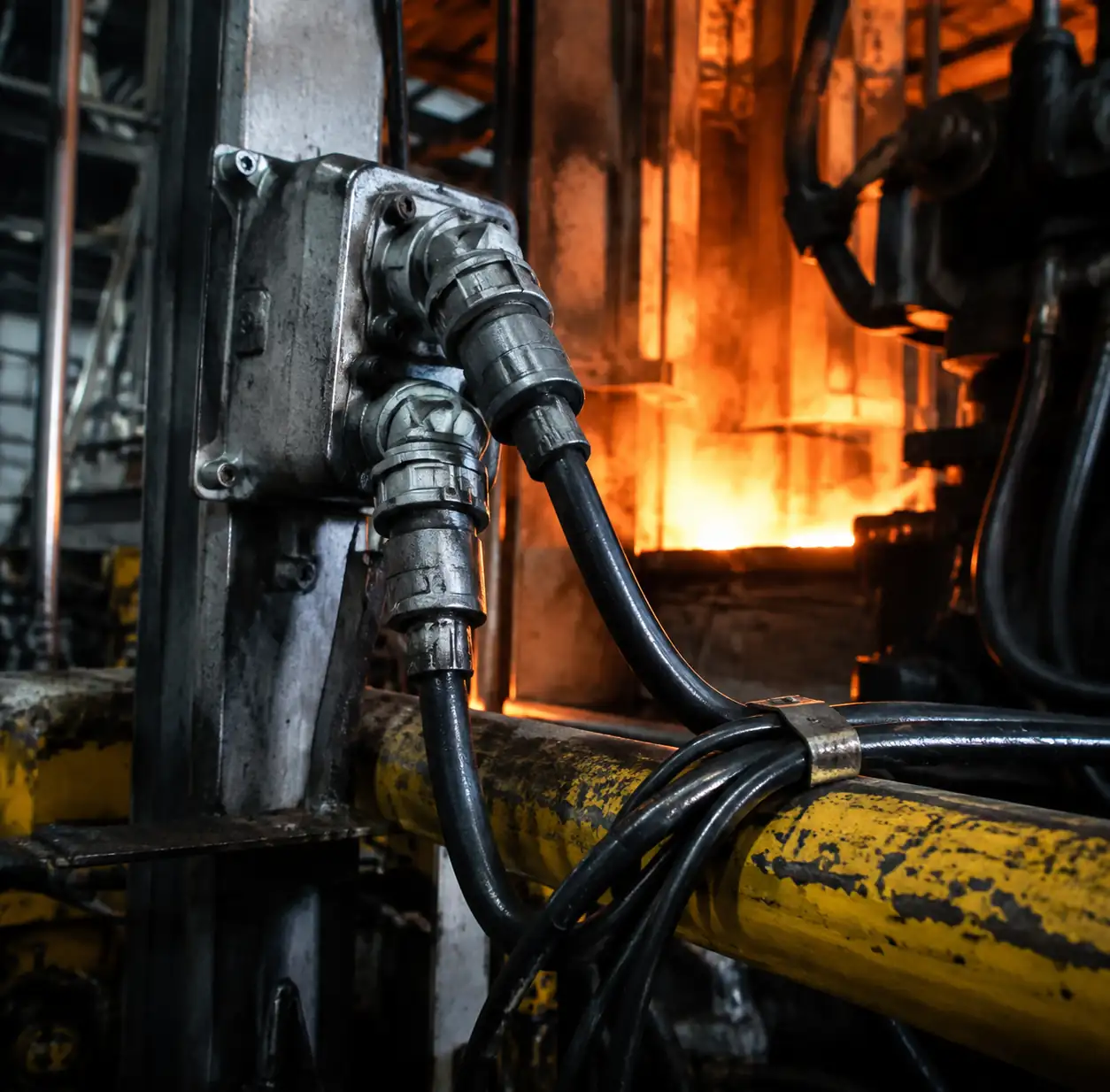 Industrial connector exposed to extreme temperature, vibration, and chemical conditions in manufacturing facility
Mechanical vibration, common in transportation, robotics, and heavy machinery, creates fatigue at contact interfaces and loosens threaded connections. Continuous vibration at frequencies between 10 Hz and 2,000 Hz causes fretting corrosion—microscopic movement between contact surfaces that wears away protective plating and increases contact resistance. A connector rated for 5G shock resistance can withstand sudden impacts, but continuous 10G vibration will degrade connections in months without proper locking mechanisms.
2. IP Rating Standards and Selection
The IP (Ingress Protection) rating system, defined by IEC 60529, provides standardized environmental protection specifications. Understanding these codes allows engineers to match connector protection levels to actual field conditions rather than over-specifying or under-protecting.
Decoding IP Ratings
The IP code consists of two digits: the first (0-6) indicates solid particle protection, and the second (0-9) specifies liquid ingress protection. An IP67 connector provides complete dust-tight protection (6) and withstands temporary immersion up to 1 meter for 30 minutes (7).
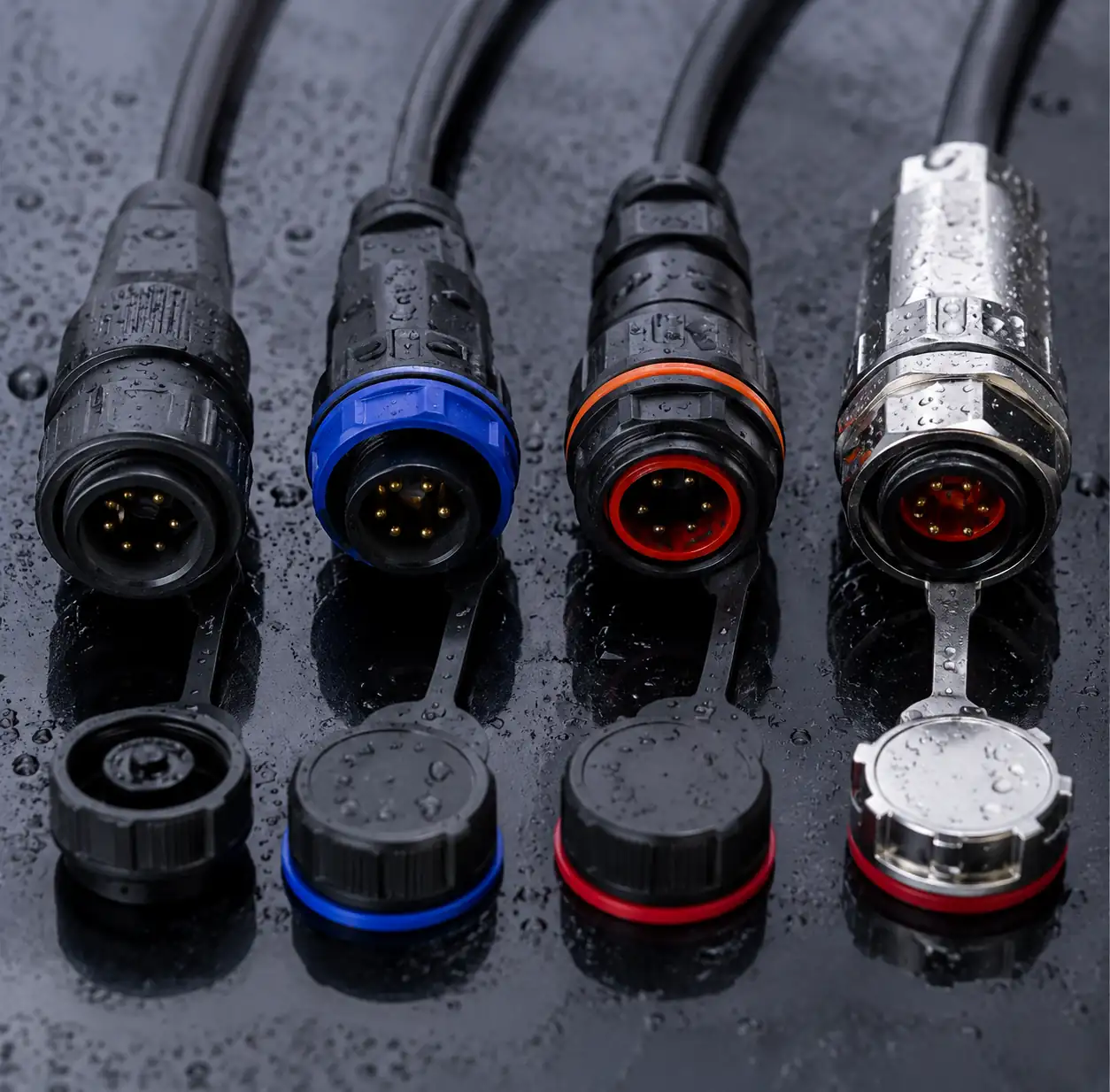 Industrial connectors demonstrating different IP rating protection levels from IP65 to IP69K
For industrial applications, the most relevant ratings are IP65, IP67, IP68, and IP69K. IP65 protects against water jets from any direction, suitable for machine tools and indoor manufacturing where occasional washdown occurs. IP67, the industrial workhorse, handles temporary submersion and is specified for factory automation, outdoor installations, and mobile equipment. IP68 allows continuous submersion beyond 1 meter with manufacturer-specified depth and duration—essential for marine applications and subsea equipment.
| IP Rating | First Digit (Solid Protection) | Second Digit (Liquid Protection) | Typical Applications |
|---|---|---|---|
| IP20 | Finger contact protection only | No water protection | Indoor control panels, clean environments |
| IP65 | Complete dust protection | Protection against water jets | Indoor manufacturing, machine tools |
| IP67 | Dust-tight (no ingress) | Temporary immersion up to 1m, 30 min | Factory automation, outdoor installations |
| IP68 | Dust-tight (no ingress) | Continuous submersion (depth specified) | Marine equipment, subsea applications |
| IP69K | Dust-tight (no ingress) | High-pressure hot water washdown | Food processing, pharmaceutical, vehicle wash |
Critical IP Rating Considerations
IP ratings apply to mated connector pairs under test conditions. An unmated connector typically provides one or two protection levels lower. Many industrial connectors specify IP67 when mated but only IP54 or IP20 unmated, requiring protective caps for unused connectors in the field.
Testing standards specify vertical mounting orientation and specific exposure durations. Real-world installations with non-vertical mounting or prolonged submersion may experience different performance. Always verify that the connector's tested configuration matches your installation orientation and expected exposure patterns.
3. Connector Types and Their Applications
Industrial environments use three primary connector families: M12 circular connectors, heavy-duty circular connectors (M23, M40), and specialized rectangular connectors. Each offers distinct advantages for specific mechanical, electrical, and environmental requirements.
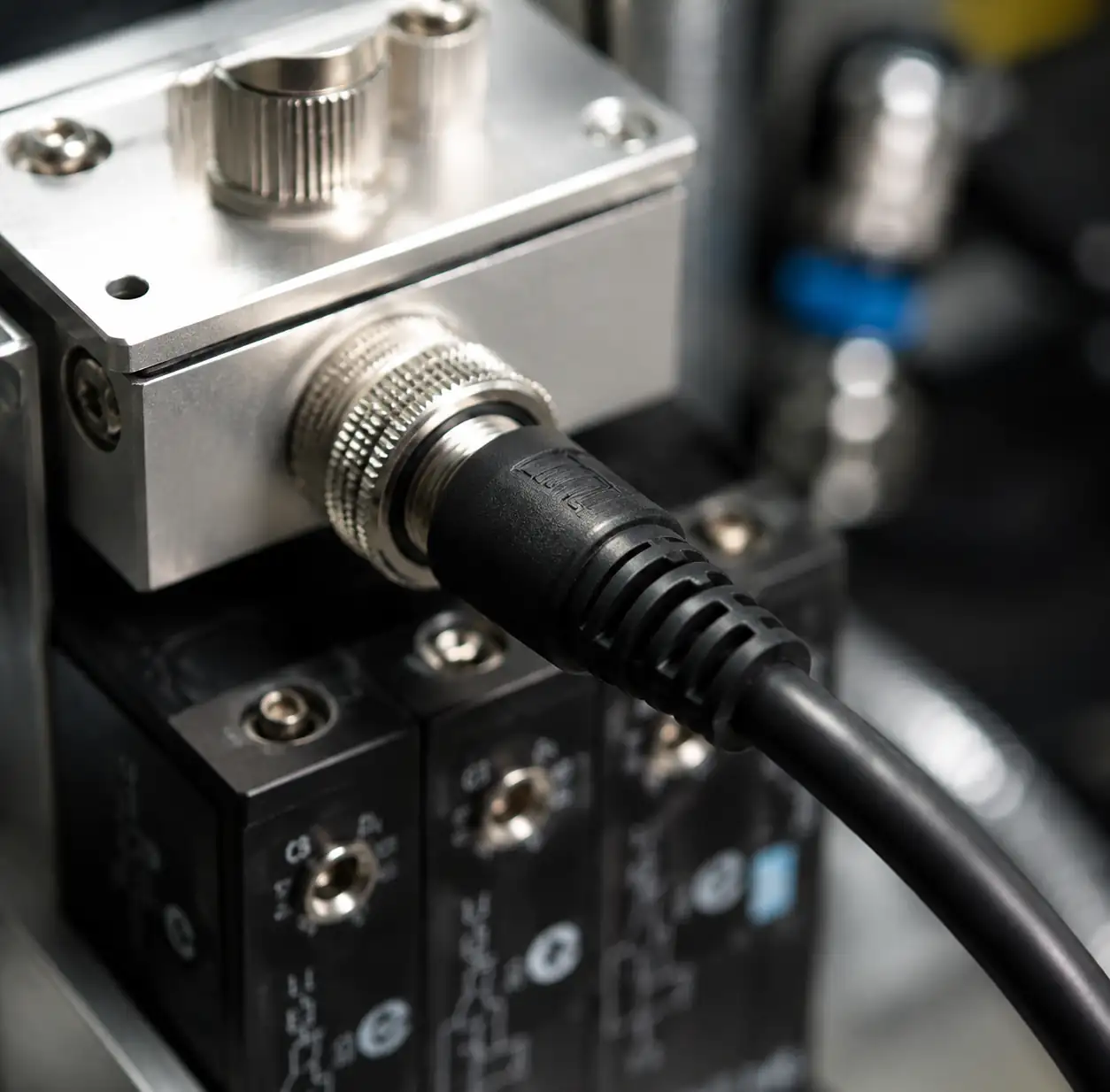 M12 circular connector with threaded coupling installed in industrial automation equipment
Current ratings reach 4A per contact at 250V for power variants, while data versions support 10 Gbps Ethernet. Temperature ratings span -40°C to +125°C with proper seal selection. The compact 12mm form factor fits tight spaces in robotics, machine vision systems, and sensor networks. Mating cycle ratings typically reach 500 cycles for industrial variants, with premium versions rated for 1,000+ cycles.
Heavy-Duty Circular Connectors
When applications demand higher current ratings (20A to 40A per contact), greater contact counts (up to 128 positions), or extreme environmental protection, heavy-duty circular connectors in M23, M40, or military specification formats provide the solution. These connectors use bayonet or threaded coupling mechanisms with metal shells (typically zinc die-cast or stainless steel) for maximum durability.
Rectangular Connectors for Panel Mounting
Panel-mount rectangular connectors with IP65 to IP67 protection serve applications requiring high contact density in limited panel space. These connectors accommodate 6 to 104 contacts in compact housings, supporting mixed signal, power, and data requirements in a single interconnect. Typical applications include PLC control panels, industrial HMI systems, and motor control centers.
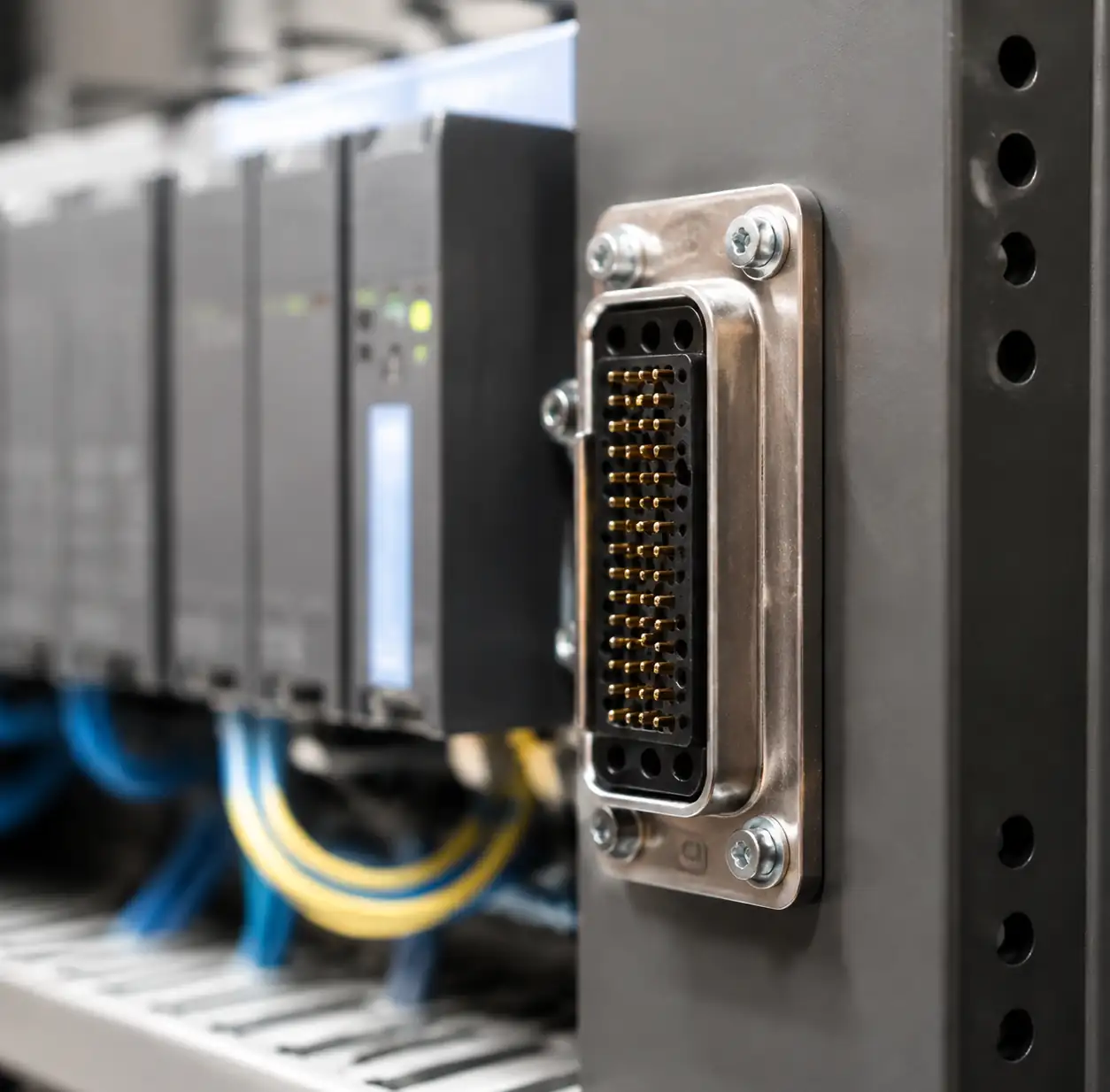 Panel-mount rectangular industrial connector with multiple contacts for control panel application
4. Temperature and Vibration Resistance
Temperature and vibration specifications directly determine connector reliability in industrial installations. Under-specifying either parameter leads to field failures that manifest months after deployment, often during peak production periods.
Temperature Rating Components
Connector temperature ratings depend on three separate material specifications: contact spring material retention temperature (typically beryllium copper to +125°C, phosphor bronze to +150°C), housing material glass transition or melting point (nylon 66 to +120°C, LCP to +260°C), and seal elastomer temperature range.
The seal material often becomes the limiting factor. Nitrile rubber (NBR) seals operate from -40°C to +100°C, suitable for most indoor applications. Ethylene propylene diene monomer (EPDM) extends the lower range to -50°C while maintaining +135°C upper limit—ideal for outdoor installations with winter cold snaps. Fluorocarbon (FKM/Viton) seals reach +200°C and provide superior chemical resistance but cost 3-5 times more than NBR.
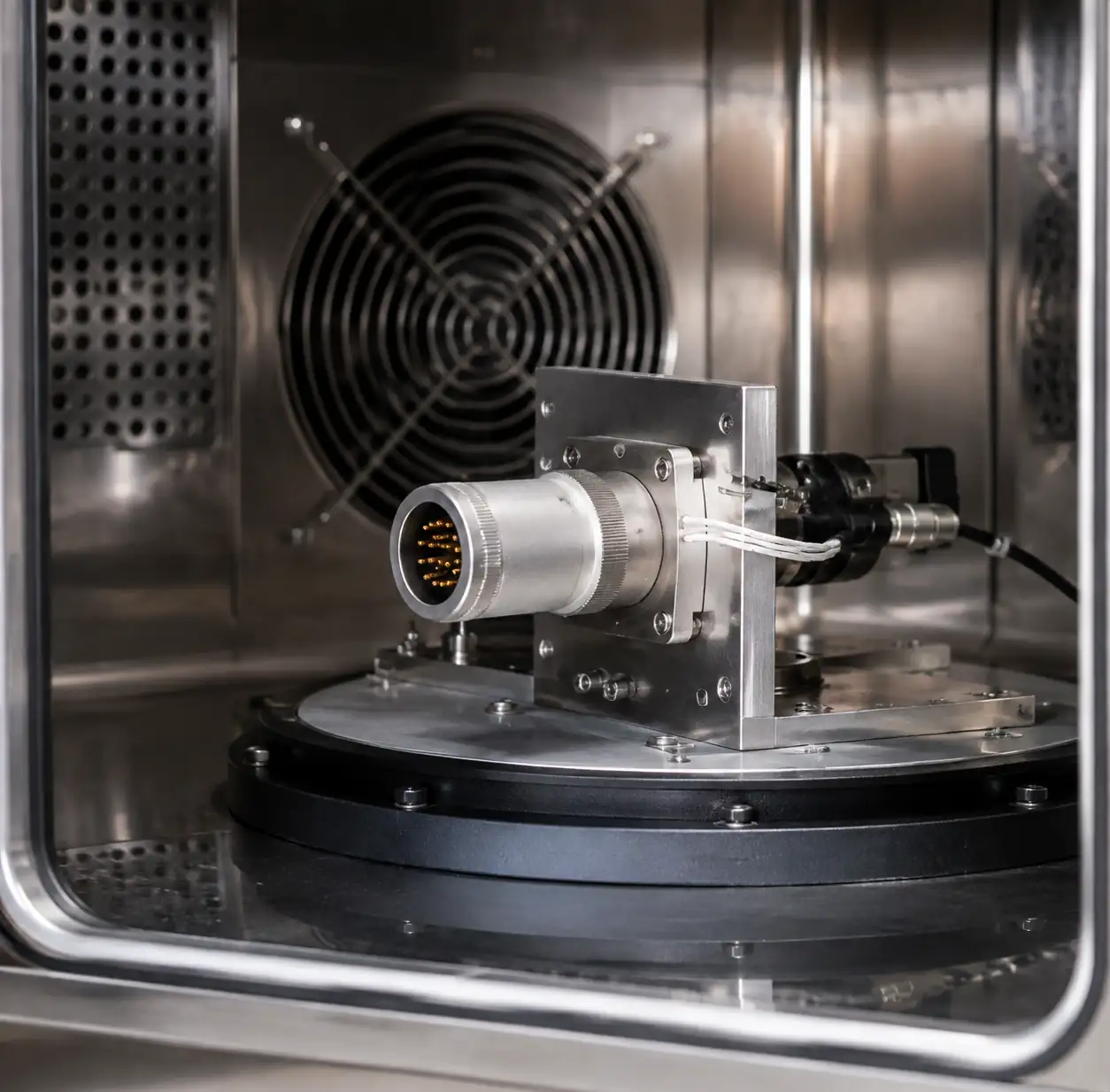 Industrial connector undergoing temperature and vibration testing in environmental test chamber
Vibration Resistance Design
Vibration resistance requires mechanical coupling that maintains contact pressure through continuous movement. Threaded couplings used in M12 and M23 connectors resist loosening under vibration far better than friction-fit or simple latching connections. Proper thread engagement depth (minimum 3 full turns) and coupling torque (typically 0.6 to 1.2 N⋅m for M12) must be specified and verified during installation.
Contact design determines fretting corrosion resistance. Multiple-point contact geometry, where each contact pin engages the socket at 3 to 6 discrete points, distributes normal force and minimizes micromovement. Single-point contacts, common in low-cost commercial connectors, concentrate force and wear at one location, accelerating resistance increase.
| Vibration/Shock Specification | Test Standard | Industrial Connector Requirement | Application Example |
|---|---|---|---|
| Sine vibration | IEC 60068-2-6 | 10-2,000 Hz, 5G, 10 hours per axis | Factory automation, robotics |
| Random vibration | IEC 60068-2-64 | 10-500 Hz, 1.5G RMS, 12 hours | Mobile equipment, vehicles |
| Mechanical shock | IEC 60068-2-27 | 50G peak, 11ms half-sine | Transportation, packaging equipment |
| Thermal shock | IEC 60068-2-14 | -40°C to +125°C, 100 cycles | Outdoor installations, engine compartments |
5. Contact Material and Plating Selection
Contact resistance stability over thousands of mating cycles and years of environmental exposure depends entirely on base metal selection and surface plating. Understanding the trade-offs between conductivity, spring force, corrosion resistance, and cost allows optimized contact specifications.
Base Contact Materials
Beryllium copper (BeCu) alloys provide the optimal combination of electrical conductivity (45-50% IACS), spring force retention, and cost for industrial connectors. The material maintains spring characteristics through 500+ mating cycles and withstands operating temperatures to +125°C without stress relaxation. Phosphor bronze offers similar performance at slightly lower cost but with reduced spring force, making it suitable for lower-mating-cycle applications.
For extreme temperature applications (+150°C to +200°C), copper-nickel-tin alloys maintain spring properties where BeCu would soften. These specialized alloys cost 40-60% more than standard BeCu but prevent contact failure in high-temperature industrial environments like furnace controls and engine management systems.
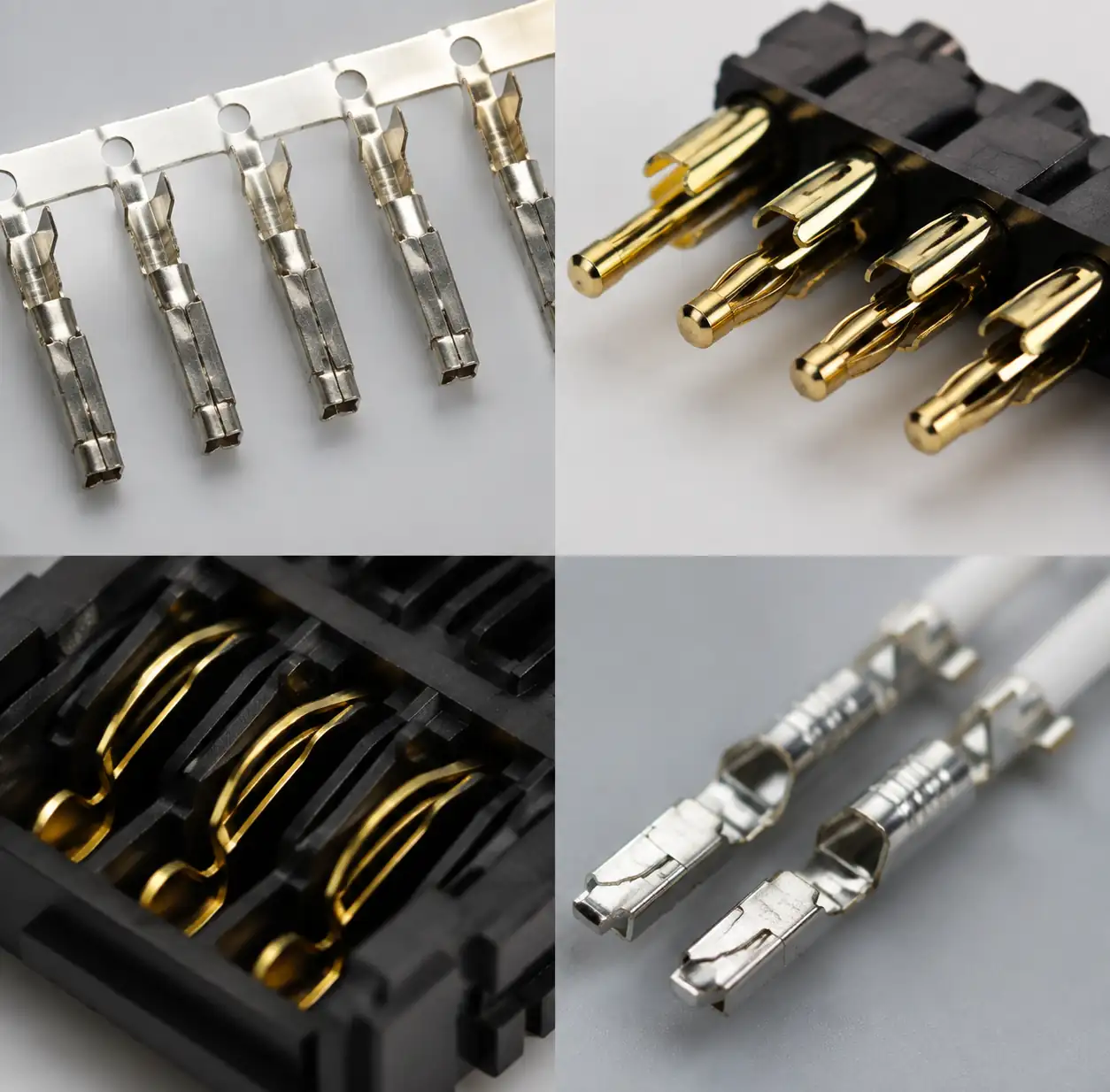 Microscopic view of industrial connector contacts showing gold and tin plating on copper base material
Contact Plating Systems
Gold plating (0.76 to 1.27 µm thickness over nickel underplate) provides the lowest contact resistance and highest corrosion protection, making it essential for signal contacts operating below 100mA where oxide films cannot be penetrated by contact force. The soft gold surface wipes clean during mating, maintaining low resistance through hundreds of cycles. However, gold plating adds $0.50 to $2.00 per contact and suffers wear in high-mating-cycle applications.
Silver plating, once common in industrial connectors, has largely been replaced due to tarnishing and sulfidation in industrial atmospheres containing sulfur compounds. Where still used, it requires environmental sealing to IP67 minimum. Nickel plating serves primarily as an underplate barrier layer, preventing copper diffusion through gold or tin surface layers.
6. Mating Cycles and Service Life
Mating cycle ratings quantify how many connect-disconnect operations a connector withstands before contact resistance exceeds acceptable limits or mechanical retention fails. These ratings directly impact maintenance intervals and total cost of ownership for industrial installations.
Understanding Mating Cycle Degradation
Each mating cycle wears away microscopic amounts of contact plating through mechanical abrasion and friction. Gold plating, despite its corrosion resistance, is soft and wears through to the nickel underplate after 100 to 500 cycles depending on normal force and alignment precision. Once gold wears through, contact resistance increases 5-10× as harder nickel creates higher contact interface resistance.
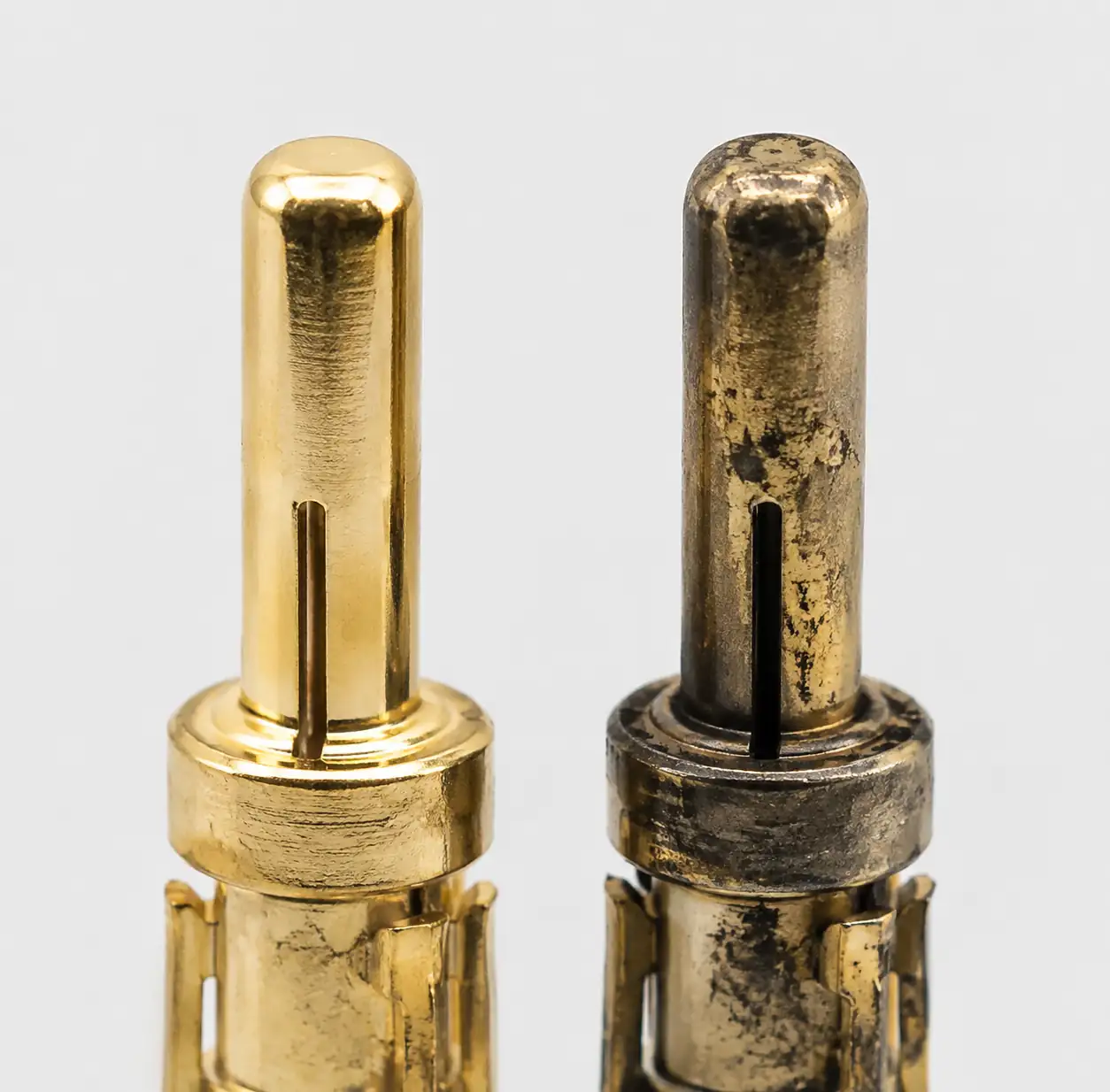 Comparison of new and used industrial connector contacts showing wear after multiple mating cycles
Tin-plated contacts exhibit different wear patterns. The initial 10-20 mating cycles actually improve contact resistance as mating action disrupts surface oxide films. After 50-100 cycles, depending on contact design and normal force, tin begins galling (adhesive wear) and resistance climbs. Proper contact geometry with controlled wipe distance (0.5 to 1.0mm) minimizes galling and extends cycle life.
Industrial connectors specify mating cycle ratings under controlled test conditions: proper alignment, specified insertion force, and clean environments. Field installations with misalignment, contamination, or improper insertion technique (partial insertion, rocking motion) reduce actual cycle life to 30-50% of rated values.
Application-Specific Cycle Requirements
Installation type determines required mating cycle ratings. Fixed installations like machine vision systems or PLC connections that disconnect only for maintenance or equipment moves require minimum cycle ratings—25 to 50 cycles suffice for 10+ year service life. Quick-change tooling, hot-swap power supplies, or test equipment interconnects experiencing weekly or daily cycling demand 500 to 1,000+ cycle ratings.
For connectors exceeding rated cycles, implement condition-based monitoring by measuring contact resistance periodically. Resistance increases exceeding 50% of initial values indicate approaching end-of-life and allow planned replacement before field failure.
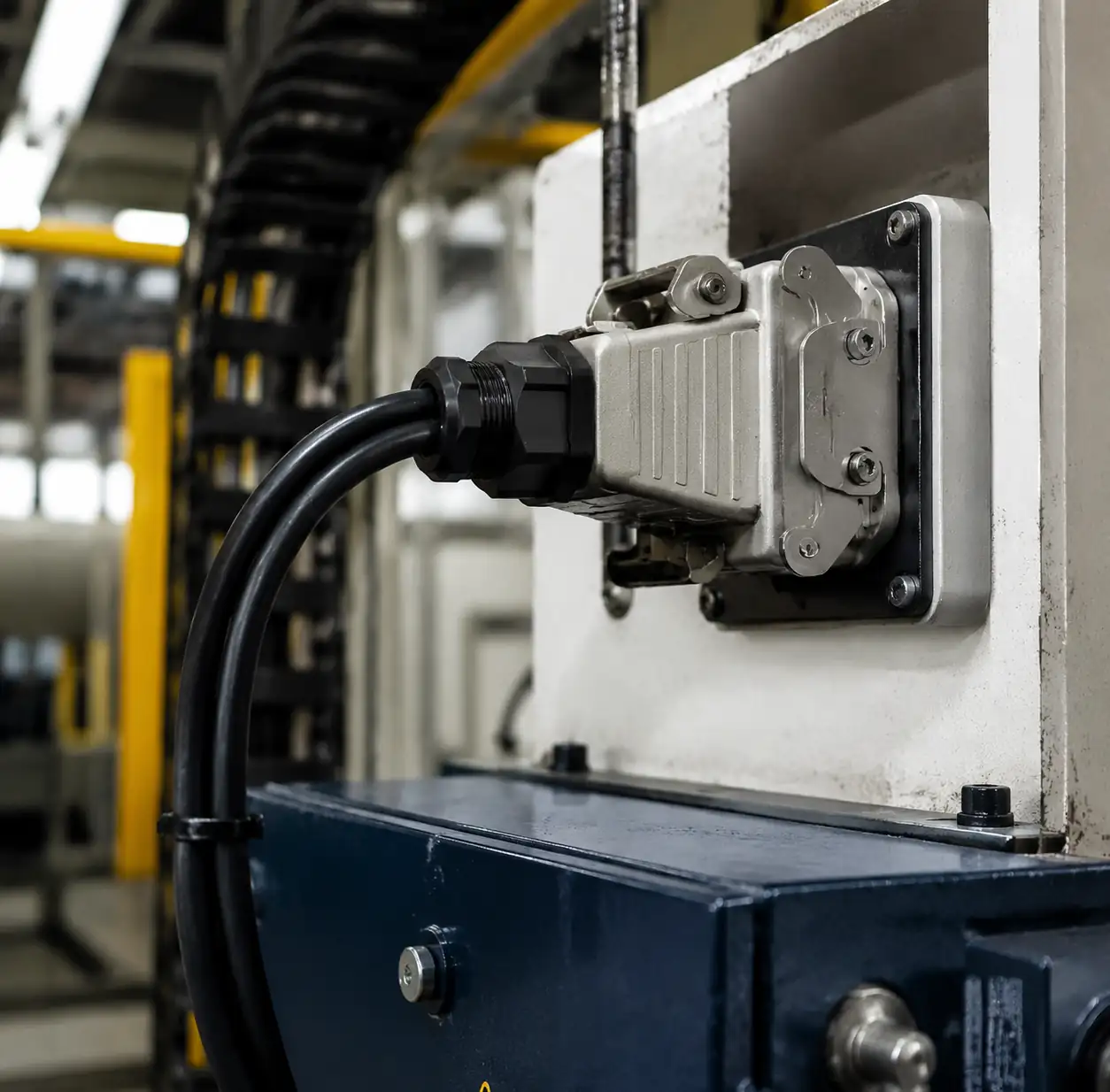 Industrial connector field installation showing proper cable management and strain relief
7. FAQ
What is the difference between IP67 and IP69K ratings for industrial connectors?
IP67 protects against temporary immersion up to 1 meter depth for 30 minutes, while IP69K protects against high-pressure (80-100 bar), high-temperature (80°C) water jets from close range. IP67 suits most factory automation and outdoor applications, while IP69K is required for food processing, pharmaceutical manufacturing, and commercial vehicle wash systems where aggressive cleaning protocols are mandatory. IP69K testing is significantly more stringent, and connectors meeting this standard cost 40-80% more than IP67 equivalents. For applications without high-pressure washdown requirements, IP67 provides adequate protection at lower cost.
How do I select between threaded and bayonet coupling mechanisms?
Threaded couplings (used in M12, M23 connectors) provide superior vibration resistance and require tools or significant torque to disconnect, preventing accidental uncoupling. They suit fixed installations with vibration exposure but require 3-5 full rotations to mate/unmate. Bayonet couplings connect with a quarter-turn and disconnect easily, ideal for frequent-access applications like test equipment or hot-swap modules. They cost 20-30% more than threaded types due to precision machining requirements. For applications with continuous vibration exceeding 10G, specify threaded coupling with proper torque application during installation.
Can I use commercial-grade M12 connectors in outdoor industrial applications?
Commercial-grade M12 connectors typically use nylon 66 housings and NBR seals rated for -25°C to +85°C, inadequate for outdoor installations experiencing temperature extremes. Industrial-grade variants specify LCP or metal housings with EPDM seals rated -40°C to +125°C, providing the necessary temperature range and UV resistance. Additionally, commercial grades often lack proper IP rating certification, relying on design similarity rather than tested performance. For outdoor installations, verify industrial-grade specification, IP67 minimum rating with test certification, and temperature rating covering your local climate extremes plus margin. The cost premium for industrial-grade is 30-50% but prevents premature failures.
What causes increasing contact resistance over time in sealed connectors?
Contact resistance degradation in sealed connectors results from fretting corrosion, seal permeation, and galvanic corrosion. Fretting corrosion occurs when vibration causes microscopic movement between contact surfaces, wearing away protective plating and creating insulating oxide debris. Even IP67 seals allow slow moisture vapor transmission (5-20 g/m²/day for elastomers), and over months to years this moisture reacts with contact surfaces, particularly at elevated temperatures. Galvanic corrosion develops when dissimilar metals (brass housing, copper contacts, aluminum equipment) create electrochemical cells in the presence of moisture. Minimize resistance increase through proper contact plating selection (gold for critical signals), vibration isolation, and periodic contact resistance monitoring.
8. Conclusion
Selecting connectors for harsh industrial environments requires balancing IP rating protection, temperature range, vibration resistance, and contact plating against application requirements and cost constraints. For most factory automation and outdoor installations, M12 connectors with IP67 rating, -40°C to +125°C temperature range, and threaded coupling provide optimal performance. High-current or extreme-environment applications justify heavy-duty circular connectors with IP68 or IP69K protection and metal housings.
Critical selection factors include verifying IP rating applies to mated configuration in your installation orientation, confirming temperature rating covers worst-case ambient plus self-heating at rated current, specifying contact plating appropriate for signal level and mating cycle requirements, and selecting locking mechanism (threaded vs. bayonet) based on vibration exposure and maintenance access needs. For applications exceeding 100 mating cycles, implement contact resistance monitoring to enable predictive maintenance before field failures occur.