



How to Source Low-Volume Electronic Components for R&D Prototyping (2024 Guide)
You have just finalized your PCB layout. You are ready to build the first 10 prototypes. But when you upload your Bill of Materials (BOM) to a major distributor, reality hits: your critical microcontroller has a 52-week lead time, and the power management IC requires a Minimum Order Quantity (MOQ) of 3,000 pieces. For R&D engineers and hardware startup founders, sourcing low-volume electronic components for New Product Introduction (NPI) is often a frustrating race against time, budget, and supply chain bottlenecks.
In this guide, we will break down exactly how to bypass crippling MOQs, avoid the dangerous trap of counterfeit parts in the grey market, and build a flexible BOM that guarantees your prototype moves to production without a hitch.
Table of Contents
- Understanding Low-Volume Sourcing: The Prototyping Reality
- Core Concepts Simplified
- Step-by-Step Guide to Sourcing for R&D
- Expert Tips & Common Pitfalls to Avoid
- Conclusion & Final Thoughts
- FAQ
1. Understanding Low-Volume Sourcing: The Prototyping Reality
In the hardware development lifecycle, the prototyping and NPI phases are uniquely vulnerable. You are not buying enough parts to command attention from Tier-1 manufacturers, yet you need the exact same high-quality, traceable components as a Fortune 500 company.
Why is low-volume sourcing so difficult for R&D teams today?
- The Post-Pandemic Hangover: While the global chip shortage has eased, manufacturers have shifted their focus to high-volume, high-margin automotive and AI sectors. Legacy chips and niche components are increasingly facing End-of-Life (EOL) statuses.
- The MOQ Barrier: Franchised distributors are optimized for mass production. Selling you five pieces of a specific operational amplifier often costs them more in logistics than the profit it generates.
- The Speed Imperative: In R&D, iterating quickly is everything. Waiting months for a single component can kill a startup's time-to-market advantage.
Learning how to navigate this landscape—knowing when to use aggregators, when to lean on Turnkey PCBA services, and how to safely source obsolete components for prototyping—is a critical skill for any modern hardware engineer.
2. Core Concepts Simplified
Before diving into the strategies, let's clarify the industry jargon. Think of the electronic supply chain as a vast grocery network. If you don't know the rules of the market, you will either overpay or go home empty-handed.
- MOQ (Minimum Order Quantity): This is the "wholesale club" rule. A supplier might have millions of resistors in stock, but they refuse to sell you less than a full reel of 5,000. For an R&D team needing only 20, this is a budget-killer.
- Turnkey PCBA (Printed Circuit Board Assembly): Think of this as hiring a personal shopper who is also a master chef. You simply hand over your recipe (BOM) and blueprint (Gerber files). The manufacturer leverages their massive supply chain network to buy the exact small quantities you need, solders them onto the board, and delivers a ready-to-use product.
- Authorized (Franchised) Distributor: This is the "official 4S car dealership." Buying from Digi-Key, Mouser, or Farnell means the parts come directly from the original manufacturer (e.g., Texas Instruments, STMicroelectronics). You get a 100% guarantee of authenticity and full traceability.
Sourcing Channels Comparison Table
| Sourcing Channel | Best For | MOQ Flexibility | Counterfeit Risk | Pricing for Low Volume |
|---|---|---|---|---|
| Authorized Distributors | Standard ICs, absolute reliability | Low to Medium | Zero (Safest) | High |
| Independent Brokers (Grey Market) | Obsolete/Hard-to-find parts | High (Highly negotiable) | High (Requires testing) | Very High |
| Turnkey PCBA Partners | Hassle-free prototyping, pooling orders | Excellent | Low (They manage the risk) | Medium (Cost-effective overall) |
3. Step-by-Step Guide to Sourcing for R&D
Securing parts for a small batch run requires a mix of clever engineering and strategic purchasing. Here is the exact playbook used by seasoned hardware founders.
3.1 Scenario A: Beating the MOQ Trap
When an authorized distributor demands an unreasonable MOQ, do not immediately redesign your board. Instead, use scale to your advantage.
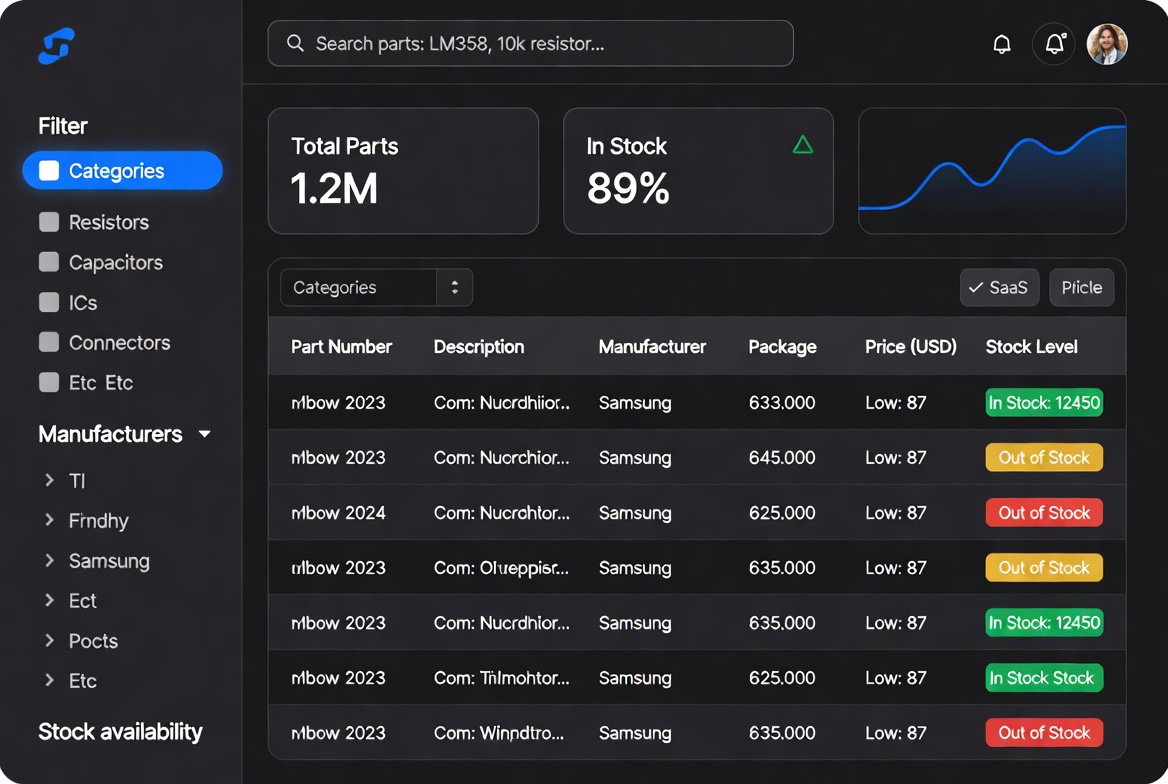
Step 1: Use Component Aggregators Instead of manually searching individual websites, use API-driven aggregators like Octopart or Findchips. These platforms scan inventory across hundreds of distributors globally in real-time. You might find that while Mouser requires an MOQ of 1,000, a smaller authorized distributor in Europe has 50 pieces in stock with no MOQ.
Step 2: Leverage Turnkey PCBA Pooling If you only need 10 boards, partner with a Turnkey PCBA manufacturer. Because these factories assemble thousands of different boards daily, they buy common passive components (resistors, capacitors) and popular MCUs in massive bulk. They can allocate just the 10 pieces you need from their internal stock, completely bypassing the distributor's MOQ.
3.2 Scenario B: Designing for Availability (BOM Flexibility)
The biggest mistake junior engineers make is locking their design to a "unicorn" chip early in the R&D phase. If you are baking a cake and cannot find a rare imported vanilla bean, you need to know which local vanilla extract is a perfect substitute.
Cross-Referencing and Drop-in Replacements: Always design with alternative parts in mind. A "drop-in replacement" is a chip from a different manufacturer that has the exact same pinout, footprint, and electrical characteristics.
Pro Tip: When selecting a component, check its lifecycle status. Never design a new prototype around a part marked "NRND" (Not Recommended for New Designs).
Example: BOM Alternative Specification Data
| Component Type | Primary Selection (Out of Stock) | Viable Alternative (Drop-in) | Key Spec Difference to Check |
|---|---|---|---|
| Voltage Regulator | TI LM317 (TO-220) | ON Semi LM317TG | Thermal resistance variations |
| Microcontroller | STM32F103C8T6 | GD32F103C8T6 | Clock speed max, flash memory timing |
| Op-Amp | TL072 | RC4558 | Slew rate, input bias current |
3.3 Scenario C: Counterfeit Mitigation in the Grey Market
Sometimes, you have no choice. You need to know how to source obsolete components for prototyping, and the only people holding stock are independent brokers on the grey market. This is where the risk of counterfeit parts skyrockets.
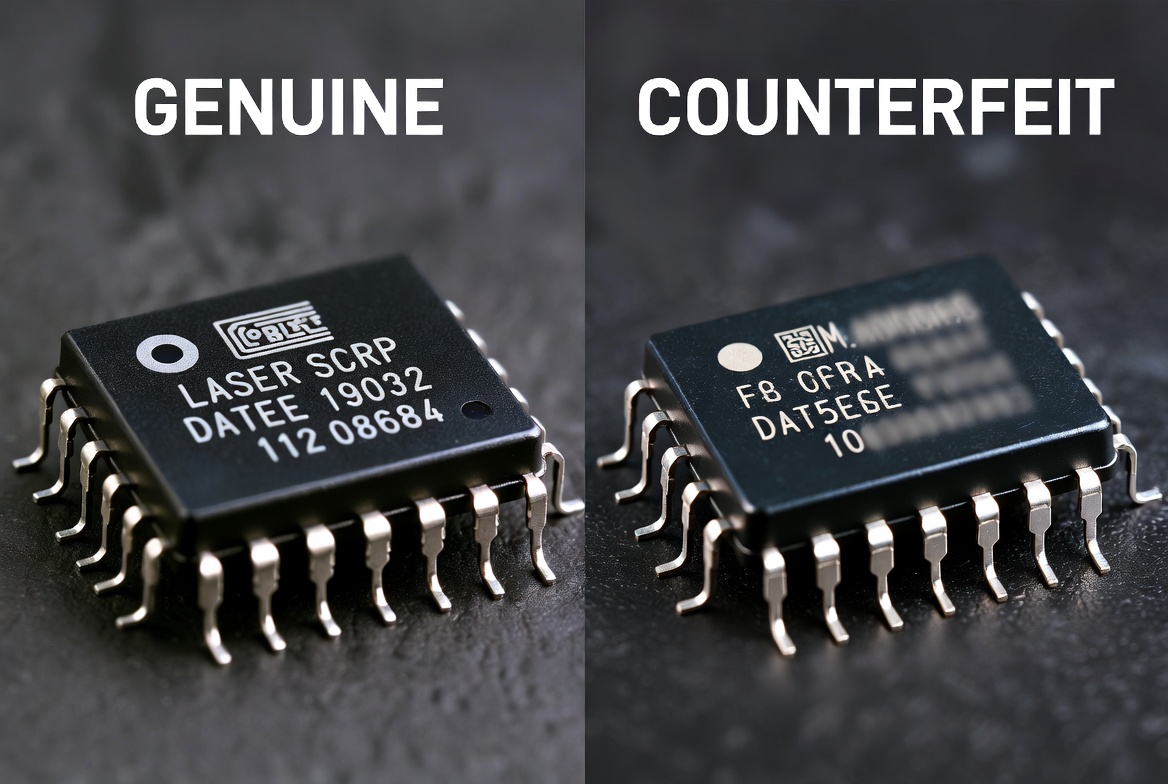
Counterfeiters will often take old, e-waste boards, desolder the chips, sand off the original markings, and laser-etch new logos to sell them as brand-new, high-grade components.
How to Protect Your R&D Build:
- Demand Traceability: Ask the broker for a Certificate of Conformance (CoC) or paperwork tracing the parts back to the original manufacturer.
- Visual Inspection: Look for "blacktopping" (a thin layer of black resin used to cover old markings). Wipe the chip with acetone; if the ink smears or the surface dissolves, it is fake.
- Check the Pins: Are the pins perfectly straight and shiny, or do they show signs of oxidation, scratches, or residual solder?
- Third-Party Testing: For expensive or critical ICs, mandate that the broker performs X-ray inspection (to check the wire bonds inside) or decapsulation (chemically dissolving the top to inspect the silicon die) before shipping.
4. Expert Tips & Common Pitfalls to Avoid
If you spend time on engineering communities like Reddit's r/PrintedCircuitBoard or the EEVblog forums, you will quickly notice recurring horror stories regarding low-volume sourcing. Here is the unfiltered advice from veteran hardware developers:
- Pitfall 1: Trusting Random Alibaba Suppliers for Critical ICs. The Reality: While platforms like Alibaba or AliExpress are fine for buying cheap LEDs, generic resistors, or mechanical switches for a proof-of-concept, never buy your core microprocessors or high-precision sensors there. The counterfeit rate is astronomically high. Stick to authorized channels for the "brains" of your board.
- Pitfall 2: Ignoring Date Codes. The Reality: Components age. Plastic absorbs moisture. If you buy a batch of chips with a date code from 8 years ago, they might fail during the reflow soldering process (the "popcorn effect"). Always ask for parts with a date code of less than 2 years, or ensure they are shipped in sealed, moisture-barrier bags with desiccant.
- Expert Tip: API Integration in EDA Tools. Stop designing in a vacuum. Modern Electronic Design Automation (EDA) tools like Altium Designer or KiCad have plugins that connect directly to distributor APIs. This allows you to see real-time pricing, stock levels, and lifecycle data while you are drawing the schematic. If a part goes out of stock, you know immediately, not three weeks later when you generate the BOM.
5. Conclusion & Final Thoughts
Sourcing electronic components for low-volume prototyping doesn't have to be a nightmare of high MOQs and shady grey-market dealers. By understanding the mechanics of the supply chain, utilizing smart aggregator tools, and designing your BOM with flexibility in mind, R&D teams can drastically reduce NPI lead times.
Remember, the goal of a prototype is to validate the design, not to fight supply chain battles. When in doubt, leveraging professional contact our team or utilizing Turnkey PCBA services can offload the procurement stress, allowing your engineers to focus on what they do best: innovating.
Here is a concise 6-question FAQ for this blog post. Copy and paste it directly into your blog:
6. FAQ
Q1: What is MOQ and why does it kill R&D budgets? MOQ (Minimum Order Quantity) is the minimum amount a supplier will sell you—often a full reel of 5,000 resistors when you only need 20. For prototyping, this forces you to overpay for inventory you will never use.
Q2: How do I beat MOQs without redesigning my board? Use component aggregators like Octopart or Findchips to find smaller distributors with no MOQ. Better yet, partner with a Turnkey PCBA manufacturer—they pool massive bulk orders and can allocate exactly the 10 pieces you need from their internal stock.
Q3: What is a drop-in replacement and why do I need one? A drop-in replacement is an alternative chip from a different manufacturer with identical pinout, footprint, and electrical specs. Always design with alternates in mind so you can pivot instantly when your primary part goes out of stock or faces a 52-week lead time.
Q4: Is it safe to buy critical ICs from Alibaba or AliExpress? Never for core components. These platforms are fine for generic LEDs or mechanical switches, but the counterfeit rate for microprocessors and precision sensors is astronomically high. Always use authorized distributors for the "brains" of your board.
Q5: How do I spot counterfeit chips from grey market brokers? Check for blacktopping (wipe with acetone—smearing means fake), inspect pins for oxidation or solder residue, demand a Certificate of Conformance, and mandate third-party X-ray or decapsulation testing for expensive ICs before shipping.
Q6: What is the single best way to speed up my NPI sourcing? Design with BOM flexibility from day one: use standard footprints, identify drop-in replacements early, avoid NRND parts, and leverage Turnkey PCBA services to offload procurement entirely. Speed comes from planning, not scrambling.
Quick Summary
| Strategy Focus | Key Action Items | Expected Benefit |
|---|---|---|
| Bypassing MOQs | Use Octopart/Findchips; Partner with Turnkey PCBA factories. | Procure exact quantities needed; save R&D budget. |
| BOM Flexibility | Identify drop-in replacements early; avoid NRND parts. | Immunity to sudden stock-outs and lead time spikes. |
| Counterfeit Defense | Buy authorized; demand X-ray/decapsulation for grey market obsolete parts. | Prevent prototype failures and debugging nightmares. |