



Mini DisplayPort: Complete Technical Selection Guide for Display Interface Design (2026)
Mini DisplayPort (mDP) remains a critical display interface standard for high-performance computing, professional AV equipment, and embedded display systems. This guide provides engineers and technical buyers with the data needed to evaluate Mini DisplayPort against alternative display interfaces and specify the right connector solution for your product design.
Table of Contents
- Introduction
- Key Technical Parameters Explained
- How to Select the Right Solution
- Performance Comparison by Specification
- Design Considerations and Common Mistakes
- Supply Chain and Sourcing Factors
- FAQ
- Conclusion
1. Introduction
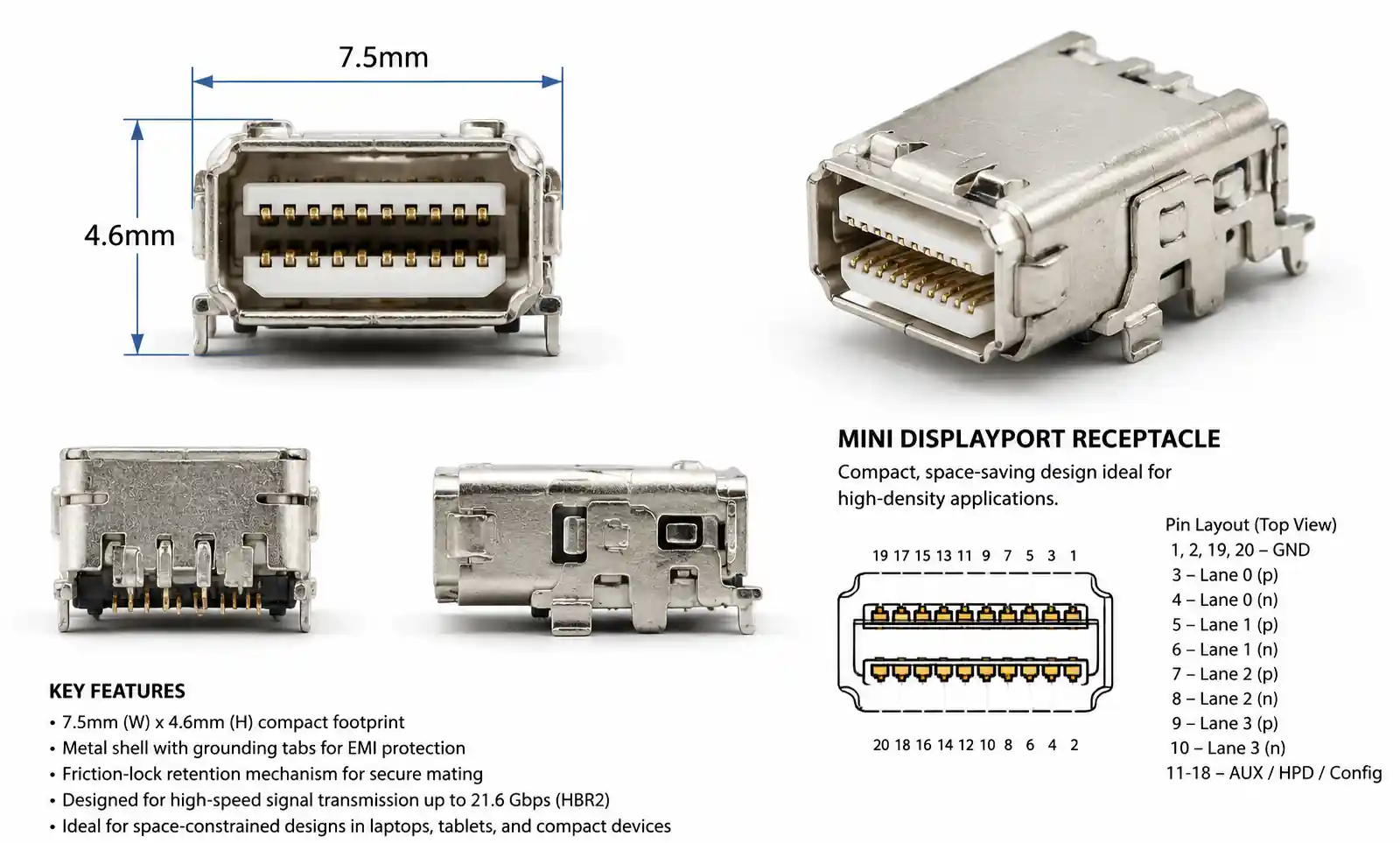
Mini DisplayPort offers distinct advantages in bandwidth efficiency, signal integrity, and implementation cost for specific applications. We'll examine technical specifications that matter most—bandwidth capabilities, mechanical durability, EMI performance, and thermal characteristics—alongside performance comparison tables and common design mistakes to avoid.
2. Key Technical Parameters Explained
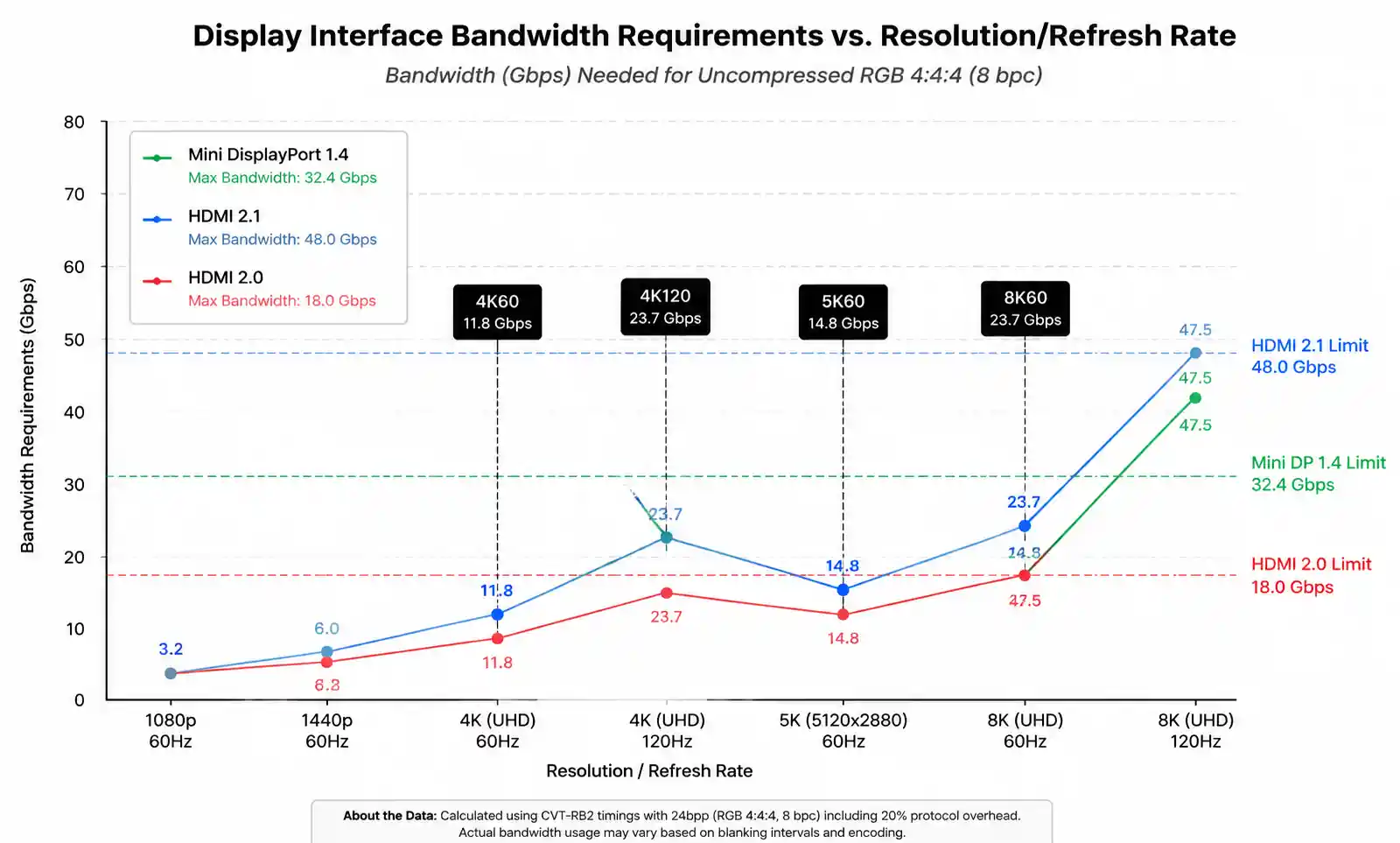
Bandwidth and Data Rate Capacity — Mini DisplayPort supports up to four high-speed lanes with data rates reaching 8.1 Gbps per lane in DP 1.4 implementations. Total bandwidth of 32.4 Gbps enables uncompressed 4K at 120Hz with 8-bit color, or 5K at 60Hz. For 8K output, DisplayPort Stream Compression (DSC) achieves visually lossless compression at 3:1 ratios.
Signal Integrity and Cable Length — Passive cables maintain signal integrity up to 2 meters for 4K60. For 3-5 meter runs, active cables with integrated signal repeaters prevent bit error rate increases. Higher bandwidth modes reduce effective cable distance.
Mechanical Durability — Mini DisplayPort connectors are rated for 10,000 mating cycles minimum, with premium connectors achieving 15,000+ cycles. Friction-lock provides 15-20N insertion force and 30-50N extraction force. Unlike standard DisplayPort's latch, friction fit suits portable equipment where accidental disconnection must be prevented.
Power Delivery — Mini DisplayPort can supply up to 500mA at 3.3V through the auxiliary channel. If your application requires simultaneous video and high-power delivery, USB-C with DisplayPort Alt Mode may be necessary.
EMI and Regulatory Compliance — Connectors with proper shielding achieve FCC Class B and meet IEC 61000-4-2 ESD requirements (±8kV contact, ±15kV air). Signal pairs require 100-ohm differential impedance control across the entire path. Common pitfall: inadequate ground plane continuity causes radiated emissions failures.
3. How to Select the Right Solution
Resolution and Performance — DP 1.4 handles 8K at 60Hz with DSC, or 4K at 240Hz without compression. If your product requires HDR10+ with 10-bit or 12-bit color, verify combined bandwidth doesn't exceed 32.4 Gbps. 4K60 with 10-bit and 4:4:4 requires ~22.3 Gbps.
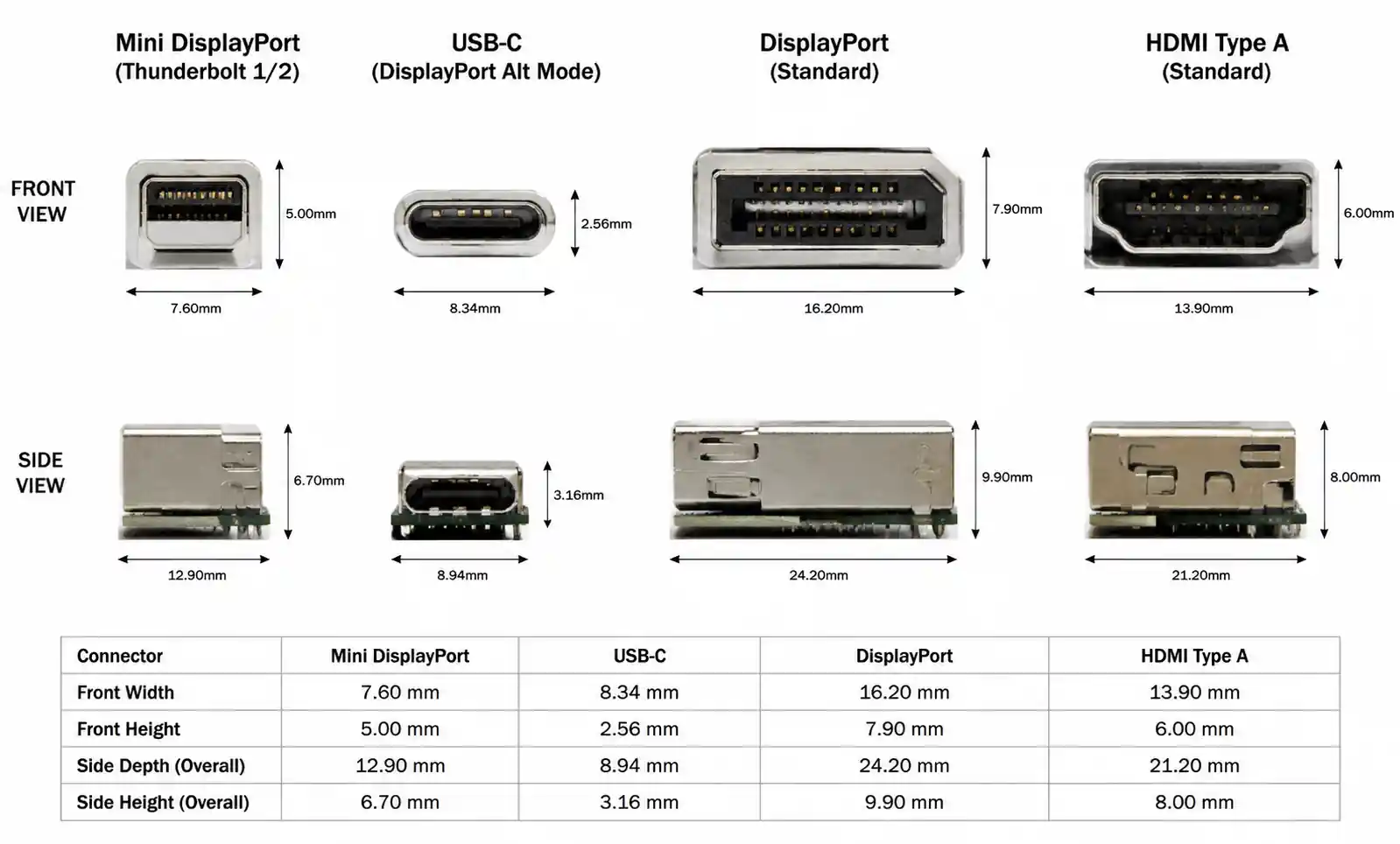
Physical Constraints — Mini DisplayPort's 7.5mm × 4.6mm footprint is ideal for slim form factors where standard DP's 19mm width is prohibitive. USB-C offers even smaller height (2.6mm vs 4.6mm). Trade-off: USB-C Alt Mode reduces USB 3.x bandwidth when transmitting video simultaneously.
Cable Length — Passive cables work up to 2 meters for 4K60. For 3-5 meter runs, budget for active cables ($15-30 each). For fixed installations exceeding 5 meters, consider fiber optic DP extenders. Industrial applications should specify cables rated -40°C to +85°C.
Ecosystem Availability — Mini DisplayPort to HDMI adapters are commodity items ($8-15), but requiring end users to carry adapters reduces UX quality. Evaluate whether your target market uses Mini DP or has transitioned to USB-C.
Cost — Mini DisplayPort connectors cost $1.20-2.80 in 10K volumes, 40-60% more than HDMI Type A. Lead times normalized to 12-16 weeks. Maintain relationships with at least two qualified suppliers.
4. Performance Comparison by Specification
Table 1: Bandwidth and Resolution Comparison
| Interface | Max Bandwidth | 4K@60Hz 10-bit | 4K@120Hz 8-bit | 5K@60Hz | 8K@60Hz | Passive Cable Length |
|---|---|---|---|---|---|---|
| Mini DP 1.4 | 32.4 Gbps | Yes | Yes | Yes | Yes (w/ DSC) | 2m |
| Standard DP 1.4 | 32.4 Gbps | Yes | Yes | Yes | Yes (w/ DSC) | 2m |
| USB-C (DP Alt Mode) | 32.4 Gbps | Yes | Yes | Yes | Yes (w/ DSC) | 1-2m |
| HDMI 2.1 | 48 Gbps | Yes | Yes | Yes | Yes | 3m |
| HDMI 2.0 | 18 Gbps | Yes | No | No | No | 5m |
Mini DP 1.4 matches standard DP but falls behind HDMI 2.1's 48 Gbps. For 4K@144Hz or 8K@60Hz without compression, HDMI 2.1 offers more headroom. However, Mini DP's signal integrity allows reliable full-bandwidth operation over rated distance.
Table 2: Physical and Mechanical Specifications
| Parameter | Mini DP | Standard DP | USB-C | HDMI Type A |
|---|---|---|---|---|
| Connector Width | 7.5mm | 19.0mm | 8.4mm | 13.9mm |
| Connector Height | 4.6mm | 5.8mm | 2.6mm | 4.5mm |
| PCB Footprint | 9×7mm | 21×8mm | 9×7mm | 15×7mm |
| Mating Cycles | 10,000 min | 10,000 min | 10,000 min | 10,000 min |
| Retention Force | 30-50N | 40-60N | 5-20N | 30-50N |
| Locking Mechanism | Friction fit | Latch | Friction fit | Friction fit |
Mini DP's 60% width reduction vs standard DP is critical for thin designs. USB-C offers even lower height (2.6mm vs 4.6mm). Lack of latch is advantageous in portable applications—no latch to break, lower PCB stress.
5. Design Considerations and Common Mistakes
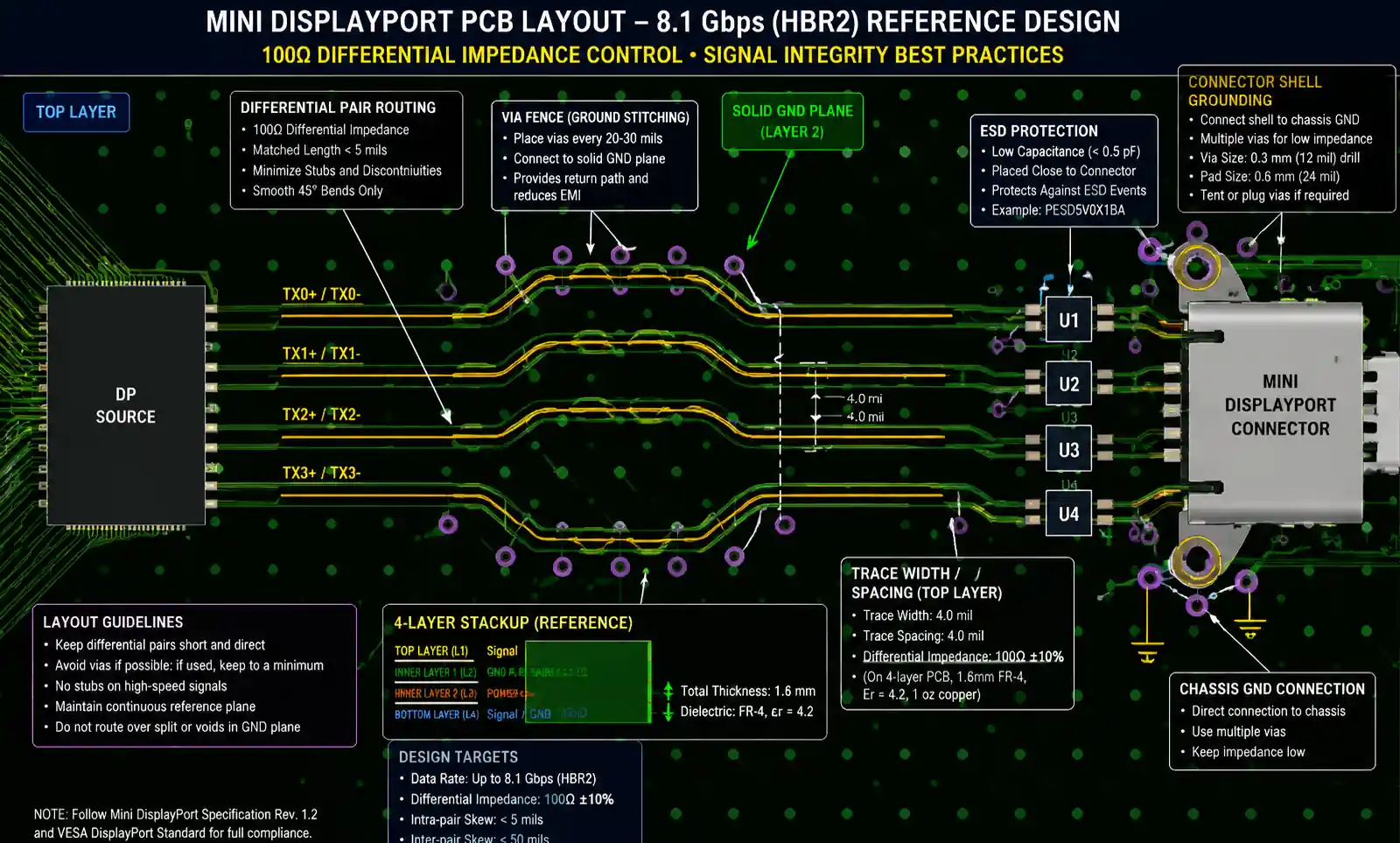
PCB Layout and Impedance Control — Maintain 100-ohm differential impedance across the entire signal path. Route pairs on same layer with symmetric geometry, 0.2mm minimum pair-to-pair spacing, and avoid via fields creating stub resonances. Impedance tolerance must be ±10% across full frequency range to 4th harmonic.
Connector Shell Grounding — Inadequate shell grounding causes 80% of EMI failures. Provide direct, low-inductance connection to ground plane through multiple vias (minimum 4× 0.3mm vias around connector perimeter). Create grounded copper keep-out around connector footprint.
ESD Protection — High-speed lanes require TVS diodes with capacitance under 0.5pF per lane to avoid signal degradation. Standard ESD diodes with 2-3pF cause intersymbol interference at 8.1 Gbps. Specify ultra-low capacitance TVS arrays (0.3-0.4pF) within 5mm of connector pins.
Hot-Plug Detection — HPD signaling requires proper pull-up and current limiting. Source must provide 1.0-3.3V signal with 470-ohm series resistance and 100-150kΩ pull-down on display side. Incorrect HPD causes intermittent detection failures.
Cable Validation — Test selected cable at maximum data rate using DP compliance patterns. Reject batches with BER above 10^-12 or >3dB insertion loss variation between lanes. For extended runs, implement cable presence detection and fallback to lower data rates.
6. Supply Chain and Sourcing Factors
Connector Suppliers — Five tier-one manufacturers dominate: Amphenol (FCI), Molex, JAE Electronics, TE Connectivity, Samtec. Amphenol's 10132771 series is widely qualified; Molex 47571 offers lower cost ($1.30 in 10K) but longer lead times (16-18 weeks).
Lead Times and MOQ — Standard Mini DP receptacles: 12-16 weeks lead time, MOQs 1,000-3,000 pieces. Prototype quantities (10-100): 3-4× production price, 8-10 week lead times. Place long-lead orders before completing PCB layout.
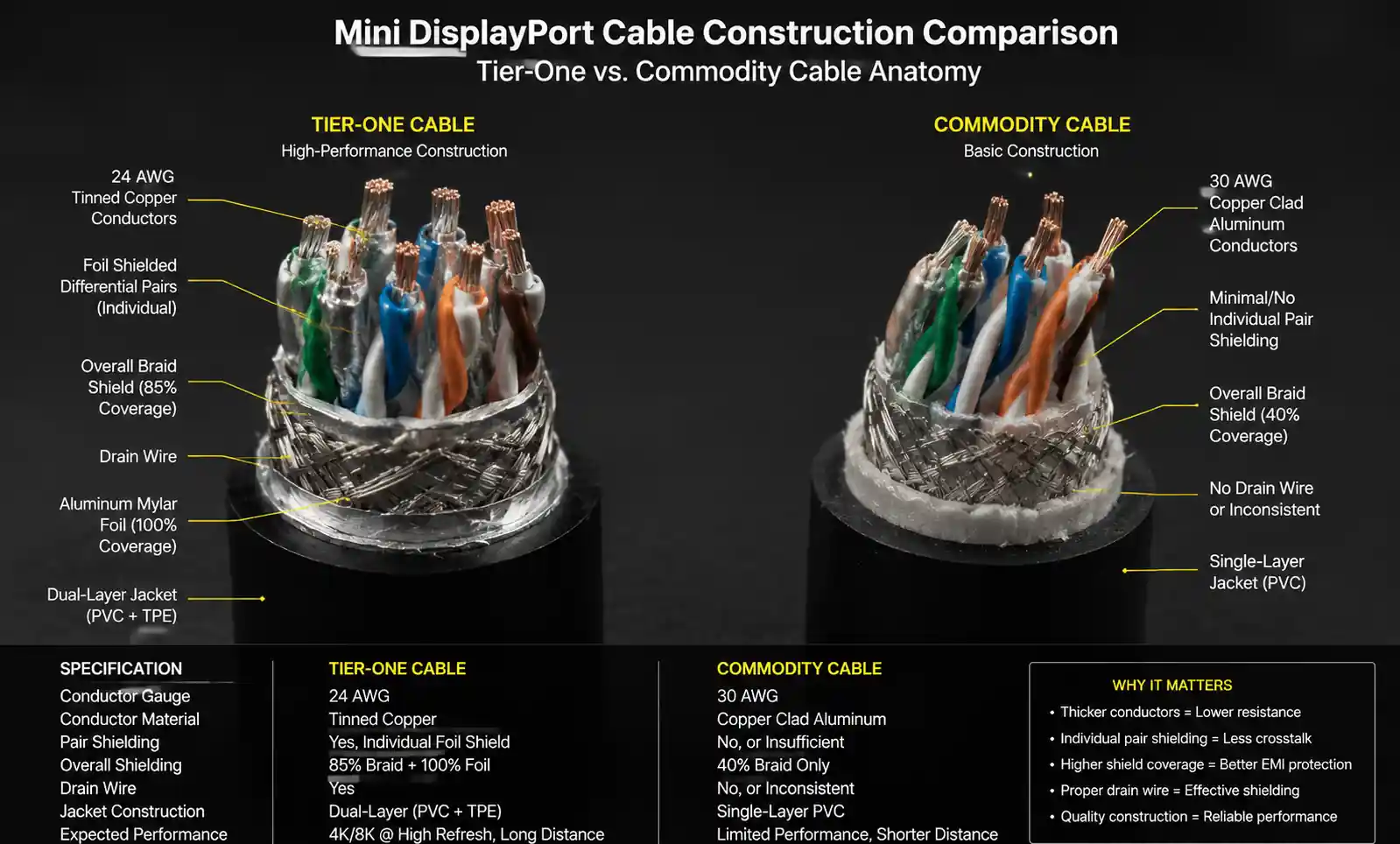
Cable Quality Tiers — Tier-one manufacturers (Bizlink, Luxshare, Volex): $8-15/meter with consistent quality. Commodity cables: $3-6 but high defect rates (2-5% field failures). Specify VESA DisplayPort certified cables for professional applications.
Regulatory Certifications — Budget $15,000-25,000 for FCC Part 15 Class B and CE EMC testing. Common failures: insufficient shell grounding (500-800 MHz emissions), inadequate bulk decoupling (conducted emissions). Plan for two test iterations.
Obsolescence Risk — Industry trend toward USB-C creates long-term risk. Implement dual-footprint PCB designs accepting Mini DP or USB-C connectors with minimal rework. Maintain approved vendor lists with at least two qualified suppliers.
7. FAQ
Can Mini DP cables be used with standard DP connectors via passive adapter?
Yes—identical electrical signaling and pinouts. Passive adapters work up to cable's rated bandwidth. For 4K@120Hz+, use native connectors to maintain signal integrity.
Maximum daisy-chained displays?
DP Multi-Stream Transport supports up to four displays, limited by total bandwidth. Four 1080p@60Hz or two 4K@60Hz with reduced color depth. Verify displays support MST pass-through.
Troubleshooting intermittent connections?
Check: connector retention force (30-50N extraction), HPD signal integrity (clean 3.3V rise), and signal quality (try 5.4 Gbps vs 8.1 Gbps to identify bandwidth margin issues). Replace with certified cables.
Temperature limitations for industrial use?
Standard connectors: 0-70°C operation. High-temp variants rated 105°C (Amphenol, TE). PVC cables degrade above 60°C—specify fluoropolymer jackets (FEP/PTFE) for high-temperature environments.
Audio transmission support?
Yes—up to 8 channels uncompressed at 192 kHz. Receiving device must support DP audio extraction. Audio capability is mandatory in DP specification.
Practical difference between DP 1.2, 1.3, and 1.4?
Primary difference: 1.2 = 5.4 Gbps/lane (21.6 Gbps total); 1.3/1.4 = 8.1 Gbps/lane (32.4 Gbps total). 1.4 adds DSC for 8K support and HDR metadata. If not exceeding 4K@60Hz, DP 1.2 is adequate and 15-20% less costly.
Mini DP vs Thunderbolt for displays?
Thunderbolt 2 uses mDP connector but includes PCIe channels. Thunderbolt 3/4 use USB-C. For display-only, Mini DP is simpler and less expensive. Thunderbolt licensing adds ~$0.50-1.00 per unit.
8. Conclusion
For applications requiring reliable 4K+ display connectivity with proven signal integrity and a compact footprint, Mini DisplayPort remains a strong technical choice despite the industry's momentum toward USB-C consolidation. If your product serves professional, medical, or industrial markets where established standards, regulatory approvals, and mature ecosystem support matter, Mini DP's lower integration risk often outweighs the convenience of connector consolidation. Before finalizing your design, confirm that your maximum resolution and refresh rate fall within DP 1.4's 32.4 Gbps bandwidth with adequate margin, verify that your preferred connector supplier maintains active production with acceptable lead times, and ensure that your target cable length stays within passive limits or that you have budgeted for active cables where needed.