



50 Hz vs 60 Hz: Complete Guide to Power Frequency Differences (2026)
When you plug in an appliance or flip a light switch, you're tapping into an electrical grid that operates at a specific frequency—either 50 Hz or 60 Hz. While these numbers might seem like minor technical details, they have significant impacts on everything from motor speed to international travel with electronics. This comprehensive guide explores the differences between these two power frequencies, their global distribution, and what they mean for your devices and appliances.
Table of Contents
- What Are 50 Hz and 60 Hz? Understanding Power Frequency Basics
- Global Distribution: Which Countries Use Which Frequency?
- Key Technical Differences Between 50 Hz and 60 Hz
- How Frequency Affects Motor Performance and Speed
- Efficiency Considerations: Which Frequency Is Better?
- Appliance Compatibility: What Works Where?
- Converting Between 50 Hz and 60 Hz: Solutions and Converters
- Historical Context: Why Two Different Standards?
- Practical Implications for Travelers and Expats
- Future Trends: Will Power Frequencies Ever Unify?
1. What Are 50 Hz and 60 Hz? Understanding Power Frequency Basics
Power frequency refers to how many times per second alternating current (AC) changes direction in an electrical system. The "Hz" stands for Hertz, a unit measuring cycles per second.
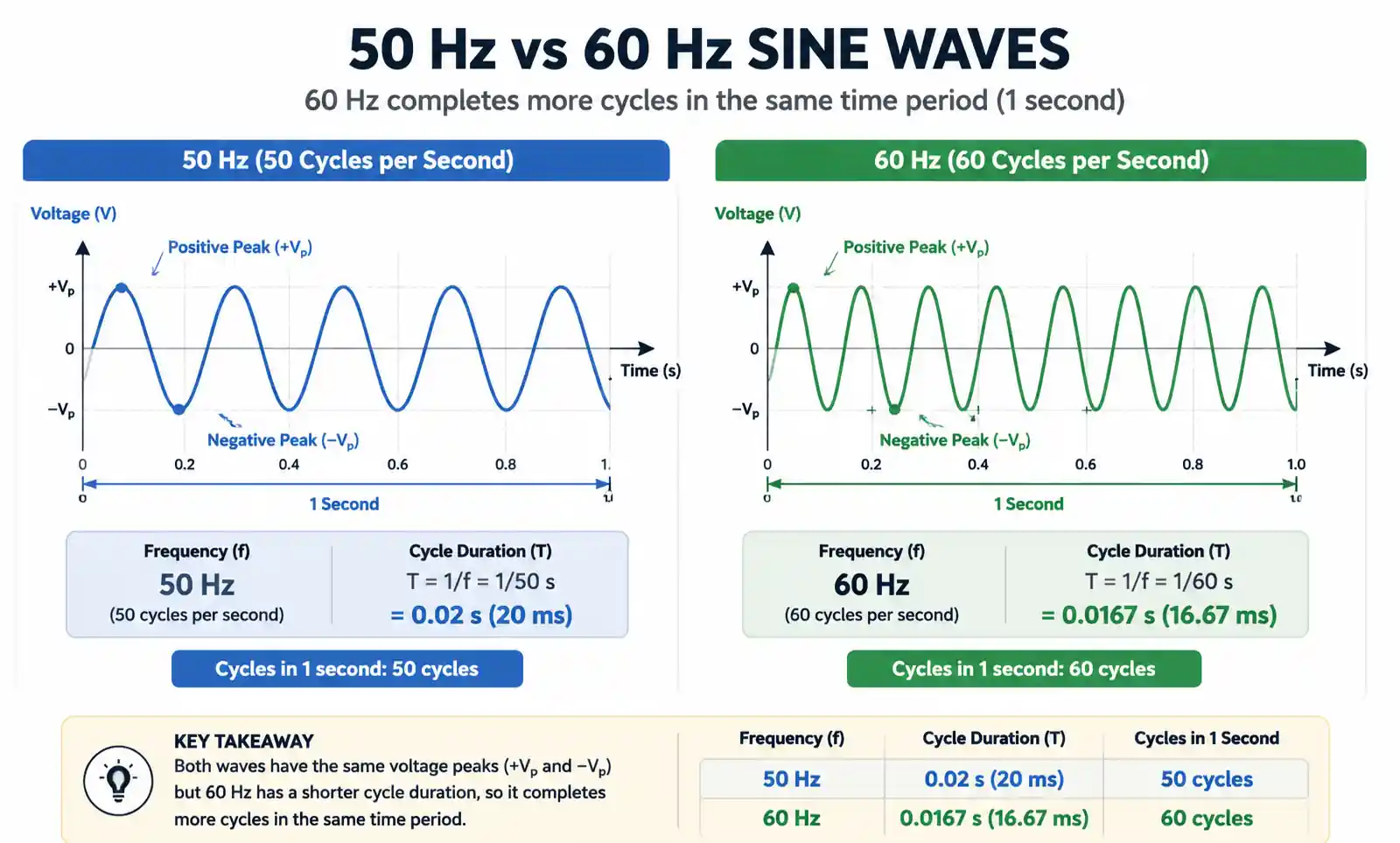
In a 50 Hz system, electricity completes 50 complete cycles every second—the current flows in one direction, reverses, and returns to its starting point 50 times. In a 60 Hz system, this happens 60 times per second, representing a 20% faster oscillation rate.
This difference might seem small, but it affects everything from power generation to how your devices operate. The frequency is determined at the power plant level, where generators rotate at specific speeds to produce these exact frequencies. For 50 Hz, generators typically spin at 3,000 RPM (revolutions per minute) for two-pole designs, while 60 Hz generators rotate at 3,600 RPM.
Why Frequency Matters
The frequency of your power supply impacts:
- Motor speeds in appliances like washing machines, fans, and refrigerators
- Transformer efficiency in power distribution networks
- Timing circuits in older analog clocks and timers
- Power transmission losses over long distances
- Flicker effects in lighting systems
2. Global Distribution: Which Countries Use Which Frequency?
The world is divided between these two frequency standards, largely based on historical choices made over a century ago.
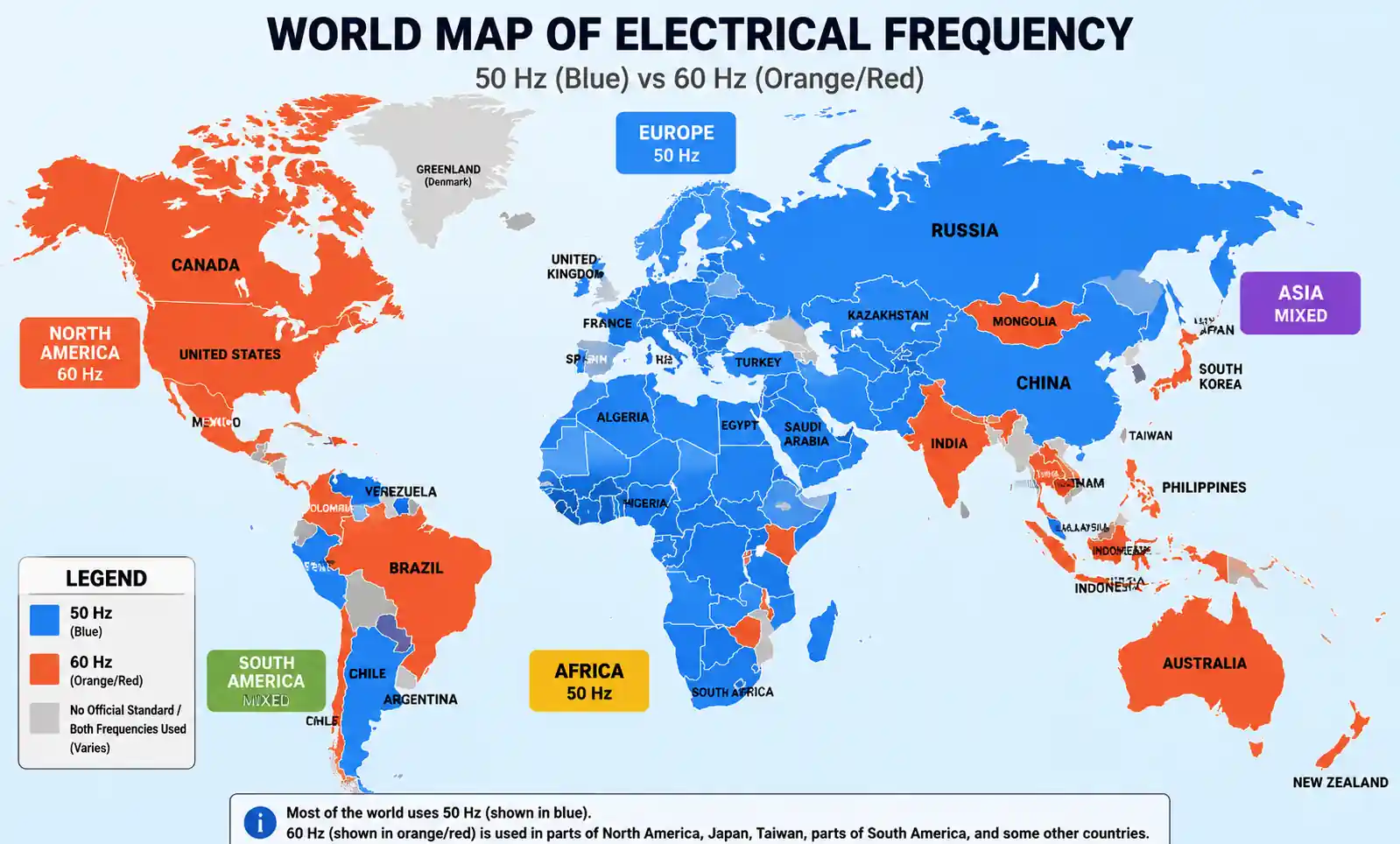
60 Hz Regions
- North America: United States, Canada, Mexico
- Parts of Central and South America: Brazil (partial), Colombia, Ecuador, Venezuela
- Caribbean nations: Most island nations
- Parts of Asia: Taiwan, South Korea, Philippines, parts of Japan (eastern regions)
- Saudi Arabia and a few Middle Eastern countries
50 Hz Regions
- Europe: Entire European Union and surrounding countries
- Most of Asia: China, India, Indonesia, Thailand, Vietnam, Singapore, western Japan
- Africa: Entire continent
- Australia and New Zealand
- Russia and former Soviet states
- Middle East: Most countries except Saudi Arabia
- South America: Argentina, Chile, Uruguay, Peru, and parts of Brazil
Voltage Differences
An important pattern: 50 Hz regions typically use 220-240V systems, while 60 Hz regions commonly use 100-127V systems. This voltage difference is just as important as frequency when considering appliance compatibility.
3. Key Technical Differences Between 50 Hz and 60 Hz
Beyond the basic cycle count, several technical factors differentiate these two standards.
Cycle Rate and Waveform
The 20% difference in cycle rate means that in one second:
- 50 Hz: 50 complete sine waves
- 60 Hz: 60 complete sine waves
This affects the rate at which electromagnetic fields build and collapse in transformers, motors, and other inductive components.
Reactance and Impedance
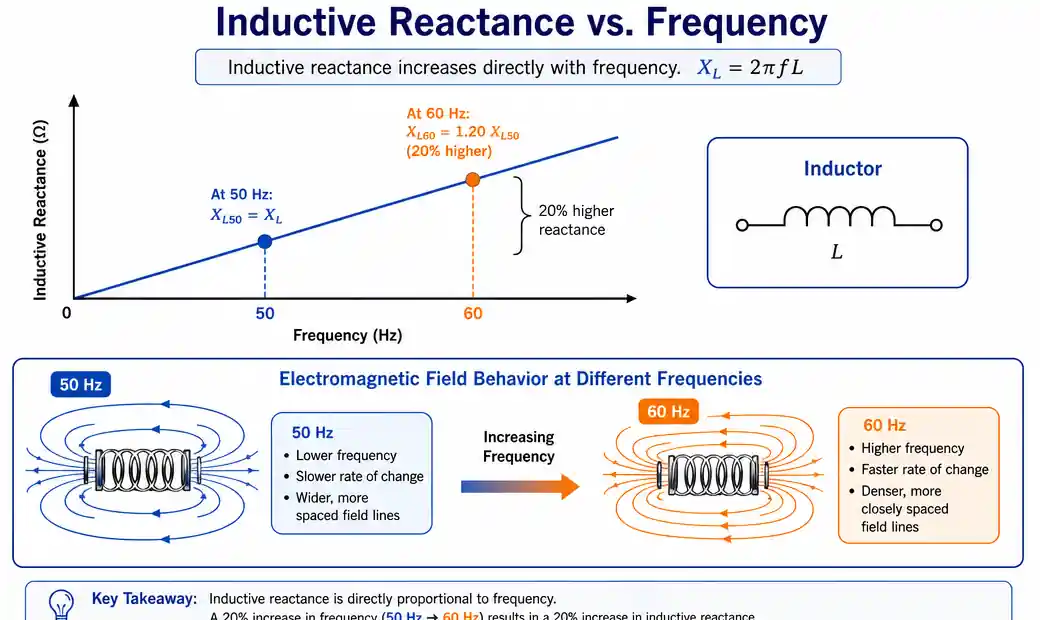
Electrical reactance (opposition to current flow in AC circuits) is frequency-dependent. The formula for inductive reactance is:
XL = 2πfL
Where:
- XL = inductive reactance
- f = frequency (50 or 60 Hz)
- L = inductance
This means that at 60 Hz, inductive reactance is 20% higher than at 50 Hz for the same inductor. This affects:
- Power factor in distribution systems
- Voltage drops in transmission lines
- Motor starting characteristics
- Filter design in power electronics
Harmonics and Power Quality
Higher frequency systems (60 Hz) have shorter wavelengths, which can affect harmonic distortion and electromagnetic interference patterns. However, modern power electronics have largely minimized these differences.
4. How Frequency Affects Motor Performance and Speed
Electric motors are perhaps the most frequency-sensitive devices in common use.
AC Induction Motors
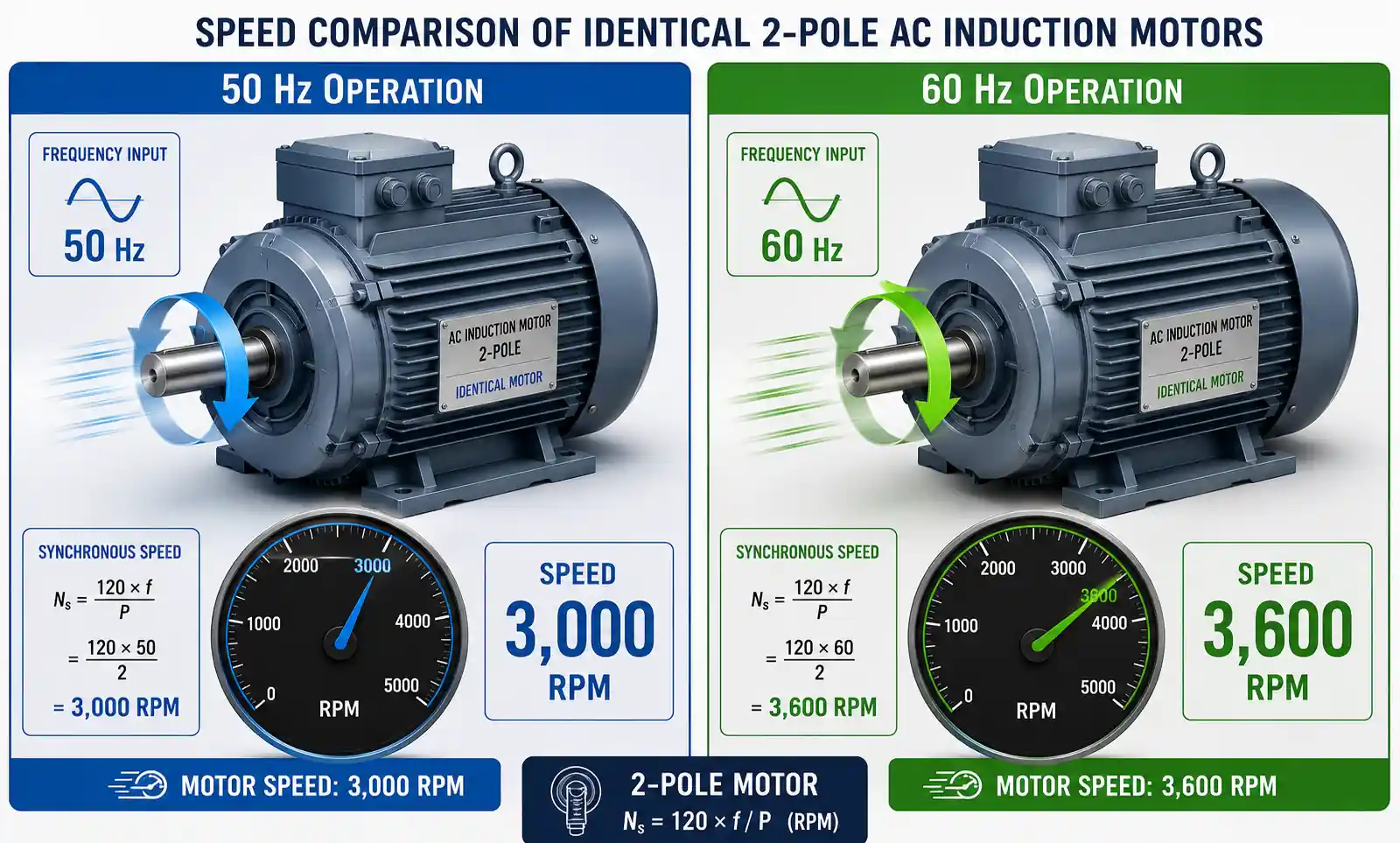
For standard AC induction motors, the synchronous speed is determined by:
RPM = (120 × Frequency) / Number of Poles
This means:
- A 2-pole motor runs at 3,000 RPM on 50 Hz or 3,600 RPM on 60 Hz
- A 4-pole motor runs at 1,500 RPM on 50 Hz or 1,800 RPM on 60 Hz
Running a 60 Hz Motor on 50 Hz
When you operate a 60 Hz motor on a 50 Hz supply:
- Speed drops by approximately 17% (from the motor's rated speed)
- Current draw increases significantly due to lower inductive reactance
- Overheating risk increases as windings carry excessive current
- Efficiency decreases and power output drops by about 20%
Running a 50 Hz Motor on 60 Hz
Conversely, when a 50 Hz motor operates on 60 Hz:
- Speed increases by 20%
- Shaft power output increases proportionally
- Torque remains relatively constant
- Generally safer than the reverse scenario, though still outside design specifications
- Mechanical wear accelerates due to higher operating speeds
Universal Motors and Transformers
Universal motors (used in power tools and vacuum cleaners) are less sensitive to frequency changes since they're series-wound designs. However, transformers designed for one frequency will show different characteristics on another—50 Hz transformers on 60 Hz supply will run cooler but with slightly higher losses.
5. Efficiency Considerations: Which Frequency Is Better?
The question of which frequency is "better" depends on your priorities.
Advantages of 50 Hz
- Lower transmission losses: Better for long-distance power transmission, making it ideal for countries with large geographic areas
- Reduced iron losses: Lower frequency means reduced eddy current losses in transformer cores
- Less insulation stress: Slower cycling reduces electrical stress on insulation systems
- Better for large transformers: High-power distribution transformers are slightly more efficient
.webp)
Advantages of 60 Hz
- Higher power output: 20% more cycles means equipment can deliver more power in the same time frame
- Smaller transformers: Higher frequency allows for more compact transformer designs for the same power rating
- Lighter equipment: Motors and generators can be physically smaller for equivalent power
- Reduced flicker: Slightly better for fluorescent and older lighting technologies (though largely irrelevant with modern LED lighting)
Modern Perspective
With contemporary power electronics and materials technology, the efficiency differences between 50 Hz and 60 Hz systems are minimal. The choice of frequency has much less impact on overall system efficiency than factors like:
- Grid infrastructure quality
- Power factor correction
- Modern solid-state switching devices
- Smart grid technologies
6. Appliance Compatibility: What Works Where?
Understanding which devices can cross frequency boundaries is essential for international travel or relocation.
Devices That Don't Care About Frequency
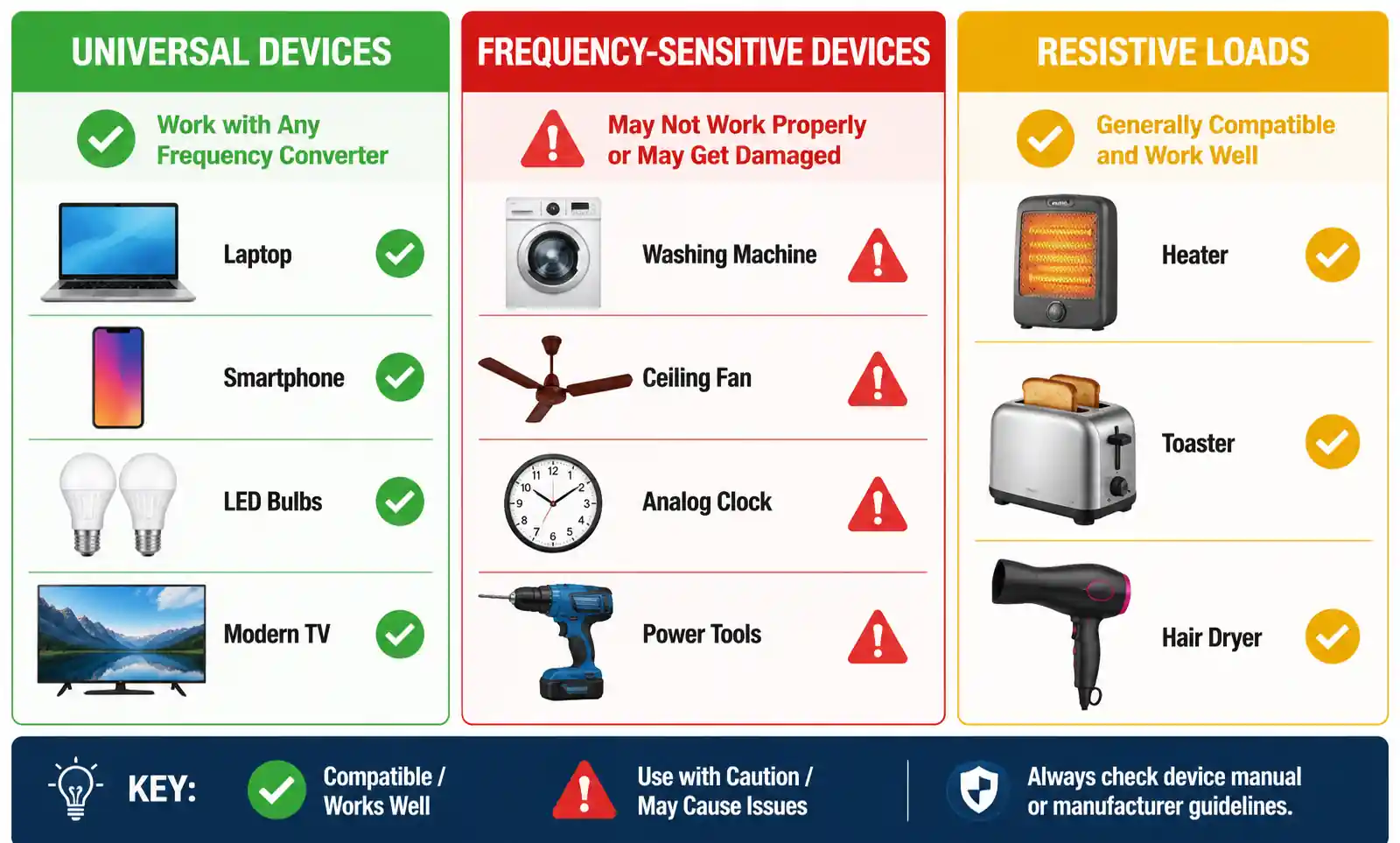
Resistive loads (heating elements):
- Electric heaters
- Incandescent light bulbs (mostly obsolete)
- Water heaters
- Toasters and electric kettles
- Hair dryers with simple heating coils
Modern electronics (with switching power supplies):
- Laptop computers and chargers
- Smartphones and tablets
- LED lighting
- Modern TVs and monitors
- Most modern appliances with electronic controls
These devices convert AC to DC internally and can typically handle both frequencies, provided the voltage is compatible (check the label for "100-240V" marking).
Frequency-Sensitive Devices
AC motors (most affected):
- Washing machines with direct-drive motors
- Older refrigerators and freezers
- Ceiling fans
- Air conditioners with AC compressors
- Power tools with induction motors
- Vacuum cleaners with universal motors (less affected)
Timing-dependent devices:
- Older analog clocks
- Some timers and delay circuits
- Older audio equipment (turntables)
- Vintage appliances
The Voltage Factor
Remember that frequency is only half the compatibility equation. A device rated for "120V 60Hz" will not work safely on a "230V 50Hz" supply without a voltage converter, regardless of whether it can handle the frequency difference.
7. Converting Between 50 Hz and 60 Hz: Solutions and Converters
When you need to use equipment designed for one frequency on a different power system, several solutions exist.
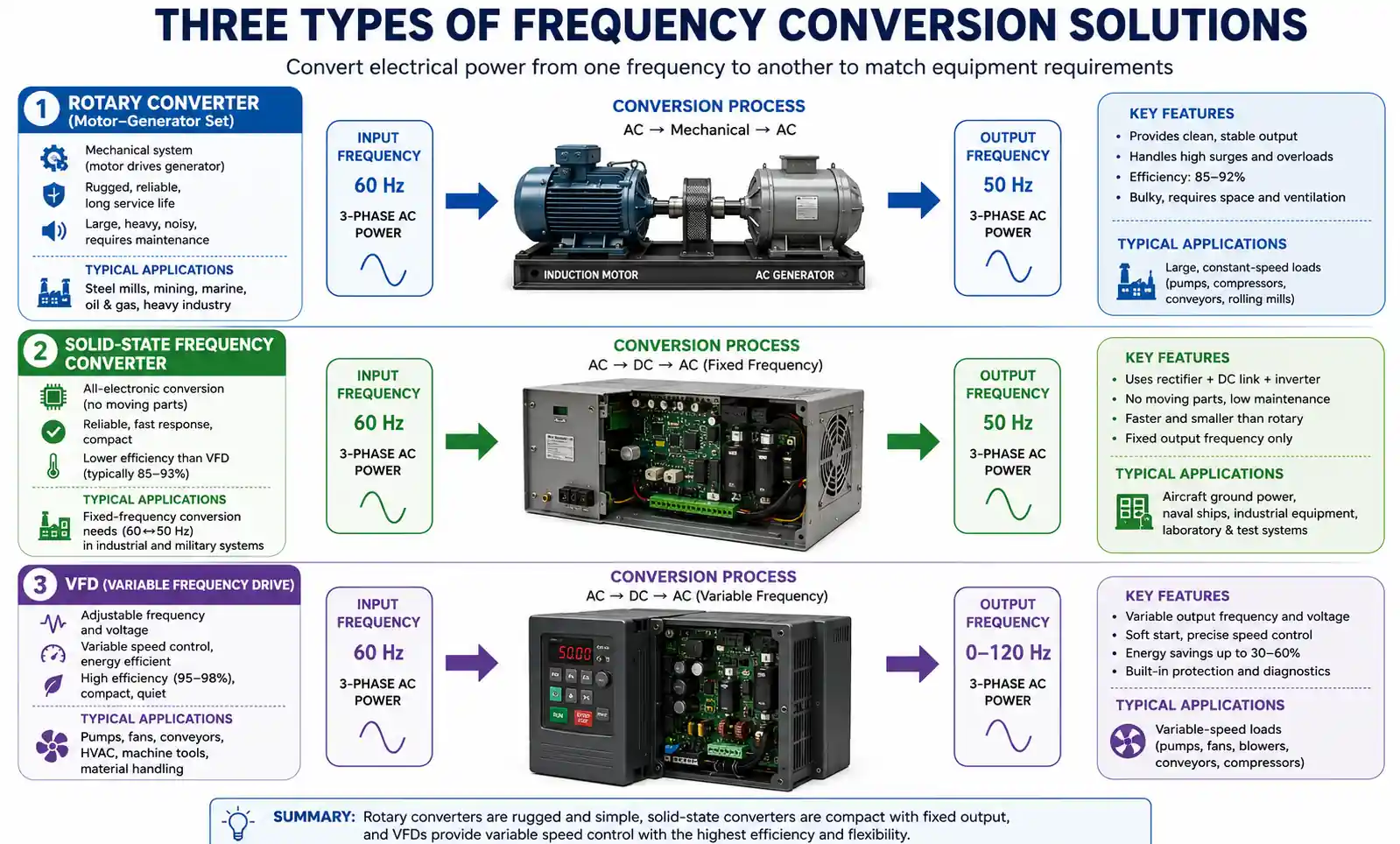
Frequency Converters
Rotary converters: Motor-generator sets that mechanically convert frequency—expensive but reliable for high-power applications.
Solid-state frequency converters: Electronic devices using power electronics to change frequency—more common, efficient, and available in various power ratings from small appliances to industrial machinery.
Variable Frequency Drives (VFDs)
For motor-driven equipment, VFDs offer the most flexible solution. They:
- Convert incoming AC to DC
- Regenerate AC at the desired frequency
- Allow precise speed control
- Protect motors from frequency mismatch damage
- Range from small 1HP units (~$100-300) to industrial-scale systems
Voltage and Frequency Converters
Combined units address both voltage and frequency differences, essential for international moves. Expect to pay:
- Small units (100-300W): $150-400
- Medium units (1000-3000W): $500-1,500
- Large units (5000W+): $1,500-5,000+
When Conversion Isn't Worth It
For low-cost appliances, buying a new device designed for your local power system is often more economical than investing in a converter. This especially applies to:
- Small kitchen appliances
- Fans and portable heaters
- Inexpensive power tools
8. Historical Context: Why Two Different Standards?
The split between 50 Hz and 60 Hz traces back to the early days of electrical power distribution in the late 1800s and early 1900s.
The Birth of AC Power
In the 1880s and 1890s, the "War of Currents" between Thomas Edison (DC) and George Westinghouse/Nikola Tesla (AC) resulted in AC power becoming the standard. However, no international agreement existed on frequency.
Early Experimentation
Early power systems used various frequencies:
- 25 Hz: Used in some early systems, especially for railway electrification
- 40 Hz: Considered but found too low for efficient lighting
- 50 Hz: Adopted in Germany by AEG (Allgemeine Elektrizitäts-Gesellschaft)
- 60 Hz: Chosen by Westinghouse in the United States
- 133 Hz and others: Experimental frequencies that proved impractical
Why 50 Hz in Europe?
European engineers, particularly in Germany, chose 50 Hz as a compromise:
- High enough to prevent visible flicker in incandescent lights
- Low enough for efficient generation and transmission
- Compatible with metric system calculations (easier mathematics)
Why 60 Hz in America?
The United States adopted 60 Hz because:
- Westinghouse and Tesla built early infrastructure at this frequency
- Provided 20% better performance for the same equipment size
- Better for reducing light flicker
- Already established before international standardization efforts
Colonial and Economic Influences
As electrical systems spread globally:
- Former British, French, and German colonies adopted 50 Hz (European influence)
- Areas with strong American economic ties chose 60 Hz
- Geographic proximity to existing systems influenced choices
- Path dependence made changing frequencies prohibitively expensive
9. Practical Implications for Travelers and Expats
If you're traveling internationally or relocating to a different frequency region, here's what you need to know.
Quick Compatibility Check
Before your trip or move:
- Check device labels: Look for "100-240V 50/60Hz" markings—these work anywhere
- Identify motor-driven appliances: These need the most attention
- List your essentials: Determine what you must bring versus what you can replace
Travel Scenarios
Short-term travel: Most modern electronics (phones, laptops, cameras) work globally with just a plug adapter. Don't worry about frequency.
Extended stays or relocation: Consider:
- Selling motor-driven appliances and buying locally
- Investing in frequency converters for valuable equipment
- Shipping only truly irreplaceable items
Common Issues and Solutions
Problem: Microwave runs slower or faster Solution: Use a frequency converter or buy locally (microwaves are frequency-sensitive due to timing circuits)
Problem: Analog clock runs at wrong speed Solution: Replace with digital or local analog clock
Problem: Power tools perform poorly Solution: Professional-grade VFD or purchase local equivalents
Problem: Laptop charger gets warm Solution: Modern laptop chargers handle both frequencies—warmth is normal within limits
10. Future Trends: Will Power Frequencies Ever Unify?
The coexistence of 50 Hz and 60 Hz systems has persisted for over a century. Will this ever change?
Why Unification Is Unlikely
Infrastructure investment: Changing an entire country's frequency would require:
- Replacing or modifying all power generation equipment
- Updating transmission and distribution systems
- Adapting or replacing countless motors, transformers, and appliances
- Coordinating a massive simultaneous switchover
The cost would be astronomical—estimated in the trillions of dollars for a large country—with minimal practical benefit.
Technological Mitigation
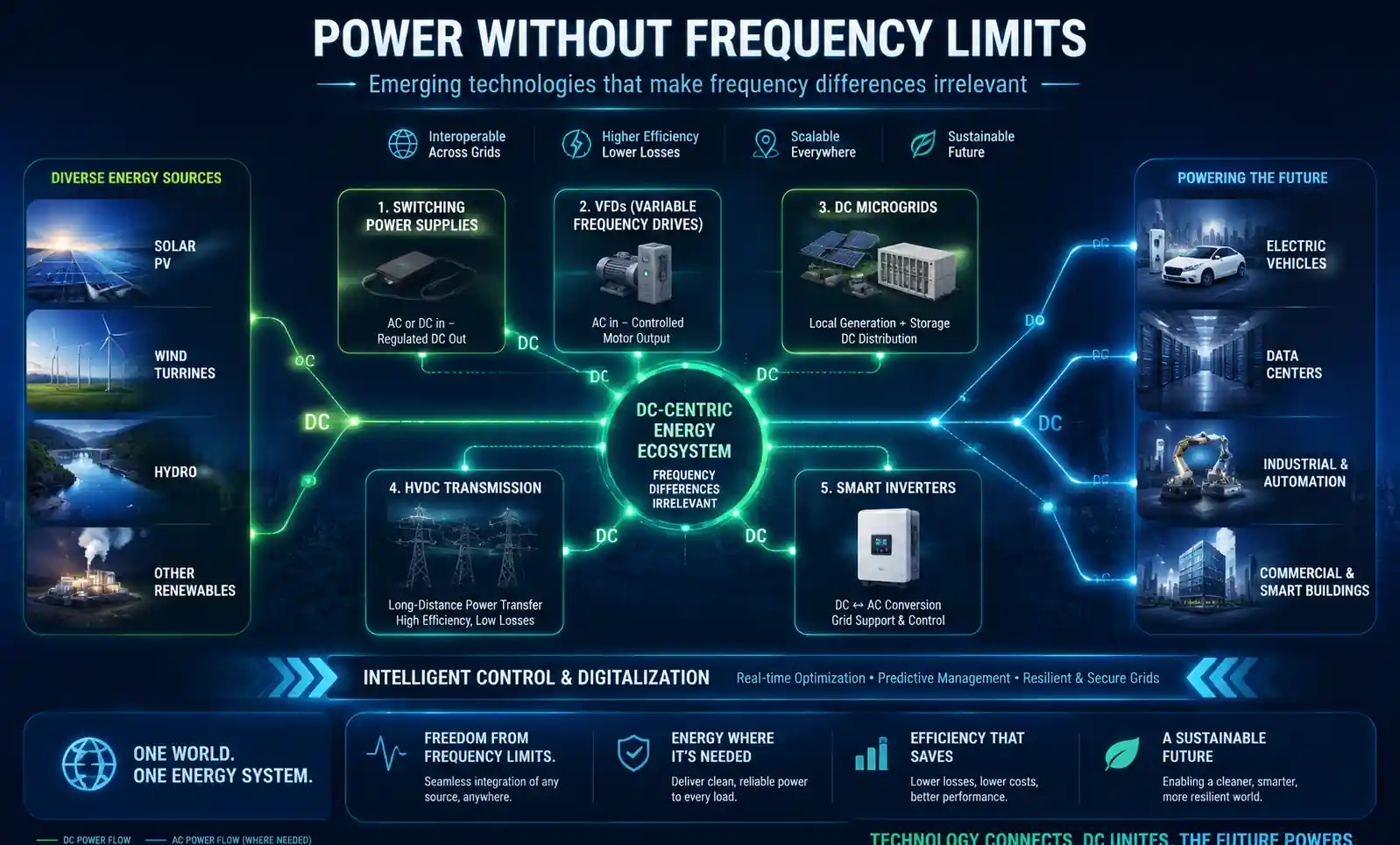
Rather than unification, technology is making frequency differences irrelevant:
Switching power supplies: Modern electronics use power supplies that work with any frequency, eliminating compatibility issues for most consumer devices.
Variable frequency drives: Industrial equipment increasingly uses VFDs that can operate motors at any desired frequency regardless of grid frequency.
DC microgrids: Some new developments use DC distribution internally, eliminating frequency concerns entirely.
Smart inverters: Solar installations and battery systems use inverters that can work with any grid frequency.
The Role of DC Systems
Interestingly, some experts predict a partial return to DC for certain applications:
- Data centers: Many run on DC internally for efficiency
- Electric vehicle charging: DC fast charging bypasses AC entirely
- Renewable energy: Solar panels and batteries are inherently DC
- LED lighting: LEDs are DC devices
High-voltage DC (HVDC) transmission is also growing for long-distance power transmission, as it avoids frequency issues entirely and reduces losses.
Regional Integration Challenges
Even regions considering power grid integration (like connecting European and North African grids) use HVDC links to bridge the frequency divide when necessary, rather than attempting to synchronize frequencies.
Conclusion
The 50 Hz versus 60 Hz divide is a fascinating example of how early technical choices create lasting global standards. While the 20% difference in frequency creates real technical distinctions—particularly in motor speed, transformer design, and power transmission characteristics—modern technology has largely neutralized these differences for everyday users.
For most people today, frequency differences matter primarily when:
- Traveling internationally with motor-driven appliances
- Relocating permanently to a different frequency region
- Operating specialized industrial equipment
- Working with vintage or highly frequency-sensitive devices
The good news is that the vast majority of modern electronics—from smartphones to laptops to LED lights—are designed to work with both frequencies. And for the cases where frequency matters, solutions like frequency converters and variable frequency drives provide practical workarounds.
Rather than the world converging on a single frequency standard, we're more likely to see continued coexistence of 50 Hz and 60 Hz systems, with technology increasingly making the distinction irrelevant for end users. The legacy of 19th-century engineering decisions will continue to shape our power systems for the foreseeable future, but its practical impact on daily life continues to diminish.
Whether you're in a 50 Hz or 60 Hz region, the electricity flowing through your walls remains one of humanity's most transformative innovations—a testament to the pioneers who built these systems over a century ago.