



Amplifier Classes (Class A / B / AB / C / D / T)
Quick Preview — What Are Amplifier Classes?
Ever looked at an audio amp or radio transmitter and wondered why engineers keep arguing about Class A versus Class D? Amplifier classes are just different ways to make electronic amplifiers do the same job — take a small input signal and make it bigger — but each class trades off efficiency, linearity, heat, and complexity in its own way.
Think of them as different car types: a vintage Rolls-Royce (Class A) vs. a hybrid Prius (Class D) — both get you there, but with different style and fuel use.
Why amplifier class matters
Different tasks need different behavior. Do you want the cleanest audio for a studio monitor? Or maximum battery life in a Bluetooth speaker? The amplifier class you pick shapes sound quality, battery run-time, and how much cooling you need.
Trade-offs: efficiency vs linearity
Here’s the classic tug-of-war:
-
Linearity → faithful reproduction
-
Efficiency → less wasted heat
Usually, the more linear the amp, the more power it wastes as heat. The design challenge is picking the right balance for your goal.
Basic Concepts You Should Know
Conduction angle explained
Conduction angle is the portion of the input waveform cycle during which the output device conducts current:
-
360° → always on
-
180° → half the cycle
-
< 180° → short bursts
This single concept defines much of each amplifier class’s behavior.
Efficiency, linearity, distortion — what's what
-
Efficiency: how much DC power becomes useful AC output
-
Linearity: how closely output follows input
-
Distortion: unwanted signal changes (harmonic & intermodulation)
THD and IMD in plain terms
-
THD (Total Harmonic Distortion): unwanted harmonics created by nonlinearity
-
IMD (Intermodulation Distortion): mixing products from multiple tones
Lower values = cleaner sound.
Power dissipation and heat
Power not converted to output becomes heat. That’s why Class A amplifiers run hot — they conduct current constantly.
Class A
How Class A works (single-ended, conduction = 360°)
The device conducts for the entire signal cycle and never turns off. It’s like an engine idling all the time — wasteful, but instantly responsive.
Pros and cons
-
Pros: excellent linearity, simple design, no crossover distortion
-
Cons: very low efficiency (often <25%), lots of heat, large heatsinks
Typical schematic and biasing
Usually a single transistor or tube biased deeply in its linear region.
Where you still see Class A today
High-end headphone amps, boutique guitar amps, audiophile equipment.
Class B
How Class B works (push-pull, conduction = 180°)
Two devices share the job: one handles positive half-cycles, the other negative. Efficiency improves greatly over Class A.
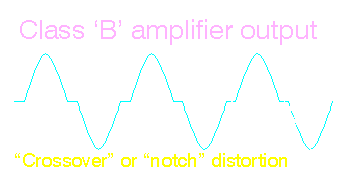
Crossover distortion and why it happens
Near zero crossing, neither device conducts perfectly, causing distortion — a “handoff problem.”
Ways to mitigate crossover distortion
-
Slight biasing (Class AB)
-
Global feedback
-
Matched output devices
Applications for Class B
Historically used in audio power amps, now mostly replaced by Class AB.
Class AB
Combining A and B — conduction between 180°–360°
Devices are biased to overlap slightly at crossover, smoothing the transition.
Biasing methods and practical circuits
-
Diode bias networks
-
VBE multipliers
-
Active bias control
Advantages over pure A or B
-
Much better efficiency than A
-
Much less distortion than B
Typical use cases (audio amplifiers)
Home audio, car audio, studio monitors — the most common linear class.
Class C
Short conduction angle (<180°) — tuned for RF
Devices conduct only in short pulses. A tuned output reconstructs the waveform.
Where Class C shines and where it fails
-
Excellent: RF transmitters
-
Terrible: audio, wideband signals
Resonant circuits and efficiency
LC tanks smooth current pulses into a sine wave at one frequency.
Not for audio — why
Audio is wideband; Class C destroys waveform fidelity outside tuned circuits.
Class D
Switching amplifiers: PWM, PDM, and modulation basics
Transistors switch fully on/off at high speed. The signal is encoded into pulses and reconstructed by a low-pass filter.
Output filter and EMI concerns
Fast switching creates EMI. Good filtering, layout, and grounding are essential.
Efficiency and thermal behavior
-
Efficiency often >90%
-
Minimal heat
-
Small, lightweight designs
Real-world performance and misconceptions
Modern Class D rivals Class AB in sound quality when well designed.
Class T
What Class T refers to (Tripath / hybrid approaches)
A proprietary marketing term for an optimized Class D architecture with adaptive modulation and feedback.
How Class T differs from pure Class D
Smarter control algorithms reduce distortion and improve transient response.
Advantages and criticisms
-
Pros: high efficiency + improved sound
-
Cons: proprietary, not a fundamentally new class
Comparing All Classes — A Practical Table
| Class | Conduction Angle | Efficiency | Linearity | Distortion | Typical Uses |
|---|---|---|---|---|---|
| A | 360° | Very Low | Excellent | Very Low | Audiophile, headphone amps |
| B | 180° | Moderate | Fair | High (crossover) | Historical audio designs |
| AB | 180°–360° | Good | Very Good | Low | Most audio amplifiers |
| C | <180° | Very High | Poor | Very High | RF transmitters |
| D | Switching | Excellent | Good–Very Good | Low (modern) | Portable & consumer audio |
| T | Switching (optimized D) | Excellent | Very Good | Low | High-quality Class D audio |
Designing or Choosing an Amplifier — Key Considerations
Matching class to application
-
Portable speaker → Class D
-
Studio monitor → Class AB or premium D
-
RF transmitter → Class C
Power supply, heat sinking, and layout tips
-
Linear amps: big heatsinks, stable bias
-
Switching amps: tight loops, good gate drive, low-ESR caps
When to favor linearity vs efficiency
-
Heat OK, sound critical → linear classes
-
Battery-powered, compact → switching classes
Practical Tips for Hobbyists and Builders
Measuring performance at home (tools and methods)
-
Multimeter
-
Oscilloscope
-
Audio analyzer apps
-
Known reference tracks
Common pitfalls and quick fixes
-
Noisy Class D → improve PCB layout
-
Overbiased AB → reduce idle current
-
Hum → improve grounding (star ground)
Conclusion
Amplifier classes are tools, not winners. Class A delivers purity at the cost of heat. Class AB balances performance and efficiency. Class C dominates RF. Class D (and T) bring modern efficiency and compactness.
Choose based on application, constraints, and priorities — then execute well. Biasing, layout, and filtering matter as much as the class itself.
FAQs
Q1: Which amplifier class gives the best sound for music? A1: Class A and high-quality Class AB are favorites, but modern Class D can match them closely.
Q2: Is Class D noisy or low-fidelity? A2: Early designs were, but modern Class D can be extremely clean.
Q3: Can I use Class C for audio? A3: No. It only works with tuned RF outputs.
Q4: What's the main problem with Class B? A4: Crossover distortion — fixed by Class AB.
Q5: Is Class T better than Class D? A5: It’s an optimized, branded form of Class D, not a fundamentally new class.