



Automotive-Grade Electronic Components: Standards and Selection
Selecting the right components for automotive applications isn't just about meeting specifications—it's about understanding qualification frameworks that separate consumer electronics from parts that must survive 15 years under the hood. In this guide, we'll walk through AEC-Q standards, temperature grading, and the selection criteria that matter when you're designing for vehicles rather than benchtop prototypes.
Table of Contents
- What Makes a Component "Automotive-Grade"?
- Understanding AEC-Q Qualification Standards
- Temperature Grades and Operating Ranges
- Automotive vs Industrial Components: Key Differences
- The PPAP Process for Component Qualification
- Selection Criteria for Vehicle Systems
- FAQ
- Conclusion
What Makes a Component "Automotive-Grade"?
Automotive-grade components undergo stress testing that simulates accelerated lifetime conditions far beyond typical operating parameters. The Automotive Electronics Council (AEC) establishes these qualification standards to ensure components survive thermal cycling between -40°C and +150°C, humidity exposure, mechanical shock, and electrical stress over a vehicle's 15-year service life.
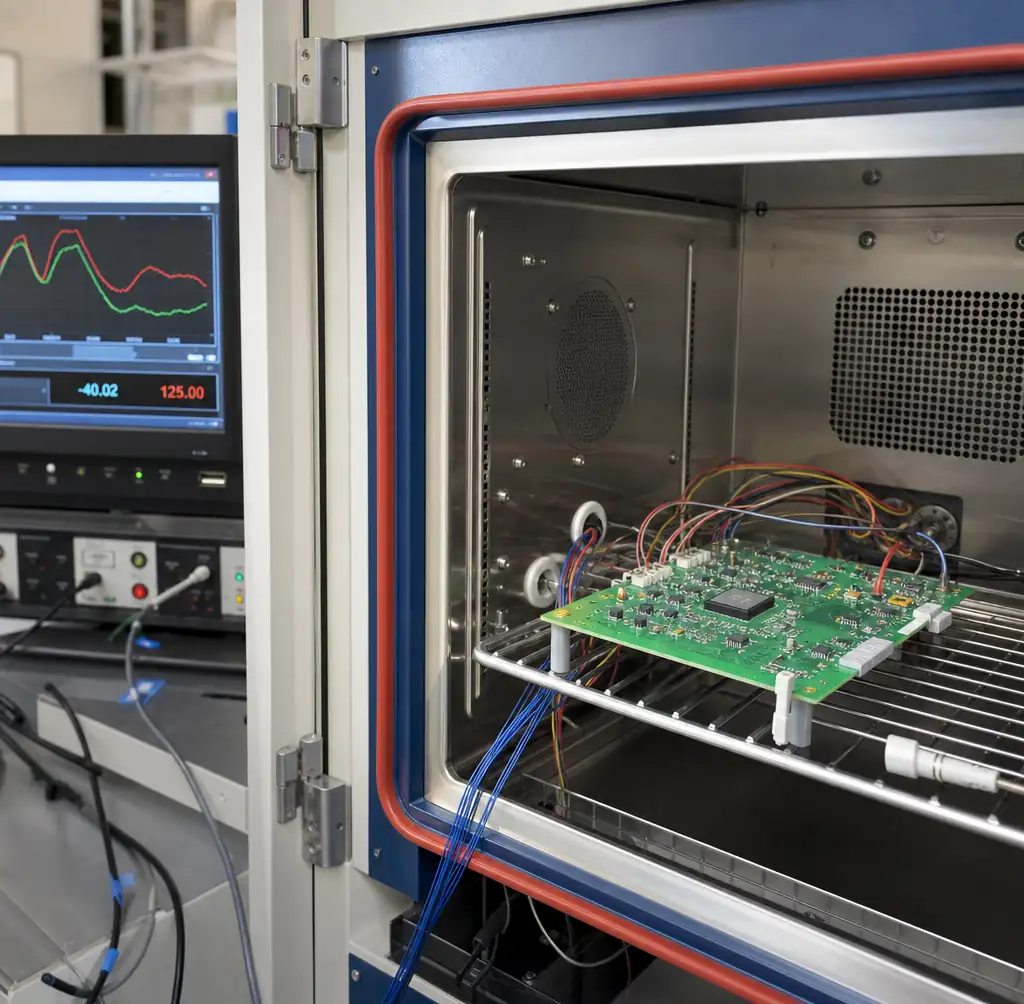 Automotive-grade electronic component undergoing temperature cycling test
The qualification isn't about a single parameter—it's a test sequence covering 15+ categories including temperature cycling (500-1000 cycles), high-temperature operating life (HTOL) testing for 1000+ hours, and humidity resistance testing. Components passing these tests receive AEC-Q certification, which OEMs require before design-in approval.
Unlike industrial or commercial components that may tolerate occasional failures, automotive parts must demonstrate near-zero defect rates measured in parts per billion (PPB). This reflects the cost and safety implications of field failures in vehicles, where a recalled component can trigger millions of dollars in warranty claims and safety investigations.
Understanding AEC-Q Qualification Standards
The AEC maintains three primary qualification standards, each targeting different component categories. Understanding which standard applies to your design is the first step in component selection.
| Standard | Component Type | Key Requirements | Typical Test Duration |
|---|---|---|---|
| AEC-Q100 | Integrated Circuits | Temperature cycling, HTOL, ESD (HBM/CDM), latch-up | 6-12 months |
| AEC-Q101 | Discrete Semiconductors | Power cycling, avalanche energy, dV/dt immunity | 4-8 months |
| AEC-Q200 | Passive Components | Moisture resistance, thermal shock, vibration, solderability | 3-6 months |
AEC-Q100 qualifies automotive ICs through accelerated testing: 500-1000 temperature cycles, 1000+ hour HTOL at maximum junction temperature, and ESD testing (HBM ≥2kV, CDM ≥500V). These tests identify latent defects that normal qualification misses.
AEC-Q200 applies to passives—MLCCs, inductors, resistors. Capacitors must maintain capacitance across temperature, resist vibration-induced piezoelectric effects, and survive moisture ingress. Testing includes 1000-hour biased humidity exposure and thermal shock transitions exceeding 100°C in seconds.
Qualification isn't one-time. Manufacturer changes to die suppliers, assembly sites, or packaging materials trigger mandatory requalification, ensuring "automotive-grade" stays meaningful across production lots.
Temperature Grades and Operating Ranges
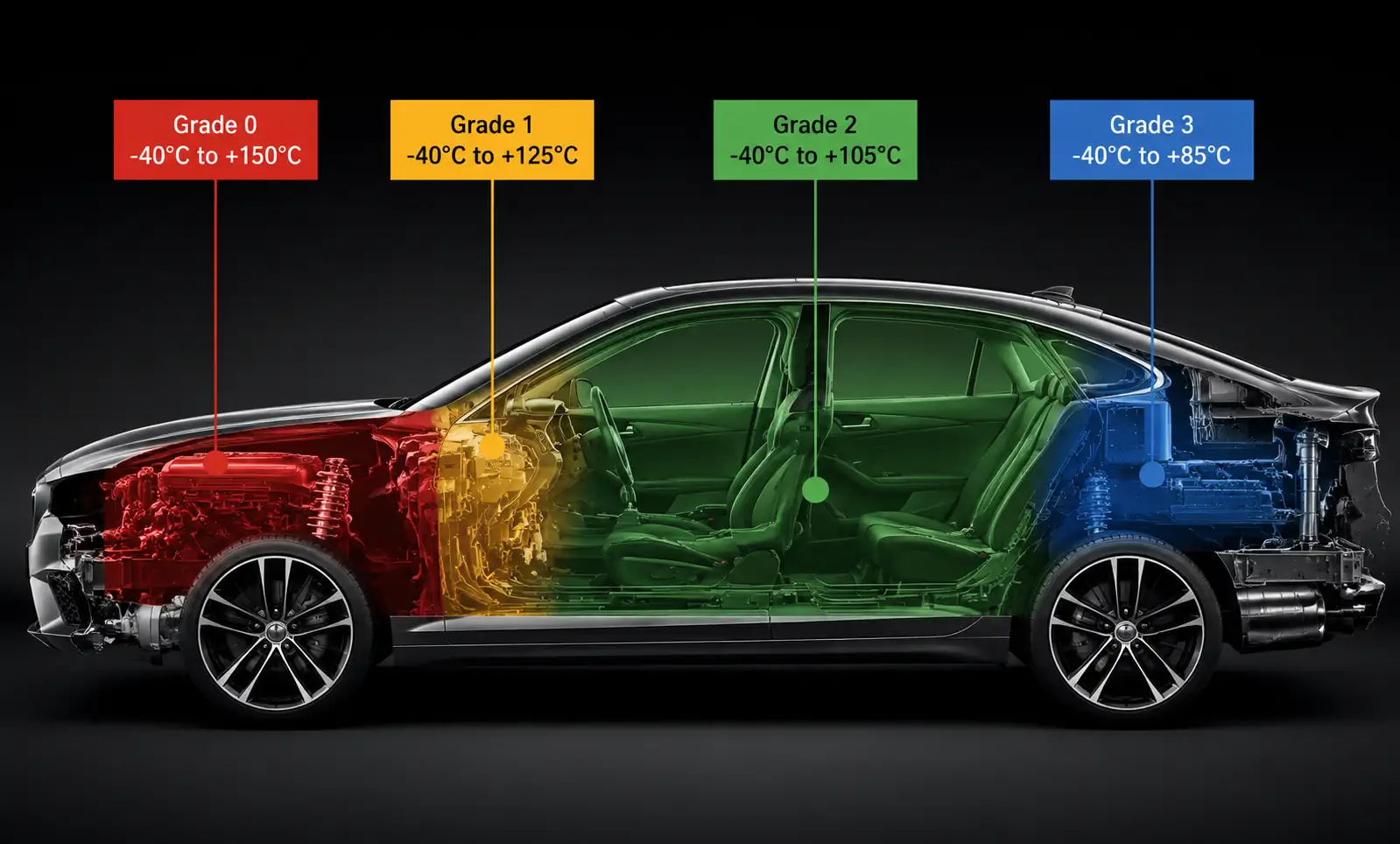 Vehicle thermal zones showing engine compartment, under-hood, and cabin temperature ranges
AEC-Q100 defines four temperature grades that correspond to different vehicle zones. Selecting the correct grade prevents over-specifying (unnecessary cost) or under-specifying (reliability risk).
| Grade | Temperature Range | Typical Location | Example Applications |
|---|---|---|---|
| Grade 0 | -40°C to +150°C | Engine compartment, transmission | Engine control units, fuel injection, exhaust sensors |
| Grade 1 | -40°C to +125°C | Under-hood areas | Power distribution, lighting control, HVAC modules |
| Grade 2 | -40°C to +105°C | Passenger compartment | Infotainment, instrument cluster, body control |
| Grade 3 | -40°C to +85°C | Climate-controlled cabin | Navigation, rear-seat displays |
Grade 0 components cost 2-4× more than Grade 3 parts, so placement decisions impact BOM cost. An infotainment processor in the dashboard needs only Grade 2—not Grade 0.
Temperature ratings refer to junction temperature (Tj), not ambient. A power IC dissipating 2W must keep Tj below 125°C when ambient hits 105°C under-hood. Verify thermal resistance using datasheet derating curves.
For passives, ceramic capacitor dielectrics (X7R, X5R, C0G) define temperature stability. X7R capacitors lose up to 15% capacitance at extremes—critical for timing circuits. X5R offers higher density but wider tolerance—fine for decoupling, problematic for analog filtering.
Automotive vs Industrial Components: Key Differences
Temperature range is the visible difference, but automotive qualification goes deeper. The table below shows what separates automotive-grade from industrial-grade components beyond the temperature rating.
| Aspect | Industrial Grade | Automotive Grade | Impact on Selection |
|---|---|---|---|
| Temperature Range | -40°C to +85°C | -40°C to +125°C (Grade 1) | Extended high-temp operation |
| Qualification Testing | Typically JEDEC standards | AEC-Q100/101/200 full suite | Proven automotive reliability |
| ESD Requirements | HBM ≥1kV typical | HBM ≥2kV, CDM ≥500V | Better manufacturing yield |
| Zero-Defect Target | PPM (parts per million) | PPB (parts per billion) | Lower field failure rates |
| Traceability | Standard lot tracking | Full genealogy tracking | Enables failure analysis |
| Cost Multiplier | 1× (baseline) | 2-4× | Must justify with reliability need |
Promwad's analysis shows ESD requirements differ significantly—automotive CDM testing (≥500V) simulates charged component discharge during automated handling, preventing latent failures appearing months post-assembly.
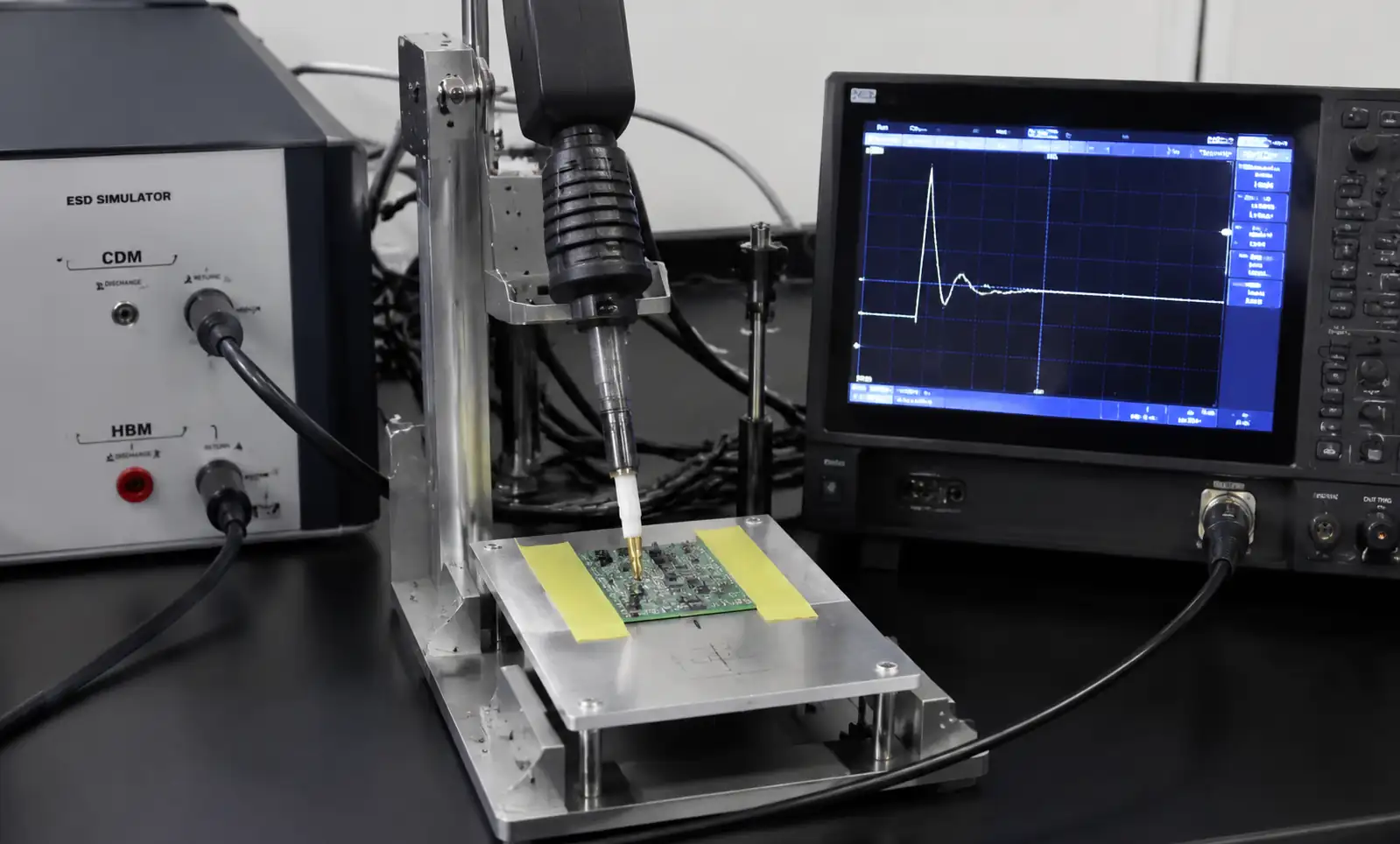 ESD testing equipment for automotive component qualification
Industrial JEDEC qualification includes temperature cycling and moisture resistance but lacks the 1000+ hour high-temperature bias testing AEC-Q mandates. Industrial parts may function initially yet develop leakage or parametric drift that automotive qualification catches.
Automotive traceability means certificates of conformance identifying die fab, assembly site, and date codes. This genealogy enables targeted recalls versus fleet-wide campaigns when failures occur, creating procurement documentation overhead.
The PPAP Process for Component Qualification
AEC-Q qualified components require Production Part Approval Process (PPAP) before production. PPAP demands 18 documented elements proving consistent manufacturing at volume: dimensional results, material reports, performance data, process flows, control plans, and measurement system analysis (MSA).
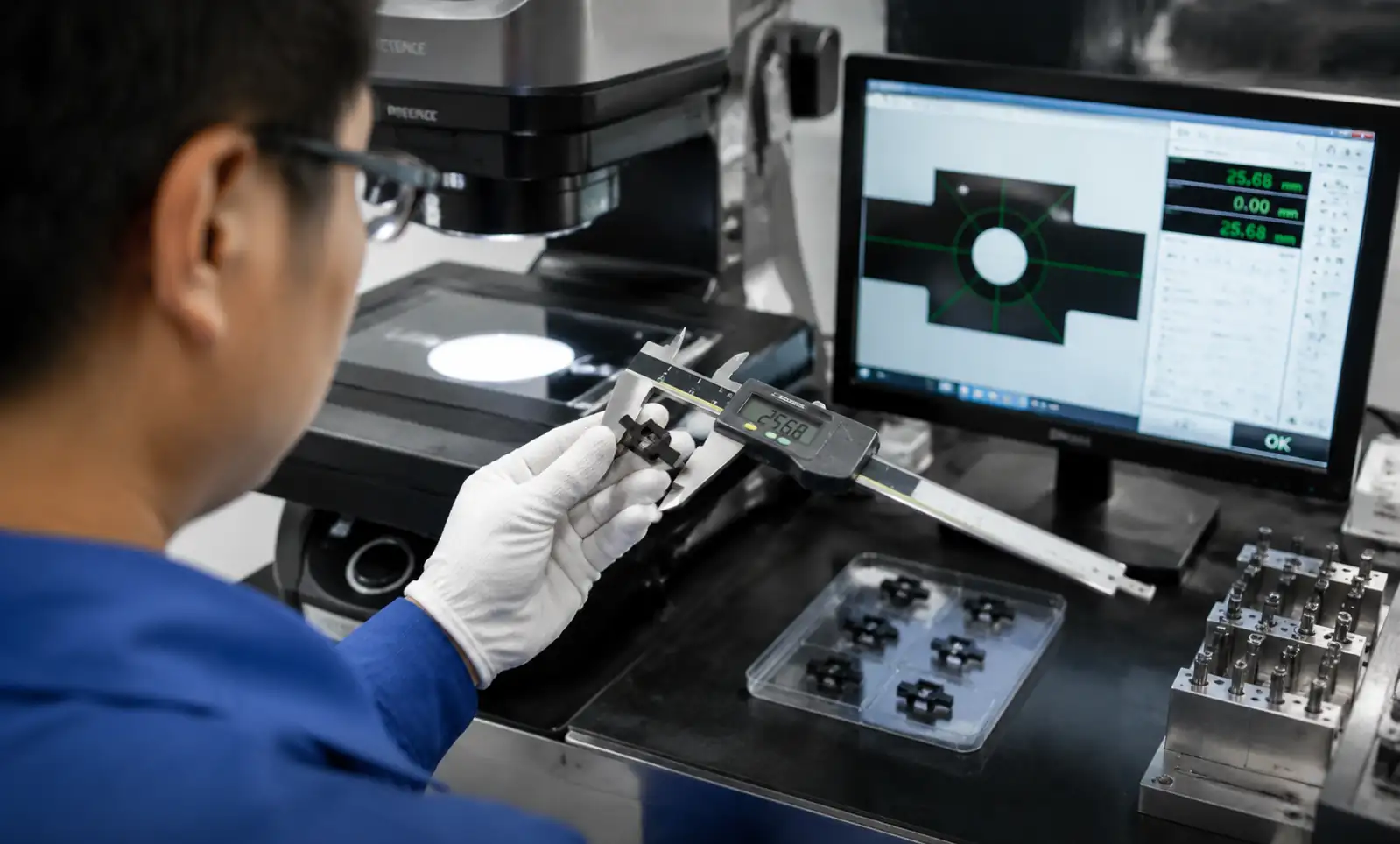 Precision measurement equipment inspecting automotive electronic components"
PPAP triggers include new parts, design changes, facility moves, or supplier switches—even between two AEC-Q200 qualified MLCC manufacturers. For buyers, PPAP documentation separates suppliers with mature processes from those merely claiming automotive-grade capability.
Selection Criteria for Vehicle Systems
Component selection balances technical needs, cost, and supply chain stability through this framework:
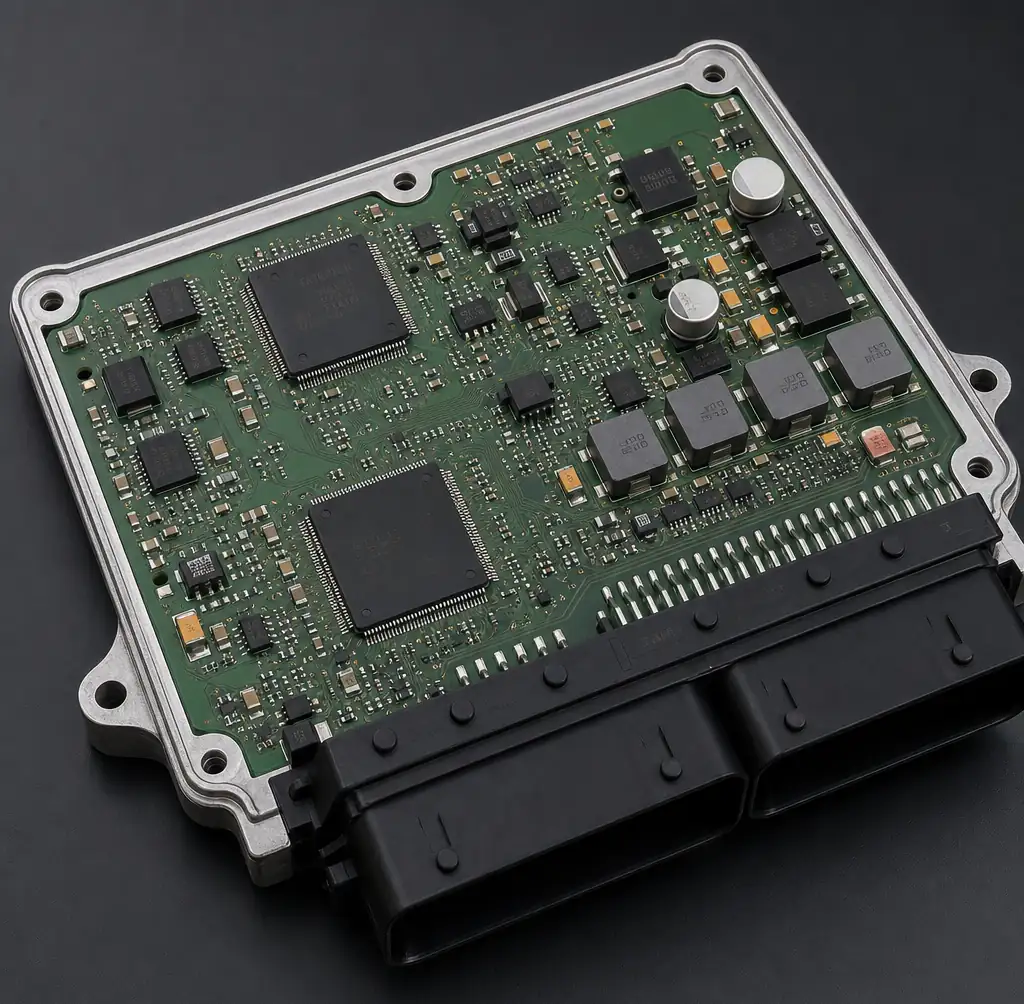 Automotive ECU printed circuit board with qualified components
Define environment: Identify mounting location, ambient temperature, moisture/vibration exposure, service life. Firewall-mounted modules need Grade 0; trunk circuits may use Grade 2.
Verify qualification: Datasheets must cite specific AEC-Q100/101/200 revision and grade. Vague "automotive quality" claims don't guarantee testing occurred.
Evaluate margins: Don't design to maximums. For 12V systems, use ≥40V parts for load dump transients (35V/100ms per ISO 7637-2). A 5A MOSFET at 25°C may handle only 3A at 125°C Tj.
Check lifecycle: Programs span 7-10 years. Verify component lifecycle status and availability commitment. "Not Recommended for New Designs" creates obsolescence risk.
Factor qualification costs: First automotive use may require funding AEC-Q testing and PPAP ($50k-$150k, 6-12 months). Use pre-qualified parts when possible.
For passives, voltage derating matters. MLCCs should operate at ≤50% rated voltage—a 50V capacitor works best under 25V to prevent dielectric breakdown and DC bias capacitance loss.
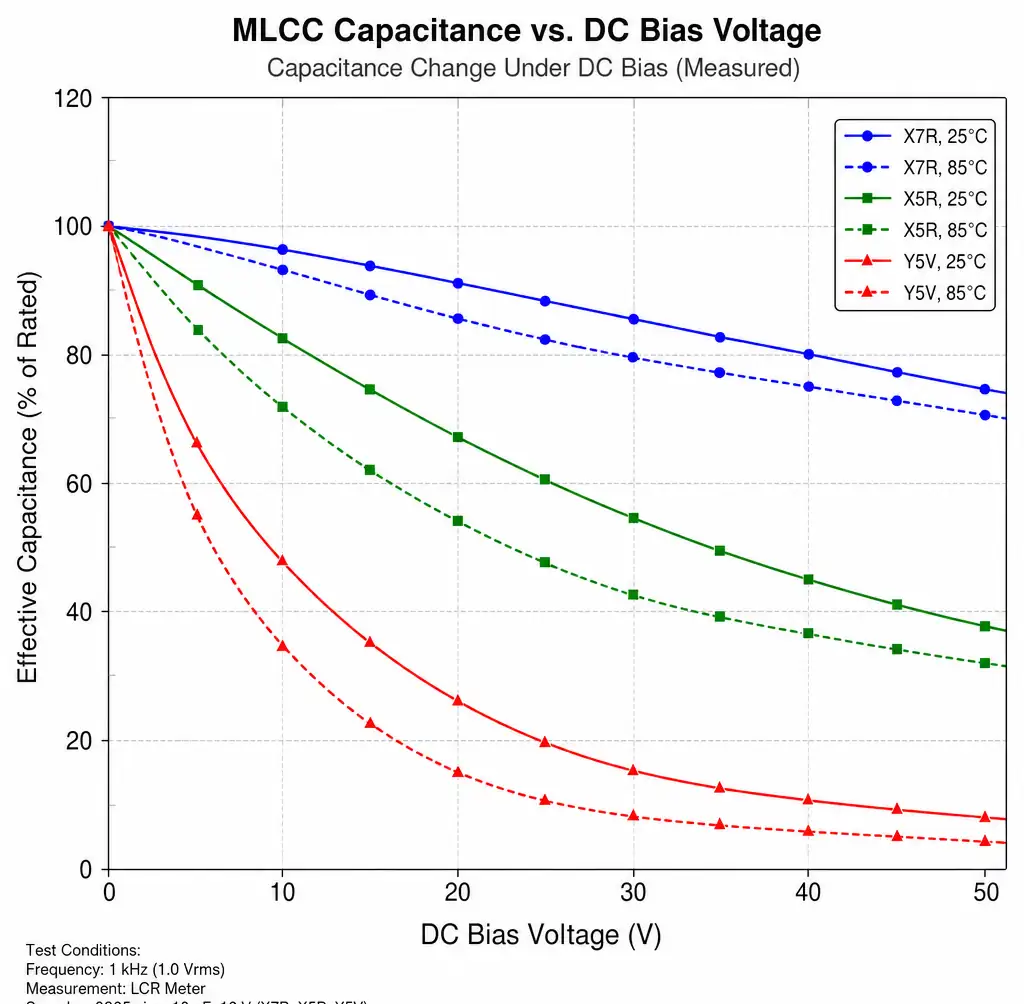 MLCC capacitance vs DC bias voltage derating curve
FAQ
What is the main difference between AEC-Q100 and AEC-Q200 standards?
AEC-Q100 qualifies integrated circuits (ICs) through stress tests like temperature cycling, high-temperature operating life, and ESD testing. AEC-Q200 qualifies passive components (resistors, capacitors, inductors) with tests focused on moisture resistance, thermal shock, and solderability. Both ensure automotive reliability but target different failure mechanisms—active devices fail from junction degradation while passives fail from mechanical stress and contamination.
Can I use industrial-grade components in automotive applications to save costs?
Yes for non-critical circuits in climate-controlled locations, but it creates warranty risk. Safety functions (braking, steering, airbags) and emission controls legally require automotive qualification in most markets. For infotainment, some OEMs allow industrial parts with proven thermal margin, but you assume field failure liability and must document the decision in your design FMEA.
How long does AEC-Q qualification testing take?
Timelines range from 3-12 months. AEC-Q200 passives take 3-6 months (environmental chambers, mechanical stress). AEC-Q100 ICs need 6-12 months for 1000-hour HTOL and electrical characterization across process corners. Failures add months for root cause investigation and retest.
What does Grade 0 vs Grade 1 temperature rating mean in practice?
Grade 0 (-40°C to +150°C) handles engine compartment mounting with exhaust heat and engine block radiation. Grade 1 (-40°C to +125°C) works for under-hood areas with thermal isolation. The 25°C difference costs 20-40% more and limits IC selection—fewer parts qualify for Grade 0. Choose the lowest grade meeting mounting requirements.
Do all components in an automotive ECU need AEC-Q qualification?
No. Safety-critical and long-life components require AEC-Q, but test points, mounting hardware, and connectors may use automotive-rated parts without full qualification. The distinction is whether component failure causes system failure. Decoupling capacitors on critical power rails need AEC-Q200; status LED resistors might not. Your DFMEA identifies which components require qualification.
How do I verify a component's AEC-Q qualification status?
Check the component datasheet for explicit AEC-Q statements citing standard revision and temperature grade (e.g., "Qualified to AEC-Q100 Rev H, Grade 1"). Manufacturers publish qualification reports on their websites—search "[part number] AEC-Q qualification report" to find test data. If documentation isn't public, request it from the manufacturer or distributor. Avoid parts with vague "automotive quality" claims without qualification evidence.
What role does PPAP play after AEC-Q qualification?
AEC-Q proves design robustness; PPAP proves manufacturing consistency. PPAP requires 18 elements including process flows, control plans, and capability studies showing processes maintain specs at production volumes. Even switching between AEC-Q qualified suppliers needs new PPAP approval because manufacturing processes differ. PPAP addresses process variation that design testing doesn't.
Conclusion
Automotive component selection demands understanding that qualification extends beyond temperature ratings to accelerated lifetime testing, parts-per-billion defect rates, and manufacturing traceability. AEC-Q100 for ICs, AEC-Q101 for discretes, and AEC-Q200 for passives define reliability requirements, while temperature grades match components to vehicle zones without over-specification.
The 2-4× cost premium versus industrial equivalents reflects qualification rigor and supply chain stability for 15-year programs. Verify explicit AEC-Q qualification in datasheets, apply proper derating, and consider PPAP production requirements. For vehicle systems where failures trigger recalls and safety investigations, automotive qualification documents that components survive conditions destroying consumer electronics.
Ready to source automotive-qualified components? Submit an RFQ with specifications and operating requirements for recommendations from our automotive-qualified suppliers.