



OLED Display Selection for Industrial and Consumer Applications
Compare OLED and LCD displays for your product. Evaluate power, contrast, lifespan, and cost with application recommendations.
Table of Contents
- What Are OLED Displays?
- OLED vs LCD: Key Performance Comparison
- Power Consumption and Efficiency
- Lifespan and Burn-In Risks
- Driver IC Requirements
- Application Suitability Guide
- Cost Analysis
- FAQ
- Conclusion
Selecting between OLED and LCD impacts product performance, power consumption, and total ownership cost. OLED delivers superior contrast ratios and power efficiency with dark content, while LCD provides longer lifespan for 24/7 industrial applications. This guide examines technical specifications, performance characteristics, and procurement considerations for industrial automation, consumer electronics, medical devices, and automotive applications.
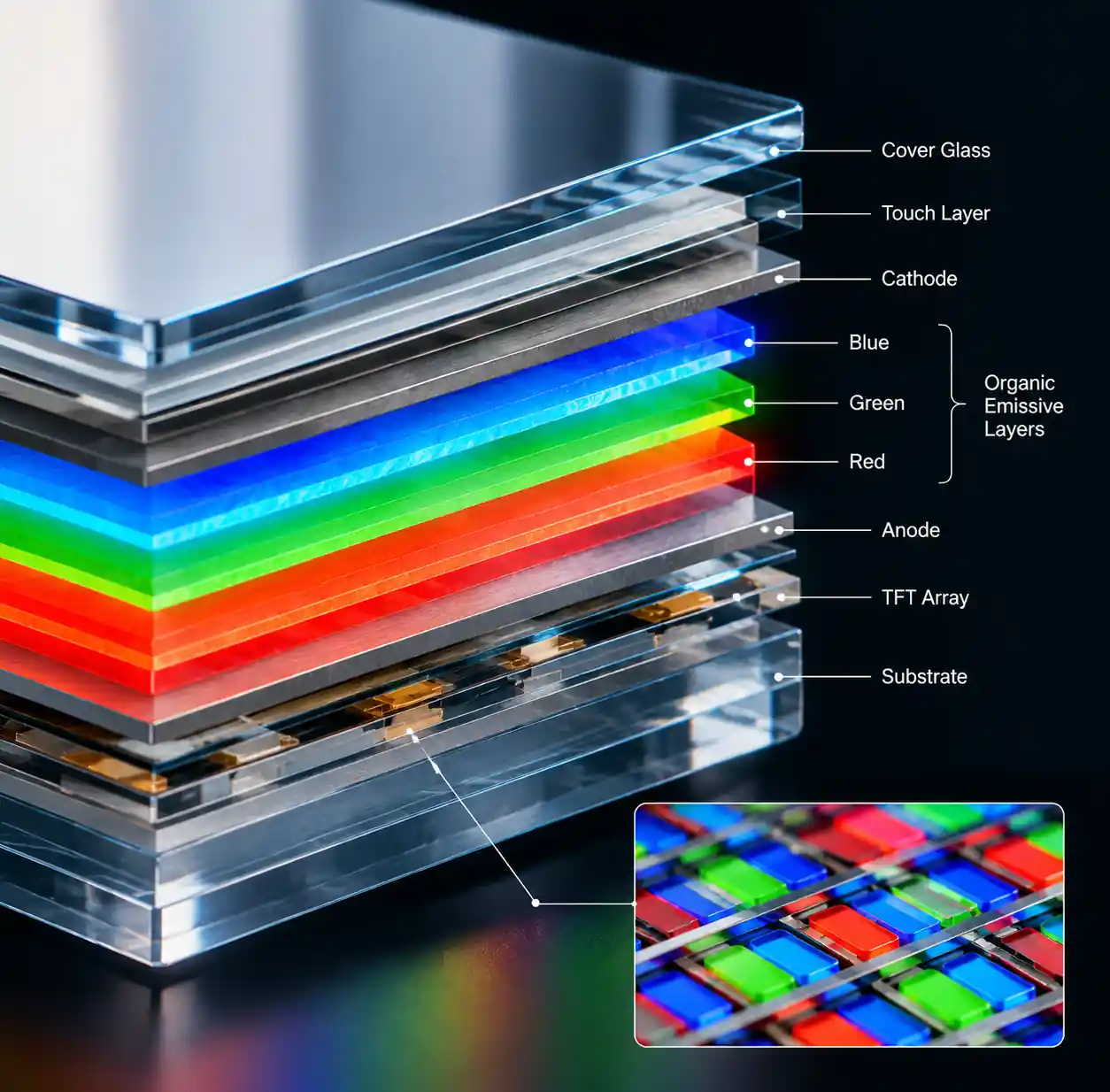 OLED display technology structure showing organic layers
What Are OLED Displays?
OLED (Organic Light-Emitting Diode) displays use organic compounds that emit light when electric current passes through them. Unlike LCD that requires backlight, OLED pixels generate their own light, enabling true black levels and infinite contrast ratios.
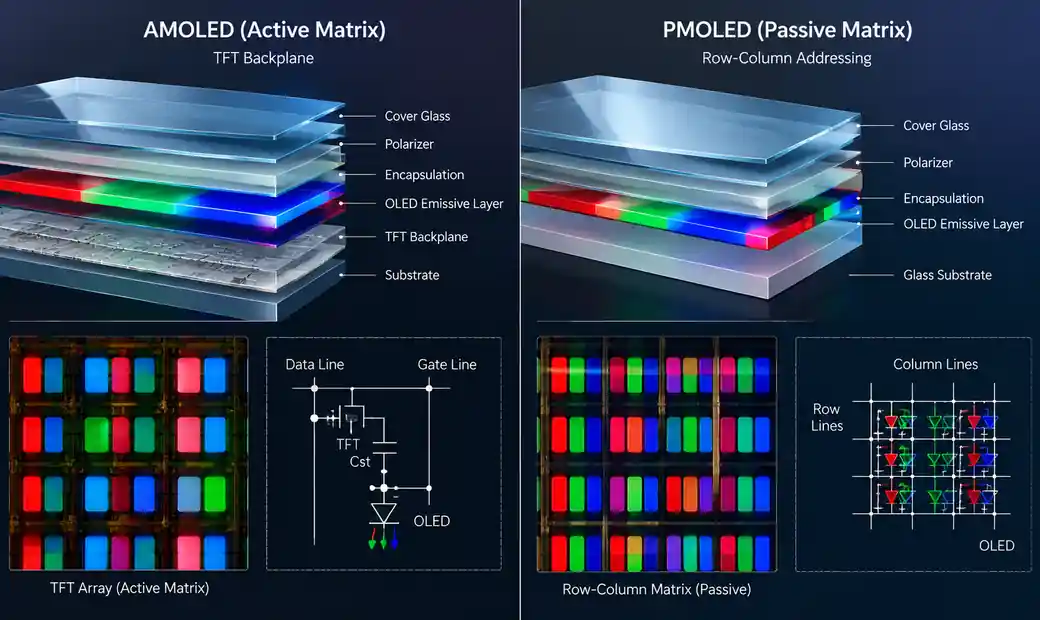 AMOLED and PMOLED display architecture comparison
AMOLED (Active-Matrix OLED) uses thin-film transistors to control each pixel independently, providing faster response and higher resolution. PMOLED (Passive-Matrix OLED) uses simpler row-column addressing but offers limited resolution. AMOLED dominates smartphones and automotive displays, while PMOLEM serves industrial HMI panels and medical instruments where cost matters more than resolution.
OLED vs LCD: Key Performance Comparison
The fundamental difference between OLED and LCD creates distinct performance profiles. LCD uses liquid crystals to block or transmit backlight, while OLED pixels emit light directly.
| Parameter | OLED | LCD | Key Difference |
|---|---|---|---|
| Contrast Ratio | ∞:1 (true blacks) | 1000:1 to 5000:1 | OLED turns pixels off completely |
| Response Time | <1 ms | 2-5 ms | OLED 5x faster for motion clarity |
| Viewing Angle | >160° | 120-140° | OLED maintains color at extreme angles |
| Thickness | 1-2 mm | 3-7 mm | OLED eliminates backlight layer |
| Brightness | 400-1000 cd/m² | 300-1500 cd/m² | LCD exceeds for outdoor use |
| Operating Life | 20,000-50,000 hrs | 50,000-100,000 hrs | LCD lasts 2-3x longer |
OLED excels in contrast, response time, and viewing angles. LCD offers higher peak brightness and significantly longer life. For industrial 24/7 operation with 3-5 year warranties, LCD durability becomes critical. For consumer products with 1-2 year cycles, OLED visual quality drives adoption in premium devices.
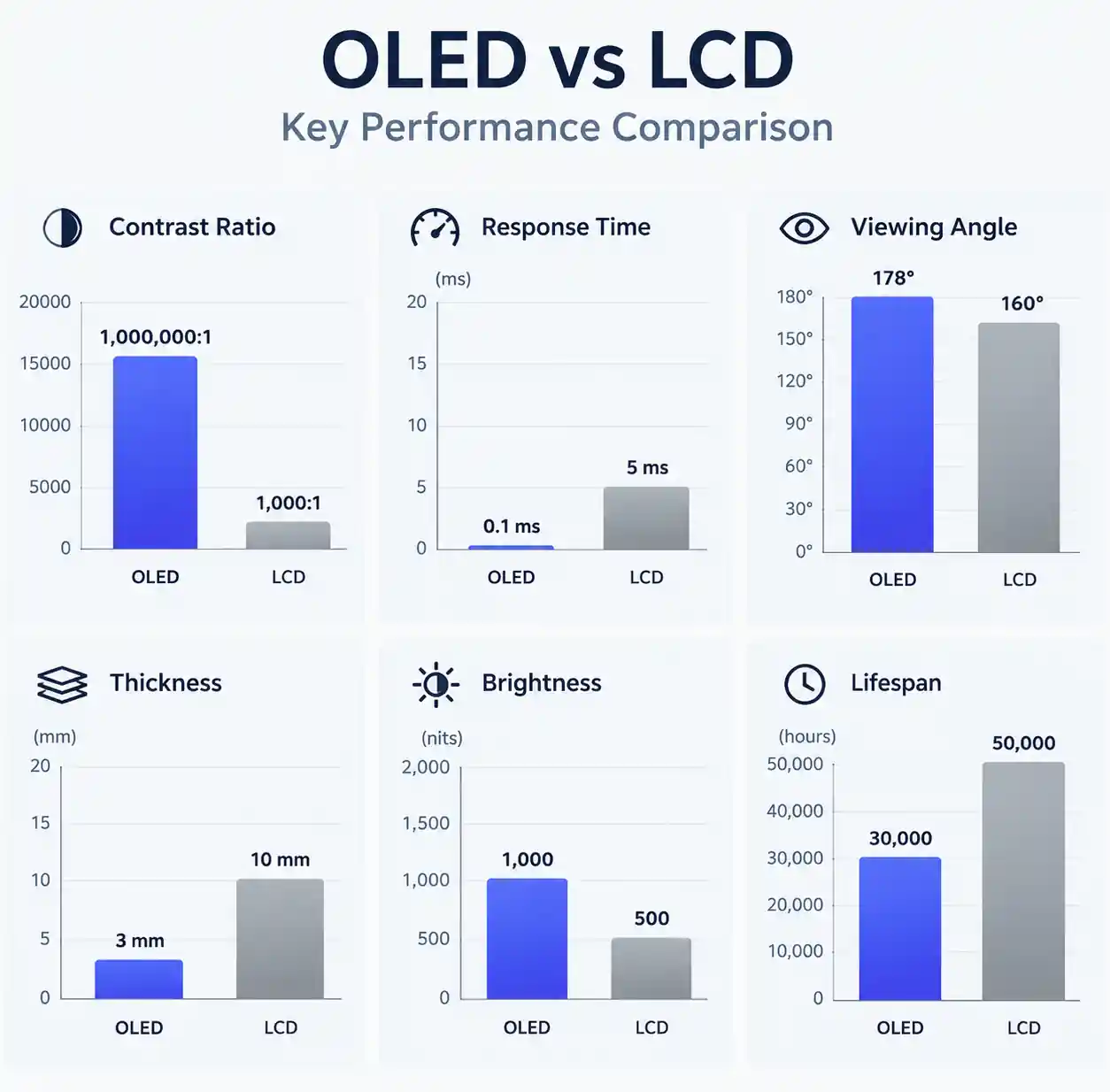 OLED vs LCD performance comparison chart
Power Consumption and Efficiency
OLED draws power proportional to pixel luminance—dark content consumes minimal current while bright screens draw maximum power. LCD backlights consume constant power regardless of content, typically 20-100 mA for small modules.
Testing with Steam Deck showed OLED achieved 28-33% longer battery life versus LCD under identical gaming workloads. This advantage appears with content containing significant dark areas like user interfaces with black backgrounds.
However, LCD power consumption remains predictable, simplifying power budget calculations. OLED varies from near-zero for all-black content to higher consumption than LCD when displaying predominantly white content. For bright user interfaces at maximum brightness, LCD may consume less total power.
Industrial instruments typically operate at moderate brightness with mixed content. For these applications, OLED offers 15-30% power reduction versus LCD. Consumer applications with variable content and automatic brightness benefit most from OLED efficiency, extending battery life in smartphones and wearables.
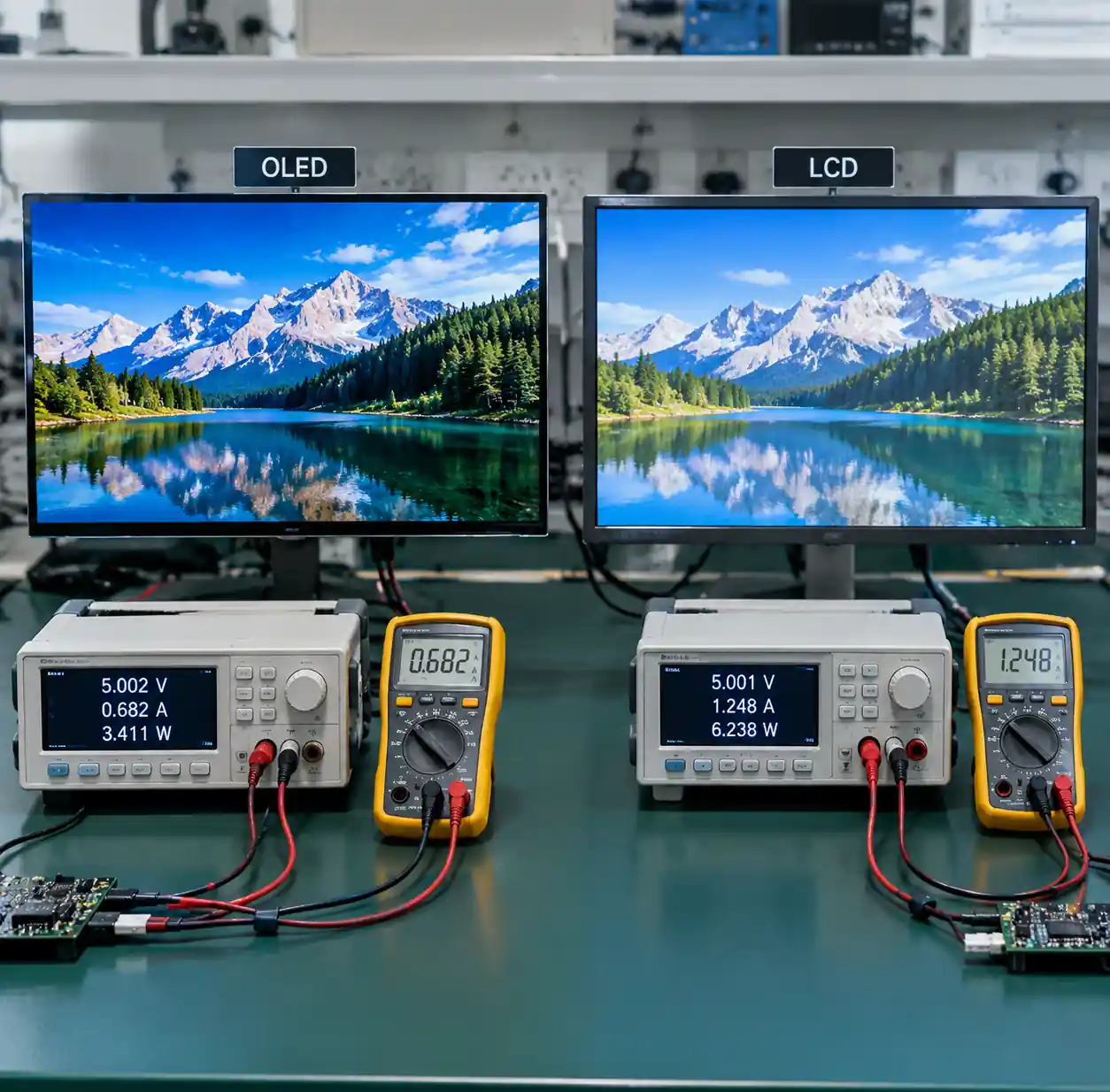 Display power consumption measurement setup
Lifespan and Burn-In Risks
OLED organic materials degrade through oxidation, reducing brightness over time. Typical OLED panels achieve 20,000-50,000 hours before brightness decreases to 50% of initial output. LCD demonstrates 50,000-100,000 hours operational life with no image retention.
Burn-in occurs when static interface elements cause uneven OLED pixel wear, creating permanent ghost images. This makes OLED unsuitable for:
- Digital signage with fixed logos and text
- Security monitoring with static timestamps
- Industrial HMIs with permanent menu structures
- Medical displays with fixed annotation overlays
- Automotive clusters with constant gauge positions
Modern OLED implements pixel shifting and brightness limiting to mitigate burn-in, but cannot eliminate fundamental degradation. For applications with 3-year or shorter cycles and varied content, OLED remains viable. Industrial applications requiring 5+ year deployments with 24/7 operation should specify LCD.
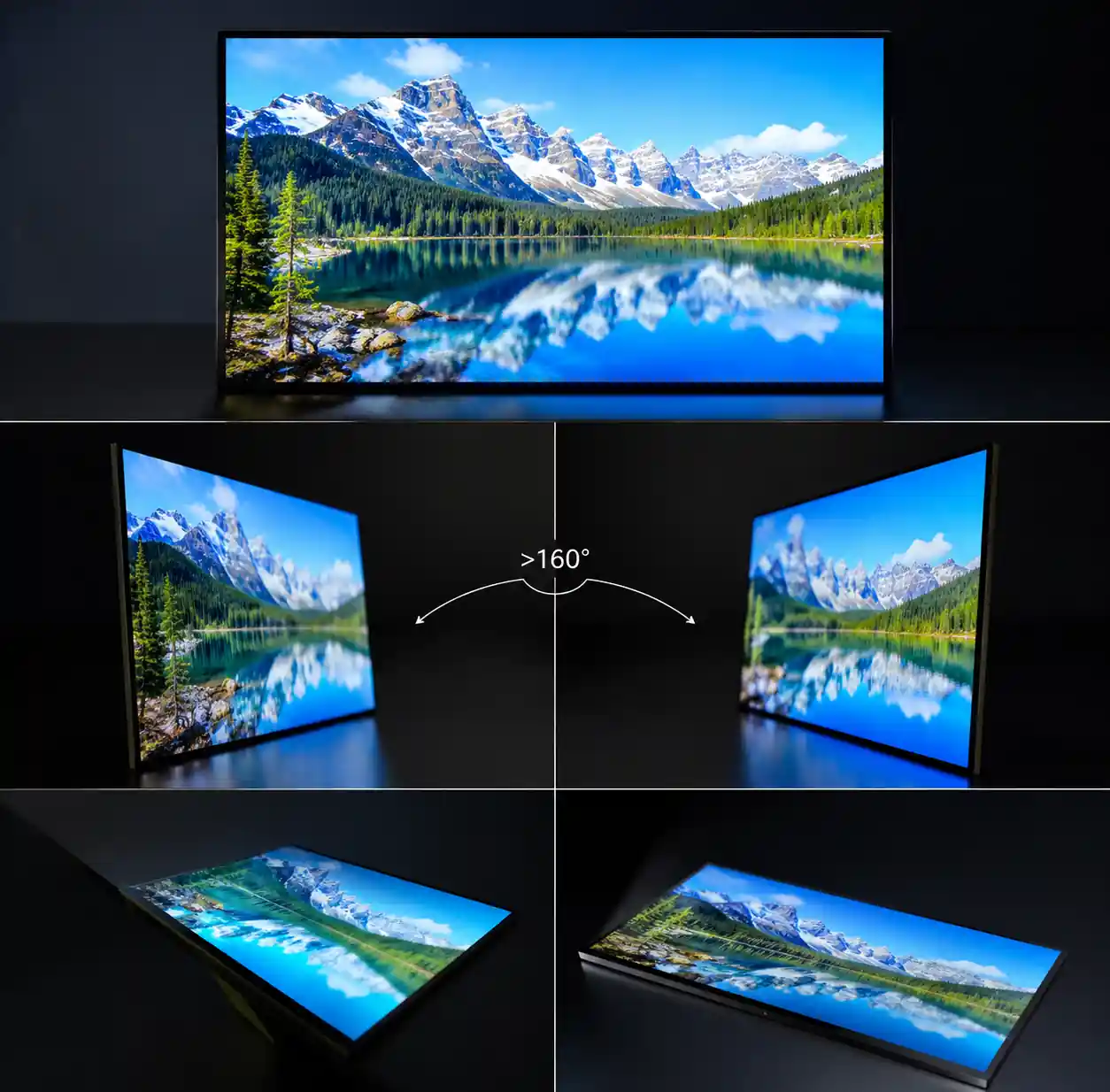 OLED display wide viewing angle demonstration
Driver IC Requirements
OLED requires specialized driver ICs (DDICs) that generate higher voltages than LCD controllers. Small OLED modules integrate drivers like SSD1306 or SSD1309 directly on the panel, simplifying connection to microcontrollers via I2C or SPI interfaces.
| Driver IC Feature | OLED Requirements | LCD Requirements |
|---|---|---|
| Voltage Generation | VDD 3.3-5V, VCOMH 7-15V | VDD 3.3V, VCOM ±5V |
| Current Drive | 10-100 mA per segment | <1 mA per pixel |
| Refresh Control | 60-120 Hz typical | 60-75 Hz typical |
| Interface | I2C, SPI, MIPI DSI | LVDS, eDP, MIPI DSI |
When sourcing display modules, verify driver IC availability and lead times. OLED driver ICs typically cost $0.50-$2.50 per unit versus $0.30-$1.50 for LCD controllers. For automotive applications requiring AEC-Q100 qualification, specify automotive-grade driver ICs with extended temperature range (-40°C to +125°C).
Application Suitability Guide
Choose OLED for:
- Smartphones, wearables, and portable devices where battery life and visual quality matter
- Automotive infotainment systems with 3-5 year replacement cycles
- Medical portable devices like patient monitors and handheld diagnostics
- Consumer electronics prioritizing thin form factor and premium appearance
- Applications with predominantly dark user interfaces
Choose LCD for:
- Industrial automation HMI panels requiring 24/7 operation for 5-10 years
- Outdoor displays needing >1000 cd/m² brightness
- Security monitoring with static overlays and timestamps
- Digital signage with fixed logos and branding elements
- Applications where cost reduction is critical
- Any deployment with constant static content
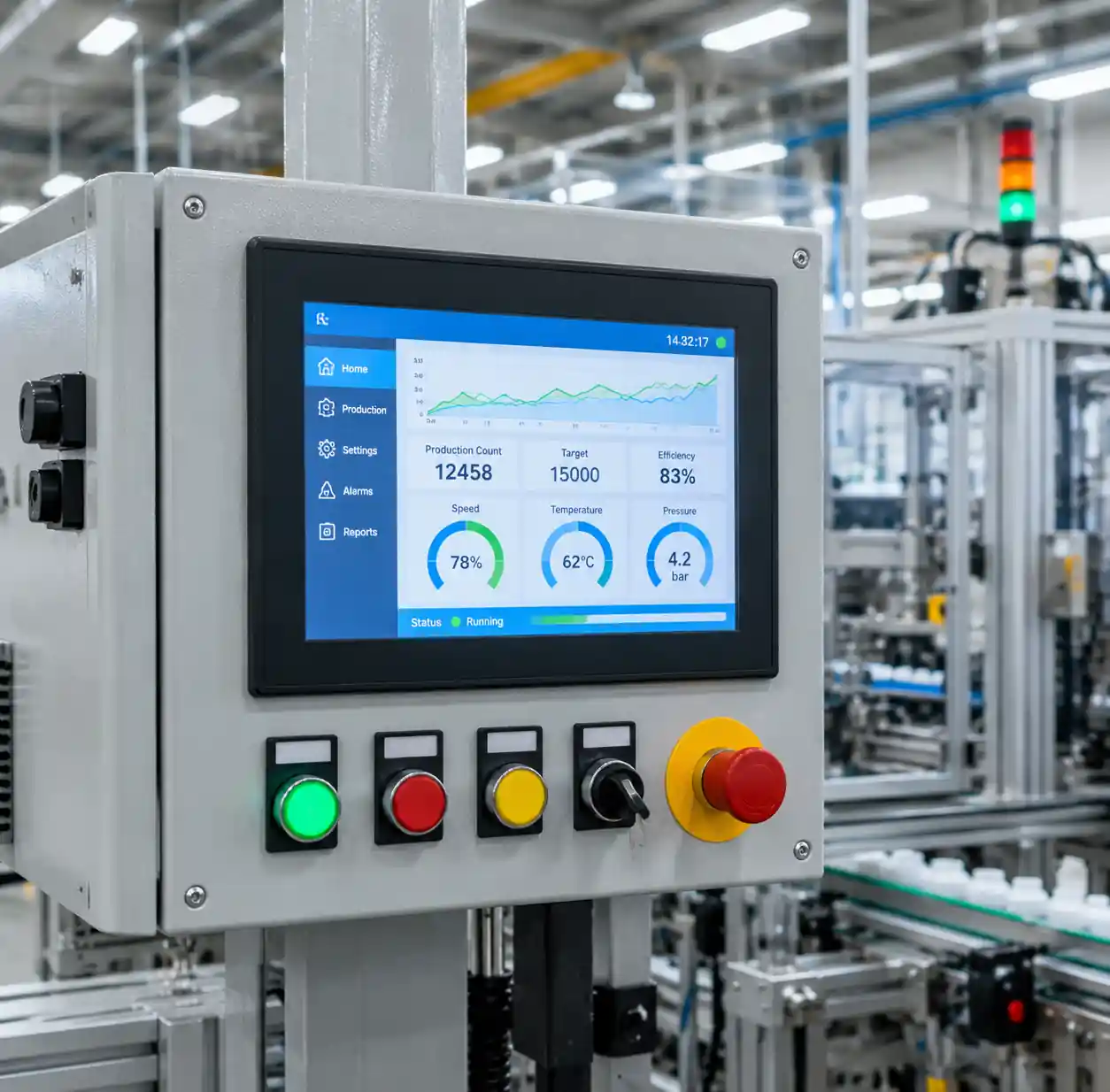 Industrial LCD control panel in manufacturing environment
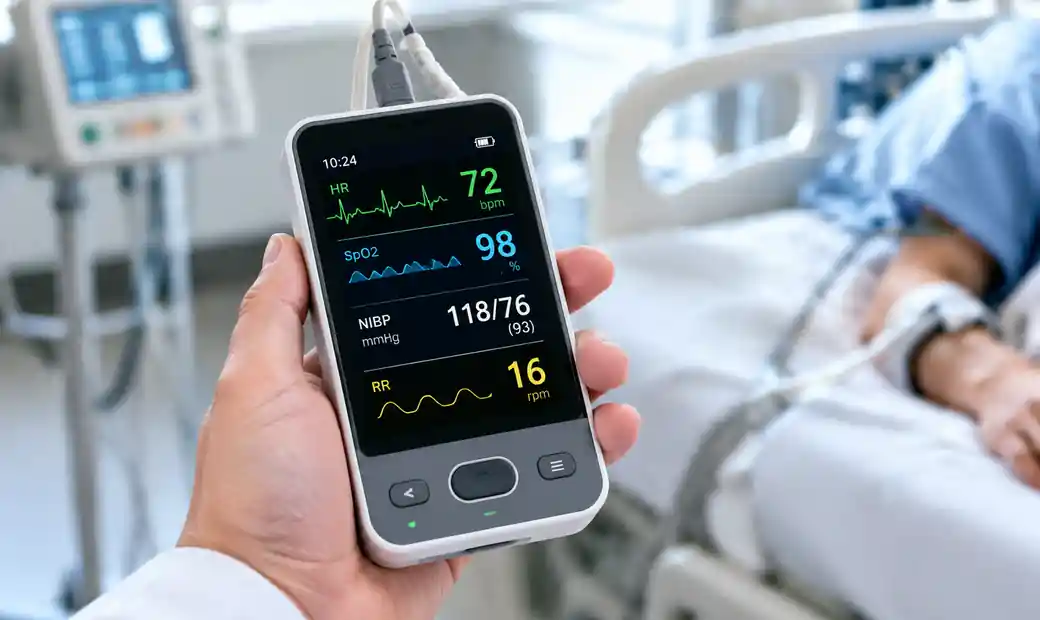 OLED display in medical device application
Cost Analysis
OLED manufacturing costs remain 20-40% higher than LCD due to organic material deposition complexity and lower production yields. However, total cost of ownership (TCO) must consider multiple factors.
Initial Component Costs:
- Small OLED modules (0.96"-2.4"): $3-$15 per unit
- Equivalent LCD modules: $2-$8 per unit
- Large OLED panels (5"+): $25-$150 per unit
- Equivalent LCD panels: $15-$80 per unit
TCO Considerations:
- OLED eliminates backlight components, reducing BOM by 2-5 parts
- Thinner OLED enables smaller enclosures, reducing housing costs
- OLED power savings reduce battery capacity requirements
- LCD longer lifespan reduces warranty claims and field replacements
- OLED burn-in risk increases support costs for static-content applications
For consumer products with 1-3 year lifecycles, OLED premium pricing pays for itself through enhanced user experience and competitive differentiation. For industrial applications requiring 5+ year deployments, LCD lower TCO from extended lifespan and zero burn-in risk outweighs OLED visual advantages.
Optimize procurement costs through authorized distributor relationships and volume purchasing. Plan for component lifecycle management as display technologies evolve rapidly.
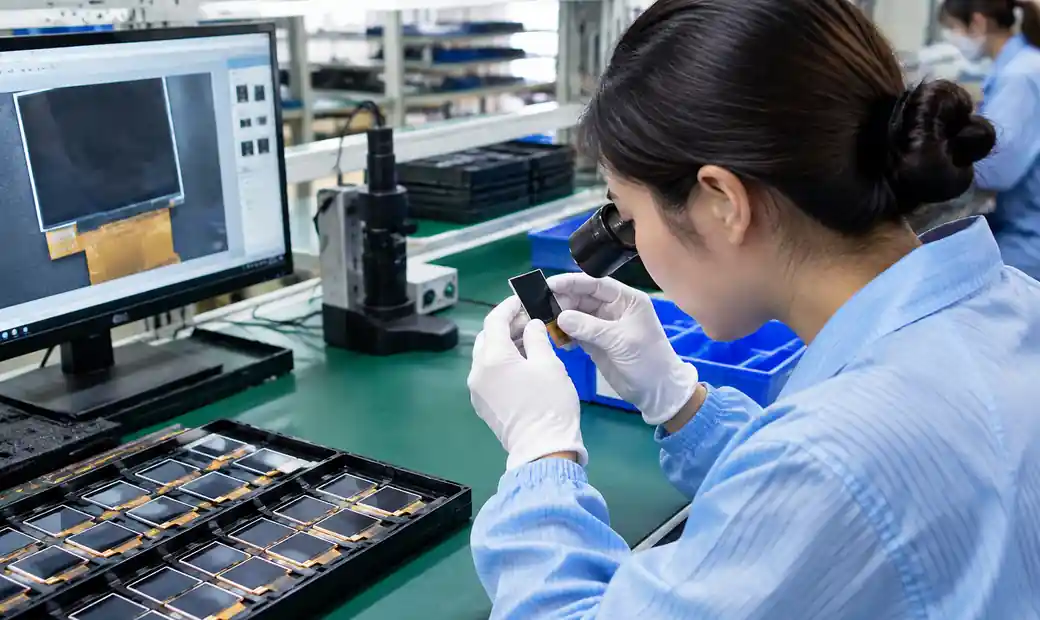 Electronic component quality verification and inspection
FAQ
Q: How long do OLED displays last in consumer applications?
OLED displays typically achieve 20,000-50,000 hours operational life before brightness degrades to 50%. For smartphones used 5 hours daily, this equals 11-27 years. However, most consumer devices replace within 2-3 years, making OLED lifespan adequate for this market.
Q: Can OLED displays operate in direct sunlight?
OLED brightness typically reaches 400-1000 cd/m², insufficient for direct sunlight visibility requiring >1500 cd/m². LCD panels with high-brightness LED backlights achieve 1500-3000 cd/m², making them superior for outdoor applications.
Q: What causes OLED burn-in and how can it be prevented?
Burn-in occurs when static content causes uneven pixel aging. Mitigation strategies include pixel shifting, brightness limiting, screensavers, and varying content. Applications with persistent static elements should use LCD instead.
Q: Are OLED displays more power-efficient than LCD?
OLED efficiency depends on content. Dark interfaces consume 30-50% less power than LCD. Bright white content consumes more power than LCD. Average mixed content shows OLED 15-30% more efficient.
Q: Which display technology is better for medical devices?
For portable medical devices like patient monitors, OLED offers better contrast and power efficiency. For fixed diagnostic imaging requiring 10+ year lifespan, LCD provides superior durability and no burn-in risk.
Conclusion
OLED and LCD serve distinct application requirements. OLED delivers superior contrast ratio, faster response time, wider viewing angles, and power efficiency with dark content, making it ideal for consumer electronics and portable devices with 1-3 year replacement cycles. LCD provides 2-3x longer operational lifespan, higher peak brightness, predictable power consumption, and zero burn-in risk, making it the correct choice for industrial automation, digital signage, and any application requiring 24/7 operation beyond 5 years.
If you need reliable display components for your product development, Hitop Tech offers comprehensive procurement services with global sourcing network across Asia, Europe, North America, and Africa. Our authorized distributor relationships ensure authentic components and on-time delivery. Contact us today for display module sourcing, technical consultation, and supply chain optimization services.