



Co-Packaged Optics (CPO) in AI Data Centers: Architecture, Trade-offs, and Engineering Realities
Co-Packaged Optics (CPO) integrates optical engines directly with switch ASICs at the package level, significantly shortening electrical interconnects. This reduces SerDes power consumption, improves bandwidth density, and enhances signal integrity. CPO is emerging as a key enabler for 800G, 1.6T, and beyond, especially in AI-driven data center networks. However, it introduces new engineering challenges in thermal management, reliability, manufacturability, and serviceability. This article provides a deep technical analysis of CPO architecture, system components, thermal constraints, operational trade-offs, and its impact compared to traditional pluggable optics.
Table of Contents
- 1. Technical Fundamentals of CPO
- 2. Why AI Data Centers Are Driving CPO Adoption
- 3. CPO System Architecture and Key Components
- 4. Signal Path and Operating Mechanism
- 5. Thermal Design and Reliability Challenges
- 6. Performance Benefits and System Value
- 7. Impact on Data Center Maintenance
- 8. Common Problems and Engineering Solutions
- 9. CPO vs Pluggable Optics
- 10. Speed Roadmap and Technology Evolution
- 11. FAQ
1. Technical Fundamentals of CPO
Co-Packaged Optics (CPO) is fundamentally a co-design approach between photonics and advanced semiconductor packaging. Instead of routing high-speed electrical signals across long PCB traces to front-panel optical modules, CPO places optical engines in close proximity to the switch ASIC within the same package or substrate.
This architectural shift results in:
- Electrical trace length reduction from centimeters to millimeters
- Significant reduction in SerDes power consumption (typically 20–40%)
- Improved signal integrity (lower insertion loss and jitter)
- Reduced dependency on high-end PCB materials and retimers
CPO essentially redefines the boundary between electrical and optical domains in data center networking.
2. Why AI Data Centers Are Driving CPO Adoption
AI workloads, especially distributed training, impose extreme demands on network infrastructure:
- Ultra-high bandwidth (Tbps-level interconnects)
- Low latency (microsecond-scale communication)
- High energy efficiency (W/Gbps optimization)
Traditional pluggable optics face several limitations:
- Increasing SerDes power consumption at 112G/224G PAM4
- Signal degradation over long PCB traces
- Bandwidth density limitations at the front panel
CPO addresses these constraints by moving optics closer to compute, enabling:
- Reduced electrical losses
- Lower latency data paths
- Higher port density and scalability
This makes CPO particularly suitable for large-scale GPU clusters and AI training fabrics.
3. CPO System Architecture and Key Components
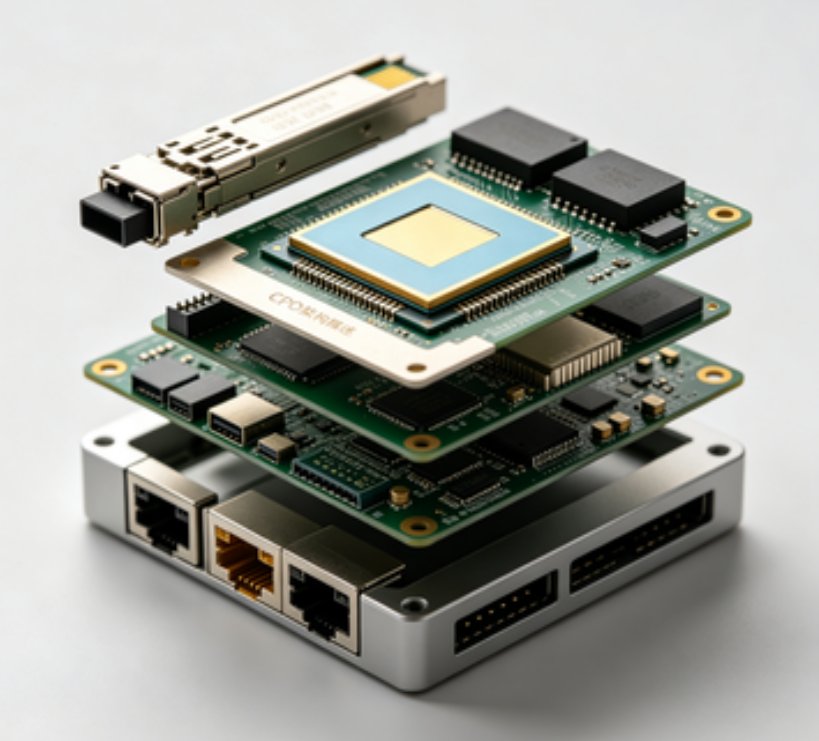
3.1 Core Components
- Switch ASIC
- Provides Tbps-level switching capacity
- Integrates high-speed SerDes (112G/224G PAM4)
- Optical Engines
- Perform electrical-to-optical (E/O) and optical-to-electrical (O/E) conversion
- Typically based on silicon photonics (SiPh) or indium phosphide (InP)
- Laser Source
- Often implemented as External Laser Source (ELS)
- Improves thermal stability and reliability
- Package Substrate / Interposer
- Enables high-density interconnects
- Supports advanced packaging (2.5D/3D integration)
- Fiber Coupling Interface
- Uses grating or edge coupling
- Requires micron-level alignment precision
4. Signal Path and Operating Mechanism
The CPO signal flow can be described as follows:
- The switch ASIC generates high-speed electrical signals
- Signals travel through ultra-short electrical interconnects (<10 mm)
- Optical engines convert electrical signals into optical signals
- Optical signals are transmitted via fiber with minimal loss
- At the receiver, optical signals are converted back to electrical signals
Key engineering optimizations:
- Elimination of retimers
- Reduced Forward Error Correction (FEC) overhead
- Lower Bit Error Rate (BER)
5. Thermal Design and Reliability Challenges
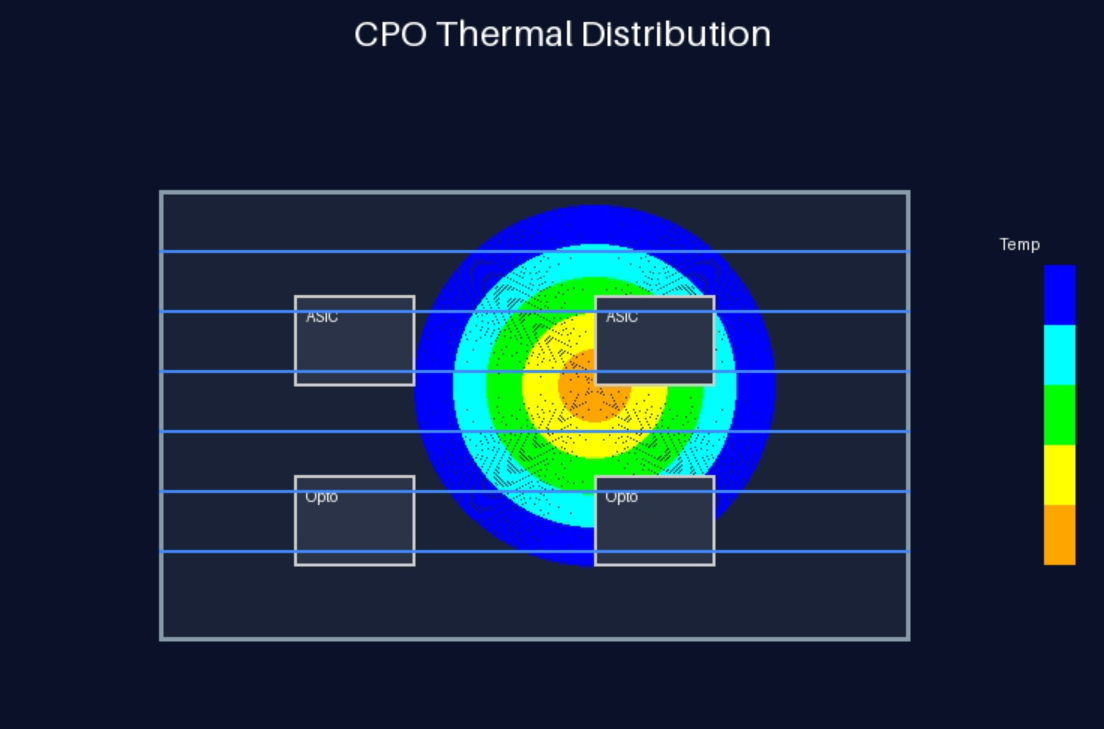
5.1 Thermal Coupling Issues
CPO introduces a critical challenge: co-locating high-power ASICs with thermally sensitive optical components.
- ASIC power: typically 400W–800W+
- Optical components require stable and relatively lower temperatures
This creates conflicting thermal requirements within a compact footprint.
5.2 Engineering Solutions
- Thermal isolation structures between ASIC and optics
- Direct-to-chip liquid cooling systems
- External Laser Source (ELS) architectures
- Thermoelectric Coolers (TEC) for precise control
5.3 Long-Term Reliability Risks
- Thermal cycling leading to mechanical stress
- Laser degradation over time
- Optical alignment drift affecting coupling efficiency
6. Performance Benefits and System Value
CPO’s value lies not only in higher speed but in efficiently enabling higher speed:
- Power reduction: ~20–40%
- Bandwidth density: >2× improvement
- Latency reduction through shorter electrical paths
- Enhanced scalability for large AI clusters
These advantages directly impact distributed training efficiency and system-level performance.
7. Impact on Data Center Maintenance
CPO significantly changes traditional maintenance workflows:
| Aspect | Pluggable Optics | CPO |
|---|---|---|
| Failure Isolation | Module-level | Board/System-level |
| Replacement Method | Hot-swappable | Full board replacement |
| MTTR | Low | High |
| Operational Complexity | Low | High |
Operational implications:
- Increased need for predictive maintenance
- Enhanced telemetry and monitoring systems
- Greater reliance on redundancy (e.g., N+1 architectures)
8. Common Problems and Engineering Solutions
| Problem | Root Cause | Solution |
|---|---|---|
| Thermal interference | ASIC-optics heat coupling | Thermal isolation + liquid cooling |
| Poor serviceability | High integration level | Modular CPO design |
| Manufacturing complexity | High-precision optical alignment | Automated packaging processes |
| Optical loss variation | Temperature drift | TEC-based control |
| High cost | Complex fabrication | Standardization and scaling |
9. CPO vs Pluggable Optics
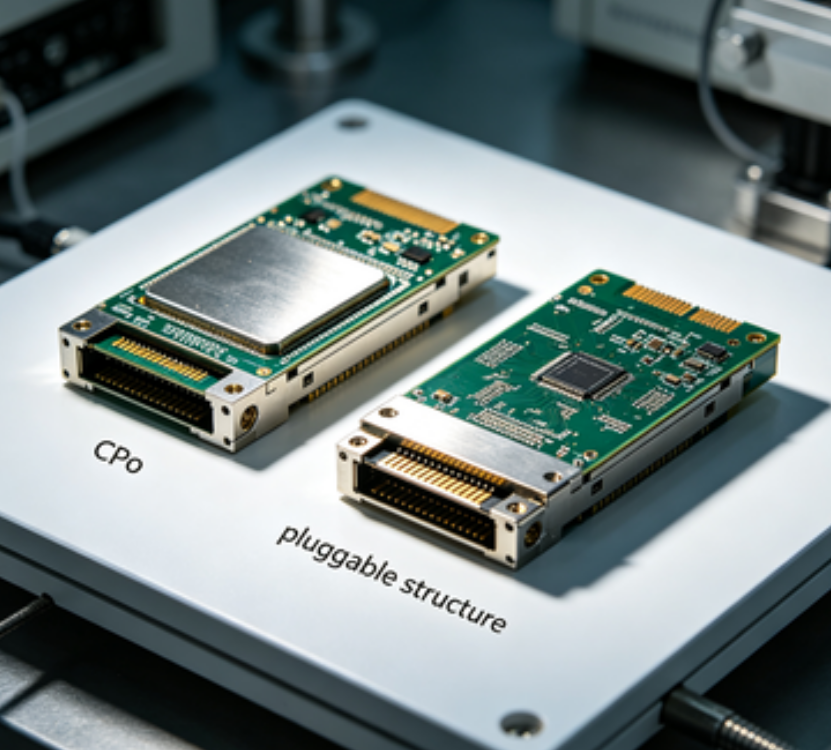
| Dimension | CPO | Pluggable Optics |
|---|---|---|
| Architecture | Package-level integration | Front-panel modules |
| Power Efficiency | Low power consumption | Higher power consumption |
| Bandwidth | Ultra-high | Limited at extreme speeds |
| Serviceability | Difficult | Easy |
| Thermal Management | Complex | Simpler |
| Maturity | Emerging | Mature |
Conclusion:
CPO and pluggable optics will coexist in the near to mid-term. CPO will primarily be deployed in hyperscale AI clusters requiring extreme bandwidth density.
10. Speed Roadmap and Technology Evolution
Current and future speed targets:
- 800G (currently deployed)
- 1.6T (under development)
- 3.2T (future roadmap)
Key enabling technologies:
- 224G SerDes
- Silicon photonics (SiPh)
- Advanced packaging (2.5D/3D integration)
- External laser architectures
CPO is positioned as a long-term solution for overcoming electrical I/O scaling limits.
11. FAQ
Q1: Will CPO replace pluggable optics completely?
No. Both technologies will coexist. CPO is best suited for ultra-high bandwidth AI environments, while pluggable optics remain practical for general-purpose networking.
Q2: What is the biggest challenge in CPO deployment?
Thermal management and serviceability are the primary engineering bottlenecks.
Q3: Why is external laser architecture preferred?
It reduces thermal load within the package and improves laser lifetime and system reliability.
Q4: What is the real benefit of CPO in AI workloads?
It reduces communication power consumption and increases bandwidth density, improving overall training efficiency and scalability.