



Electrolytic vs Solid Polymer vs Hybrid Capacitors: Complete Comparison Guide 2026
Choosing the right capacitor type can make or break your electronic design. Whether you're working on power supplies, automotive electronics, or consumer devices, understanding the differences between electrolytic, solid polymer, and hybrid capacitors is essential for optimal performance and reliability.
Table of Contents
- What Are Capacitors and Why Do They Matter?
- Electrolytic Capacitors: Traditional Workhorses
- Solid Polymer Capacitors: Modern High-Performance Solutions
- Hybrid Capacitors: Best of Both Worlds
- Performance Comparison: ESR, Ripple Current, and Temperature
- Lifespan and Reliability Factors
- Application Guide: Which Capacitor for Your Project?
- Cost vs Performance Trade-offs
- Common Failure Modes and Prevention
- Future Trends in Capacitor Technology
1. What Are Capacitors and Why Do They Matter?
Capacitors are passive electronic components that store and release electrical energy. They stabilize voltage, filter noise, and provide power bursts in virtually every electronic device you use daily.
The type of capacitor you choose directly impacts circuit performance, product lifespan, and overall reliability. Making the wrong selection can lead to premature failure, reduced efficiency, or expensive redesigns.
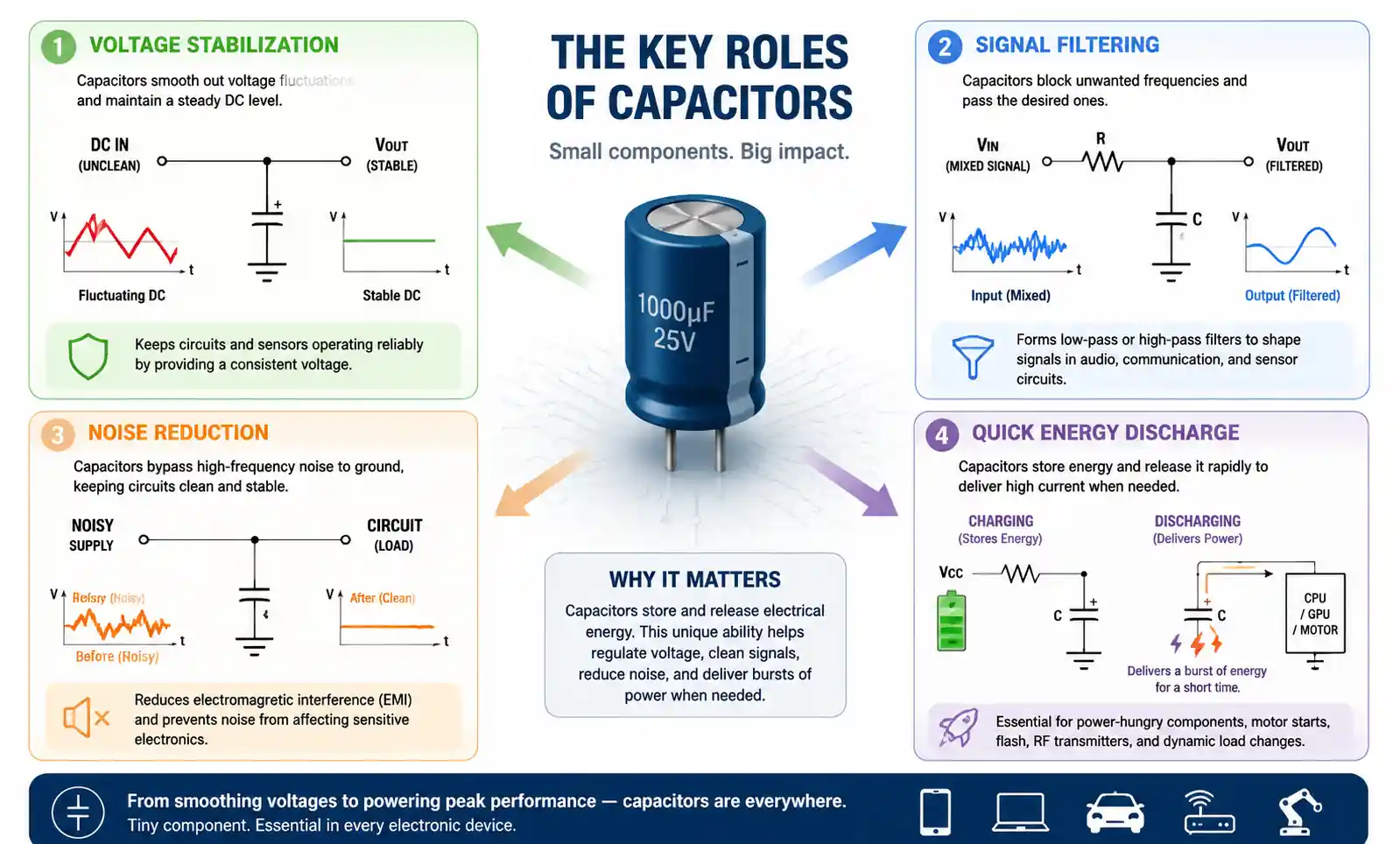
Key capacitor functions include:
- Voltage regulation in power supplies
- Signal filtering and noise reduction
- Energy storage for quick discharge
- Decoupling and bypassing in digital circuits
- Timing applications
Understanding the fundamental differences between capacitor types helps you make informed decisions that balance performance, cost, and longevity.
2. Electrolytic Capacitors: Traditional Workhorses
Electrolytic capacitors use a liquid electrolyte solution to achieve high capacitance values in relatively small packages. They've been the industry standard for decades in applications requiring significant energy storage.
How Electrolytic Capacitors Work
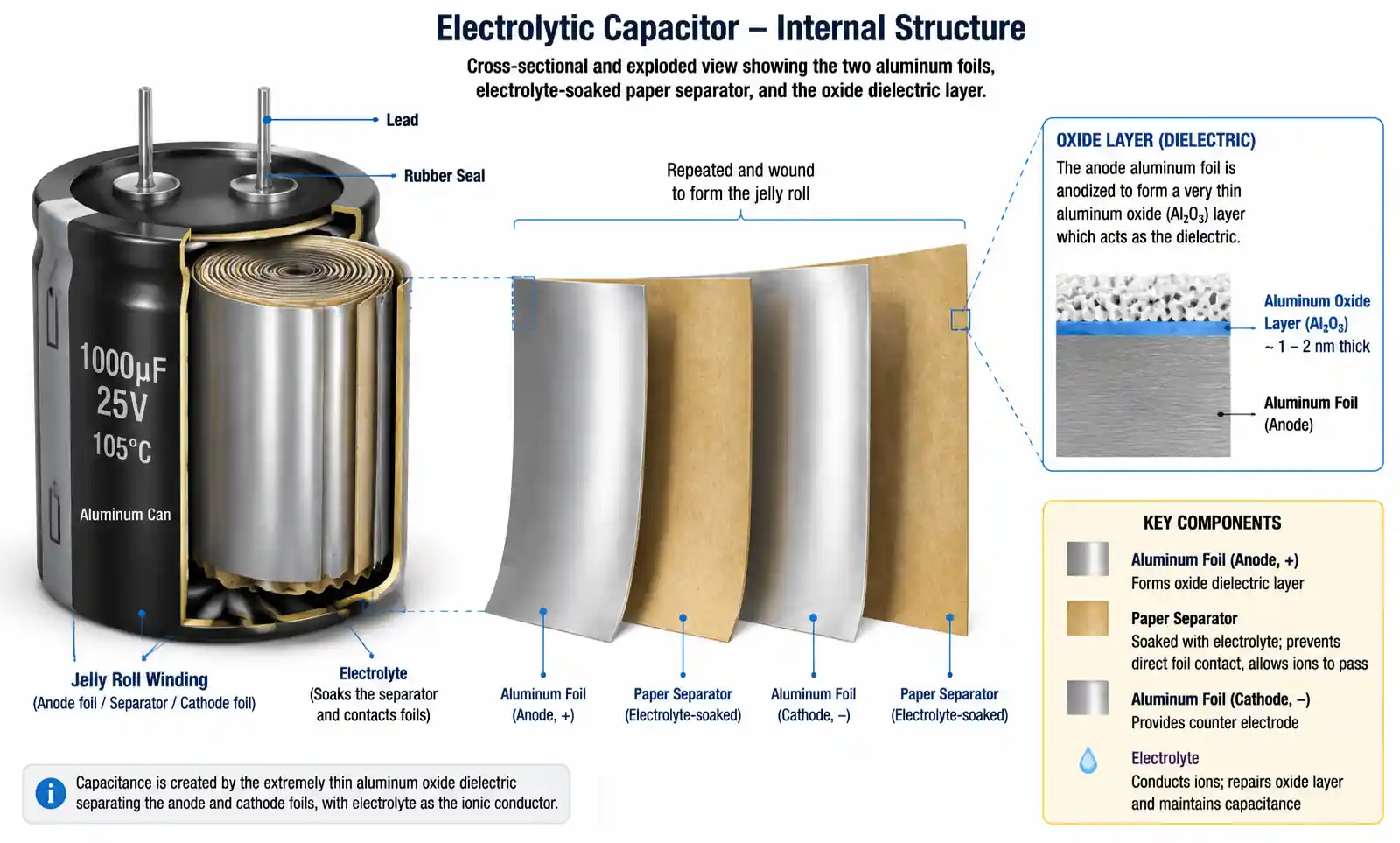
These capacitors consist of two aluminum foils separated by an electrolyte-soaked paper. One foil has an oxide layer that acts as the dielectric. The liquid electrolyte provides the electrical connection to the second electrode.
Advantages of Electrolytic Capacitors
High capacitance-to-volume ratio: Electrolytic capacitors deliver more capacitance per unit volume than most other types, making them ideal for space-constrained designs.
Cost-effective: They offer the most affordable solution for applications requiring large capacitance values (typically 1μF to several thousand μF).
Overvoltage tolerance: Traditional electrolytics handle voltage surges better than polymer alternatives, providing built-in protection against transient spikes.
Limitations to Consider
Temperature sensitivity: Capacitance can vary by up to 30% across the operating temperature range, affecting circuit stability.
Higher ESR at frequency: The liquid electrolyte has higher resistance at high frequencies, limiting performance in fast-switching applications.
Limited lifespan: The electrolyte gradually evaporates over time, especially at elevated temperatures, leading to eventual failure.
Polarity constraint: Reversed polarity causes immediate damage, requiring careful circuit design.
3. Solid Polymer Capacitors: Modern High-Performance Solutions
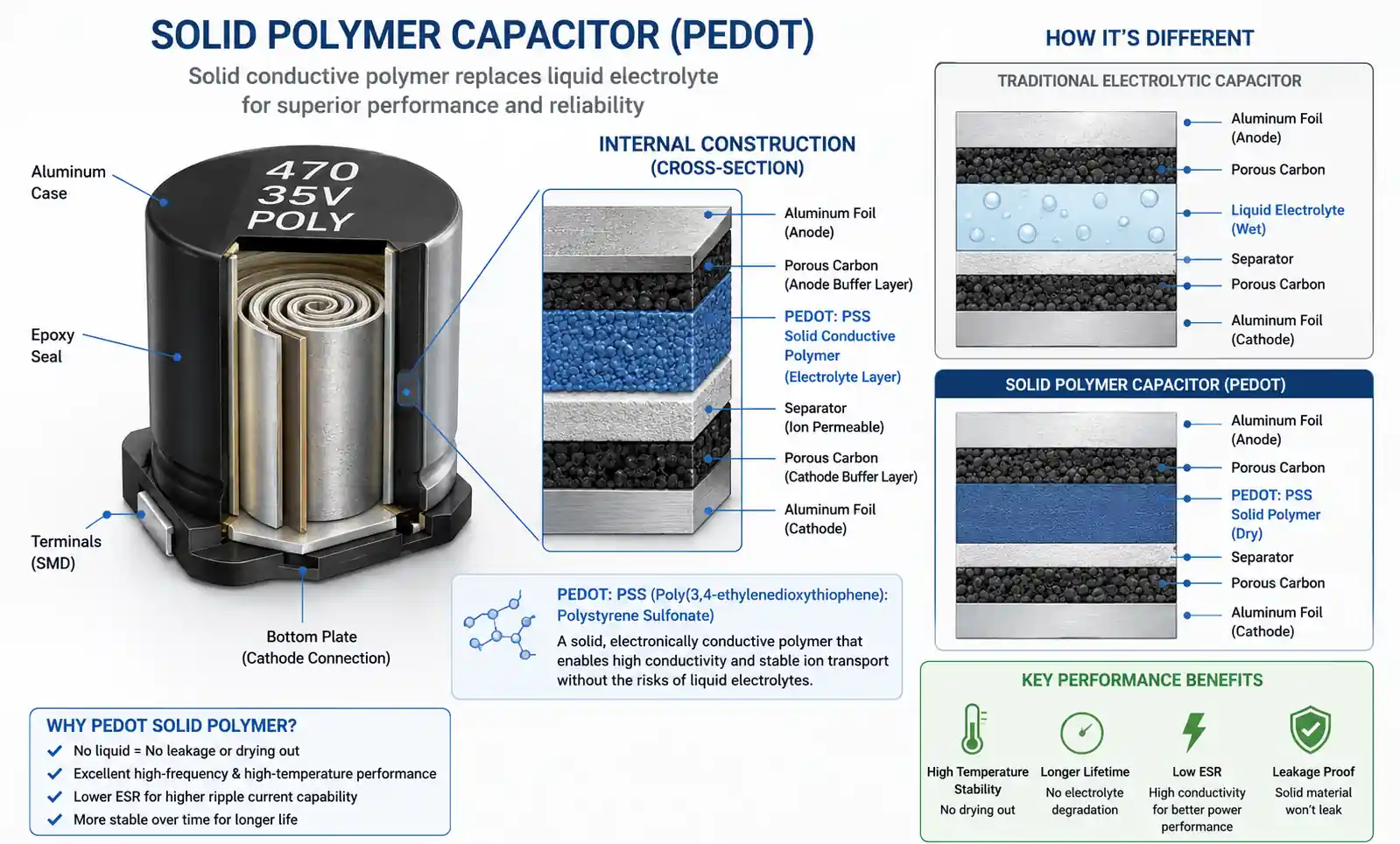
Solid polymer capacitors replace the liquid electrolyte with a conductive polymer material. This fundamental change delivers superior electrical performance and reliability.
Polymer Capacitor Construction
Instead of liquid electrolyte, these capacitors use solid conducting polymers like PEDOT (poly(3,4-ethylenedioxythiophene)). This material provides excellent conductivity while remaining solid throughout the capacitor's operating range.
Performance Advantages
Ultra-low ESR: Polymer capacitors achieve ESR values 10-20 times lower than conventional electrolytics, enabling better high-frequency performance and efficiency.
High ripple current capability: They can handle ripple currents up to 6 times higher than equivalent electrolytic capacitors without overheating.
Temperature stability: Capacitance remains within 5% of its nominal value across the full temperature range, compared to ±30% for liquid electrolytics.
Extended lifespan: Without liquid electrolyte to evaporate, polymer capacitors last significantly longer—often 10 times longer at equivalent operating conditions.
Better frequency response: Low ESR across a wide frequency range makes them ideal for high-speed digital circuits and switching power supplies.
Polymer Capacitor Limitations
Lower overvoltage tolerance: Polymer capacitors are more sensitive to voltage spikes and may fail catastrophically if significantly overvolted.
Higher cost: The advanced materials and manufacturing processes result in 2-4 times higher prices compared to standard electrolytics.
Lower maximum capacitance: The highest available capacitance values are generally lower than what electrolytics can achieve in the same package size.
4. Hybrid Capacitors: Best of Both Worlds
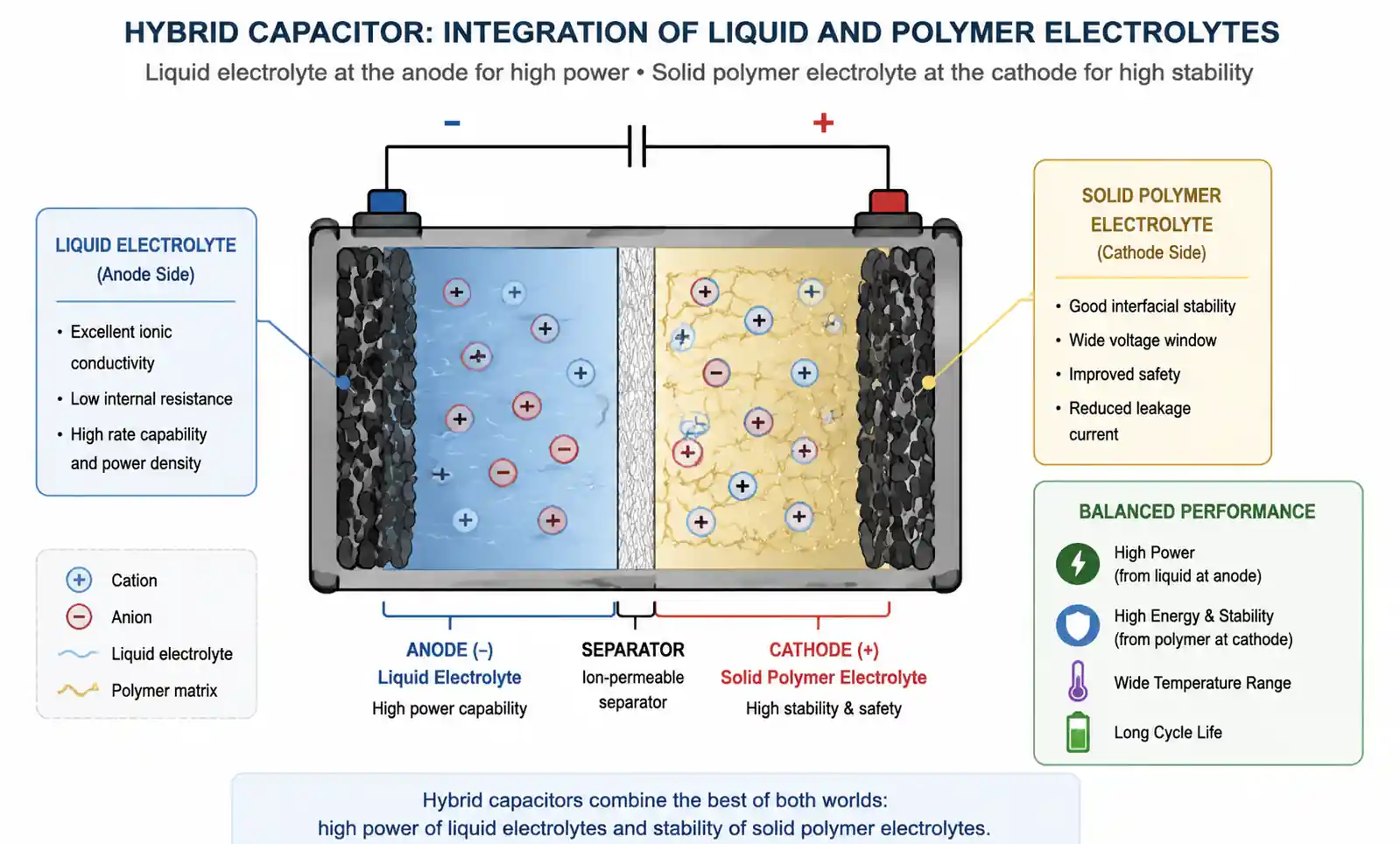
Hybrid capacitors combine liquid electrolyte with solid polymer materials to balance performance, reliability, and cost. They represent an evolutionary middle ground between traditional and modern capacitor technologies.
Hybrid Capacitor Design
Hybrid capacitors typically use liquid electrolyte for the anode connection and solid polymer at the cathode, or employ a polymer-coated separator. This configuration captures benefits from both technologies.
Why Choose Hybrid Capacitors?
Balanced ESR performance: Lower than standard electrolytics but not as extreme as pure polymer types, providing good efficiency without the overvoltage sensitivity.
Improved reliability: More resistant to electrolyte dry-out than traditional capacitors while maintaining better surge voltage handling than polymer types.
Cost-effective upgrade: Priced between standard electrolytics and polymer capacitors, they offer a practical middle option.
Enhanced ripple current: Better ripple current handling than liquid electrolytics, though not quite matching polymer performance.
Hybrid Capacitor Trade-offs
Hybrid capacitors still contain some liquid electrolyte, so they remain susceptible to gradual evaporation over time, though at a reduced rate compared to traditional electrolytics.
5. Performance Comparison: ESR, Ripple Current, and Temperature
Understanding how these capacitor types perform across critical parameters helps you match the right component to your application needs.
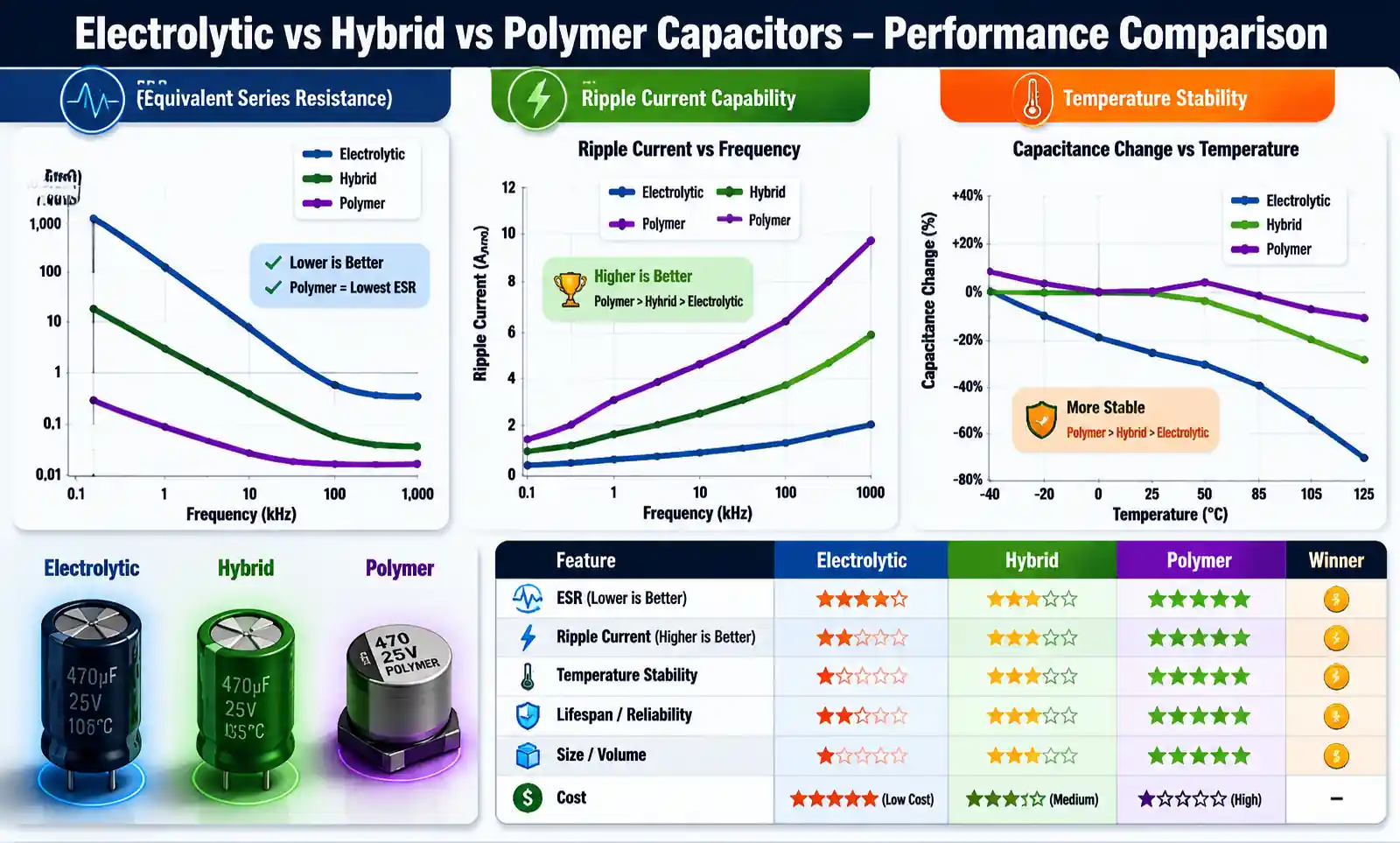
Equivalent Series Resistance (ESR)
ESR represents the resistive losses within a capacitor. Lower ESR means less heat generation, higher efficiency, and better high-frequency performance.
Typical ESR values at 100kHz:
- Electrolytic capacitors: 50-500 mΩ
- Hybrid capacitors: 20-100 mΩ
- Polymer capacitors: 5-30 mΩ
Lower ESR directly translates to reduced power dissipation, which is especially critical in high-current applications.
Ripple Current Capability
Ripple current is the AC component of the current flowing through the capacitor. Higher ripple current capability means the capacitor can handle more demanding applications without overheating.
Ripple current multipliers (vs. standard electrolytic):
- Electrolytic: 1.0x (baseline)
- Hybrid: 2-3x
- Polymer: 4-6x
This advantage makes polymer and hybrid types particularly suitable for switching power supplies and DC-DC converters.
Temperature Characteristics
Temperature affects both capacitor performance and lifespan. Understanding these effects is crucial for reliable design.
Capacitance variation over temperature range:
- Electrolytic: ±20-30%
- Hybrid: ±15-20%
- Polymer: ±5-10%
Polymer capacitors maintain stable performance across temperature extremes, reducing the need for temperature compensation in precision circuits.
6. Lifespan and Reliability Factors
Capacitor lifespan directly impacts product maintenance costs and customer satisfaction. The electrolyte type fundamentally determines reliability characteristics.
Lifespan Calculation Basics
Capacitor lifetime follows the Arrhenius equation: for every 10°C temperature increase, lifespan typically halves. This relationship applies most strongly to liquid electrolytic capacitors.
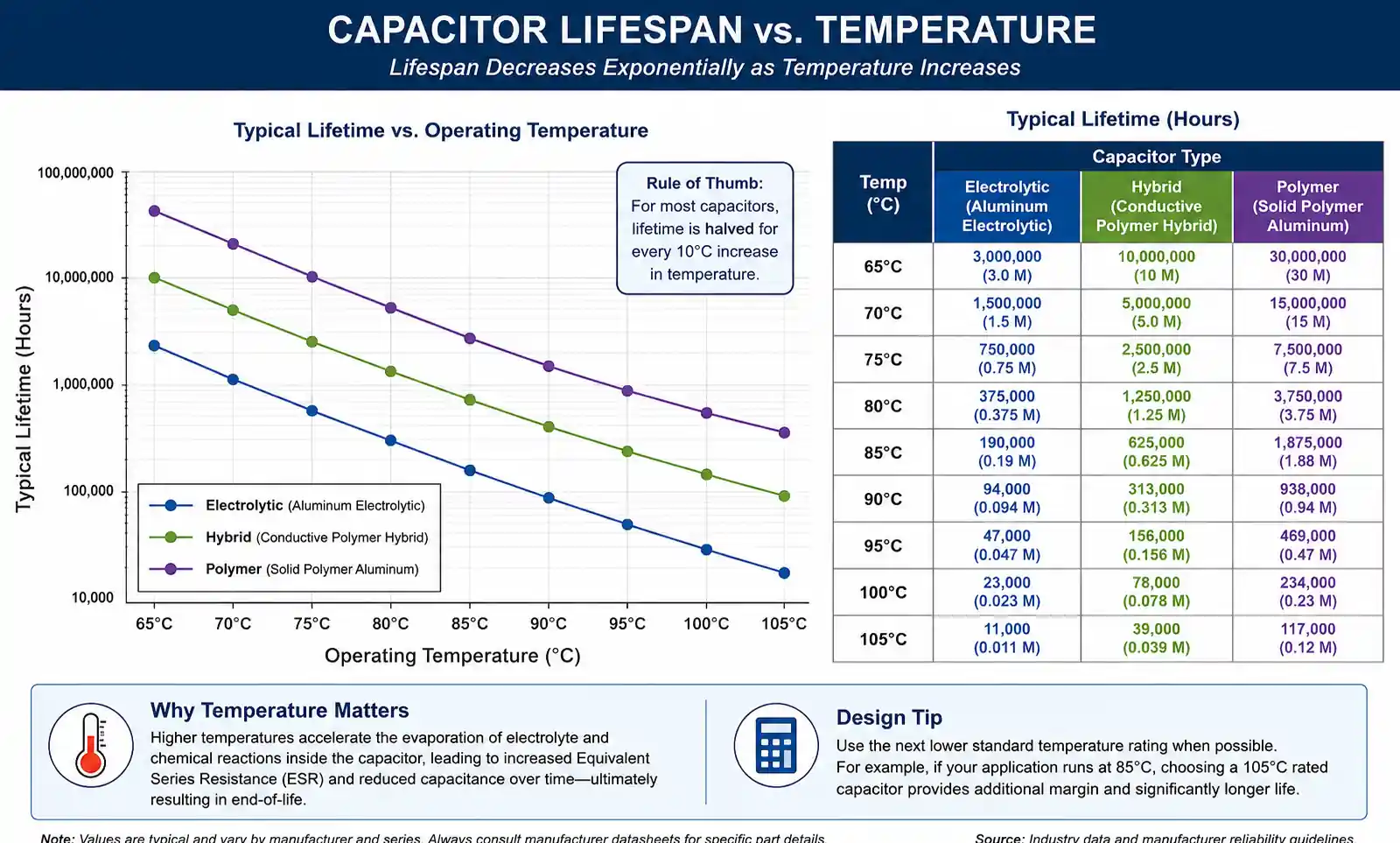
Typical rated lifespans at 105°C:
- Standard electrolytic: 2,000-5,000 hours
- Hybrid capacitors: 5,000-10,000 hours
- Polymer capacitors: 10,000-20,000 hours
At lower operating temperatures, actual lifespan extends dramatically. A capacitor rated 5,000 hours at 105°C might last 40,000 hours at 85°C.
Environmental Factors Affecting Reliability
Temperature: The primary degradation accelerator. Keeping capacitors cool dramatically extends life.
Ripple current: Excessive ripple current generates heat internally, effectively increasing operating temperature.
Voltage stress: Operating near maximum rated voltage accelerates degradation, especially in electrolytic types.
Vibration and mechanical stress: Solid polymer capacitors excel in high-vibration environments like automotive applications, as they lack liquid that can slosh or leak.
Failure Modes by Type
Electrolytic capacitors: Gradual capacitance loss and ESR increase as electrolyte evaporates. Eventually opens or shorts.
Polymer capacitors: Generally fail short-circuit mode if overvoltaged. More resistant to gradual degradation.
Hybrid capacitors: Combined failure modes, but generally more tolerant than pure types to various stress conditions.
7. Application Guide: Which Capacitor for Your Project?
Selecting the optimal capacitor type depends on your specific requirements for performance, cost, lifespan, and operating conditions.
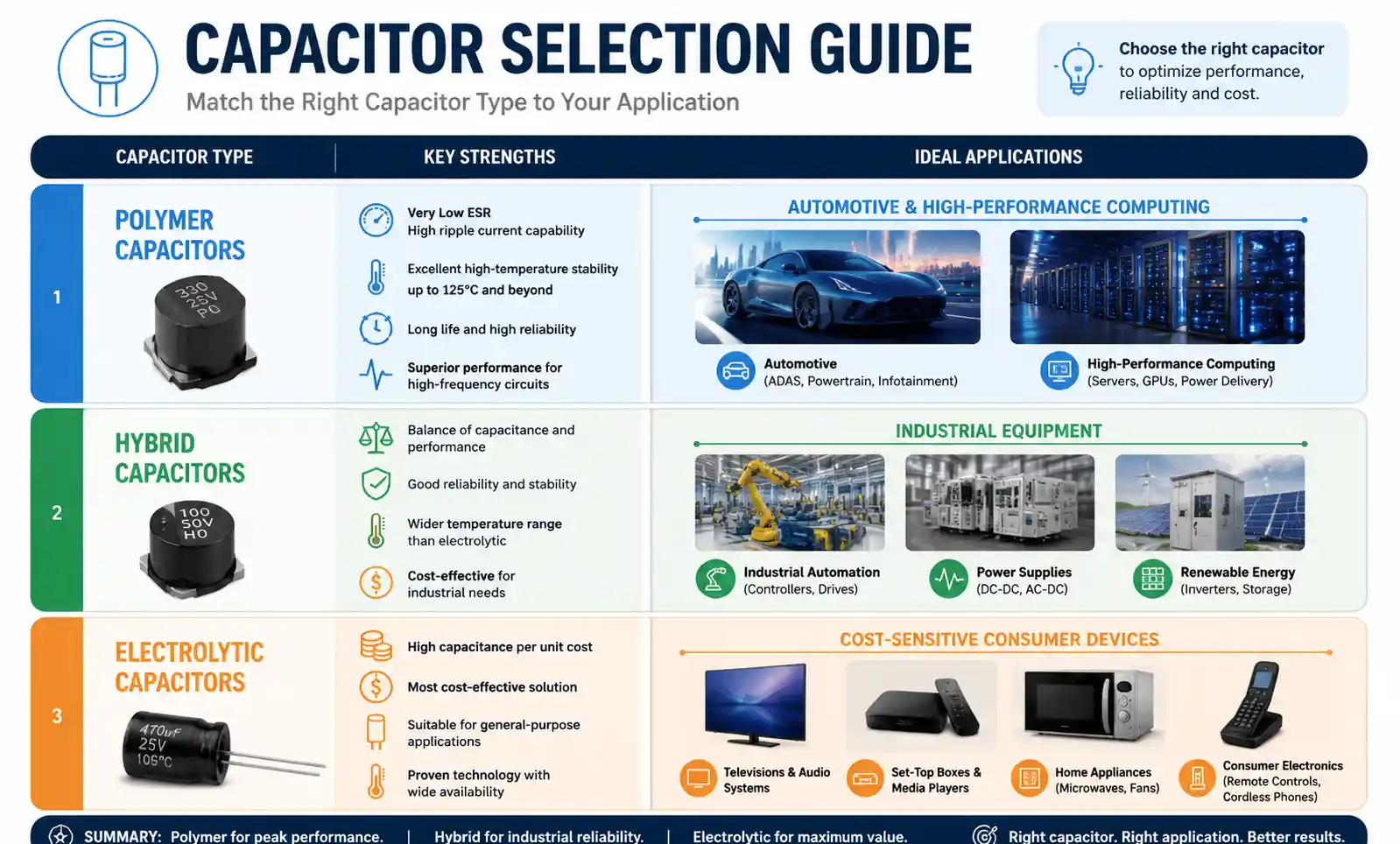
Power Supply Applications
Switch-mode power supplies (SMPS): Polymer or hybrid capacitors excel here due to low ESR, high ripple current capability, and wide frequency response.
Linear power supplies: Standard electrolytic capacitors work well, offering high capacitance at low cost for bulk energy storage.
DC-DC converters: Polymer capacitors provide the best performance for both input and output filtering in high-frequency converters.
Automotive Electronics
Automotive environments demand capacitors that withstand extreme temperatures (-40°C to 125°C), vibration, and long service life.
Best choice: Solid polymer or hybrid capacitors for critical systems. The vibration resistance and temperature stability justify the higher cost.
Application examples: Engine control units, power steering, infotainment systems, LED drivers.
Consumer Electronics
Cost sensitivity often drives capacitor selection in consumer devices, but reliability remains important for brand reputation.
Smartphones and tablets: Polymer capacitors for compact size and low ESR in power management circuits.
Audio equipment: Electrolytic capacitors for large smoothing capacitors; polymer types for signal path and bypass applications.
LED lighting: Hybrid or polymer capacitors for improved lifespan and heat tolerance.
Industrial and Medical Equipment
Long service life and high reliability are paramount. Downtime costs and safety requirements justify premium components.
Recommended: Polymer capacitors for critical circuits, hybrid types for cost-sensitive bulk applications.
Key consideration: Derating voltage and temperature specifications extends life in demanding continuous-operation scenarios.
Computing and Data Centers
High-frequency switching, thermal management, and space efficiency drive requirements.
Motherboards: Polymer capacitors near CPU power delivery for stable, low-noise power.
Server power supplies: Combination of polymer (high-frequency filtering) and hybrid (bulk storage) for optimal performance and reliability.
8. Cost vs Performance Trade-offs
Budget constraints are real. Understanding where to invest in premium capacitors and where standard types suffice optimizes both performance and cost.
Price Comparison
Relative cost per μF (approximate):
- Standard electrolytic: 1.0x (baseline)
- Hybrid capacitor: 1.5-2.5x
- Polymer capacitor: 2.5-4.0x
These multipliers vary by voltage rating and capacitance value, but the relationship remains consistent.
Total Cost of Ownership
Initial component cost is only part of the story. Consider:
Warranty costs: Premature failures lead to expensive returns and repairs.
Reputation damage: Product failures harm brand value far beyond replacement costs.
Service life: Longer-lasting capacitors reduce maintenance and replacement frequency.
Energy efficiency: Lower ESR reduces power consumption in high-current applications.
Strategic Component Selection
Critical circuits: Use polymer capacitors where failure is unacceptable or performance demands are high.
Bulk energy storage: Standard electrolytic capacitors often suffice where ESR and frequency response are less critical.
High-volume production: Even small reliability improvements justify modest cost increases when multiplied across millions of units.
9. Common Failure Modes and Prevention
Recognizing potential failure mechanisms helps you design more reliable circuits and specify appropriate safety margins.
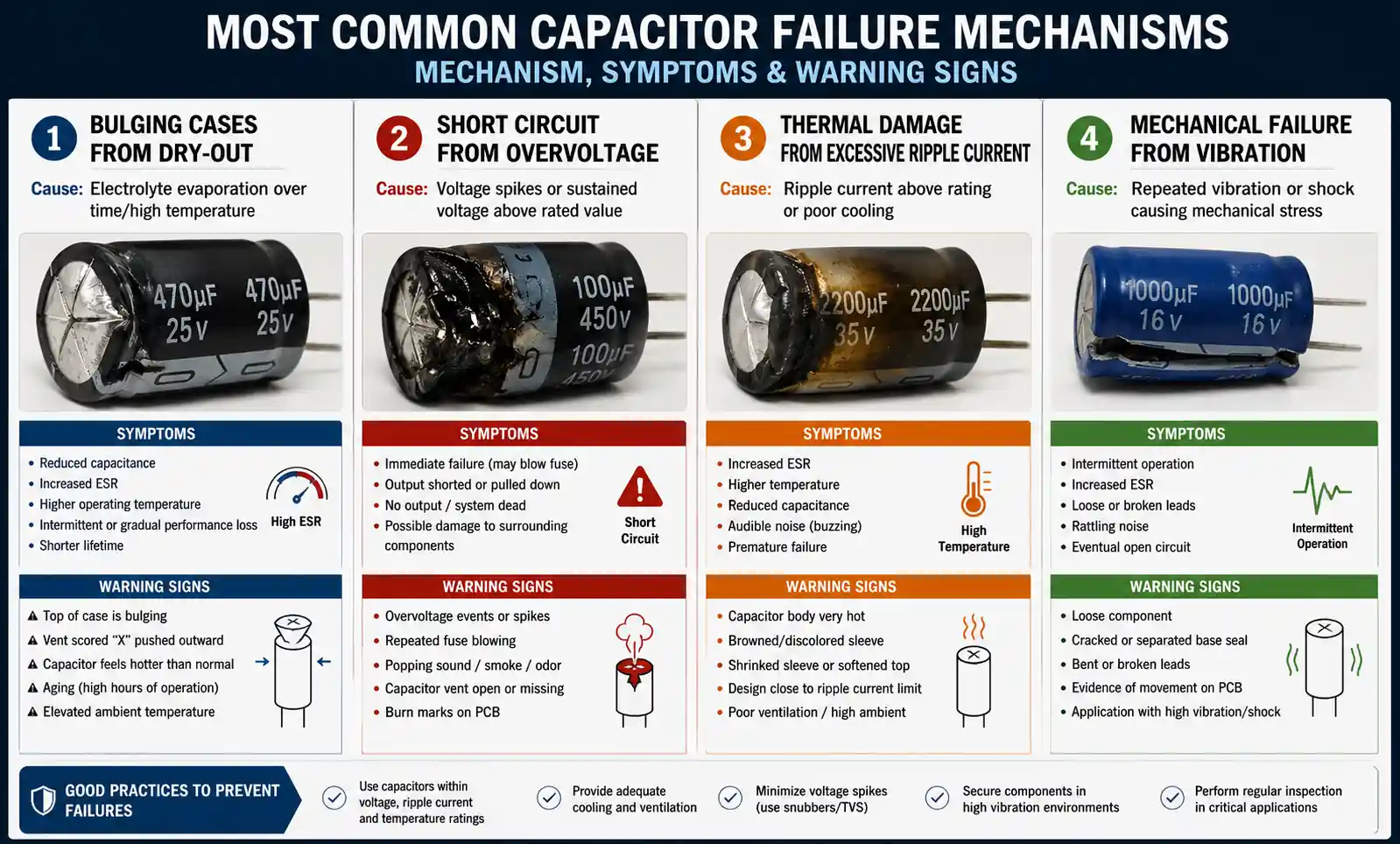
Electrolyte Dry-Out
Affects: Primarily electrolytic and hybrid capacitors
Symptoms: Gradually increasing ESR, decreasing capacitance, eventually open circuit
Prevention strategies:
- Operate at lower temperatures (thermal management)
- Derate voltage and current
- Select capacitors with higher temperature ratings
- Consider polymer alternatives for high-temperature environments
Overvoltage Failure
Affects: Especially polymer capacitors, which are less tolerant than electrolytics
Symptoms: Short circuit failure, sometimes catastrophic
Prevention strategies:
- Apply adequate voltage derating (use 80% of rated voltage maximum)
- Add transient suppression where voltage spikes occur
- Use electrolytic or hybrid types where surge voltages are unavoidable
Ripple Current Overheating
Affects: All types, but electrolytics are most susceptible
Symptoms: Accelerated aging, bulging, electrolyte leakage, thermal runaway
Prevention strategies:
- Calculate actual ripple current in your application
- Select capacitors rated for 150-200% of expected ripple current
- Use polymer capacitors for high ripple current applications
- Improve PCB thermal design
Physical Damage from Vibration
Affects: Liquid electrolytic capacitors in harsh environments
Symptoms: Internal connection failure, electrolyte leakage
Prevention strategies:
- Use solid polymer capacitors in high-vibration applications
- Properly secure capacitors to PCB
- Select capacitors with robust mechanical design
10. Future Trends in Capacitor Technology
The capacitor industry continues evolving to meet demands for higher performance, smaller size, and greater reliability.
Market Shift Toward Polymer
Research indicates a clear trend from 2026-2035 toward conductive polymer and hybrid aluminum electrolytic technology, especially in mission-critical applications requiring superior reliability and thermal stability.
Key drivers include:
- Automotive electrification (EVs, autonomous vehicles)
- 5G telecommunications infrastructure
- Renewable energy systems
- High-performance computing
Advanced Materials Development
New polymer formulations aim to increase maximum voltage ratings and capacitance values while maintaining the low ESR advantages.
Hybrid designs continue improving the balance between cost, performance, and reliability by optimizing the ratio and arrangement of liquid and solid electrolytes.
Supercapacitor Integration
Hybrid supercapacitors are bridging the gap between traditional capacitors and batteries, offering:
- 10-100× higher energy density than electrolytic capacitors
- Faster charge/discharge than batteries
- Longer cycle life (millions of cycles)
- Applications in energy harvesting and pulse power
Manufacturing Innovations
Automated production and economies of scale are gradually reducing the price premium for polymer capacitors, making them accessible for more applications.
Advanced quality control and testing methods improve reliability and reduce infant mortality rates across all capacitor types.
Conclusion: Making the Right Choice
No single capacitor type is universally superior. Your optimal choice depends on balancing performance requirements, operating conditions, lifespan expectations, and budget constraints.
Choose electrolytic capacitors when: You need maximum capacitance per dollar, have moderate performance requirements, and can accommodate larger size or shorter lifespan.
Choose polymer capacitors when: Low ESR, high ripple current, temperature stability, and long life justify the higher cost—especially in automotive, industrial, or premium consumer applications.
Choose hybrid capacitors when: You want improved performance over standard electrolytics without the full cost of polymer types, or need better surge voltage tolerance than pure polymer capacitors provide.
As capacitor technology evolves, the performance gap narrows and prices become more competitive. Staying informed about the latest developments helps you design better products and maintain competitive advantage.