



How to Master Electronic Component Inventory Management: A 2024 Guide to Avoiding Stockouts
If the post-COVID "chipageddon" taught hardware startup founders and premocurent managers anything, it is this: your supply chain is only as resilient as your inventory tracking system. Relying on messy, untraceable Excel spreadsheets to manage thousands of microchips, resistors, and capacitors is a ticking time bomb. A single missing component can halt your entire production line, delaying product launches and burning through capital. In this comprehensive guide, we will walk you through the essential strategies of electronic component inventory management. You will learn how to decouple your internal part numbers from manufacturer part numbers, safely transition away from the "Excel ceiling," manage physical environmental risks like ESD and MSL, and build a scalable system that protects your bottom line.

Table of Contents
- 1. Understanding Electronic Component Inventory Management: Why It Matters Now
- 2. Core Concepts Simplified: MPN, IPN, and BOM
- 3. Step-by-Step Guide: Moving Beyond the "Excel Ceiling"
- 4. Expert Tips & Common Pitfalls to Avoid
- 5. Conclusion & Final Thoughts
- 6. Frequently Asked Questions (FAQ)
1. Understanding Electronic Component Inventory Management: Why It Matters Now
For years, the electronics manufacturing services (EMS) industry worshiped at the altar of JIT (Just-in-Time) manufacturing. The goal was to order parts exactly when needed to minimize warehouse footprint and free up cash flow. However, the global chip shortages completely flipped this paradigm. Today, hardware startups and enterprise manufacturers alike have pivoted back to Safety Stock models—keeping extra critical components on hand "just in case."
But holding more stock introduces a new layer of complexity. Storing microchips is not like storing screws or sheet metal. Electronic components are highly sensitive to environmental factors, and their lifecycles are dictated by unpredictable manufacturer updates. Without a robust electronic component inventory management system, you risk designing a brilliant product around a chip that will be discontinued next month, or worse, destroying thousands of dollars of inventory due to improper storage.
To survive in today's hardware landscape, you need a software-agnostic, scalable approach that prioritizes traceability, flexibility, and physical component safety.
2. Core Concepts Simplified: MPN, IPN, and BOM
Before diving into software and workflows, we must establish a common language. The biggest mistake early-stage hardware teams make is confusing the part they need with the part they buy. Let’s break down the jargon using plain English.
The "Job Title" vs. "The Employee" Analogy
Imagine you are running a restaurant. You need a "Head Chef." That is the role you need to fill. You might hire John Doe or Jane Smith for that role. If John quits, Jane can step in, and the restaurant keeps running.
In electronics:
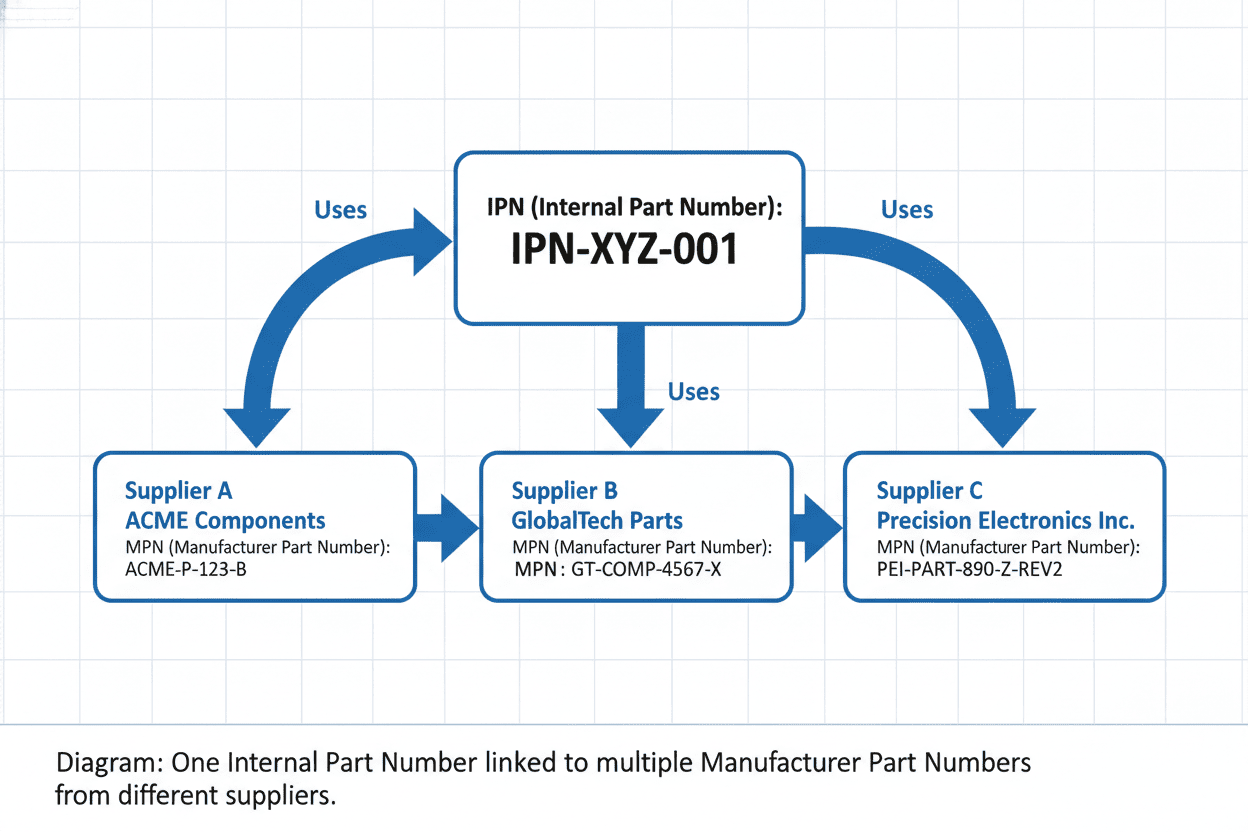
- IPN (Internal Part Number): This is the "Job Title" (e.g., Head Chef). It is your company’s unique, standardized code for a specific function (e.g., a 0.1uF 16V 0402 capacitor).
- MPN (Manufacturer Part Number): This is the "Employee" (e.g., John Doe). It is the exact, unchangeable string of characters assigned by the component's creator (e.g., Murata's
GRM155R71C104KA88D).
If you build your entire inventory system around MPNs, you are creating a single point of failure. If Murata stops making that exact capacitor, your system breaks. By using an IPN, you can link multiple approved MPNs (from Murata, Yageo, Samsung) to one internal code. When the chip shortage hits, you simply swap suppliers without changing your internal documentation.
The BOM (Bill of Materials)
Think of the BOM as the ultimate recipe for your electronic device. It lists every single ingredient (IPN) required to build one unit of your product. A hierarchical BOM management strategy ensures that when you scale from building 10 prototypes to 10,000 units, your procurement team knows exactly what to source.
MPN vs. IPN Comparison Table
| Feature | Internal Part Number (IPN) | Manufacturer Part Number (MPN) |
|---|---|---|
| Creator | You (Your Company) | The Component Manufacturer |
| Purpose | Unifies equivalent parts under one roof for flexible sourcing. | Identifies the exact physical part from a specific brand. |
| Format | Standardized to your company logic (e.g., CAP-0012). |
Complex and brand-specific (e.g., GRM155R71C104KA88D). |
| Flexibility | High. Can link to multiple approved MPNs. | Zero. Tied to one specific physical item. |
| BOM Usage | Best Practice. Keeps your BOM clean and supplier-agnostic. | High Risk. Leads to redesigns if the part goes out of stock. |
3. Step-by-Step Guide: Moving Beyond the "Excel Ceiling"
Many hardware startups begin by tracking parts in Excel or Google Sheets. This works fine for the first 100 components. But right around the 500-SKU mark—what industry veterans call the "Excel ceiling"—spreadsheets become a liability. Formulas break, version control is lost, and someone inevitably overwrites a crucial column, leading to a $10,000 purchasing mistake.
Transitioning to a relational database or dedicated MRP (Material Requirements Planning) software is non-negotiable for scaling. Here is how to approach the migration.
3.1 Choosing the Right Inventory Software
You don't necessarily need a massive, expensive enterprise ERP like NetSuite or SAP on day one. The engineering community on forums like Reddit’s r/hwstartups highly recommends stepping-stone solutions.
Inventory Software Specifications & Data Table
| Software Tier | Target Audience | Key Features | Cost Estimate | Top Examples |
|---|---|---|---|---|
| Spreadsheets | Hobbyists, Pre-seed startups (< 200 SKUs) | Free, highly customizable, manual entry. | $0 | Excel, Google Sheets, Airtable |
| Niche MRP / Open Source | Hardware Startups, EMS providers (500 - 5,000 SKUs) | BOM importing, IPN/MPN linking, barcode scanning, API integrations. | Free to $150/month | InvenTree (Open Source), PartsBox |
| Enterprise ERP | Scaling hardware companies ($10M+ Revenue) | Full financial integration, multi-warehouse routing, advanced forecasting. | $1,000+ /month | Fishbowl, NetSuite, Odoo |
Actionable Advice: If you are transitioning from Excel, look into PartsBox for a lightweight, cloud-based solution, or InvenTree if you have the technical chops to self-host an open-source system. Both handle the MPN/IPN relationship flawlessly.
3.2 Standardize Your Naming Conventions and Logging
Before importing data into your new software, clean your house. Create a rigid naming convention for your IPNs. For example, all resistors might start with RES-, followed by a 4-digit sequence.
To help you visualize what a clean, standardized inventory log should look like, here is a mobile-responsive HTML template you can use as a baseline for your internal dashboards:
| Internal Part No. (IPN) | Manufacturer Part No. (MPN) | Description | Quantity | Location (Bin) |
|---|---|---|---|---|
| CAP-0012 | GRM155R71C104KA88D | Capacitor 0.1uF 16V 0402 X7R | 5,000 | A-12-03 |
| IC-0441 | STM32F405RGT6 | MCU 32-bit ARM Cortex M4 | 150 (Low) | B-04-01 |
3.3 Implement Physical Storage Controls (ESD & MSL)
Software only tracks the numbers. If the physical components are destroyed sitting on a shelf, your software data is useless. Electronic components require strict environmental controls.
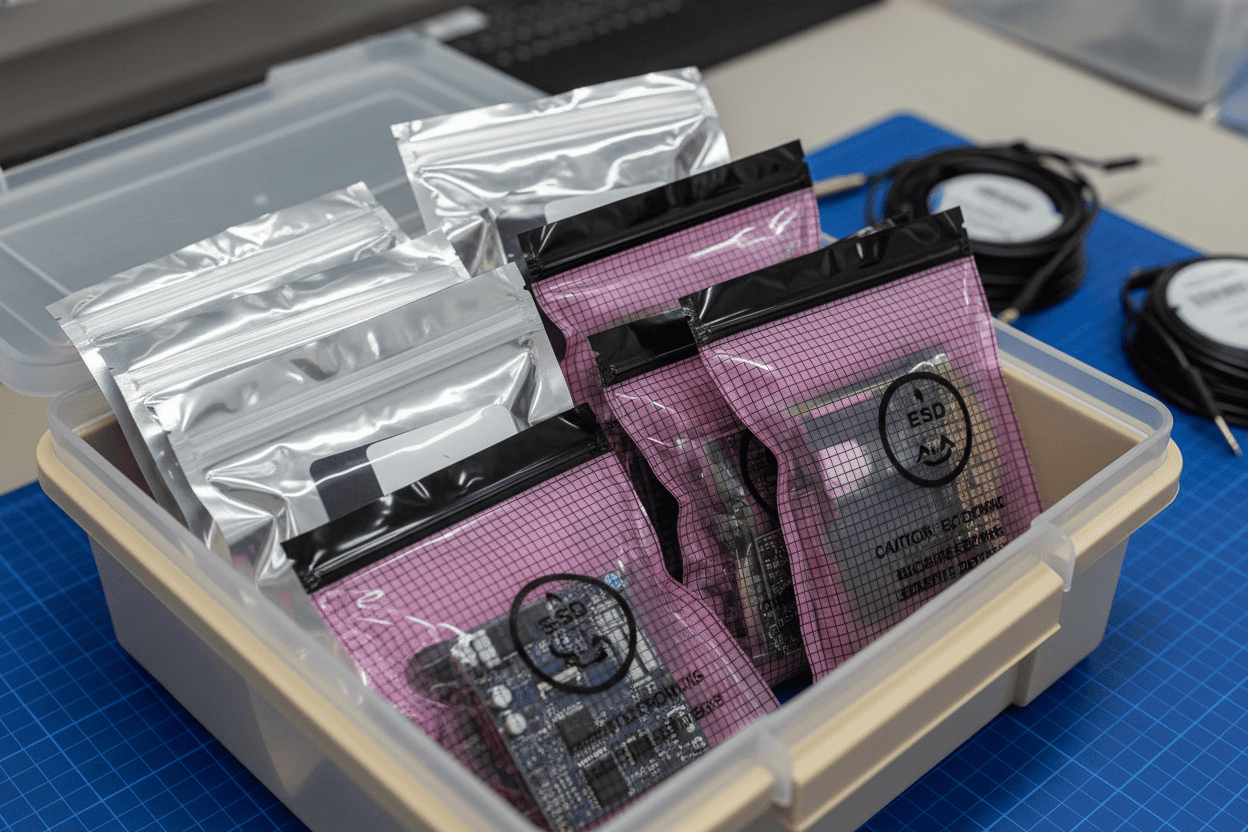
- ESD (Electrostatic Discharge): This is a sudden flow of electricity between two electrically charged objects. In plain English: it’s the tiny static shock you get from touching a doorknob in winter. While harmless to humans, that micro-shock can instantly fry a $50 microchip. Solution: Mandate the use of anti-static bags, ESD-safe bins, and grounding wrist straps for anyone handling inventory.
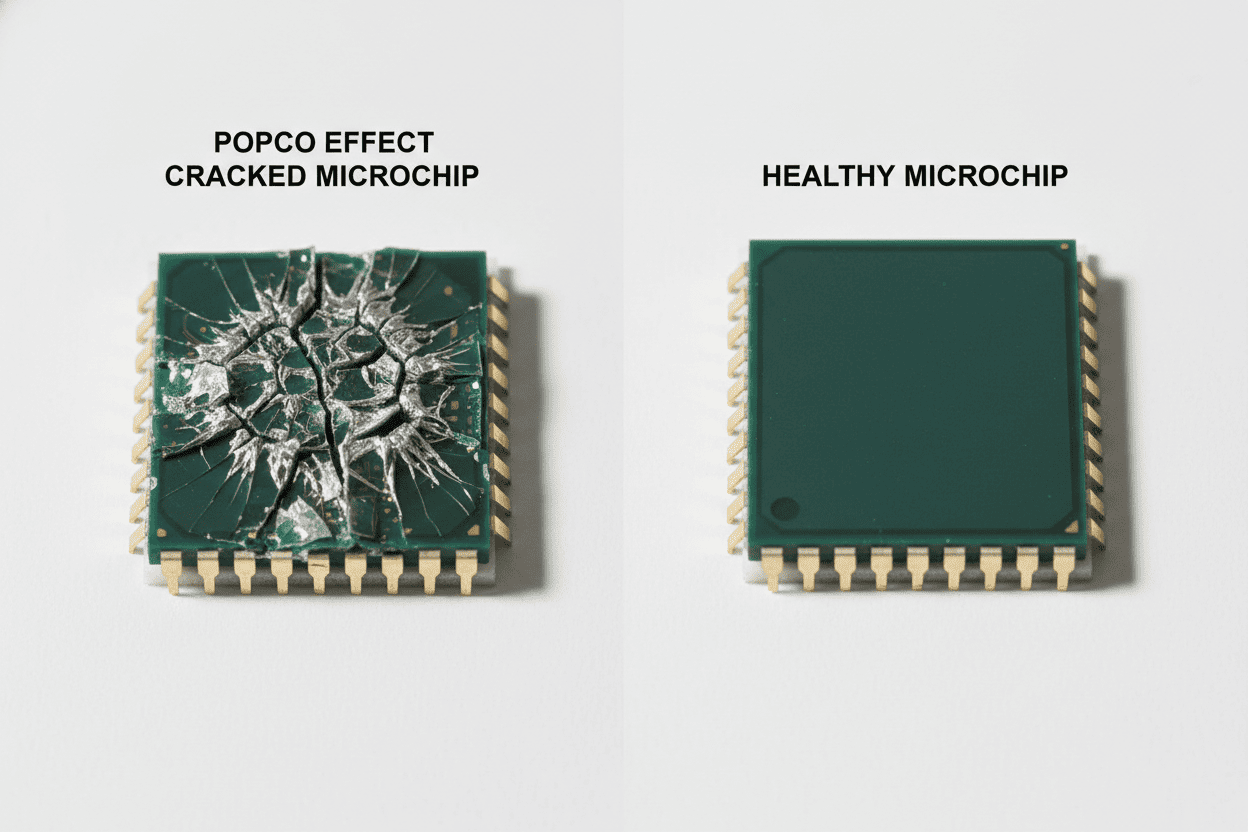
- MSL (Moisture Sensitivity Level): Many microchips absorb moisture from the air. If a "wet" component goes through a hot soldering oven during manufacturing, the trapped water instantly turns to steam, expands, and physically cracks the chip from the inside. Solution: Store moisture-sensitive components in humidity-controlled dry cabinets and track their floor life meticulously.
4. Expert Tips & Common Pitfalls to Avoid
Even with the best software, human error can derail your supply chain. Based on hard-learned lessons from procurement managers and discussions across industry forums, here are the most critical pitfalls to avoid.
Pitfall 1: Ignoring the "Popcorn Effect" (MSL Negligence)
One of the most expensive mistakes a hardware startup can make is ignoring JEDEC Standard J-STD-033, which governs the handling of moisture-sensitive devices. When a moisture-laden chip cracks in the reflow oven, it makes a tiny popping sound—hence the industry nickname, the "Popcorn Effect."
- The Fix: Always check the MSL rating on the component's datasheet. If a reel of chips has been exposed to ambient air longer than its allowed floor life, it must be "baked" in an industrial oven at specific temperatures to safely remove the moisture before assembly.
Pitfall 2: Failing to Track EOL (End of Life) and PCNs
Components do not live forever. Manufacturers regularly issue a PCN (Product Change Notification) to inform buyers of slight design tweaks, or an EOL (End of Life) notice indicating the part will be discontinued.
- The Fix: Do not let your engineering team design a PCB (Printed Circuit Board) around an obsolete chip. Subscribe to Digi-Key and Mouser supply chain insights and configure your inventory software to flag any IPN that contains an EOL manufacturer part.
Pitfall 3: The "Single-Sourcing" Trap
During the 2021 chip shortage, companies that relied entirely on a single specific microcontroller from a single brand saw their production lines halted for up to 52 weeks.
- The Fix: For every critical component on your BOM, mandate that your engineering team identifies at least two (ideally three) drop-in replacements. Link all three of these MPNs to your single IPN in your database.
5. Conclusion & Final Thoughts
Mastering electronic component inventory management is not just about counting parts; it is about building a resilient, agile supply chain. By transitioning away from fragile Excel spreadsheets, standardizing your Internal Part Numbers (IPNs), and respecting the physical realities of ESD and MSL, you protect your hardware startup from catastrophic delays and hidden costs.
Remember, the goal is to make your procurement process as boring and predictable as possible. Start small: audit your current BOMs, establish your IPN naming conventions, and trial a dedicated MRP tool like PartsBox or InvenTree before your SKU count spirals out of control.
6. Frequently Asked Questions (FAQ)
Q1: What is the difference between IPN and MPN in inventory management?
A: IPN (Internal Part Number) is your company's standardized code for a component function (e.g., CAP-0012 for a 0.1uF capacitor). MPN (Manufacturer Part Number) is the exact part string from a specific brand (e.g., Murata's GRM155R71C104KA88D). Using IPNs allows you to link multiple approved MPNs for flexible sourcing without redesigning your BOM.
Q2: When should I move from Excel to dedicated inventory software? A: The "Excel ceiling" hits around 500 SKUs. At that point, broken formulas, version control issues, and human error become liabilities. Migrate to lightweight MRP tools like PartsBox or InvenTree before your SKU count spirals out of control.
Q3: What is the "Popcorn Effect" and how do I prevent it? A: The Popcorn Effect occurs when moisture-sensitive components absorb ambient humidity, then crack internally during reflow soldering as trapped water turns to steam. Prevent it by storing MSL-rated chips in humidity-controlled dry cabinets and tracking their floor life per JEDEC J-STD-033 standards.
Q4: Why is ESD protection critical for electronic component storage? A: Electrostatic discharge (static shock) is harmless to humans but can instantly destroy microchips worth $50 or more. Always use anti-static bags, ESD-safe bins, and grounding wrist straps for anyone handling inventory.
Q5: How many alternative suppliers should I approve for each critical component? A: Mandate at least two (ideally three) drop-in replacement MPNs for every critical component on your BOM. Link all approved MPNs to your single IPN so you can swap suppliers instantly during shortages without PCB redesigns.
Q6: What software do you recommend for hardware startup inventory management? A: For pre-seed to early-stage startups, try PartsBox (cloud-based, lightweight) or InvenTree (open-source, self-hosted). Both handle IPN/MPN relationships, BOM importing, and barcode scanning. Upgrade to enterprise ERPs like NetSuite only after reaching $10M+ revenue.
Quick Summary: Your Inventory Action Plan
| Focus Area | Current Bad Habit | Best Practice Standard | ROI / Benefit |
|---|---|---|---|
| Part Naming | Using Supplier MPNs directly on the BOM. | Creating a master IPN that links to multiple MPNs. | Supply chain flexibility; easy to swap parts during shortages. |
| Software | Managing >500 SKUs in Excel. | Migrating to Relational DBs (PartsBox, InvenTree). | Eliminates broken formulas and provides low-stock alerts. |
| Storage | Throwing chips in standard plastic bins. | Utilizing ESD-safe bags and MSL dry cabinets. | Prevents the "Popcorn Effect" and static damage, saving thousands. |
| Lifecycles | Finding out a part is obsolete at order time. | Tracking PCN and EOL notices proactively. | Prevents costly emergency PCB redesigns. |
Take control of your inventory today. If you found this guide helpful, consider sharing it with your procurement and engineering teams to ensure everyone is aligned on your new hardware supply chain protocols.