



How to Avoid Counterfeit Electronic Components: The Ultimate Buyer's Guide
Imagine this: You have just spent 40 grueling hours debugging a newly assembled printed circuit board (PCB). You have rewritten the firmware, checked every solder joint, and measured every voltage rail. Everything looks perfect, yet the system keeps crashing. The culprit? It wasn’t your code or your design. It was a counterfeit STM32 microcontroller you bought from an unauthorized broker to save a few cents.
In the post-pandemic hardware industry, the electronic component supply chain has become a minefield. Global chip shortages have driven buyers toward the "gray market," leading to an explosion of fake, remarked, and recycled integrated circuits (ICs). For hardware engineers, procurement managers, and electronics makers, failing to spot a fake component doesn't just mean a loss of a few dollars—it means catastrophic product failures, massive safety hazards, and endless debugging nightmares.
In this comprehensive guide, we will walk you through exactly how to avoid counterfeit electronic components. You will learn practical, low-cost DIY verification methods, understand how to evaluate suppliers, and discover how enterprise-level compliance frameworks like AS5553 can bulletproof your supply chain.
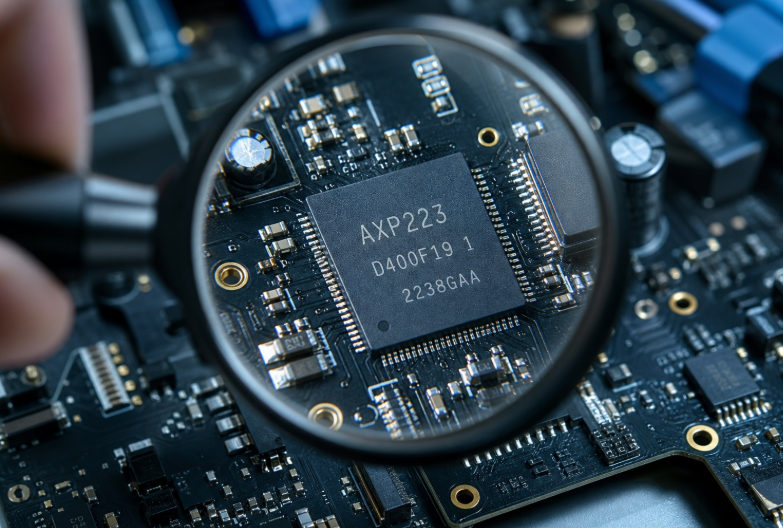
Table of Contents
1. Understanding Counterfeit Electronics: The Basics
Why is the market suddenly flooded with fake electronic parts? The answer lies in supply and demand. When Original Component Manufacturers (OCMs) quote a 52-week lead time for a critical power management IC, desperate procurement teams are forced to look outside their trusted networks. This desperation creates a lucrative opportunity for scammers.
However, a counterfeit component is rarely a "fake" piece of silicon built from scratch. Manufacturing a modern microchip requires billion-dollar fabrication plants. Instead, scammers use deceptive tactics to pass off cheap, old, or defective chips as brand-new, premium components.
The real cost of a fake component is astronomical. If you buy a fake $2 voltage regulator, your financial loss isn't $2. If that regulator makes it into a final product, it could over-voltage and destroy a $500 motherboard, cause a fire hazard in a consumer device, or trigger a complete system failure in an aerospace application. This is why establishing a secure supply chain and knowing how to verify component authenticity is a non-negotiable skill for modern hardware teams.
2. Core Concepts Simplified
To effectively navigate the component market, you need to understand the terminology used by test labs and supply chain experts. Let's break down these highly technical concepts into plain English.
The "Apple Store vs. Street Vendor" Analogy
Before diving into testing, you must understand sourcing. Buying from an Authorized (Franchised) Distributor (like DigiKey, Mouser, or Arrow) is like buying an iPhone directly from the Apple Store. You are guaranteed a brand-new, authentic product.
Buying from an unauthorized broker or a random seller on AliExpress is like buying an iPhone from a street vendor out of the trunk of a car. It might look real, it might even turn on, but it could be built with recycled parts, or it might just be an empty shell.
Decoding Industry Jargon
- Blacktopping: Think of this as a scammer sanding the rust off an old Honda, painting it red, and slapping a Ferrari badge on it. In electronics, counterfeiters sand off the original markings of a cheap or recycled chip, apply a new layer of black polymer coating (the "blacktop"), and laser-etch a new, expensive part number onto it.
- Decapsulation (Decap): This is essentially an autopsy of the microchip. Engineers use highly corrosive acids to melt away the black plastic outer shell of the component. This exposes the microscopic silicon "brain" (the die) inside, allowing engineers to read the microscopic factory logos etched directly onto the silicon to verify authenticity.
- X-Ray Inspection: Just like a medical X-ray checks your skeleton, a component X-ray checks the chip's internal wiring (wire bonds). If the X-ray reveals that the chip is completely empty inside, or if the internal wire routing doesn't match a known authentic part, you have a fake.
- Chain of Custody: This is the component's passport. It is a documented paper trail that proves exactly where a component has been—from the OCM's factory floor, to the authorized distributor, all the way to your warehouse. If the chain is broken, the risk skyrockets.
📊 Concept Comparison: Authentic vs. Counterfeit Risk
| Feature / Metric | Authorized / Authentic Components | Gray Market / High-Risk Components |
|---|---|---|
| Sourcing Channel | Franchised Distributors (DigiKey, Mouser) | Independent Brokers, AliExpress, eBay |
| Chain of Custody | 100% Transparent (Factory to Buyer) | Broken or Non-existent |
| Blacktopping Risk | Zero | Extremely High |
| Required Verification | Standard incoming inspection | Acetone test, X-Ray, Decapsulation |
| Failure Cost Impact | Covered by Manufacturer Warranty | 100% Liability on the Buyer |
3. Step-by-Step Guide: How to Spot Fake Components
You don't always need a million-dollar laboratory to spot a fake chip. Depending on your budget and resources, you can implement either a low-cost DIY approach or an enterprise-grade compliance framework. Here is how to make data-driven decisions for your procurement process.
3.1 The Low-Cost Approach: Visual Inspection & Acetone Wipe Test
If you are a hardware maker, an SME engineer, or a buyer who received a suspicious batch of chips, you can perform the Acetone Wipe Test right at your workbench. It is the most effective way to catch "blacktopped" components.
Step 1: Deep Visual Inspection Before touching any chemicals, grab a jeweler's loupe or a digital microscope. Look for these red flags:
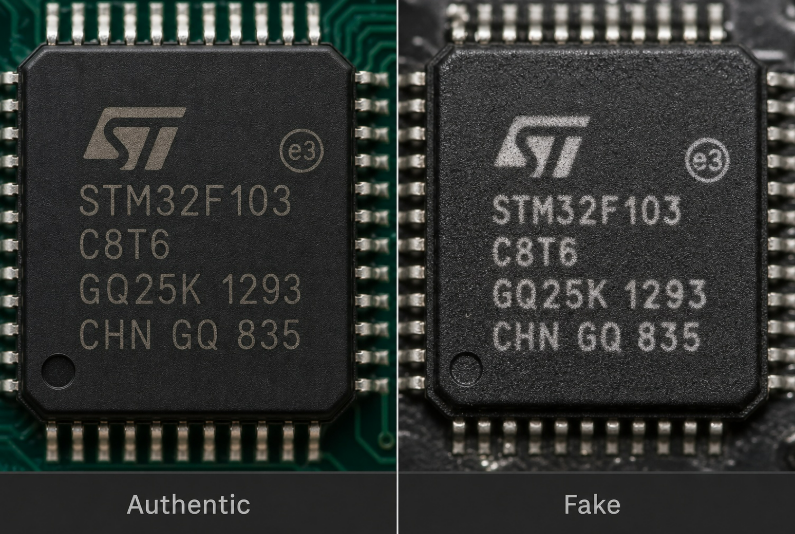
- Indents and Pin 1 Indicators: Original chips have clean, perfectly round indentations indicating Pin 1. Blacktopped chips often have shallow, partially filled, or rough indents because the new paint layer filled the original hole.
- Laser Etching Quality: Authentic laser etching is sharp and consistent. Fakes often feature blurry text, incorrect fonts, or typos.
- Pin Condition: Look at the metal legs. Are they perfectly straight and uniformly tinned? If they look bent, scratched, or have residual solder, the chip was pulled from old e-waste.
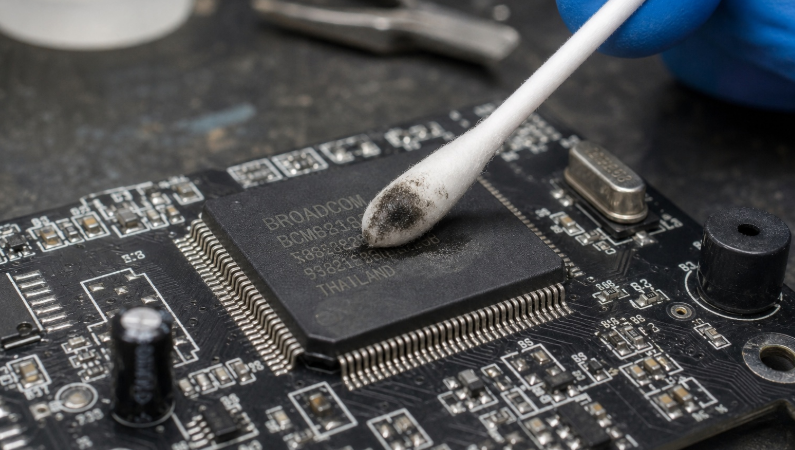
Step 2: The Acetone Wipe Test The black plastic (epoxy) used by original manufacturers is chemically inert and highly resistant to solvents. However, the fake "blacktop" paint used by scammers is usually cheap and soluble.
- Take a standard cotton swab (Q-tip).
- Dip it in high-concentration acetone (nail polish remover works, but industrial acetone is better).
- Rub the swab firmly over the top surface of the microchip for about 10 to 15 seconds.
- The Result: If the cotton swab comes away clean, the surface is likely original. If the swab turns black and the markings on the chip smear or disappear, you have a 100% confirmed fake. The acetone just dissolved the scammer's fake paint.
3.2 The Enterprise Approach: AS5553 Compliance for Procurement
For mid-to-large hardware teams, especially those in medical, automotive, or aerospace sectors, DIY tests aren't enough. You need a systemic approach. The SAE AS5553 Standard is the gold standard for counterfeit electronic parts avoidance.
While the official document is dense and full of legal jargon, procurement teams can implement its core philosophy using this simplified 3-step framework:
- Assess Supplier Risk: Never buy on price alone. Categorize your suppliers into tiers. Tier 1 (Franchised), Tier 2 (Vetted Independent with testing capabilities), and Tier 3 (High Risk/Do Not Use).
- Track Component Origin: Demand a Certificate of Conformance (CoC) and trace the Chain of Custody back to the original manufacturer. If a broker cannot provide a clear paper trail, reject the batch.
- Quarantine Suspicious Parts: If parts arrive and fail incoming inspection (e.g., mixed date codes in a single reel), immediately move them to a physical quarantine zone to prevent them from accidentally entering your manufacturing floor.
Vendor Vetting Email Template When dealing with an unfamiliar independent broker, use this template to establish authority and demand transparency:
We are looking to source [Quantity] units of [Part Number]. Before proceeding, please confirm the following to ensure compliance with our internal anti-counterfeit protocols:
- Can you provide a full Chain of Custody or a Certificate of Conformance (CoC) back to the Original Component Manufacturer (OCM)?
- Do you perform in-house or third-party testing (e.g., X-Ray, Decapsulation, Acetone Wipe) prior to shipping?
- What is the date code (D/C) and lot number for this current stock?
We require a 30-day testing window upon receipt. Please provide your official quote and lead time based on these terms.
📊 Specification Table: Supplier Evaluation Matrix
When choosing where to source your components, use this data matrix to guide your procurement strategy.
| Sourcing Channel | Traceability (Chain of Custody) | Price Premium | Risk of Counterfeits | Best For... |
|---|---|---|---|---|
| Authorized (Franchised) | 100% (Direct from Factory) | Baseline (MSRP) | 0% | Production runs, critical infrastructure, any professional PCB assembly. |
| Vetted Independent Brokers | Variable (Requires CoC) | High (Market driven) | Low-Medium | Obsolete (EOL) parts, critical shortages with strict lab testing. |
| Unverified Brokers / AliExpress | 0% (Unknown origins) | Very Low (Suspicious) | Extremely High | Hobbyist projects where failure has zero consequence. |
4. Expert Tips & Common Pitfalls to Avoid
If you spend time on hardware engineering communities like Reddit’s r/AskElectronics or the EEVblog forums, you will see endless horror stories of engineers losing weeks of their lives to fake parts. Here are the most common pitfalls and expert tips drawn from real-world experience.
Pitfall 1: Trusting "Too Good to Be True" Pricing
During the height of the chip shortage, standard STM32 microcontrollers that usually cost $3 were selling for $40 on the open market. Suddenly, a broker on AliExpress offers them for $5. Do not buy them. If authorized distributors are out of stock globally, a random vendor does not magically have 10,000 brand-new units at below-market prices. These are almost always remarked fakes or salvaged e-waste.
Pitfall 2: Ignoring Date Codes and Lot Numbers
Scammers are often lazy. A massive red flag is a reel of components that all share the exact same Date Code, yet the chips physically look different (different packaging textures, different pin shapes). Alternatively, check the date code against reality. If a chip is stamped with a date code of 2450 (Year 2024, Week 50), but you are buying it in October 2024, the chip claims to be manufactured in the future. It is a fake.
Pitfall 3: Assuming a "Working" Chip is Authentic
One of the most insidious counterfeiting tricks is remarked downgrading. A scammer will take a low-speed, commercial-grade operational amplifier (Op-Amp) and remark it as a high-speed, military-grade Op-Amp. If you plug it into a basic circuit, it will work. It passes the basic functional test. But the moment your device is deployed in a high-temperature environment, the chip fails catastrophically. Always verify the physical authenticity, not just basic functionality.
5. Conclusion & Final Thoughts
Counterfeit electronic components are a multi-billion dollar illicit industry that preys on supply chain vulnerabilities and desperate buyers. However, by shifting your procurement mindset and equipping your team with the right knowledge, you can reduce your risk to near zero.
6. Frequently Asked Questions
Q1: What is a counterfeit electronic component? A: A real chip misrepresented through remarking or recycling to appear as a different, often higher-grade, part.
Q2: What is the quickest DIY test for fake chips? A: The Acetone Wipe Test. Rub acetone on the chip surface; if markings dissolve, it is fake.
Q3: Where is the safest place to buy components? A: Authorized distributors like DigiKey, Mouser, or Arrow.
Q4: What is blacktopping? A: Sanding off original markings and repainting a chip to mimic a premium part number.
Q5: Can a fake chip still work? A: Yes. Lower-grade remarked chips may pass basic tests but fail under stress or temperature.
Q6: What is AS5553? A: The industry gold-standard framework for counterfeit parts avoidance and supply chain compliance.
📊 Quick Summary Table: Anti-Counterfeit Checklist
| Action Item | Why It Matters | Implementation Difficulty |
|---|---|---|
| Buy Franchised Only | Guarantees authentic parts and unbroken Chain of Custody. | Easy (if stock is available) |
| Check Date Codes | Catches lazy scammers using impossible or mixed manufacturing dates. | Easy |
| Acetone Wipe Test | Dissolves fake "blacktop" paint to reveal remarked chips instantly. | Low/Medium (DIY friendly) |
| Demand a CoC | Forces independent brokers to prove the origin of the components. | Medium (Requires procurement policy) |
| X-Ray / Decap Testing | The ultimate proof of authenticity by inspecting the internal silicon die. | High (Requires budget & 3rd party labs) |
Don't let a $2 fake chip ruin your product launch or cause a massive recall. Start implementing these verification steps in your incoming quality control process today.
Have you ever encountered a fake component in your projects? What were the symptoms? Share your debugging horror stories in the comments below, and let’s help each other build more resilient hardware!