



IC Chip Shortage 2026: Procurement Strategies for Africa and Southeast Asia
Power management ICs now carry 18-24 week lead times, microcontrollers stretch to 14-18 weeks, and allocation policies dominate supplier conversations. For procurement teams in Africa and Southeast Asia, the challenge is building resilient supply chains that balance cost, lead time, and quality verification in markets with limited local inventory and complex logistics.
This guide provides region-specific procurement strategies addressing extended lead times, authorized distributor access, and counterfeit risk.
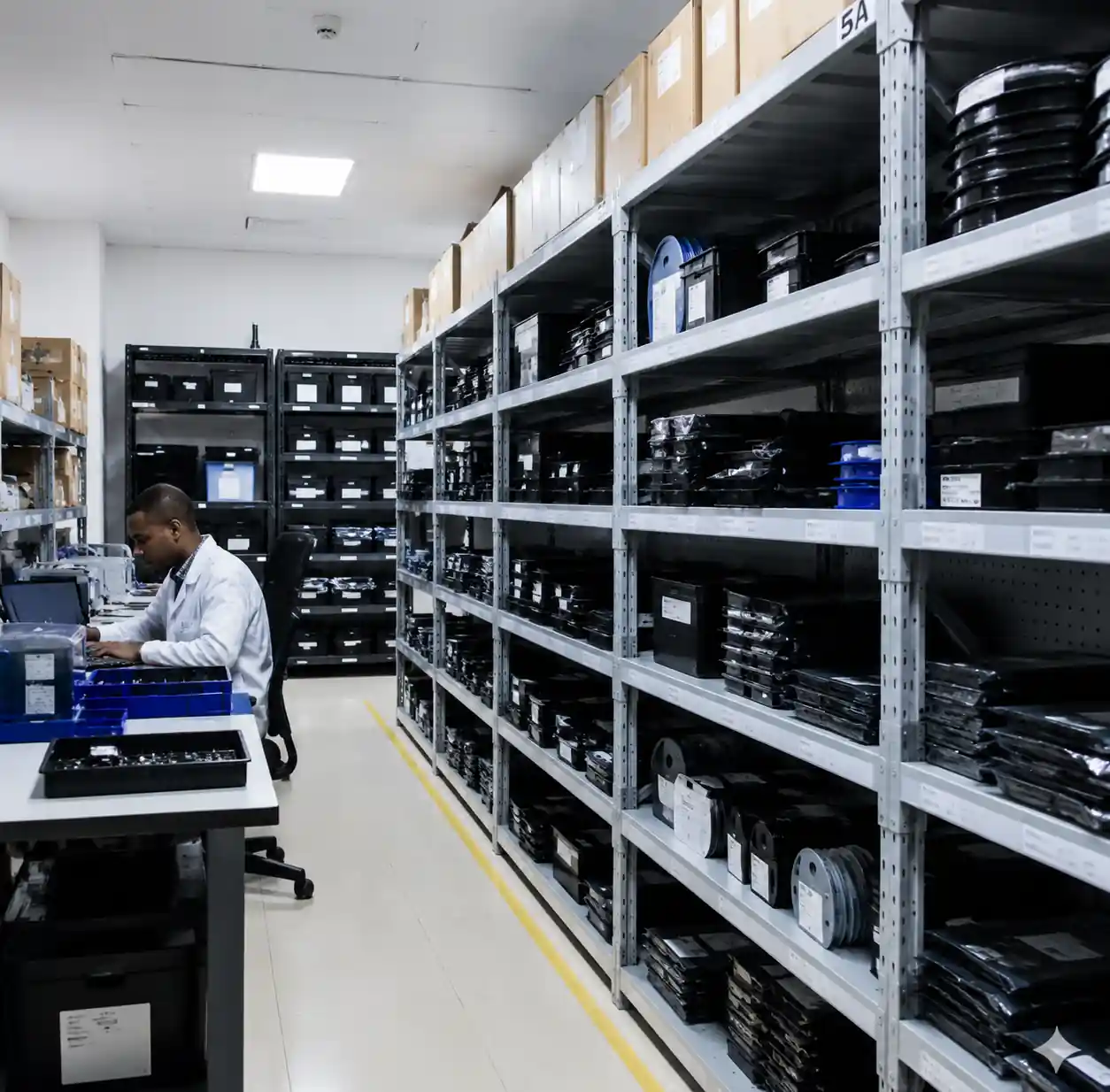 Electronics component warehouse with organized IC chip inventory in African manufacturing facility
Table of Contents
Understanding Regional IC Supply Chain Dynamics
Africa and Southeast Asia face distinctly different procurement challenges. Southeast Asia benefits from established electronics manufacturing ecosystems in Vietnam, Thailand, Malaysia, and the Philippines, with mature distributor networks and regional warehousing. Component availability typically runs 10-16 weeks for standard ICs.
Africa presents a more fragmented landscape. Electronics manufacturing hubs are emerging in Morocco, Egypt, Kenya, and South Africa, but local inventory remains limited. Most ICs require imports from Asia or Europe, pushing lead times to 16-24 weeks with customs complexity and limited freight options.
Regional Sourcing Comparison
| Factor | Africa | Southeast Asia |
|---|---|---|
| Typical Lead Times | 16-24 weeks (import-dependent) | 10-16 weeks (regional stock) |
| Local Distributor Network | Limited; concentrated in major hubs | Mature networks across centers |
| Customs Complexity | High; varies by country | Moderate; ASEAN facilitates trade |
| Regional Warehousing | Emerging in Egypt, South Africa, Kenya | Established in Singapore, Hong Kong, Thailand |
| Counterfeit Risk | Higher in informal channels | Moderate; strong authorized channels |
| MOQ Flexibility | Often higher due to import costs | More flexible for consolidation |
| Payment Terms | Typically LC or advance payment | NET 30-60 common with established accounts |
This comparison shows supplier consolidation strategies must differ by region. In Southeast Asia, leverage regional distributors with local stock. In Africa, hybrid approaches—maintaining buffer stock in regional warehouses while building distributor relationships—work best.

Procurement manager inspecting integrated circuits and verifying component quality in electronics manufacturing facility
Multi-Source Procurement for Extended Lead Times
When power management ICs carry 20+ week lead times, single-source procurement becomes a production risk. Categorize IC requirements into three tiers:
Tier 1 - Critical long-lead components (20+ weeks): Power management ICs, automotive-grade MCUs. Require early commitment with authorized distributors, 12-16 weeks buffer stock, and alternative component qualification.
Tier 2 - Standard components on allocation (12-18 weeks): Mainstream microcontrollers, interface ICs. Maintain dual-source qualification, 8-12 weeks buffer inventory, and rolling quarterly forecasts.
Tier 3 - Commodity components (6-10 weeks): Standard logic, passives. Source more flexibly with 4-6 weeks buffer stock.
Forecast accuracy determines allocation priority. Submit rolling 12-month forecasts quarterly—distributors give priority to customers who demonstrate forecast reliability.
For Africa, establish buffer stock in strategic regional warehouses—Egypt for North Africa, Kenya for East Africa, South Africa for the southern region. This reduces effective lead times from 20+ weeks to 8-12 weeks. Southeast Asian manufacturers can leverage Singapore or Hong Kong warehousing for 3-5 day delivery.
Authorized Distributor Networks: Your Quality Safeguard
Counterfeit ICs are the most expensive procurement mistake. Authorized distributors provide traceability from semiconductor manufacturers through the entire distribution channel—date codes, lot numbers, country of origin, and test data.
| Verification Method | What It Detects | Authorized Channel Advantage |
|---|---|---|
| Visual Inspection | Remarked devices, wrong packages | Consistent manufacturer marking |
| X-Ray Analysis | Die mismatches, missing wire bonds | Matches manufacturer specs |
| Electrical Testing | Performance outside specs | Components meet published specs |
| Documentation Review | Missing traceability | Complete chain of custody |
The cost differential between authorized and gray market channels typically runs 8-15% for standard ICs. That premium buys quality assurance, warranty protection, and technical support—essential cost savings through risk reduction.
In Africa, focus on distributors with authorization from major semiconductor manufacturers and established presence in your country. In Southeast Asia, verify authorization status directly with semiconductor manufacturers before establishing supply relationships.

Regional electronics distribution center in Southeast Asia with IC component inventory and logistics operations
Lead Time Management Tactics
Rolling forecast discipline: Submit 12-month rolling forecasts quarterly with firm commitments for months 1-3, ±20% flexibility for months 4-6, and planning visibility for months 7-12.
Buffer stock calculation: For 16+ week lead times, maintain buffer stock equal to 1.5× lead time in production weeks. A 20-week component needs 30 weeks of inventory on hand.
 Component traceability documentation and certificates from authorized semiconductor distributors showing quality verification
Expedite economics: If stopping production costs $15,000/day, paying 25% premium plus $800 airfreight on a $3,000 order saves $191,200 in avoided downtime. Most teams underinvest in expedites by optimizing component cost rather than total production cost.
Regional logistics: For Africa, route time-sensitive shipments through Cairo, Nairobi, or Johannesburg. A $400 freight premium reducing lead time by 5 days protects production schedules worth multiples of that cost. In Southeast Asia, leverage regional distribution centers for 3-5 day replenishment.
Customs pre-clearance: Work with distributors who initiate customs documentation before shipment arrival, reducing clearance from 5-7 days to 1-2 days in many African countries.
Quality Verification Without Slowing Production
Balance risk-based sampling with authorized distributor relationships. For authorized channels with full traceability: visual inspection on 100% of shipments plus electrical testing on 10% sampling. For non-authorized sources (rare, non-critical applications): increase sampling to 25% with full electrical characterization.
Key inspection points:
- Visual inspection (100%): Marking consistency, package condition, date code format
- Basic electrical testing (10-25%): Power consumption, functionality, voltage levels
- Advanced verification (risk-based): X-ray for critical components, decapsulation for anomalies
Document your quality verification process and maintain records for traceability—essential for customer audits, quality certifications, and field failure investigation. Product lifecycle management requires this data for design changes and obsolescence planning.
 Electronics manufacturing production line showing PCB assembly and IC component placement operations
Cost Optimization Beyond Unit Price
Total cost of ownership in emerging markets includes freight, customs duties, inventory carrying costs, quality verification, and production risk.
Volume consolidation: Combining orders across product lines typically yields 12-18% cost reduction. A single $50,000 order receives better pricing than five $10,000 orders.
Payment term optimization: NET 60 terms versus cash in advance on $100,000 monthly spend provides $200,000 working capital—worth ~$8,000 annually at 4% cost of capital.
Freight mode economics: Air freight costs 5-8× ocean freight but delivers in 5-7 days versus 28-35 days. Calculate break-even—if ocean costs $800 and air costs $3,200 for a $40,000 shipment, the $2,400 premium buys 21 days. At 8% annual carrying cost, that's $184, plus production flexibility value.
Customs duty optimization: Correct component classification significantly impacts duty rates. Work with customs brokers who understand electronics classifications to minimize duty.
Building Strategic Distributor Partnerships
Distributors managing limited supply prioritize customers who provide forecast visibility, demonstrate growth potential, and maintain payment reliability.
Quarterly business reviews: Share production forecasts, new product roadmap, and capacity expansion plans. Distributors who understand your growth trajectory can secure allocation.
Design-in collaboration: Engage distributors during product development to identify components with strong supply positions and alternatives for allocation or obsolescence.
Forecast accuracy tracking: Measure and share forecast accuracy metrics. Teams achieving 85%+ accuracy receive priority treatment when supply tightens.
Payment term compliance: Maintain 100% on-time payment performance. Relationship value exceeds short-term cash flow benefit of delayed payment.
For Africa, identify distributors with regional presence and import expertise in your manufacturing country. In Southeast Asia, leverage distributors who provide regional inventory visibility and cross-border delivery.
 Procurement team analyzing cost optimization strategies and supply chain data on computer screens
Practical Implementation Framework
Month 1 - Baseline: Categorize IC components into risk tiers. Identify components lacking second sources. Calculate current buffer stock versus lead time requirements. Document distributor relationships and verify authorization.
Month 2 - Planning: Develop multi-source qualification roadmap. Establish rolling forecast processes. Determine regional warehousing strategy. Set up quality verification protocols.
Month 3 - Implementation: Begin submitting rolling forecasts. Place buffer stock orders for critical components. Initiate alternate component qualification. Establish quarterly business reviews.
Ongoing: Track forecast accuracy monthly. Monitor lead time trends. Measure quality verification results. Review expedite decisions quarterly.
FAQ
What are realistic lead times for ICs in Africa versus Southeast Asia in 2026?
Africa: 16-24 weeks for imported ICs, with power management and automotive-grade at the longer end. Southeast Asia: 10-16 weeks for most components, with local stock for high-volume standard parts. Regional warehousing can reduce effective lead times to 8-12 weeks.
How do I find authorized distributors in emerging markets?
Start with semiconductor manufacturer websites—TI, STMicroelectronics, NXP, Infineon publish authorized distributor lists by country. Verify authorization directly with the manufacturer before establishing supply relationships.
What buffer stock levels make sense for extended lead times?
Maintain buffer stock equal to 1.5× lead time in production weeks. A 20-week component needs 30 weeks of production inventory when placing replenishment orders.
How can I reduce customs delays in Africa?
Work with freight forwarders who initiate customs documentation before shipment arrival. Engage customs brokers with electronics expertise. Consider regional consolidation through customs-efficient hubs like Egypt or South Africa.
What quality verification is necessary for IC procurement?
For authorized distributor shipments: visual inspection 100% plus electrical testing 10% sampling. For non-authorized sources: 25% electrical testing with full characterization. Document all results.
Conclusion
IC chip shortages in 2026 require procurement teams in Africa and Southeast Asia to move beyond transactional ordering toward strategic supply chain management. Success comes from understanding regional dynamics, building multi-source strategies with buffer stock, maintaining quality verification, and developing strategic distributor partnerships that provide allocation priority.
Hitop Tech provides comprehensive procurement solutions for electronics manufacturers in emerging markets, including authorized component sourcing, regional warehousing, quality verification, and supply chain optimization. Request a quote to discuss your component requirements.