



Latching vs Non-Latching Relay: Complete Guide to Choosing the Right Relay Type
Relays are fundamental components in modern electrical and electronic systems, acting as intelligent switches that allow small control signals to safely manage high-power loads. Whether you're designing a home automation system, industrial control panel, or battery-powered device, understanding the difference between latching and non-latching relays is crucial for optimal circuit performance and energy efficiency.
This comprehensive guide explores both relay types, helping you make informed decisions for your specific applications.
Table of Contents
- What is a Relay and How Does It Work?
- What is a Non-Latching Relay (Monostable Relay)?
- What is a Latching Relay (Bistable Relay)?
- Key Differences Between Latching and Non-Latching Relays
- Advantages and Disadvantages Comparison
- Common Applications for Each Relay Type
- How to Choose Between Latching and Non-Latching Relays
- Wiring Considerations and Best Practices
- Frequently Asked Questions
1. What is a Relay and How Does It Work?
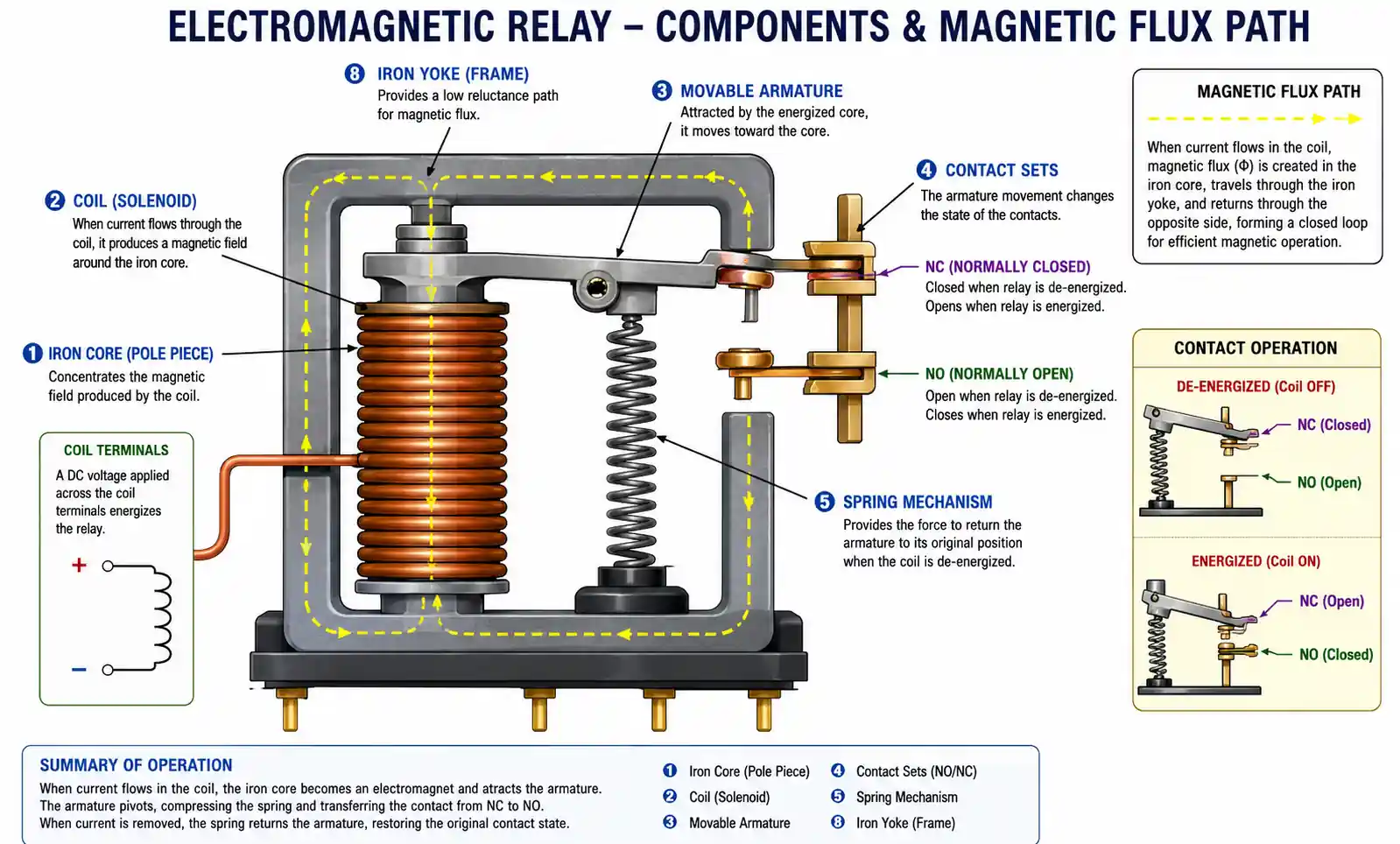
A relay is an electrically operated switch that uses an electromagnetic coil to mechanically control one or more sets of contacts. The basic working principle involves creating a magnetic field when current flows through the coil, which attracts a movable armature to open or close electrical contacts.
The fundamental advantage of relays is circuit isolation—they allow a low-power control circuit to safely switch high-power loads without direct electrical connection. This separation protects sensitive control electronics from high voltages and currents while enabling flexible circuit design.
Key components of an electromagnetic relay include:
- Electromagnetic coil wrapped around an iron core
- Movable armature attracted by the magnetic field
- Spring mechanism for returning to default position
- Contact sets (normally open NO, normally closed NC, or both)
- Iron yoke providing a magnetic flux path
2. What is a Non-Latching Relay (Monostable Relay)?
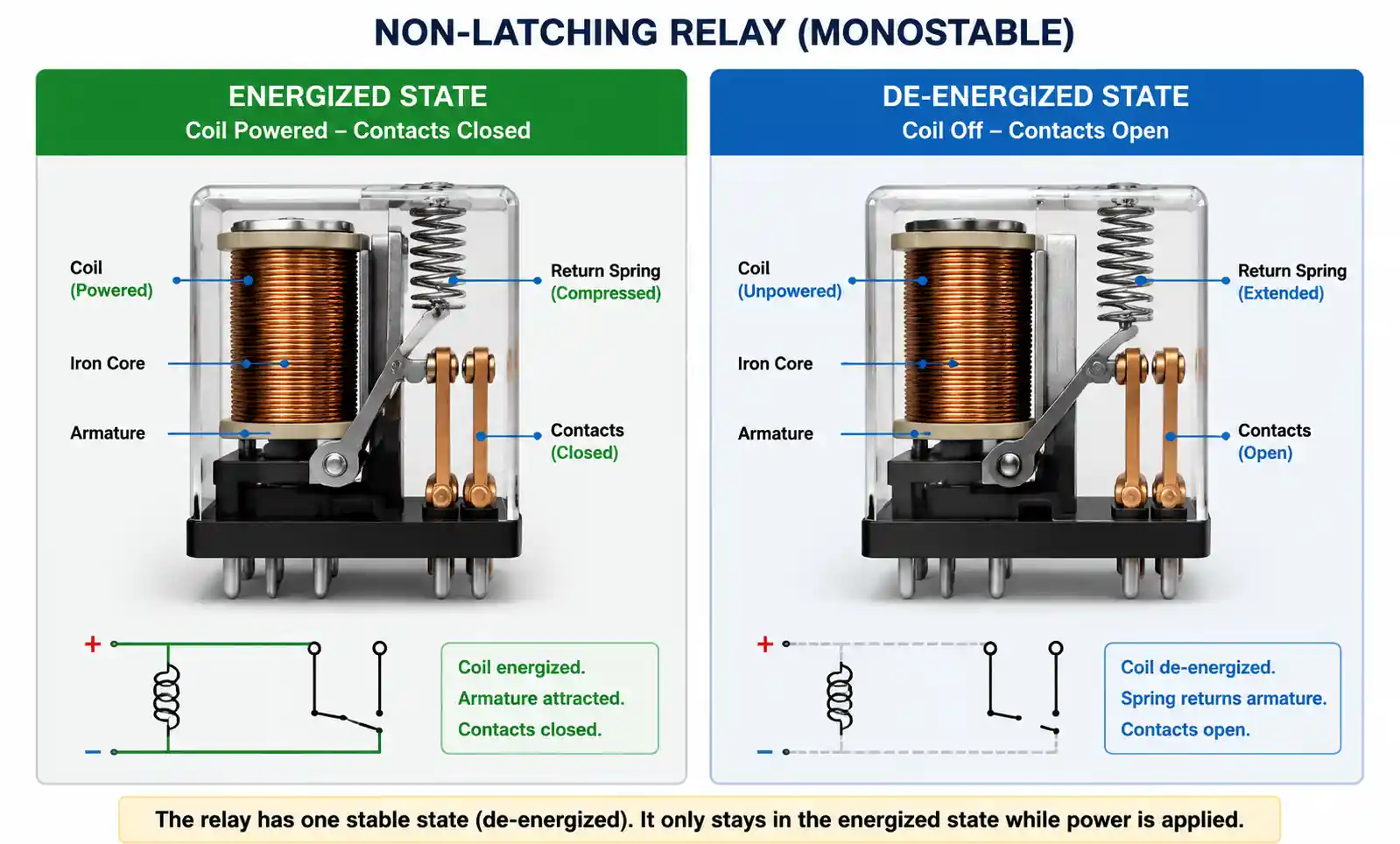
A non-latching relay, also called a monostable relay, has only one stable state. It requires continuous power to the coil to remain in the activated position and automatically returns to its default state when power is removed.
How Non-Latching Relays Work
When voltage is applied to the coil, the electromagnetic field pulls the armature, closing normally-open (NO) contacts and opening normally-closed (NC) contacts. The relay maintains this position as long as coil power continues. Once power stops, the spring mechanism immediately returns the armature to its resting position.
Key Characteristics
- Requires continuous coil energization to stay activated
- Automatic reset to default state when power is lost
- Predictable fail-safe behavior in power outage scenarios
- Simple control logic with straightforward on/off operation
- Higher steady-state power consumption due to continuous coil current
3. What is a Latching Relay (Bistable Relay)?
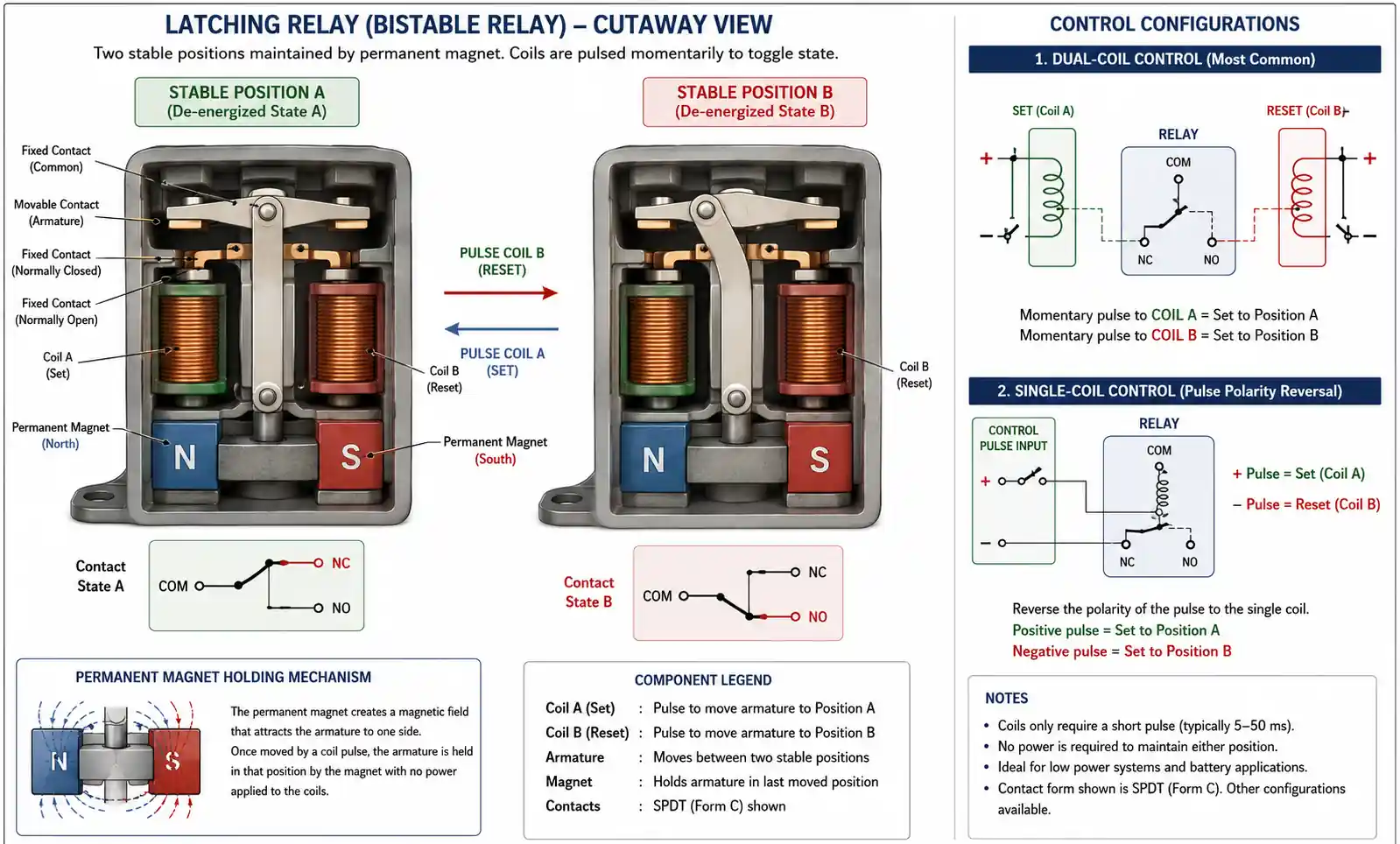
A latching relay, also known as a bistable relay or impulse relay, has two stable states and maintains its last position without requiring continuous power. It only needs brief pulses of energy to switch between states.
How Latching Relays Work
Latching relays use one of two mechanisms to maintain position:
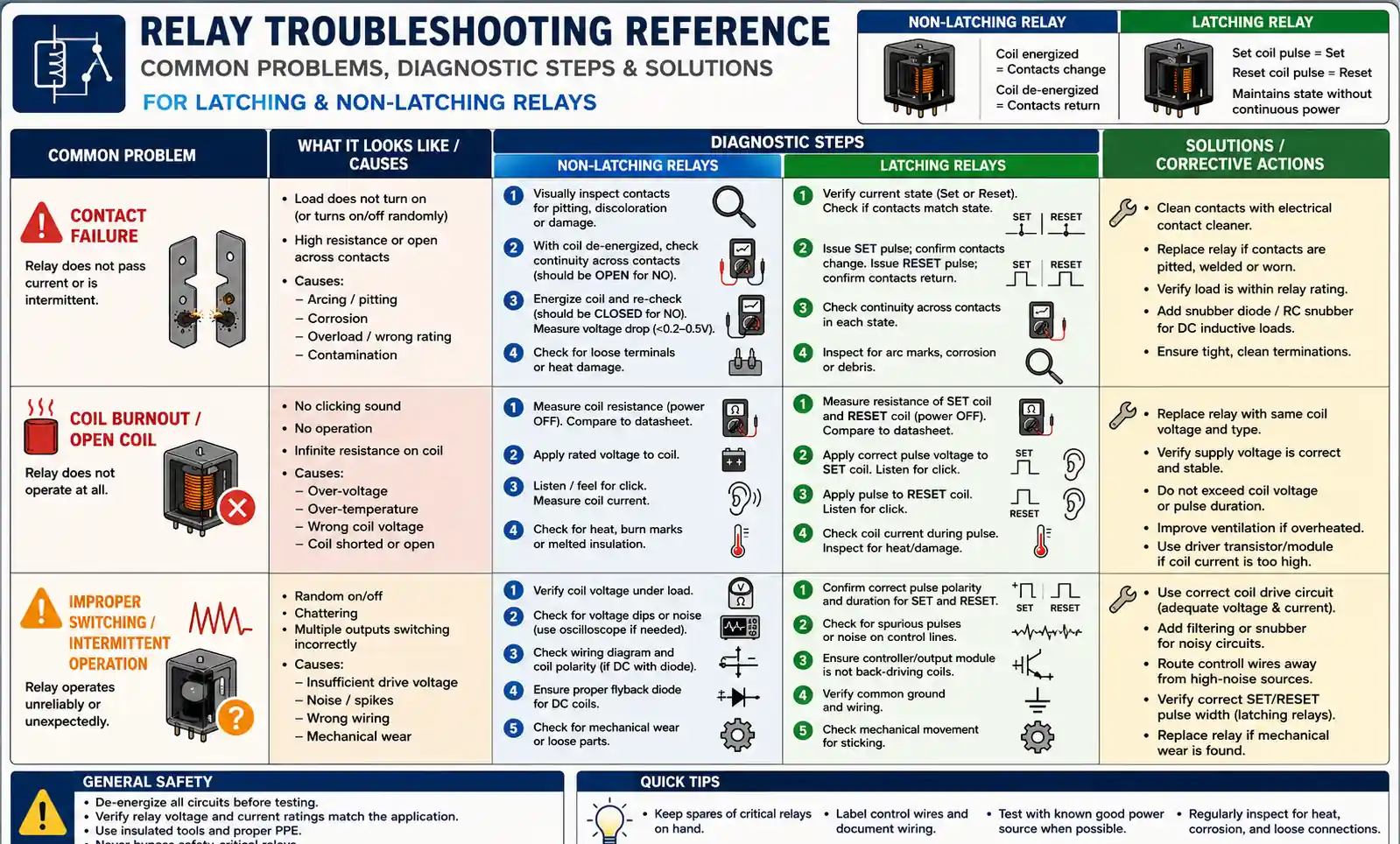
Single-coil latching relays use pulse polarity to determine action—a positive pulse sets the relay, while a negative pulse resets it. A permanent magnet holds the armature in position between pulses.
Dual-coil latching relays have separate set and reset coils. Pulsing the set coil moves contacts to one position, while pulsing the reset coil returns them to the other position.
Key Characteristics
- Maintains state without continuous power after switching
- Requires only momentary pulses to change states (typically 10-50ms)
- Zero holding current between state changes
- State memory survives power outages
- Minimal heat generation in static conditions
4. Key Differences Between Latching and Non-Latching Relays
| Feature | Non-Latching Relay | Latching Relay |
|---|---|---|
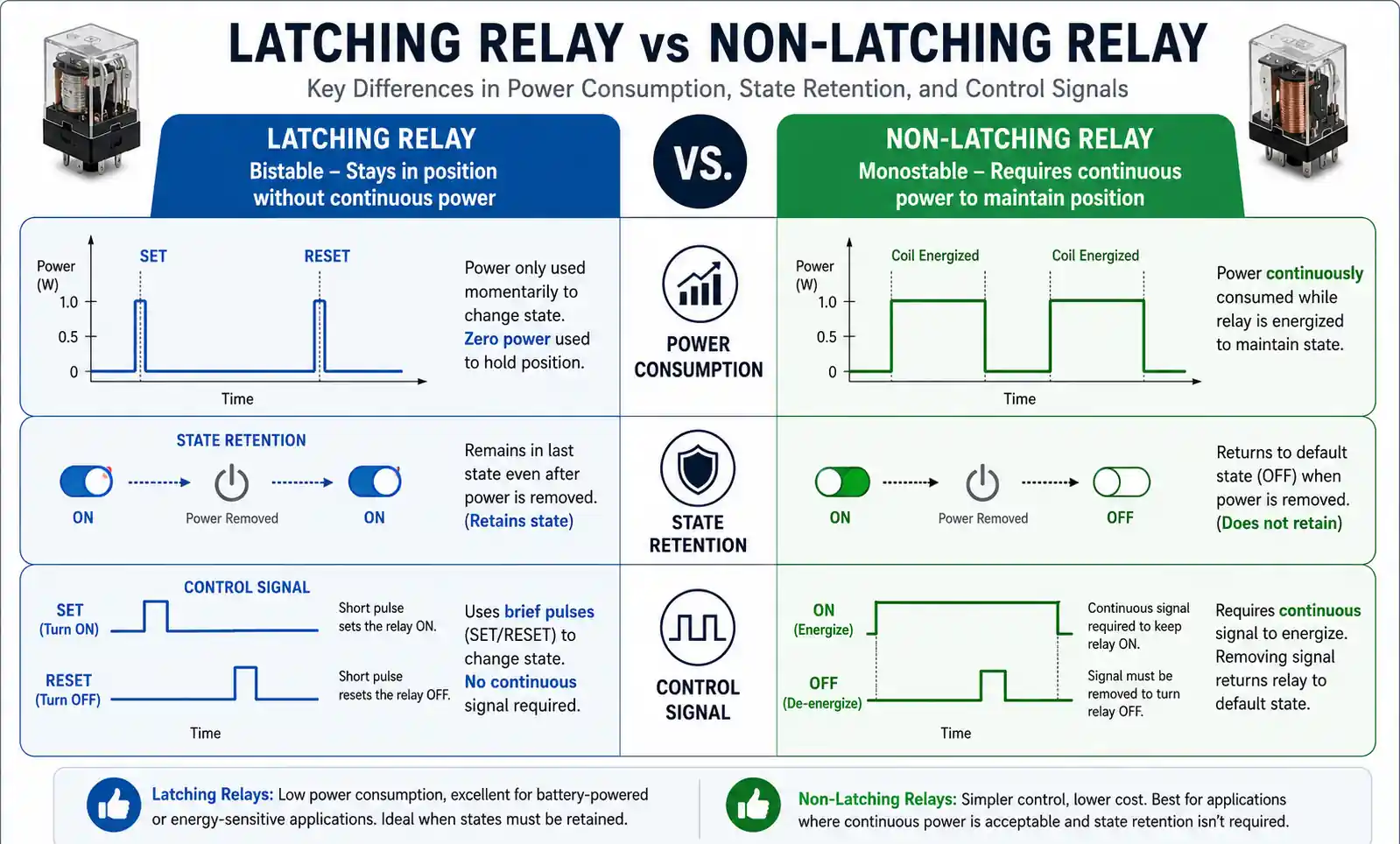
| Stable States | One (monostable) | Two (bistable) |
| Coil Power Required | Continuous while activated | Only during state changes |
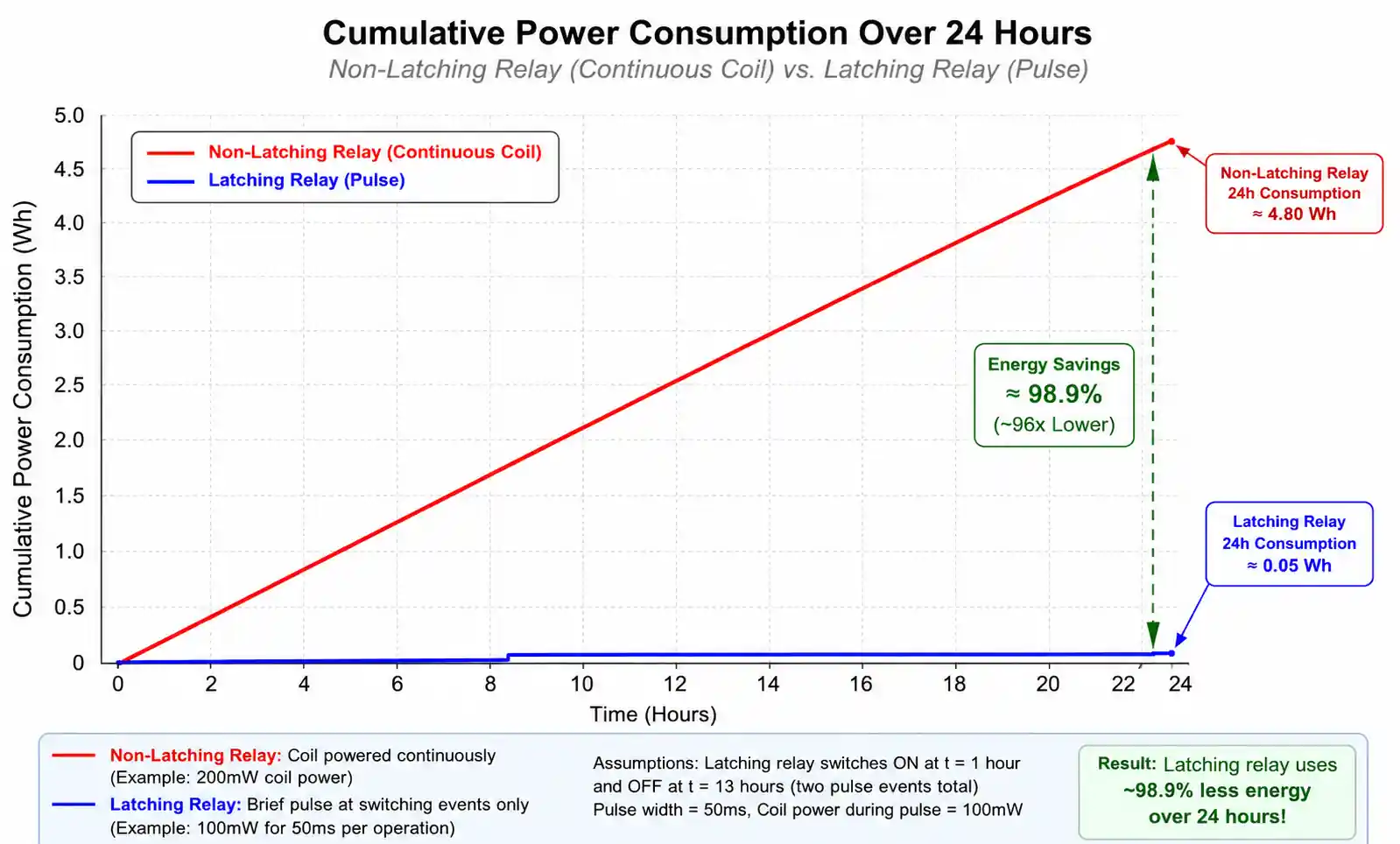
| Power Consumption | Higher (continuous holding current) | Lower (no holding current) |
| State After Power Loss | Returns to default position | Maintains last position |
| Control Complexity | Simple (apply/remove power) | Moderate (set/reset pulses) |
| Heat Generation | Higher during activation | Minimal |
| Cost | Generally lower | Generally higher |
| Response to Control Signal | Immediate on/off | Toggle on pulse |
5. Advantages and Disadvantages Comparison
Non-Latching Relay Advantages
✓ Fail-safe operation - Automatically returns to known state during power failure
✓ Simple control - Straightforward on/off logic without pulse management
✓ Predictable behavior - Always resets to default when unpowered
✓ Lower initial cost - Simpler design translates to lower price
✓ Widely available - Standard component with many options
Non-Latching Relay Disadvantages
✗ Higher power consumption - Continuous coil current (typically 100-500mA)
✗ Heat generation - Constant energization produces warmth
✗ Battery drain - Unsuitable for battery-powered applications requiring sustained activation
✗ Energy waste - Consumes power even when load state doesn't change
Latching Relay Advantages
✓ Excellent power efficiency - Zero holding current saves significant energy
✓ Battery-friendly - Ideal for portable and remote devices
✓ State retention - Remembers position through power interruptions
✓ Reduced heat - Minimal thermal output in dense installations
✓ Long-term energy savings - Each relay can save 5+ kWh annually
Latching Relay Disadvantages
✗ More complex control - Requires pulse generation circuitry
✗ Higher cost - More sophisticated design increases price
✗ State ambiguity - Unknown position after power cycling without position feedback
✗ Specialized availability - Fewer options compared to standard relays
6. Common Applications for Each Relay Type
Non-Latching Relay Applications
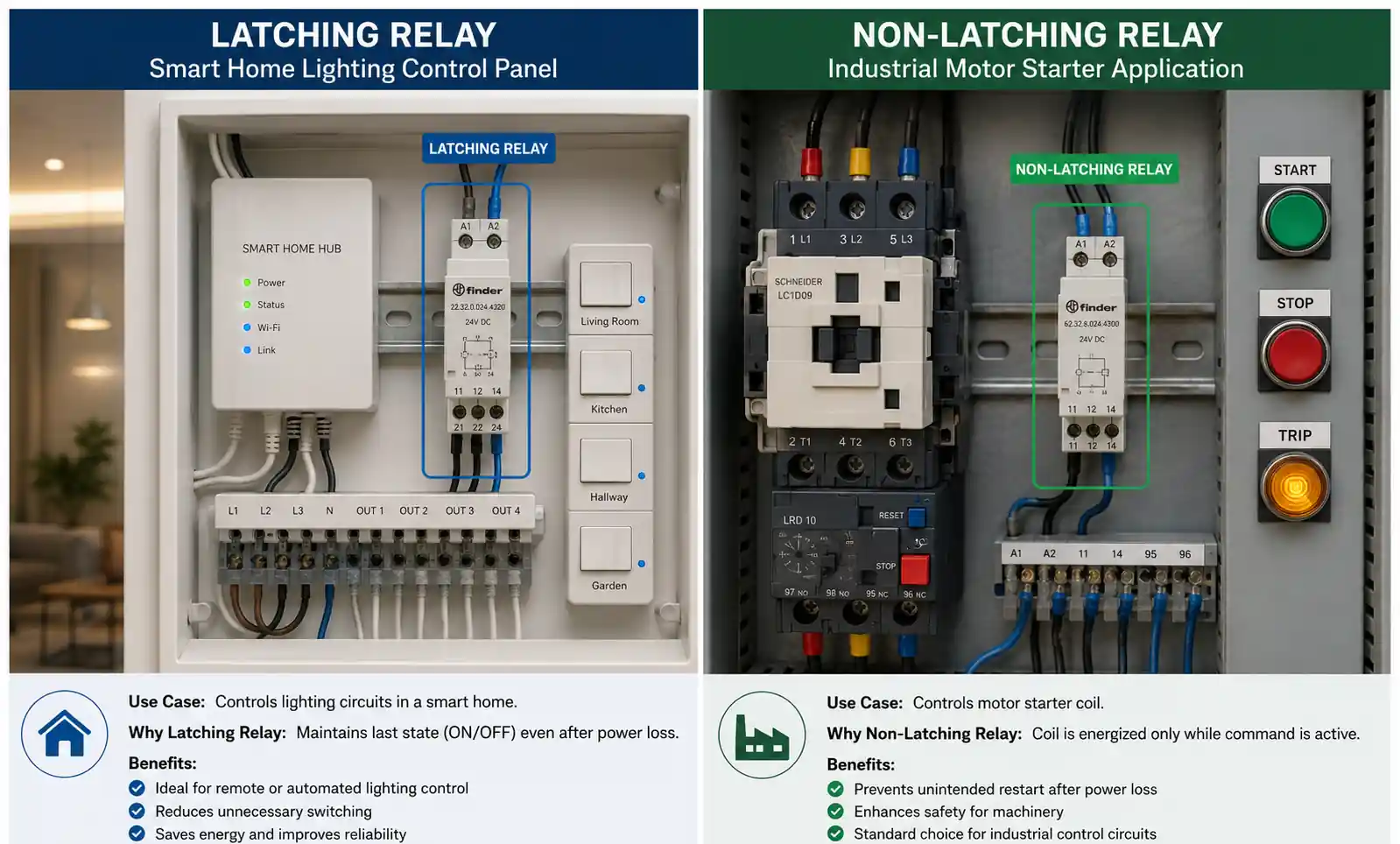
Industrial Control Systems - Motor starters, emergency stops, and safety interlocks where automatic shutdown is essential during power failure.
HVAC Systems - Compressor and fan control where default-off state provides safety and energy savings during power outages.
Automotive Electronics - Horn circuits, headlight relays, and accessory controls that should deactivate when ignition is off.
Security Systems - Door strikes and access control where fail-secure operation (locked by default) is required.
Temporary Activation - Any application where the relay should only be active while deliberately energized.
Latching Relay Applications
Smart Home Lighting - Multiple-location switches where lights maintain state without continuous control signal, saving power in always-on circuits.
Battery-Powered Devices - Remote sensors, portable equipment, and field devices where minimizing power drain is critical.
Solar and Off-Grid Systems - Load switching in renewable energy installations where every watt of efficiency matters.
Industrial Process Control - Conveyor systems and production equipment where state memory through brief power interruptions prevents production issues.
Energy Management Systems - Smart meter load control and demand response applications requiring state retention with minimal power consumption.
Marine and RV Applications - 12V DC systems where battery conservation is paramount during long periods between charging.
7. How to Choose Between Latching and Non-Latching Relays
Choose a Non-Latching Relay When:
- Safety requires automatic reset - Systems where power loss should return equipment to a safe default state
- Simple control is preferred - Applications where straightforward on/off logic simplifies system design
- Continuous power is available - Grid-powered installations where energy consumption is not a primary concern
- State after power loss must be predictable - Circuits requiring guaranteed position after power cycling
- Cost is the primary factor - Budget-constrained projects where initial component cost matters most
Choose a Latching Relay When:
- Power efficiency is critical - Battery-operated, solar-powered, or energy-sensitive applications
- State must survive power interruptions - Systems that should maintain their configuration through brief outages
- Heat generation must be minimized - Dense relay installations or temperature-sensitive environments
- Long-term operating costs matter - Projects where energy savings over years justify higher initial investment
- Remote operation is involved - Applications where frequent communication with the relay would waste transmission energy
Decision Framework
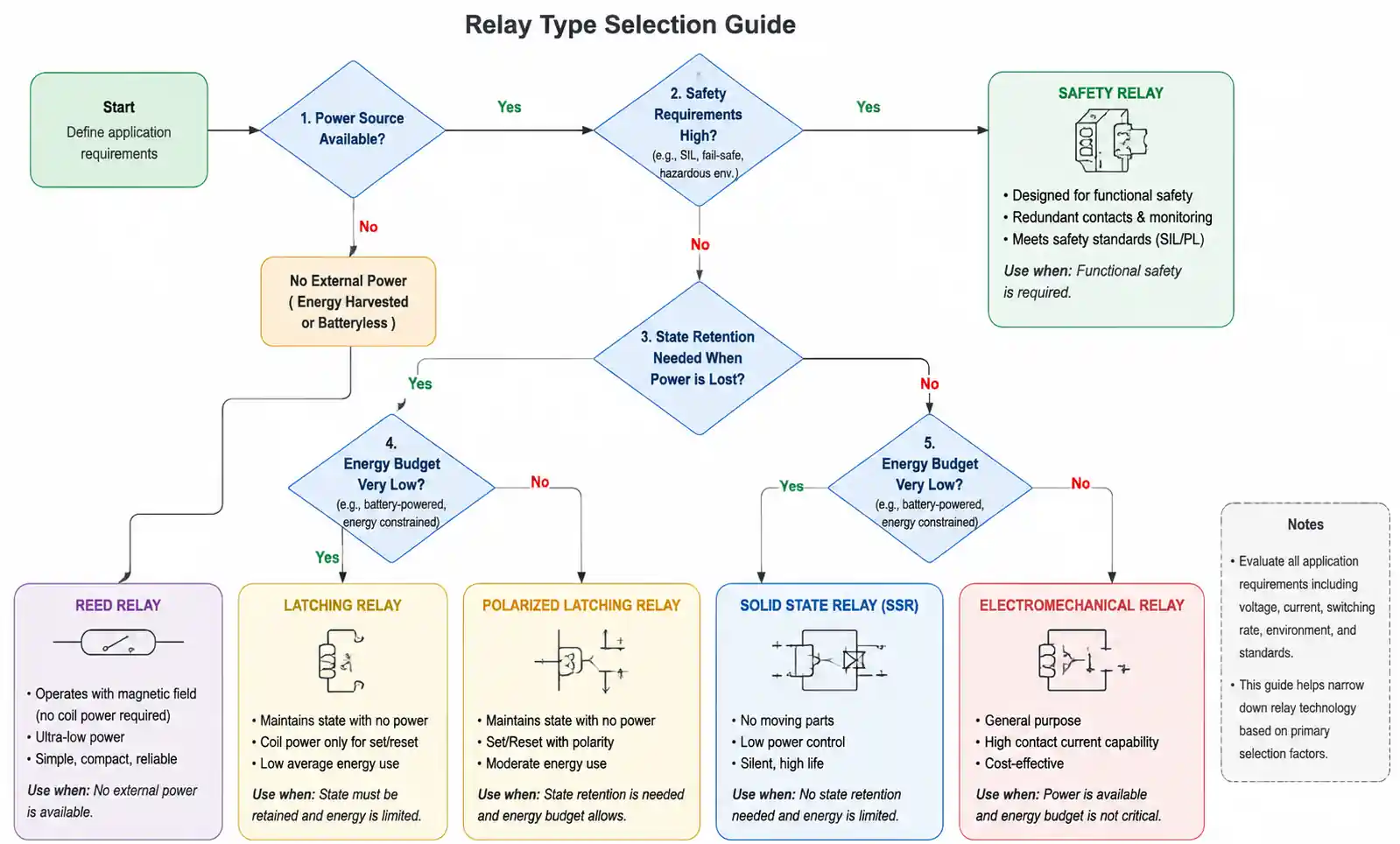
Ask these questions to guide your selection:
-
What happens if power is lost? If the relay must return to a default state, choose non-latching. If it should maintain position, choose latching.
-
How often does the state change? Frequently switching states favors non-latching for simplicity. Infrequent changes favor latching for efficiency.
-
What is the power source? Battery or solar power strongly favors latching. Grid power reduces the importance of efficiency.
-
How critical is the total energy budget? Energy-conscious designs benefit significantly from latching relays' zero holding current.
-
What control complexity is acceptable? Simple projects may prefer non-latching. Sophisticated systems can easily handle latching relay pulse requirements.
8. Wiring Considerations and Best Practices
Non-Latching Relay Wiring
Non-latching relays use straightforward connections:
- Coil terminals - Connect to control voltage (observe polarity for DC coils)
- Common (COM) - Connect to load power source
- Normally Open (NO) - Connected to load when relay is energized
- Normally Closed (NC) - Disconnected from load when relay is energized
Best Practices:
- Add a flyback diode across DC coils to suppress voltage spikes when de-energizing
- Use adequate wire gauge for contact current ratings
- Ensure control power can sustain coil current continuously
- Consider contact voltage and current ratings with safety margin
Latching Relay Wiring
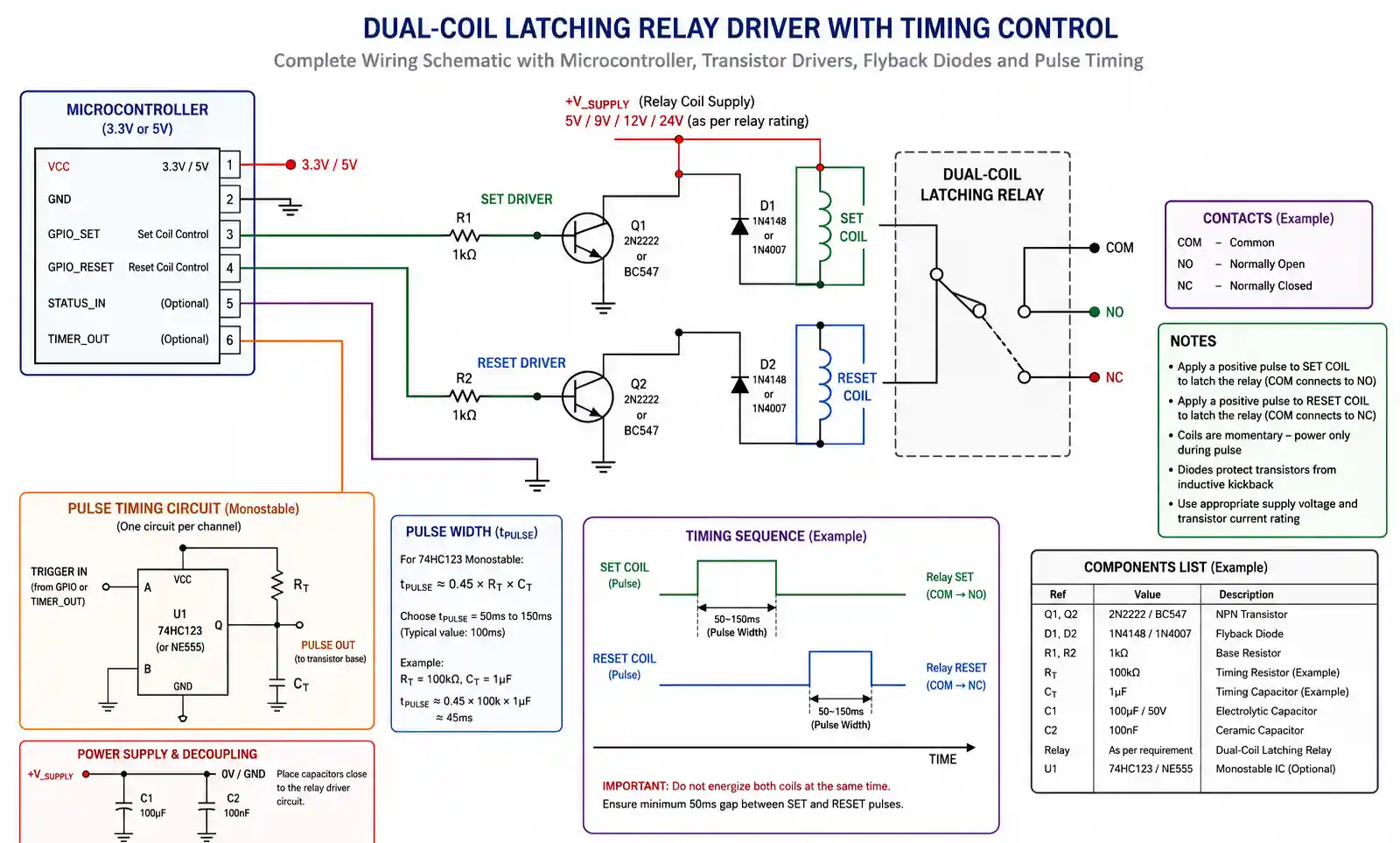
Latching relays require pulse control circuits:
Single-coil latching:
- Apply positive pulse to set
- Apply negative pulse to reset
- H-bridge or polarity-reversing circuit needed
Dual-coil latching:
- Separate connections for set coil and reset coil
- Brief pulse (10-50ms typical) to either coil changes state
- Simpler control than single-coil but requires more connections
Best Practices:
- Use capacitors or pulse generators for reliable switching
- Implement pulse duration limiting to prevent coil overheating
- Add position indicators (LEDs or sensors) if state visibility is needed
- Consider microcontroller-based control for precise pulse timing
- Include protection circuitry for both coils in dual-coil designs
9. Frequently Asked Questions
Can I replace a non-latching relay with a latching relay?
Not directly. The control circuits differ significantly. Non-latching relays require continuous power application, while latching relays need momentary set/reset pulses. You must modify the control circuit to provide appropriate pulse signals and ensure your system can function correctly with state retention behavior.
How much power does a latching relay really save?
A typical non-latching relay draws 150-200mA continuously when activated. At 12V, this equals approximately 2W constant consumption. Over a year of continuous operation, one latching relay can save 17+ kWh compared to a non-latching alternative. In installations with multiple relays, savings multiply significantly.
Do latching relays have a default position?
No. Latching relays maintain their last switched position, so after power cycling or initial installation, the state is indeterminate without position feedback. Many systems address this by incorporating position sensors or executing a known sequence of reset pulses during startup to establish a defined state.
Which type is more reliable?
Both types are highly reliable when properly applied. Non-latching relays have simpler mechanisms but experience more thermal stress from continuous coil energization. Latching relays have more complex internal mechanisms but experience less thermal cycling. Quality and proper application matter more than relay type for reliability.
Can latching relays be used in safety-critical applications?
Yes, but with careful design. While non-latching relays offer automatic fail-safe behavior, latching relays can be used in safety applications when combined with position monitoring, redundancy, or active control systems that can force a safe state. The specific safety requirements of your application determine suitability.
How do I control a latching relay with a microcontroller?
Use GPIO pins to generate brief pulses (typically 10-50ms). For single-coil types, use an H-bridge to reverse polarity. For dual-coil types, use separate transistor drivers for each coil. Include current-limiting resistors and flyback diodes for coil protection. Most implementations use simple digital output pulses with timing control in firmware.
Conclusion
Both latching and non-latching relays serve important roles in electrical and electronic design. Non-latching relays excel in applications requiring fail-safe operation, predictable behavior, and simple control. Their automatic reset capability makes them ideal for safety systems and applications where default states matter.
Latching relays shine in power-conscious designs, particularly battery-operated and remote systems. Their ability to maintain state without continuous power consumption delivers significant energy savings over time while providing state memory through power interruptions.
The right choice depends on your specific requirements: power budget, safety needs, control complexity, and operational environment. By understanding the fundamental differences and carefully evaluating your application's priorities, you can select the optimal relay type for reliable, efficient circuit operation.