



Memory IC Selection Guide: SRAM, DRAM, Flash, and EEPROM Compared
Selecting the right memory IC determines whether your embedded system meets real-time requirements, survives 100,000 write cycles, or operates within power budgets. Engineers frequently misapply memory technologies—choosing SRAM for cost-sensitive IoT nodes or EEPROM for data logging that exceeds write endurance limits. This guide compares SRAM, DRAM, Flash, and EEPROM across speed, endurance, power consumption, and cost per bit, with selection frameworks for automotive, industrial, and consumer applications.
Hitop Tech Limited's product categories include verified memory IC suppliers with full traceability and competitive lead times for volume production.
Table of Contents
- Memory Technology Fundamentals
- SRAM: Speed and Volatility Trade-offs
- DRAM: High Density with Refresh Requirements
- Flash Memory: Non-Volatile Storage for Code and Data
- EEPROM: Byte-Level Updates with Limited Endurance
- Selection Criteria: Speed, Endurance, and Cost Analysis
- FAQ
- Conclusion
Memory Technology Fundamentals
Memory ICs divide into volatile (data lost at power-off) and non-volatile (data retained) architectures. SRAM and DRAM are volatile, requiring constant or periodic power. Flash and EEPROM are non-volatile, retaining data for 10-20 years at room temperature.
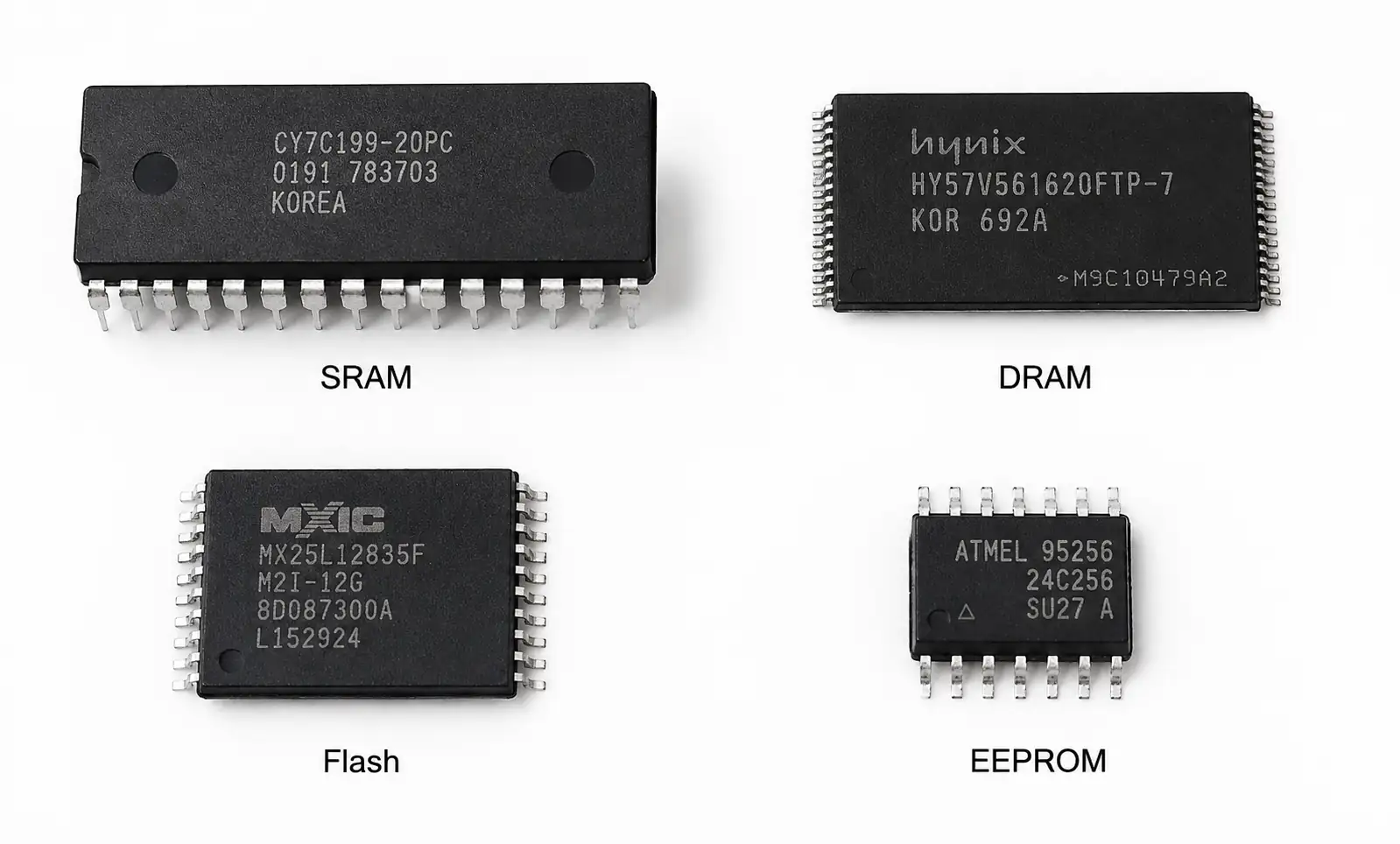 Memory IC types comparison showing volatile and non-volatile architectures
The engineering trade-off centers on six parameters: access time, density, write endurance, data retention, power consumption, and cost per bit. No single technology optimizes all six—each excels in specific application domains.
SRAM uses six transistors per bit, delivering 2-10ns access with unlimited write cycles but consuming 4-6× the die area of DRAM. DRAM stores charge in capacitors requiring 3ns refresh every 64ms, achieving 4× density but adding controller complexity. Flash stacks charge in floating gates, enabling high density and 10-year retention but limiting write endurance to 10K-100K cycles. EEPROM allows byte-level updates with 1M cycle endurance but costs 5-10× more per bit than Flash.
SRAM: Speed and Volatility Trade-offs
SRAM delivers deterministic 2-45ns access times without refresh overhead, making it essential for cache memory, real-time buffers, and timing-critical applications. Six-transistor cells maintain data as long as power remains applied, with unlimited write cycles but 4-6× larger die area than DRAM.
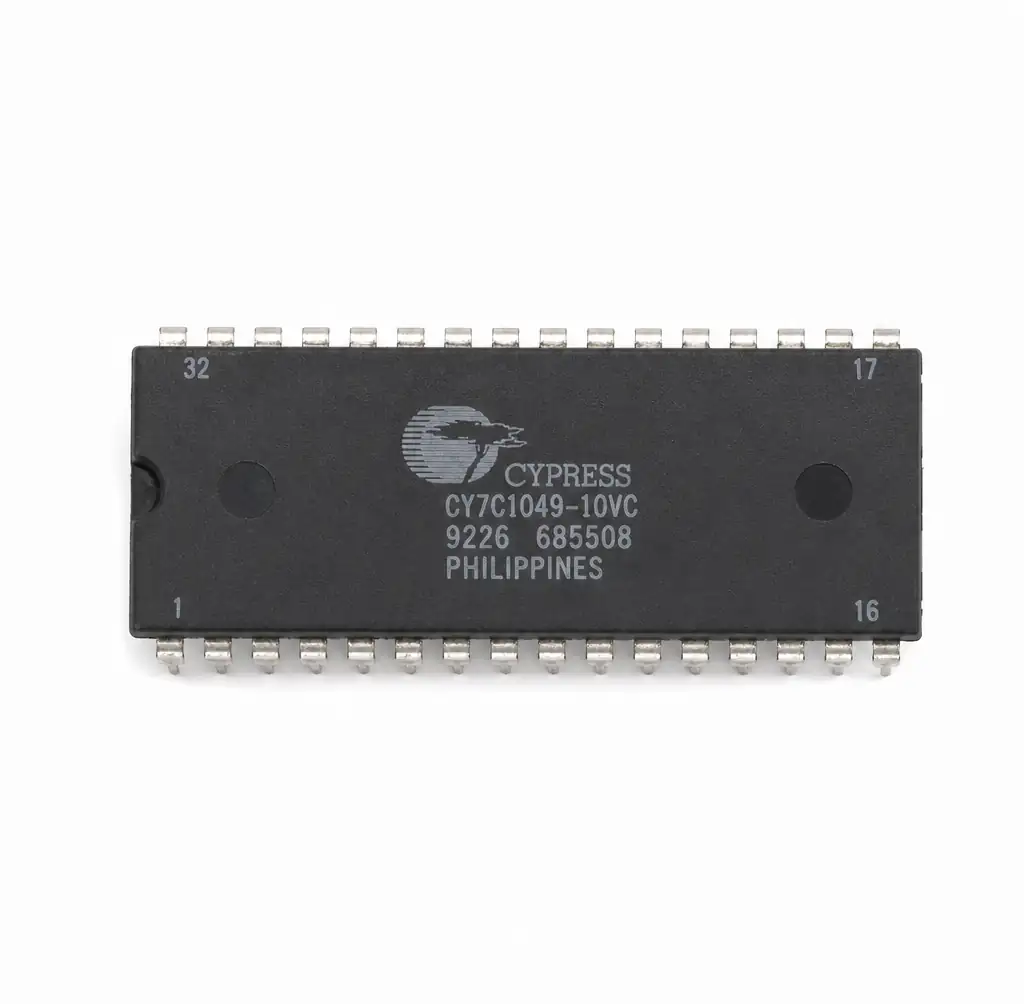 SRAM integrated circuit showing parallel interface pins and package type
Commercial SRAM reaches 512Kbit to 16Mbit densities with parallel or SPI interfaces. Asynchronous SRAM provides sub-10ns random access ideal for processor cache extensions. Low-power SRAM reduces standby current to 1-5µA for battery-backed retention in industrial controllers, extending CR2032 battery life beyond 5 years for 512Kbit capacity.
Use SRAM when deterministic timing matters more than cost. Automotive radar processors require 2Mbit SRAM for real-time FFT buffers where DRAM refresh latency creates measurement jitter. Industrial motor controllers use 256Kbit SRAM for commutation tables accessed every 50µs. The constraint is cost: $0.50-2.00 per megabit versus $0.05-0.15 for DRAM.
DRAM: High Density with Refresh Requirements
DRAM achieves 4-8× density advantage over SRAM through one-transistor-one-capacitor cells, but charge leakage requires refresh cycles every 64ms. DRAM controllers perform 8,192 refresh cycles per 64ms window, blocking access for 30-60ns per refresh and consuming 3-5% of memory bandwidth.
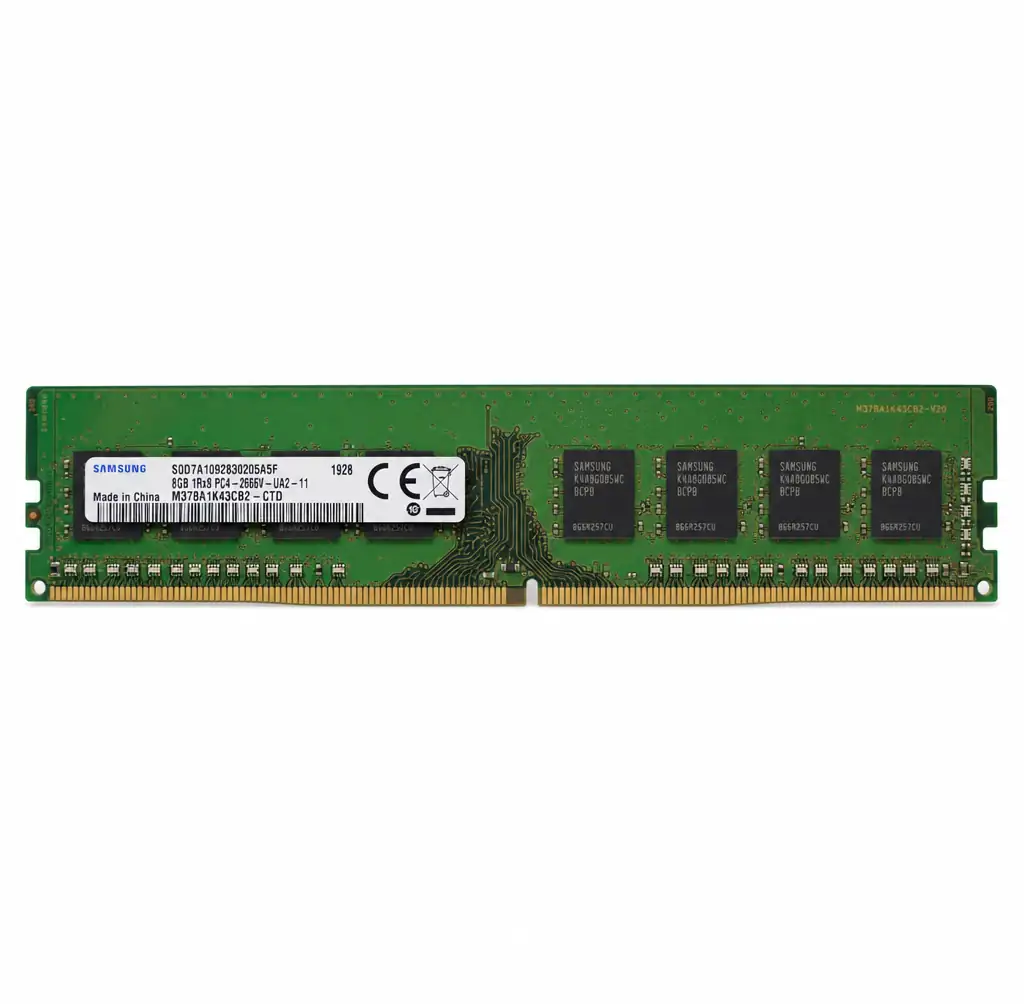 DDR4 SDRAM memory module showing high-density chip configuration
DDR4 SDRAM reaches 4-16Gbit densities at $0.05-0.15 per megabit with 15ns CAS latency, enabling cost-effective video buffers, embedded Linux systems, and AI inference weight storage. LPDDR4 reduces standby current to 50-200mA but still exceeds SRAM by 1000×.
DRAM fits applications prioritizing density and cost over power efficiency: embedded Linux systems requiring 512Mbit-2Gbit working memory, digital video recorders, or network switches. DRAM becomes problematic for ultra-low-power IoT sensors, battery-backed data retention, or safety-critical systems where refresh timing complicates certification.
| Memory Type | Access Time | Density | Write Endurance | Data Retention | Standby Power | Cost per Mb |
|---|---|---|---|---|---|---|
| SRAM | 2-45ns | Low (512Kb-16Mb typical) | Unlimited | Volatile (battery-backup possible) | 1-5µA | $0.50-2.00 |
| DRAM | 15-25ns | High (256Mb-16Gb typical) | Unlimited | Volatile (requires refresh) | 50-200mA | $0.05-0.15 |
| NOR Flash | 50-120ns read, 100µs write | Medium (4Mb-2Gb typical) | 100,000 cycles | 20 years | 10-50µA | $0.08-0.25 |
| NAND Flash | 25µs read, 200µs write | Very High (4Gb-1Tb) | 10,000-100,000 cycles | 10 years | 5-20µA | $0.02-0.08 |
| EEPROM | 150ns-1µs read, 5ms write | Low (16Kb-4Mb typical) | 1,000,000 cycles | 40 years | 1-10µA | $0.40-1.50 |
Flash Memory: Non-Volatile Storage for Code and Data
Flash memory divides into NOR (execute-in-place code storage) and NAND (high-density data storage) architectures. Both store charge in floating gates requiring high-voltage programming pulses and block-erase operations, but differ in access granularity and performance.
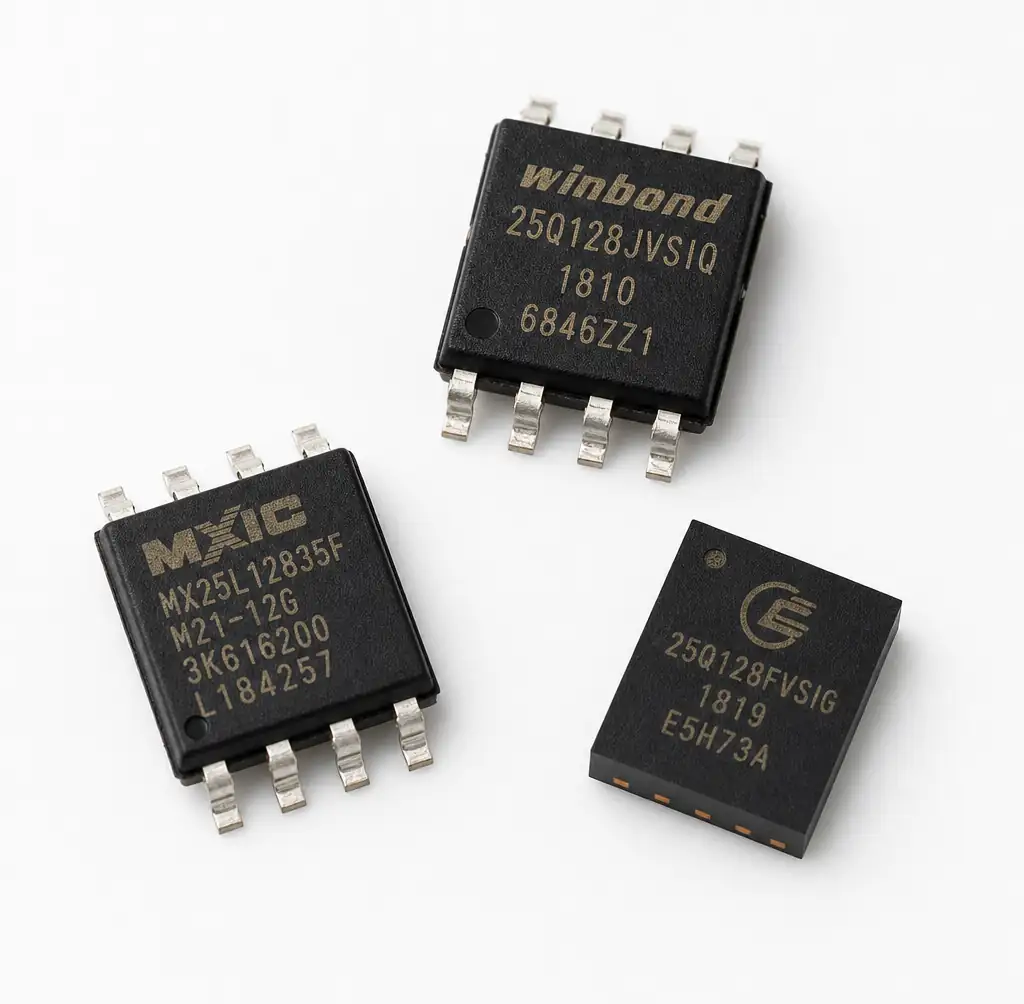 SPI NOR Flash memory IC for embedded firmware storage
NOR Flash provides byte-level random read access with 50-120ns latency, enabling direct code execution (XIP) without copying to RAM. SPI NOR Flash reaches 512Mbit at $0.15-0.25 per megabit with Quad-SPI modes delivering 50-80MB/s read throughput. Write operations require page programming (256 bytes) taking 0.5-3ms, and block erases (4-64KB) taking 100-400ms. Write endurance reaches 100,000 cycles for SLC NOR—distributing writes across blocks or implementing wear leveling extends operational life.
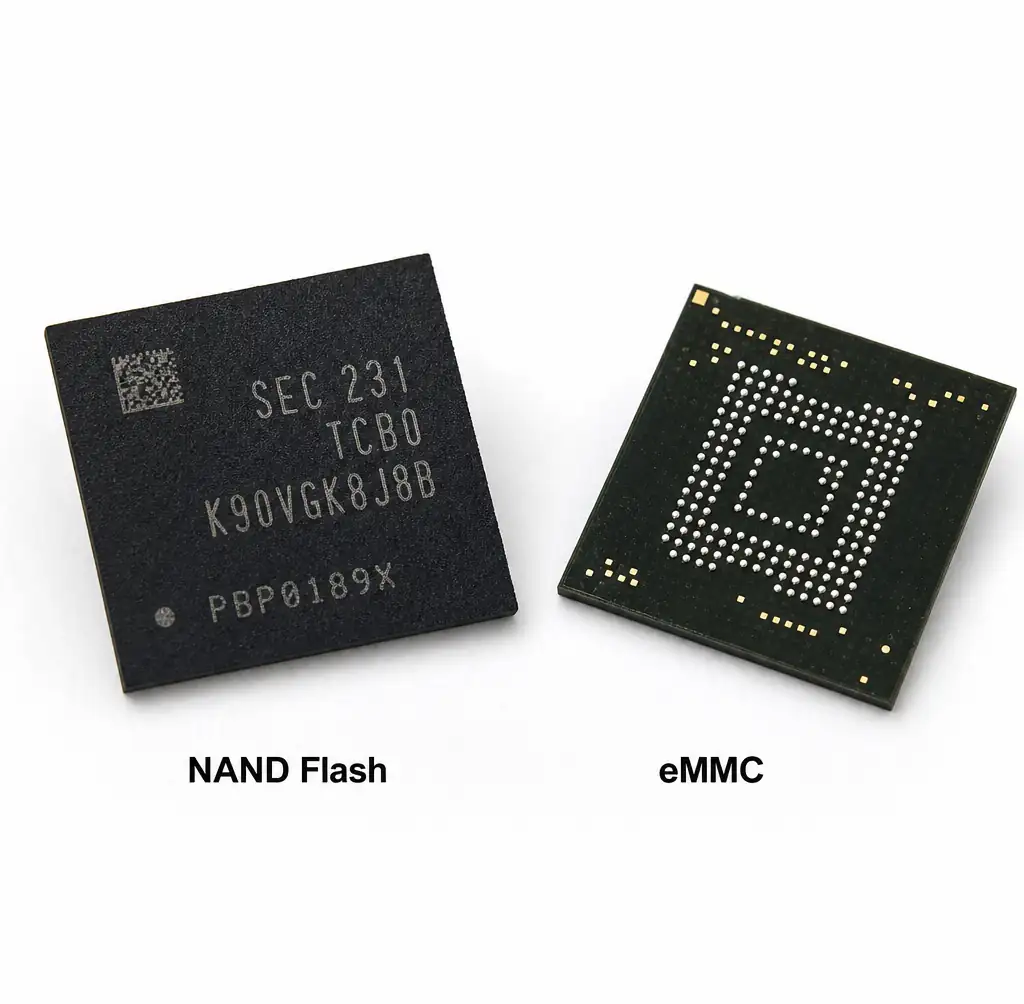 NAND Flash and eMMC packages for high-capacity data storage
NAND Flash organizes into pages (2-16KB) and blocks (128KB-4MB) requiring external controllers for error correction (ECC), bad block management, and wear leveling. Raw NAND reaches $0.02-0.05 per megabit in densities exceeding 1Tb. SLC (single-level cell) NAND delivers 100,000 cycle endurance suitable for industrial data logging. MLC (multi-level cell) reduces cost to $0.02-0.03 per megabit but limits endurance to 10,000 cycles. eMMC and UFS packages integrate NAND with controllers, providing filesystem-ready storage for applications needing 4-128GB capacity: automotive black boxes, medical imaging archives, or industrial HMI systems.
EEPROM: Byte-Level Updates with Limited Endurance
EEPROM enables byte-level electrical erase and reprogramming with 1,000,000 cycle endurance—10× higher than Flash—making it ideal for frequently updated configuration registers, calibration data, or event counters. Write times reach 5ms per byte versus 100µs per 256-byte page for Flash, but the ability to update single bytes without erasing surrounding data simplifies firmware implementation.
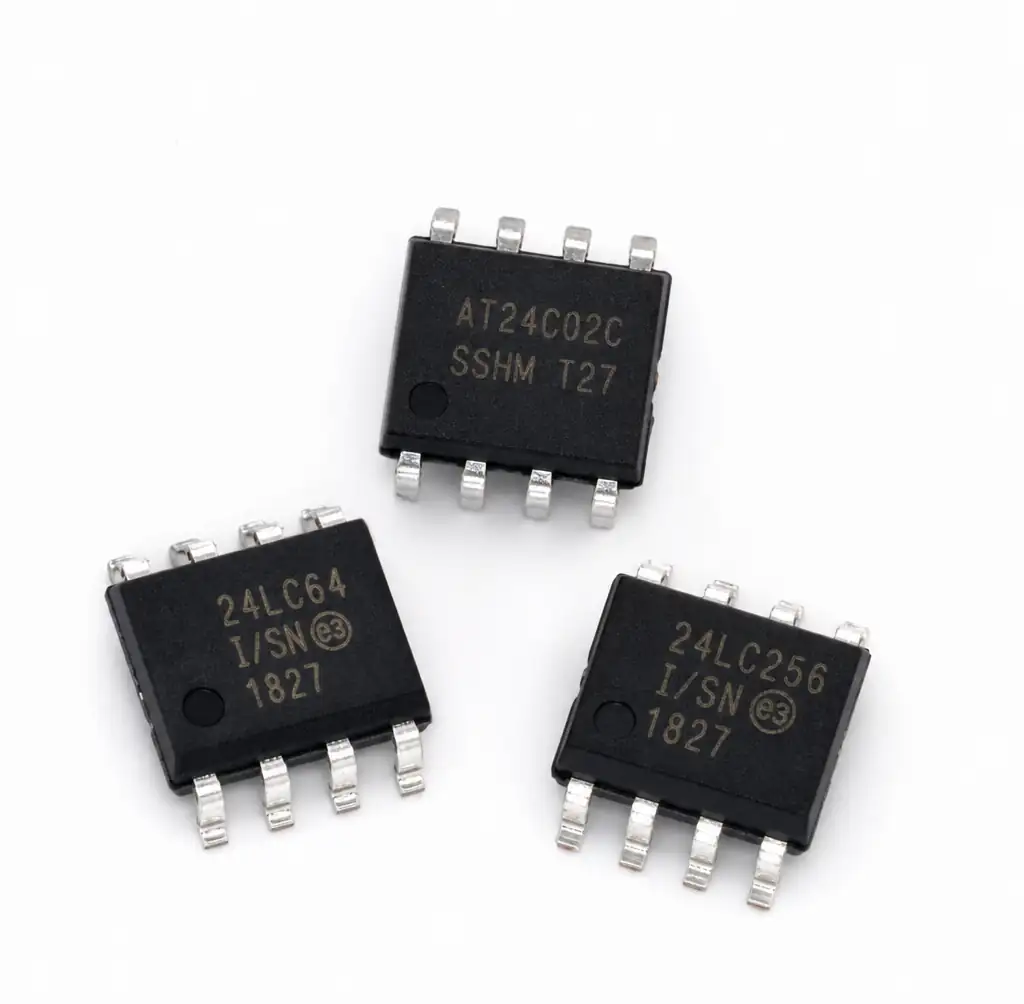 I2C EEPROM chips showing serial interface for configuration data storage
I²C EEPROM in 16Kbit-4Mbit densities costs $0.40-1.50 per megabit—10× Flash pricing—but provides deterministic single-byte updates without wear-leveling algorithms. EEPROM's 1M cycle endurance supports 100 daily updates for 27 years or 10,000 updates daily for 270 days. Data retention exceeds 40 years at 25°C, degrading to 10 years at 85°C due to charge leakage acceleration. Automotive and industrial systems operating at 125°C junction temperature should verify retention specifications—many EEPROM families guarantee only 200-500 cycles at maximum temperature.
Selection Criteria: Speed, Endurance, and Cost Analysis
Memory selection balances six constraints: access speed requirements, write frequency and endurance needs, power budget (active and standby), data retention requirements, density and cost targets, and integration complexity.
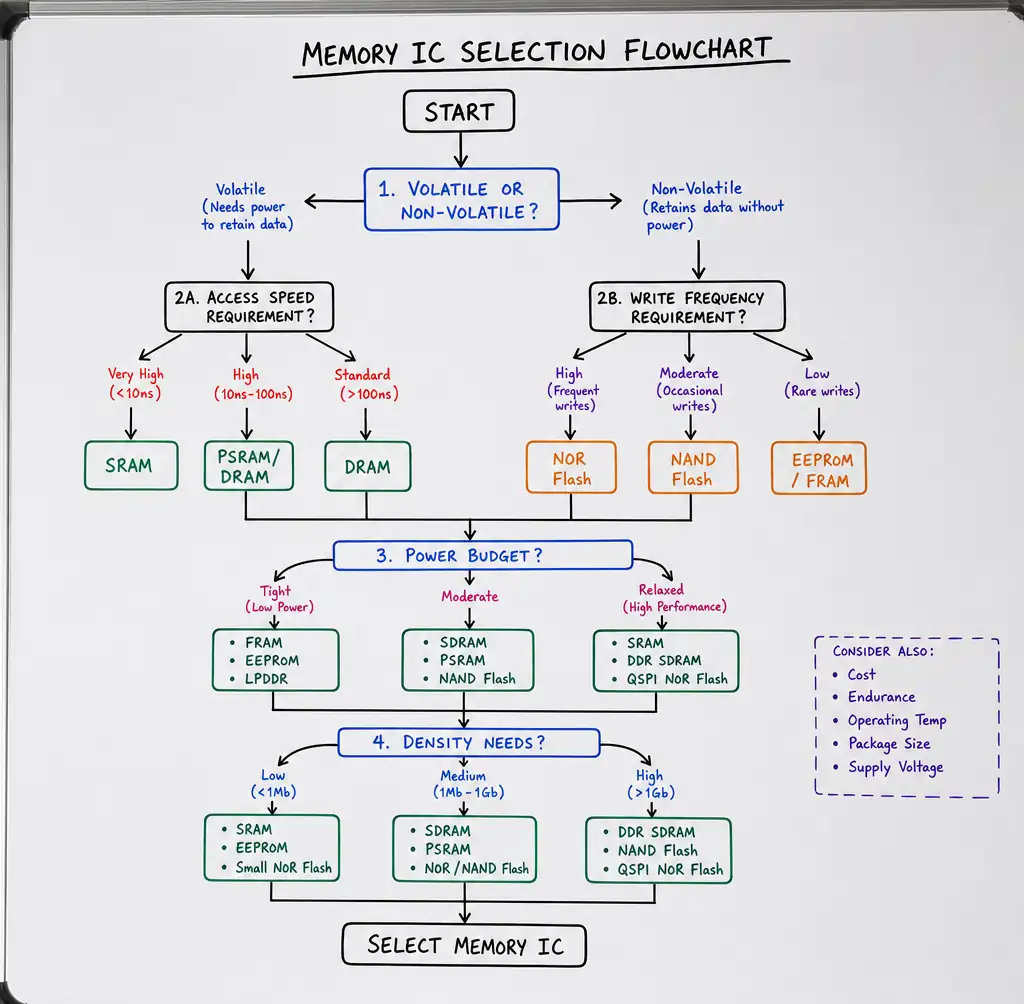 Memory IC selection decision flowchart for embedded system design
Real-time control systems prioritize deterministic access—select SRAM for buffers updated every microsecond, Flash for firmware and constants, EEPROM for calibration data. Battery-powered IoT sensors prioritize standby power—select low-power SRAM with battery backup for active variables, Flash for firmware and logged data, avoid DRAM entirely. High-density data logging prioritizes cost per bit—select NAND Flash with wear leveling, avoid EEPROM for high-frequency logging. Automotive safety systems prioritize reliability and retention—select automotive-grade EEPROM (AEC-Q100) for configuration, ECC-protected Flash for code, avoid MLC NAND for safety-critical data.
| Application | Working Memory | Firmware/Code | Configuration/Calibration | Data Logging |
|---|---|---|---|---|
| Industrial PLC | 512Kb-2Mb SRAM | 4-16Mb NOR Flash | 32-128Kb EEPROM | 128Mb-1Gb NAND Flash |
| IoT Sensor Node | 64-256Kb SRAM | 1-4Mb SPI Flash | 16-64Kb EEPROM | 4-64Mb SPI Flash |
| Automotive Infotainment | 1-4Gb LPDDR4 | 128Mb-1Gb eMMC | 256Kb-1Mb EEPROM | 8-64Gb eMMC |
| Medical Device | 256Kb-2Mb SRAM | 8-64Mb NOR Flash | 128Kb-512Kb EEPROM | 256Mb-4Gb NAND Flash |
| Consumer Wearable | 128-512Kb SRAM | 4-16Mb SPI Flash | 32-128Kb EEPROM | 512Mb-4Gb eMMC |
FAQ {#faq}
When should I choose SRAM over DRAM despite higher cost?
Choose SRAM when deterministic timing matters more than density. Applications requiring microsecond-level response without refresh latency—real-time control loops, radar signal processing, or safety-critical buffers—justify SRAM's 10× cost premium. Battery-backed SRAM suits systems requiring instant recovery after power loss with standby currents below 5µA.
Can I use Flash memory for frequently updated data logging?
Flash works for data logging if daily write volume stays below endurance limits. SLC Flash with 100,000 cycle endurance supports 100 daily updates for 2.7 years per block. Implement wear leveling to distribute writes. For logging exceeding 1,000 updates daily, EEPROM provides better endurance.
How do I calculate Flash endurance for my application?
Divide Flash endurance (cycles per block) by daily writes to that block. For 16Mbit SPI Flash with 4KB blocks and 100,000 cycle endurance, logging 1KB daily to different blocks cycles through all blocks in 11.2 years. Logging 1KB daily to the same block exhausts it in 400 days.
What memory type suits automotive temperature range (-40°C to 125°C)?
All four technologies offer automotive-grade options, but specifications degrade at temperature extremes. SRAM and DRAM maintain performance across temperature. Flash write endurance drops 2-5× at 125°C. EEPROM retention degrades from 40 years at 25°C to 10 years at 85°C. Select AEC-Q100 qualified parts with Grade 1 (-40°C to 125°C) rating.
How does standby power consumption compare for battery-backed systems?
SRAM: 1-5µA standby extends CR2032 battery life beyond 5 years for 512Kbit. Flash: 5-20µA suitable for periodic wake cycles. DRAM: 50-200mA impractical for battery backup. EEPROM: 1-10µA suitable for long-term battery-backed storage.
What is the difference between NOR and NAND Flash for embedded systems?
NOR Flash supports execute-in-place (XIP) with byte-level random read access, ideal for microcontroller firmware storage. NAND Flash requires external controllers for error correction but delivers 4-10× higher density at lower cost, ideal for data logging or embedded Linux systems.
Can I replace EEPROM with Flash to reduce cost?
Flash can replace EEPROM for infrequently updated data (under 10,000 lifetime writes), but requires firmware to manage page programming and block erasing. EEPROM's byte-level updates simplify firmware and provide 10× higher endurance. For cost-sensitive designs with low write frequency, Flash with wear leveling delivers adequate endurance at 5-10× lower cost.
Conclusion {#conclusion}
Memory IC selection hinges on application-specific trade-offs between speed, endurance, power, and cost. SRAM delivers deterministic performance for real-time systems but costs 10× more than DRAM per bit. DRAM optimizes density for high-capacity applications but requires refresh overhead unsuitable for ultra-low-power designs. Flash provides non-volatile storage with good density but limited write endurance requiring wear management. EEPROM enables frequent byte-level updates with high endurance but costs 10× more than Flash.
For real-time control, prioritize SRAM for buffers and Flash for firmware. For battery-powered IoT, use low-power SRAM with battery backup and Flash for logging. For high-density data storage, implement NAND Flash with wear leveling. For frequently updated calibration, select EEPROM despite cost premium.
Hitop Tech Limited maintains inventory of automotive-grade, industrial-grade, and commercial memory ICs from authorized manufacturers. Our procurement services provide competitive pricing with full traceability and lead time management for volume production. Submit your requirements through our RFQ portal for supplier-direct pricing and availability.