



MOSFET vs Relay: Complete Comparison Guide for Switching Applications
Choosing between a MOSFET and a relay for your electronic project can feel overwhelming. Both are switching devices, but they work in fundamentally different ways and excel in different scenarios. This guide breaks down everything you need to know to make the right choice for your application.
Table of Contents
- What Is a MOSFET?
- What Is a Relay?
- Key Differences Between MOSFET and Relay
- MOSFET vs Relay: Switching Speed Comparison
- Lifespan and Durability: Which Lasts Longer?
- Electrical Isolation Explained
- Power Handling Capabilities
- When to Use a MOSFET
- When to Use a Relay
- Solid State Relays: The Middle Ground
- Cost and Size Considerations
- Frequently Asked Questions
1. What Is a MOSFET?
A MOSFET (Metal-Oxide-Semiconductor Field-Effect Transistor) is a solid-state semiconductor device that controls electrical current flow using voltage. Think of it as an electronic valve controlled by an electric field.
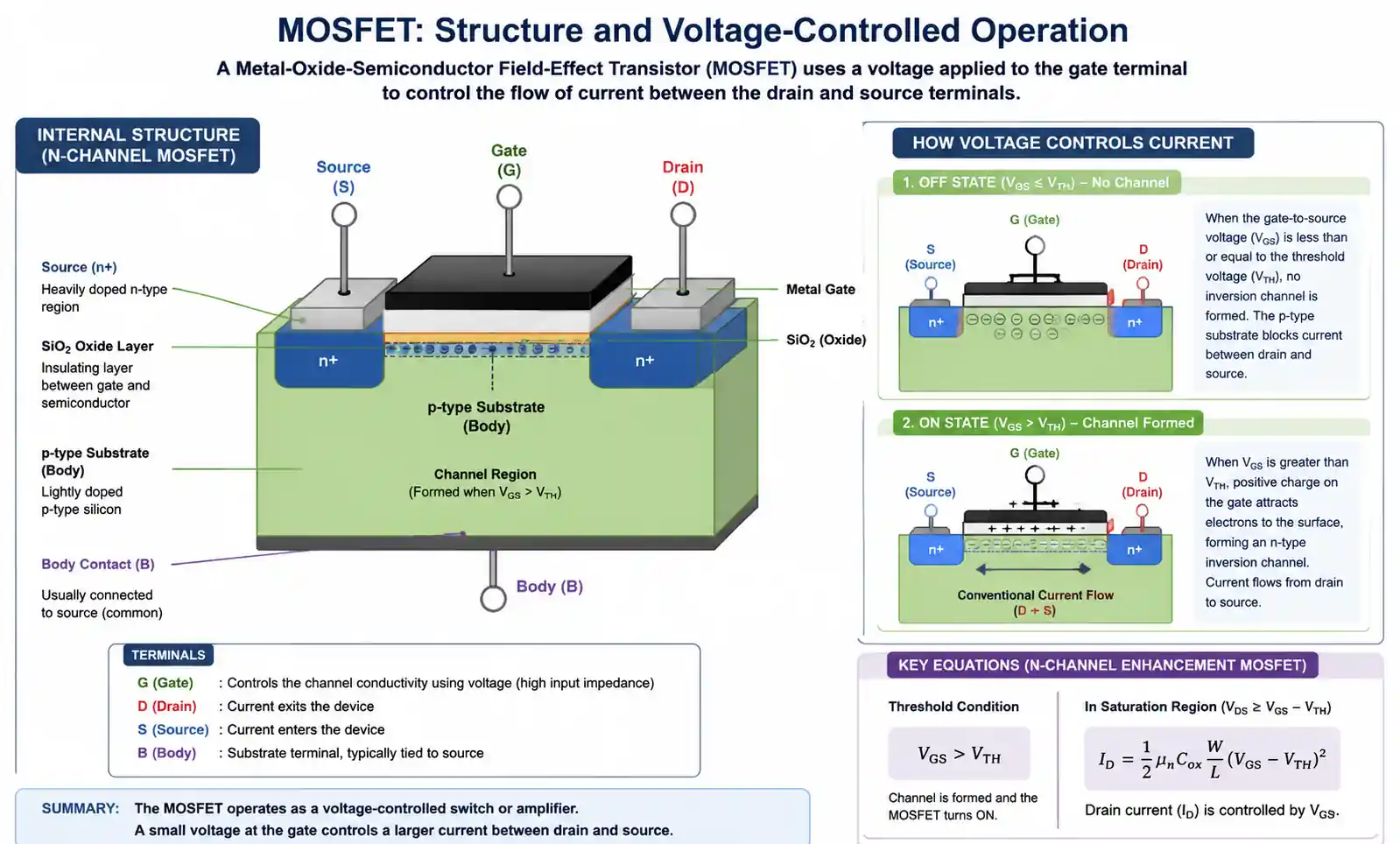
MOSFETs have three terminals: gate, drain, and source. When you apply voltage to the gate, it creates an electric field that allows current to flow between the drain and source. The beauty of MOSFETs lies in their voltage-controlled operation—they draw virtually no current from the control circuit.
MOSFETs come in two main types: N-channel and P-channel. N-channel MOSFETs are more common because they're easier to drive and more efficient for low-side switching applications.
2. What Is a Relay?
A relay is an electromechanical switch that uses an electromagnet to physically move a metal contact. When current flows through the relay's coil, it creates a magnetic field that pulls a metal armature, closing or opening electrical contacts.
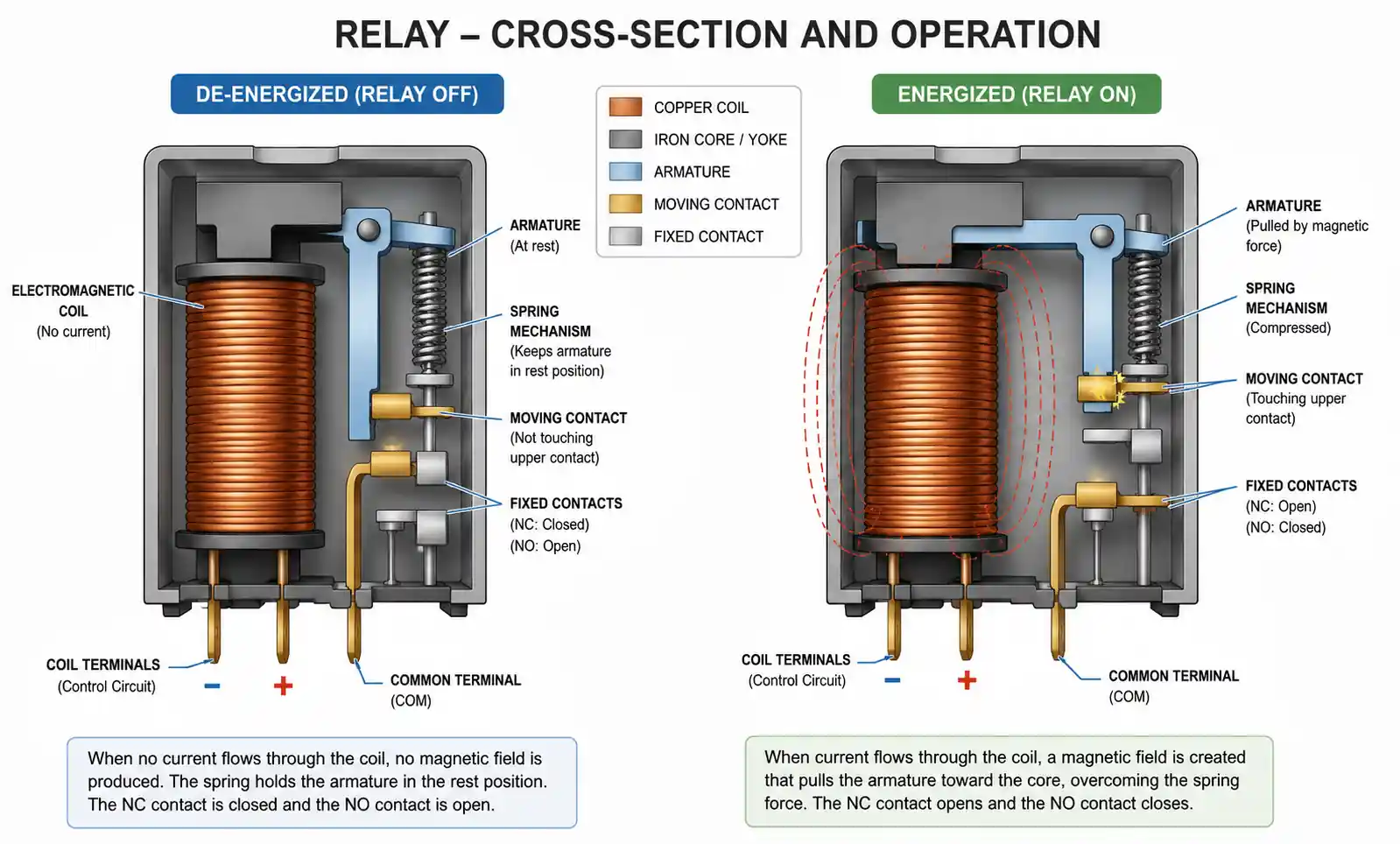
Traditional relays have moving parts—coils, springs, and contact points. This mechanical operation is both their strength and weakness. The physical separation between the control coil and switching contacts provides excellent electrical isolation, but mechanical wear limits their lifespan.
Relays can handle both AC and DC loads, making them incredibly versatile for high-power applications like controlling motors, heaters, and household appliances.
3. Key Differences Between MOSFET and Relay
The fundamental difference comes down to solid-state versus electromechanical design. Here's a quick comparison:
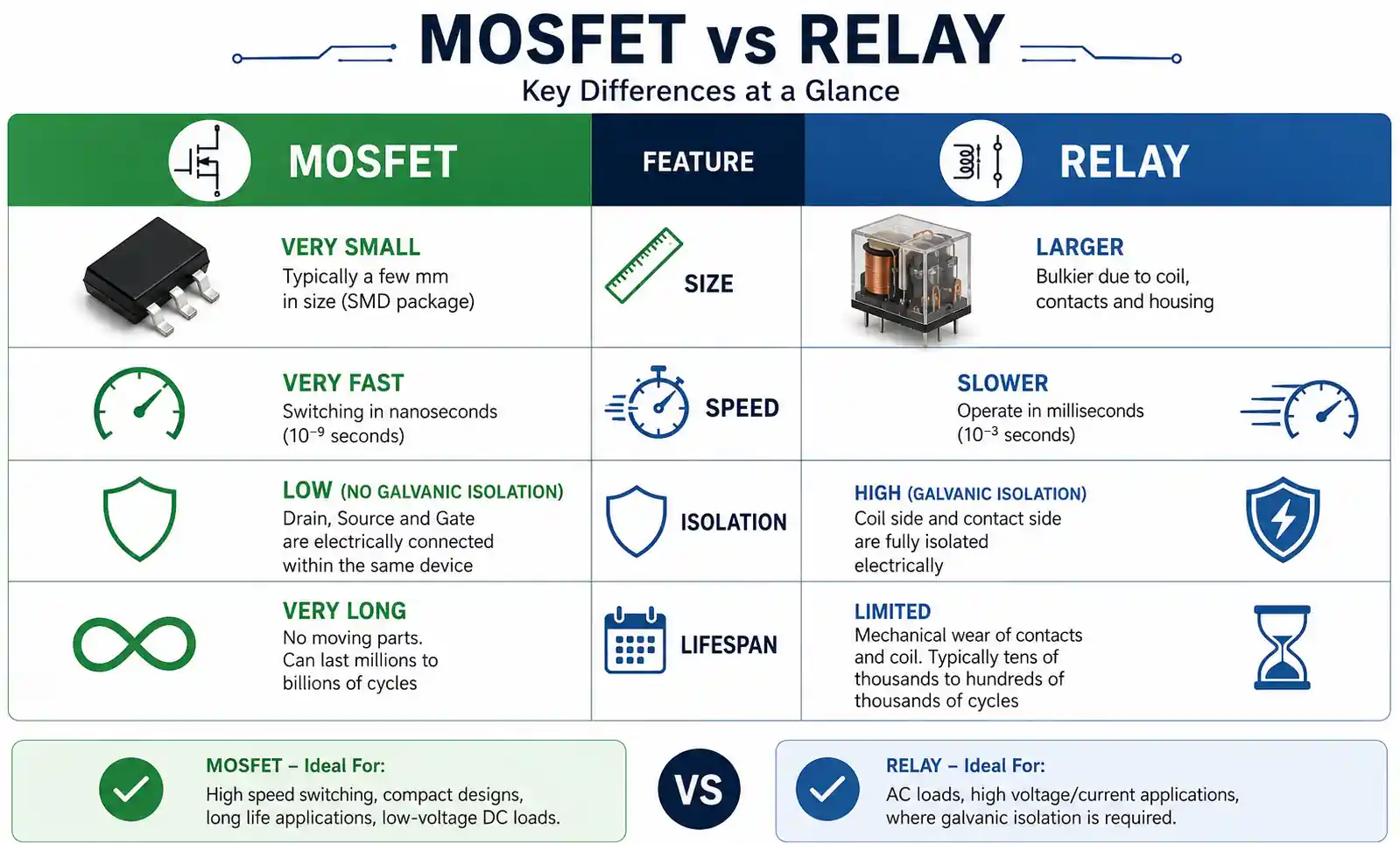
| Feature | MOSFET | Relay |
|---|---|---|
| Operating Principle | Voltage-controlled semiconductor | Electromagnetic coil with mechanical contacts |
| Switching Speed | Nanoseconds to microseconds | 5-15 milliseconds |
| Lifespan | Virtually unlimited | 100,000 to 1,000,000+ cycles |
| Electrical Isolation | None (requires additional circuitry) | Complete galvanic isolation |
| Size | Compact | Bulkier |
| Noise | Silent | Audible click |
| Power Consumption | Very low | Moderate (coil requires continuous power) |
MOSFETs operate silently and can switch millions of times per second, while relays make an audible click and switch much slower. However, relays provide complete isolation between control and load circuits—a critical safety feature in many applications.
4. MOSFET vs Relay: Switching Speed Comparison
Switching speed often determines which device you should use. MOSFETs switch incredibly fast—typically in nanoseconds to microseconds. This makes them ideal for PWM (Pulse Width Modulation) applications, high-frequency switching power supplies, and digital circuits.
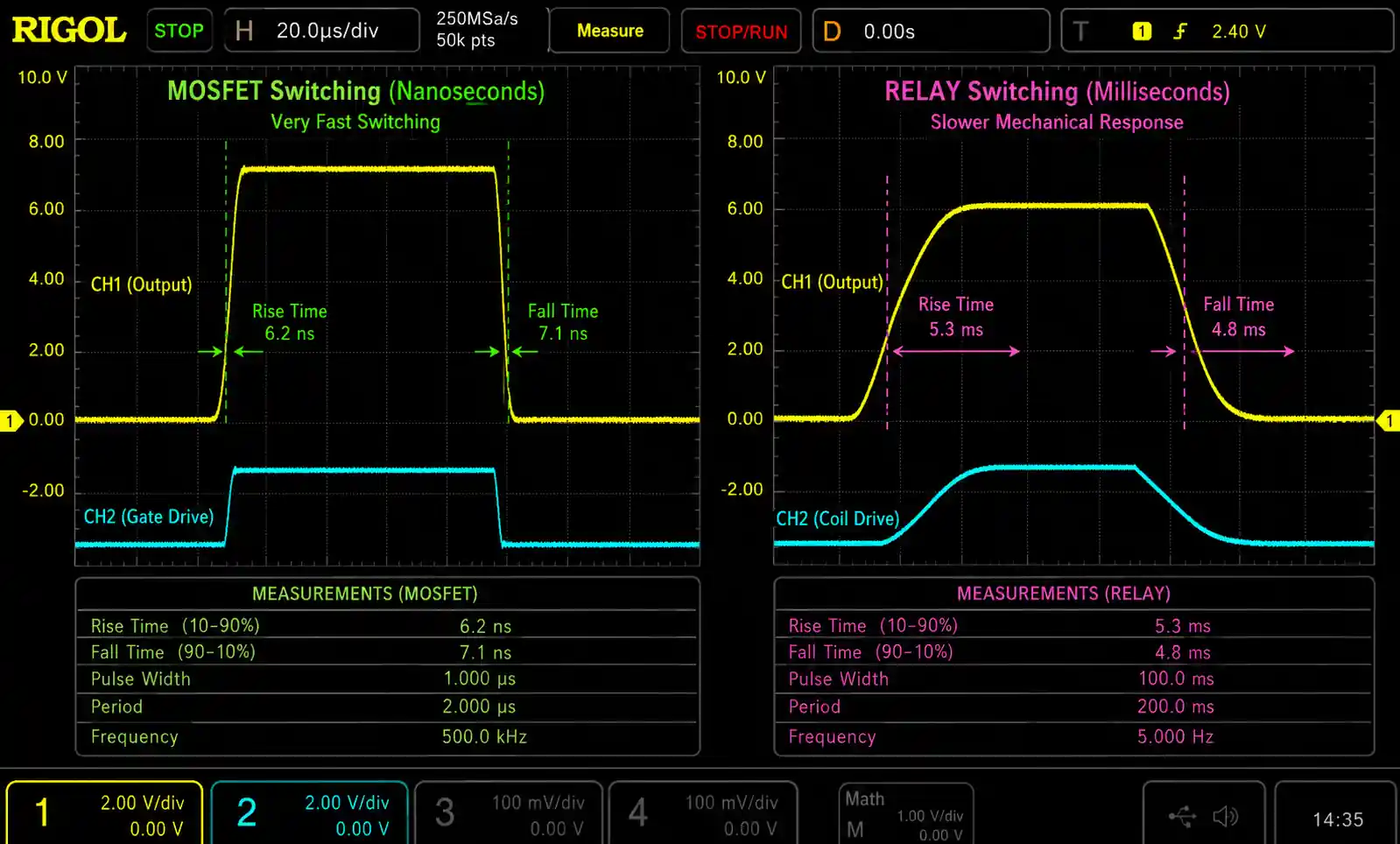
Relays, by contrast, have mechanical inertia. The armature needs time to physically move, resulting in switching times of 5-15 milliseconds. For applications like controlling a light or motor where you're switching once per minute or hour, this delay is irrelevant. But for PWM dimming or high-frequency applications, relays simply can't keep up.
Consider an LED dimming circuit. A MOSFET can switch thousands of times per second to create smooth dimming effects. A relay would wear out almost instantly attempting the same task and produce terrible flickering.
5. Lifespan and Durability: Which Lasts Longer?
MOSFETs have no moving parts, so they don't wear out from switching. A properly designed MOSFET circuit can operate for decades without degradation. The main failure modes are thermal stress and voltage spikes—both preventable with proper circuit design.
Relays have a rated cycle life, typically ranging from 100,000 cycles for small signal relays to over 1,000,000 cycles for industrial-grade relays. Every time the contacts close, they experience arcing and mechanical wear. High-current loads accelerate this wear through contact welding and erosion.
For applications requiring millions of switching cycles—like automated test equipment or high-frequency control systems—MOSFETs are the clear winner. For applications with infrequent switching, relay lifespan is more than adequate.
6. Electrical Isolation Explained
Electrical isolation is perhaps the most important difference between these devices. Relays provide complete galvanic isolation—there's no electrical connection between the control coil and the switching contacts. If something goes wrong on the load side (a short circuit, voltage spike, or fault), the control circuit remains protected.
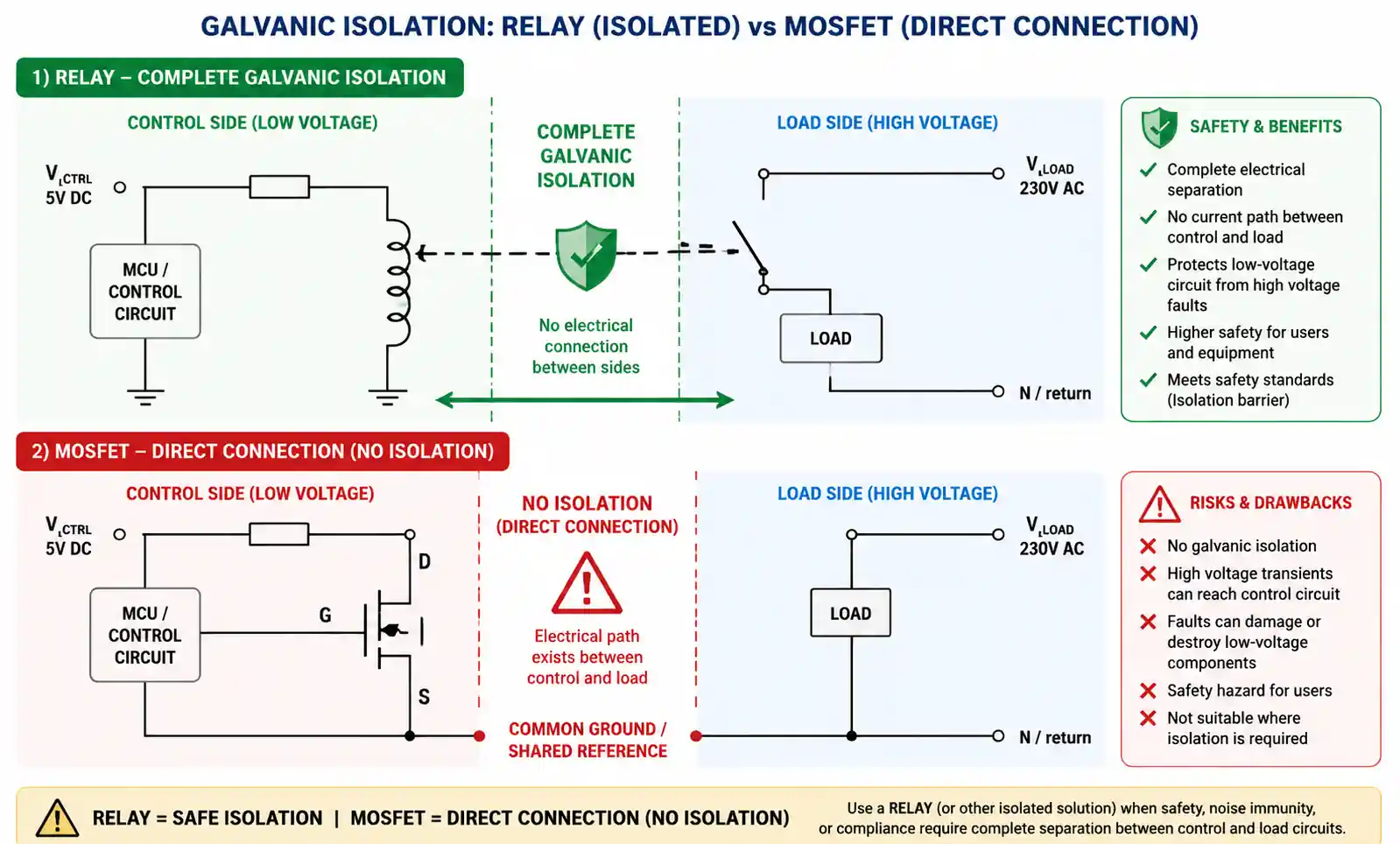
MOSFETs have no inherent isolation. The gate, drain, and source are all part of the same semiconductor substrate. If you're switching a high-voltage load with a MOSFET, you need additional circuitry—optocouplers or isolated gate drivers—to protect your control circuit.
This isolation matters enormously in safety-critical applications. When controlling mains voltage (120V or 240V AC), relays provide a physical air gap between your low-voltage control circuit and potentially lethal voltages. MOSFETs require careful design to achieve the same safety level.
7. Power Handling Capabilities
Relays excel at handling high voltage and high current. Industrial relays can switch hundreds of amps at hundreds of volts. The physical contact can handle large surge currents that would instantly destroy a MOSFET.

MOSFETs are better suited for moderate power levels. While power MOSFETs can handle significant current (30-100+ amps), they generate heat proportional to current squared times on-resistance. High-current MOSFETs require heat sinks and careful thermal management.
For AC loads, relays are often simpler. MOSFETs are inherently DC devices—switching AC requires two MOSFETs in a back-to-back configuration or a solid-state relay (SSR) design.
8. When to Use a MOSFET
Choose a MOSFET when you need:
- Fast switching speeds – PWM applications, switching power supplies, motor speed control
- Silent operation – Audio equipment, residential applications where noise matters
- Frequent switching – Automated systems requiring millions of cycles
- Low power consumption – Battery-powered devices, energy-efficient designs
- Compact size – Space-constrained PCB designs
- DC loads – LED drivers, battery management, digital circuits
MOSFETs shine in modern electronics where efficiency, speed, and size matter. They're the go-to choice for switching DC loads up to moderate current levels (typically under 50A without heroic thermal management).
9. When to Use a Relay
Choose a relay when you need:
- Electrical isolation – Safety-critical applications, mains voltage control
- High-power handling – Large motors, heaters, industrial equipment
- AC switching – Household appliances, HVAC systems
- Unknown load characteristics – When you need to handle any type of load safely
- Infrequent switching – Applications that switch a few times per hour or day
- Multiple circuits – Multi-pole relays can switch several circuits simultaneously
Relays are the reliable workhorse for high-power, infrequently switched applications. They're particularly valuable when you need absolute electrical isolation for safety or when dealing with challenging loads like incandescent lamps or motors with high inrush currents.
10. Solid State Relays: The Middle Ground
Solid State Relays (SSRs) combine the benefits of both technologies. They use semiconductor devices (often MOSFETs or TRIACs) internally but package them with optical isolation to create a drop-in relay replacement.
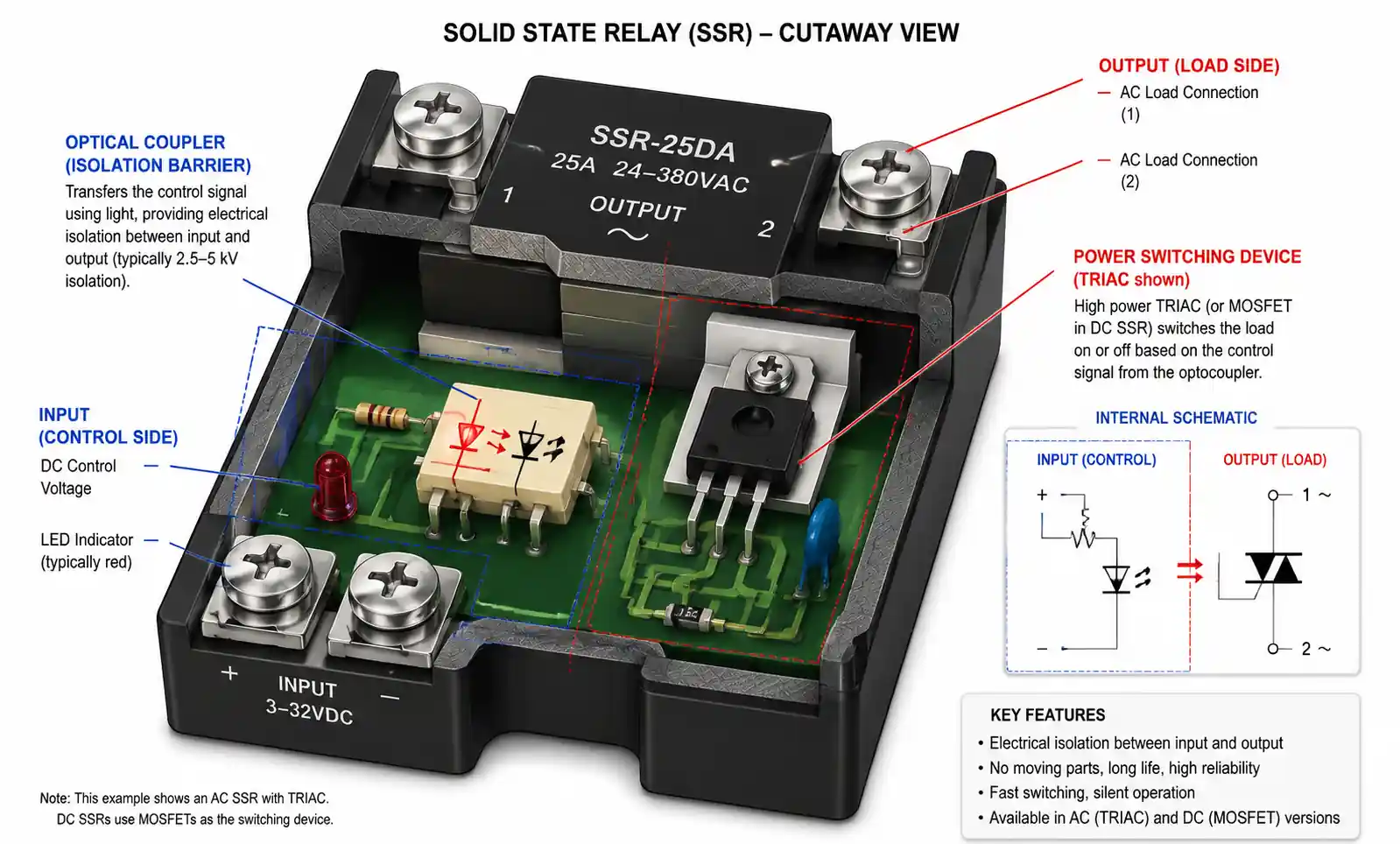
SSRs offer:
- Fast switching like MOSFETs
- Electrical isolation like mechanical relays
- Silent operation
- Long lifespan (no moving parts)
The tradeoff is higher cost and voltage drop during conduction. SSRs typically have 1-2V forward voltage drop, generating heat that must be dissipated. For moderate current applications where both speed and isolation matter, SSRs offer an excellent compromise.
11. Cost and Size Considerations
For mass production, MOSFETs are generally more cost-effective. A suitable power MOSFET might cost $0.50-$3.00, while a comparable relay costs $3-$10 or more. MOSFETs also require less PCB space.
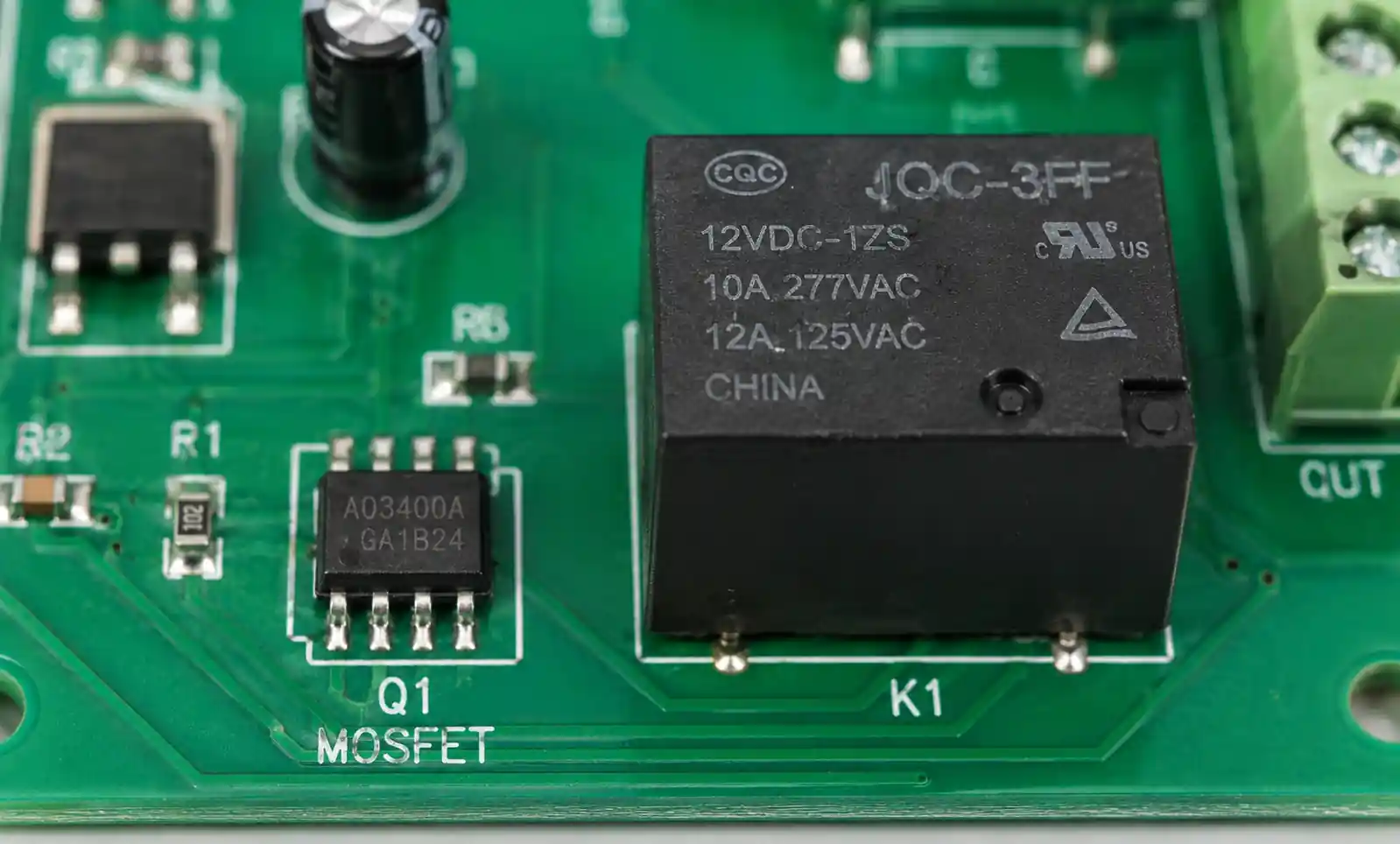
However, simple cost comparison misses important factors. Driving a MOSFET properly requires additional components—gate resistors, protection diodes, possibly gate drivers. Achieving isolation requires optocouplers. The total system cost might be comparable.
For one-off projects or prototypes, the price difference is negligible. Choose based on performance requirements, not a dollar or two in component cost.
12. Frequently Asked Questions
Can I replace a relay with a MOSFET?
Not always. MOSFETs lack inherent isolation and may not handle AC loads directly. Evaluate your specific requirements for voltage, current, isolation, and switching speed.
Which is more energy efficient?
MOSFETs consume virtually no power in the off state and have very low on-resistance, making them more efficient. Relays consume continuous power to keep the coil energized.
Do MOSFETs make noise?
No. MOSFETs operate silently since they have no moving parts. Relays produce an audible click when switching.
How do I choose between N-channel and P-channel MOSFET?
N-channel MOSFETs are easier to drive and more efficient for low-side switching (switching the ground side of the load). P-channel MOSFETs are used for high-side switching (switching the positive side).
Can relays handle inductive loads?
Yes, but inductive loads like motors and solenoids cause arcing across relay contacts, reducing lifespan. Use snubber circuits or choose relays rated for inductive loads.
What is on-resistance in MOSFETs?
On-resistance (RDS(on)) is the resistance between drain and source when the MOSFET is fully turned on. Lower on-resistance means less power dissipation and heat generation.
Conclusion
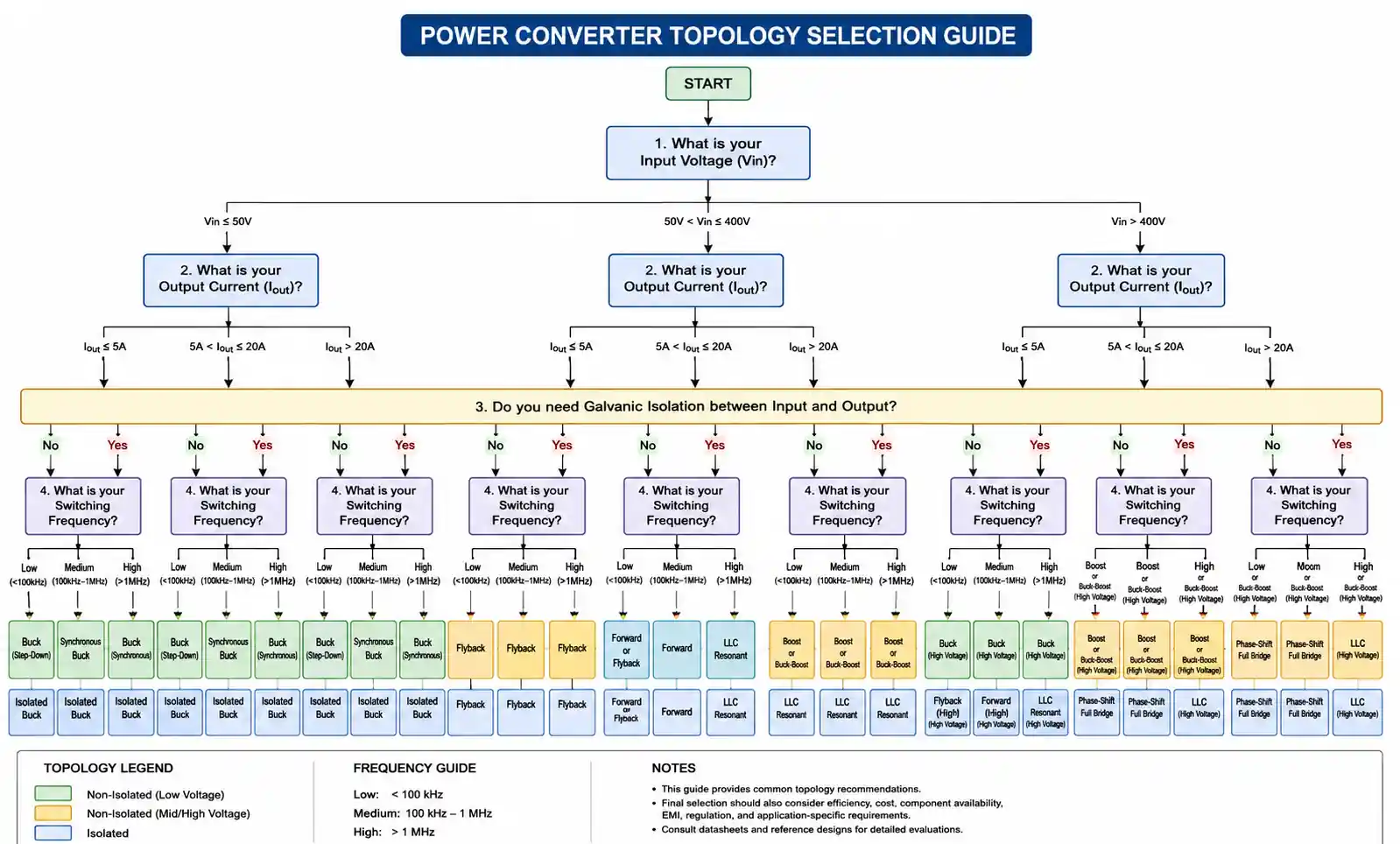
There's no universal "better" choice between MOSFETs and relays—each excels in different scenarios. MOSFETs offer speed, efficiency, and longevity for modern DC switching applications. Relays provide robust isolation and power handling for high-voltage, high-current, and AC loads.
Understanding your application's requirements—switching frequency, power levels, isolation needs, and cost constraints—will guide you to the right choice. Many professional designs use both, leveraging each component's strengths where they matter most.
For further reading on switching technologies and circuit design, explore resources from electronics forums and manufacturer application notes.