



How to Choose the Best Smart Home SoC: The Ultimate Guide to Matter, Thread, and Low Power (2026)
Picture this: Your customer buys a smart door sensor, installs it, and connects it to their network. Two months later, they are climbing a ladder to replace a dead coin-cell battery. Or worse, they realize the sensor only talks to Alexa, but their household uses Apple HomeKit.
For IoT hardware engineers and product managers, the fragmented smart home ecosystem has historically been a nightmare. But the game has changed. With the rise of the Matter protocol, Thread networks, and a massive consumer demand for 100% local control (thanks to the booming Home Assistant community), selecting the right System on a Chip (SoC) is no longer just about cost—it is about survival.
In this deep-dive guide, we will break down exactly how to select the best smart home SoC for your next project. You will learn how to future-proof your hardware, achieve years of battery life, and avoid the hidden memory pitfalls of Matter that are currently frustrating developers on Reddit.
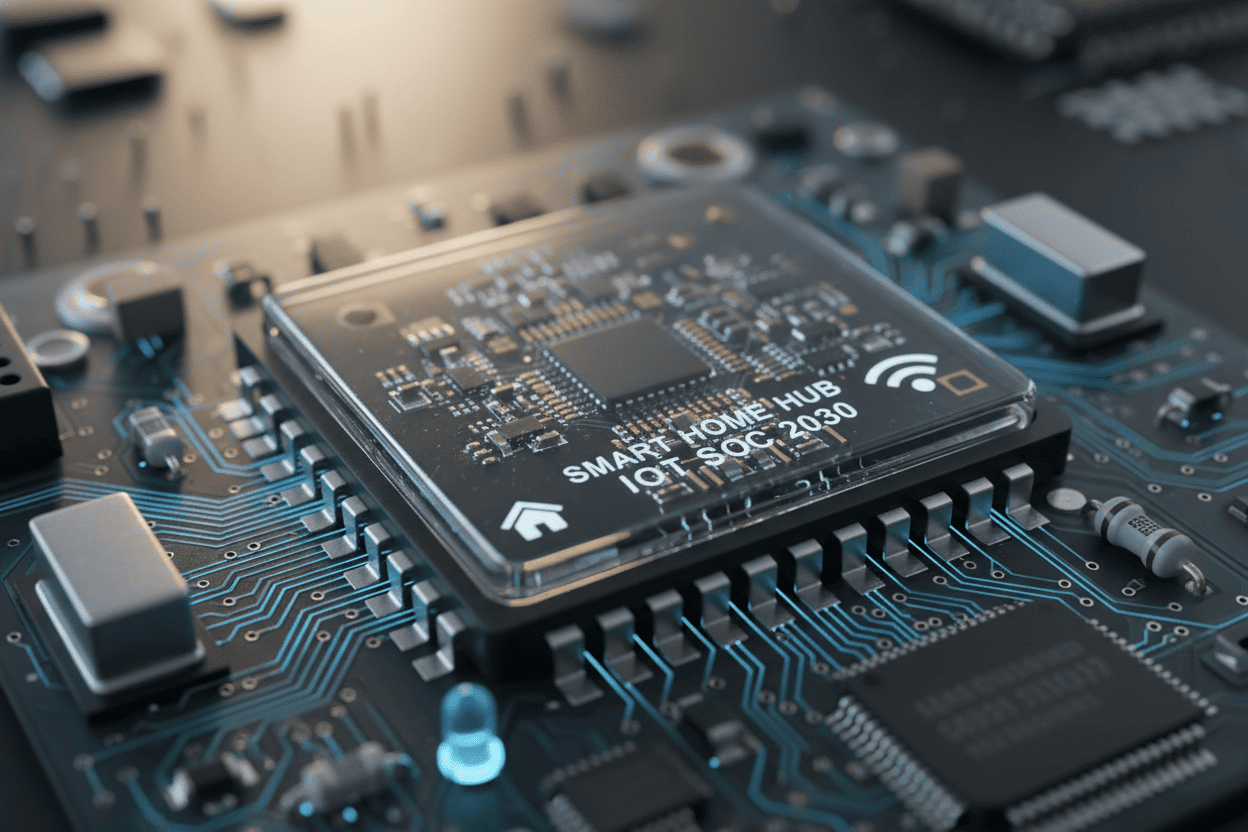
Table of Contents
1. Understanding Smart Home Chip Selection: The Basics
Why is choosing the right silicon more critical now than it was five years ago?
In the North American and European markets, consumer expectations have drastically matured. Buyers are no longer impressed by a basic Wi-Fi smart plug that requires a proprietary app and a cloud account. Today's consumers and DIY geeks demand privacy, interoperability, and sustainability.
- The Privacy Shift (Local Control): European and NA users are highly sensitive to data privacy. They want devices that process commands locally (Edge Computing). If the internet goes down, the smart lights should still turn on. Relying on cloud-dependent chips is a fast track to negative reviews.
- The Ecosystem Unification: Consumers are tired of "walled gardens." They want a device that works seamlessly across Apple, Google, and Amazon ecosystems out of the box.
- The Eco-Friendly Mandate: Replacing batteries is a massive friction point. Hardware that drains a CR2032 battery in weeks is considered defective by modern standards. You need ultra-low power consumption architecture to ensure a 2-to-3-year battery lifespan.
If you choose an outdated Wi-Fi MCU today, your product will be obsolete before it even hits the shelves of Digi-Key or Mouser.
2. Core Concepts Simplified
Before we dive into the spec sheets of Espressif and Silicon Labs, let's translate the heavy engineering jargon into plain English.
What is an SoC (System on a Chip)?
Think of an SoC as the "brain" of your smart device. Instead of having a separate processor for thinking, a separate chip for memory, and a separate antenna for Wi-Fi, an SoC compresses all of this into a single, fingernail-sized square. This high level of integration saves precious PCB space and drastically reduces power consumption.
Matter over Thread: The New Gold Standard
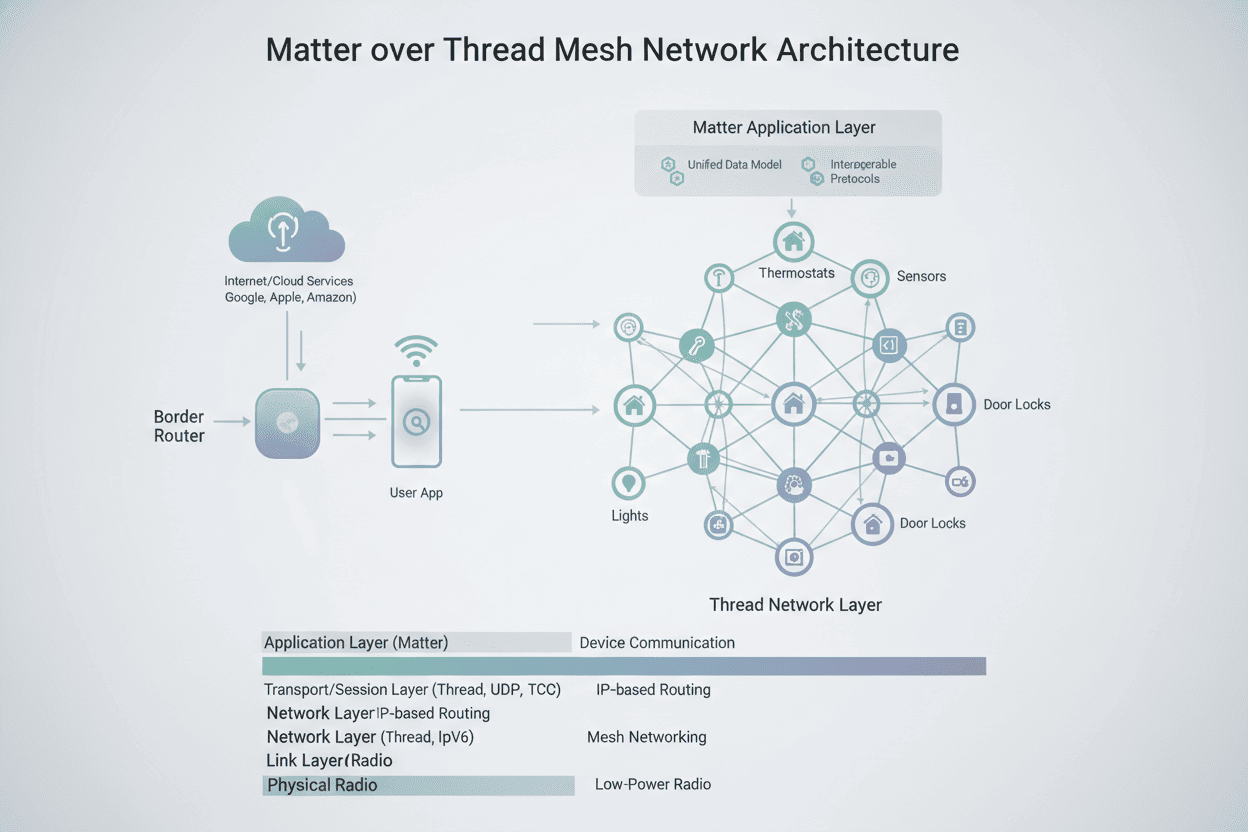
- Matter is the "universal translator" of the smart home world. If your chip supports Matter natively, you write your firmware once, and your device can instantly talk to Apple HomePod, Google Nest, and Amazon Echo. No more developing three different API integrations.
- Thread is the "spiderweb network" that Matter runs on. Unlike Wi-Fi, which drains batteries rapidly, Thread is a low-power, self-healing mesh network. If one Thread router goes offline, the devices automatically find another path to communicate.
Hardware Security Module (HSM)
An HSM is a "digital vault" physically built into the silicon. It stores cryptographic keys and passwords. Even if a hacker physically tears down your smart lock and probes the memory, they cannot extract the keys. The Connectivity Standards Alliance (CSA) Official Guidelines strictly mandate robust security for Matter certification, making an HSM non-negotiable.
Core Concept Comparison: Cloud vs. Local/Edge
To understand why modern SoC selection leans heavily toward Edge AI and Local Control, look at this comparison:
| Feature | Legacy Cloud-Dependent SoC | Modern Edge/Local Control SoC (Matter) |
|---|---|---|
| Response Time | High latency (200ms - 2 seconds) | Instantaneous (< 50ms) |
| Internet Outage | Device becomes a useless brick | Full functionality retained via local mesh |
| Privacy Risk | High (Voice/data sent to AWS/Google) | Zero (Data stays inside the home network) |
| Power Drain | High (Constant Wi-Fi keep-alive pings) | Ultra-Low (Thread sleepy end devices) |
3. Step-by-Step Guide / Case Studies
Selecting the right SoC depends entirely on your product's power source and primary function. Let's break down the two most common scenarios based on real-world engineering demands.
3.1 Scenario A: Battery-Powered Edge Devices (Sensors, Locks)
If you are building a door/window sensor, a motion detector, or a smart lock, Wi-Fi is your enemy. You need an SoC designed for sleepy end devices (SED) using Bluetooth Low Energy (BLE) and Thread.
Top Contenders:
- Nordic Semiconductor nRF52840: The undisputed king of low power. It has massive community support and native Thread/Matter capabilities. With proper sleep state programming, you can run a sensor on a single CR2032 coin cell for over 2 years.
- Silicon Labs EFR32MG24: A powerhouse for Edge AI. It features a built-in AI/ML hardware accelerator. If you are building a battery-powered camera that needs to recognize a face locally without waking up the main processor, this is your go-to chip.
Hardware Specification Comparison Table
| SoC Model | Ideal Protocol | Active Current (Radio TX) | Sleep Current | Built-in AI Accelerator? | Best Use Case |
|---|---|---|---|---|---|
| Nordic nRF52840 | Thread / BLE 5.3 | ~4.8 mA | ~1.5 µA | No | Contact sensors, buttons |
| SiLabs MG24 | Matter over Thread | ~4.4 mA | ~1.3 µA | Yes (Matrix Vector) | Smart locks, local voice |
| Espressif ESP32-C6 | Wi-Fi 6 / Thread | ~270 mA (Wi-Fi) | ~7 µA | No | Smart plugs, wired hubs |
3.2 Scenario B: Mains-Powered Hubs & Wi-Fi Devices
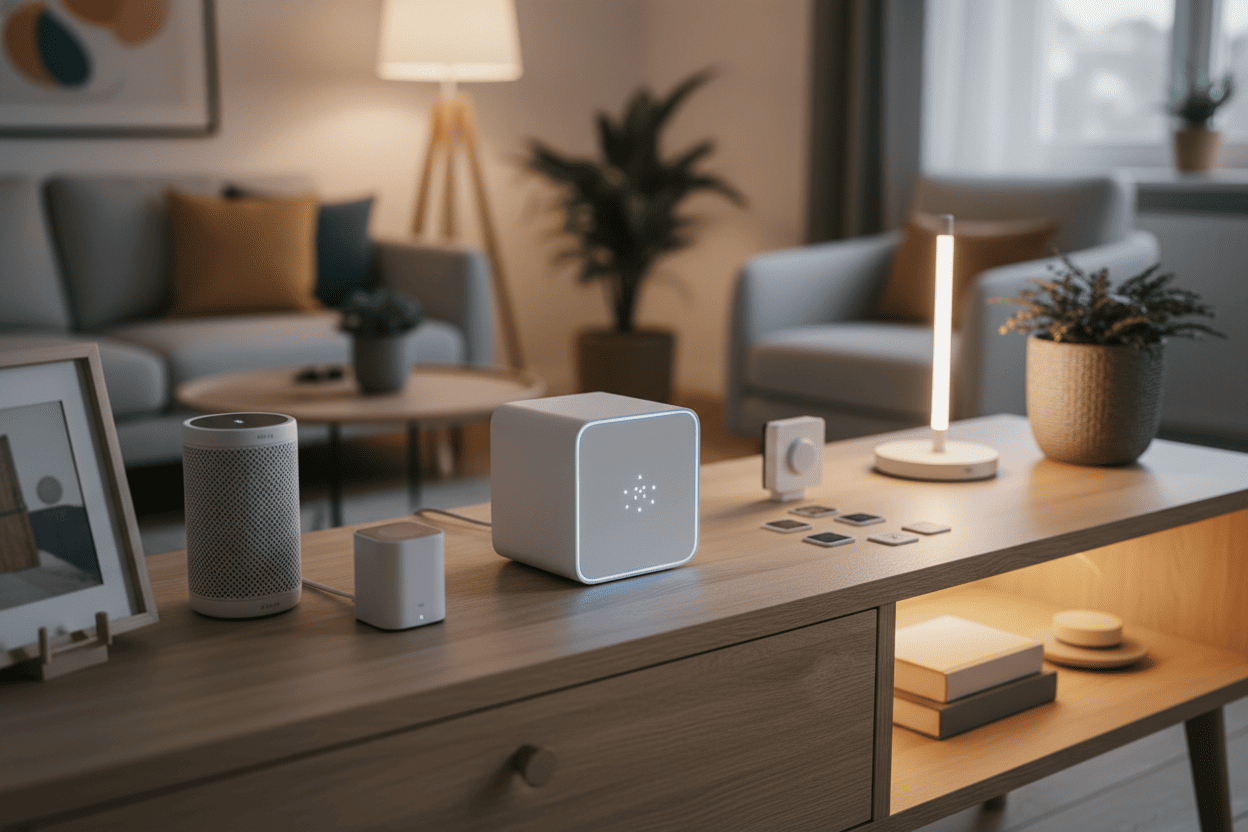
If your device plugs directly into a wall outlet (e.g., smart plugs, light bulbs, or Thread Border Routers), power consumption is less of a strict constraint. Here, you want maximum processing power, Wi-Fi 6 compatibility, and plenty of RAM.
Top Contender:
- Espressif ESP32-C6: This SoC is a massive hit in the r/homeassistant and r/embedded communities. It combines Wi-Fi 6, Bluetooth 5.3, and an 802.15.4 radio (Thread/Zigbee) on a single RISC-V chip. It is incredibly cost-effective and perfect for building Matter bridges.
Practical Implementation Snippet: When configuring an ESP32-C6 for a Matter-enabled smart plug using the ESP-IDF, ensuring your device declares itself correctly to the Matter fabric is crucial. Here is a simplified conceptual configuration template for setting up the basic device type:
4. Expert Tips & Common Pitfalls to Avoid
If you spend any time browsing engineering forums or reading Silicon Labs & Espressif Official Blogs, you will quickly realize that spec sheets don't tell the whole story. Here are the most common pitfalls engineers face when selecting a smart home SoC, and how to avoid them.
Pitfall 1: Underestimating Matter's Memory Footprint
The Mistake: Choosing an SoC with 256KB of RAM and 512KB of Flash, thinking it's enough because "it worked for Zigbee." The Reality: Matter is a heavy protocol. It requires robust IPv6 networking, advanced cryptography, and Over-The-Air (OTA) update partitions. The Fix: Do not attempt to run a native Matter device on anything less than 320KB of SRAM and 1MB of Flash. For comfortable development and future OTA updates, aim for 2MB+ Flash. If your chosen SoC lacks this, you will face endless compilation errors and stack overflows.
Pitfall 2: Ignoring the "Cloud-Washing" Backlash
The Mistake: Building a device that claims to be "Smart" but requires a constant ping to an AWS server to function, effectively faking local control. The Reality: The DIY smart home community (which heavily drives early adoption and product reviews) absolutely despises cloud-dependent hardware. The Fix: Ensure your SoC can run Edge computing tasks. If it's a voice assistant, use an SoC with a small NPU (like the SiLabs MG24) to process wake words locally. Keep the data inside the house.
Pitfall 3: Poor Antenna Placement on PCB
The Mistake: Buying the best Thread SoC (like the nRF52840) but burying the PCB antenna under a thick metal casing or near noisy power regulators. The Reality: Thread relies on low-power mesh networking. A bad antenna design will cause packet loss, forcing the SoC to re-transmit data constantly, which destroys your battery life. The Fix: Follow the manufacturer's exact layout guidelines for the RF path. If your industrial design requires metal, opt for an SoC variant that supports an external U.FL antenna.
5. Conclusion & Final Thoughts
Choosing the right SoC for your smart home device is the foundational decision that will dictate your product's success or failure in the market. The era of cheap, power-hungry, cloud-only Wi-Fi chips is ending. The future belongs to Matter, Thread, and Local Edge Processing.
6. Quick Summary: SoC Selection Matrix
| Your Product Type | Primary Requirement | Recommended SoC Strategy |
|---|---|---|
| Battery Sensors (Doors, Motion) | Years of battery life, small size | Nordic nRF52840 (Thread/BLE) |
| Smart Plugs / Light Bulbs | Wall-powered, network bridging | Espressif ESP32-C6 (Wi-Fi 6 + Thread) |
| Local Voice / Edge AI Cameras | On-device processing, privacy | Silicon Labs MG24 (Built-in NPU) |
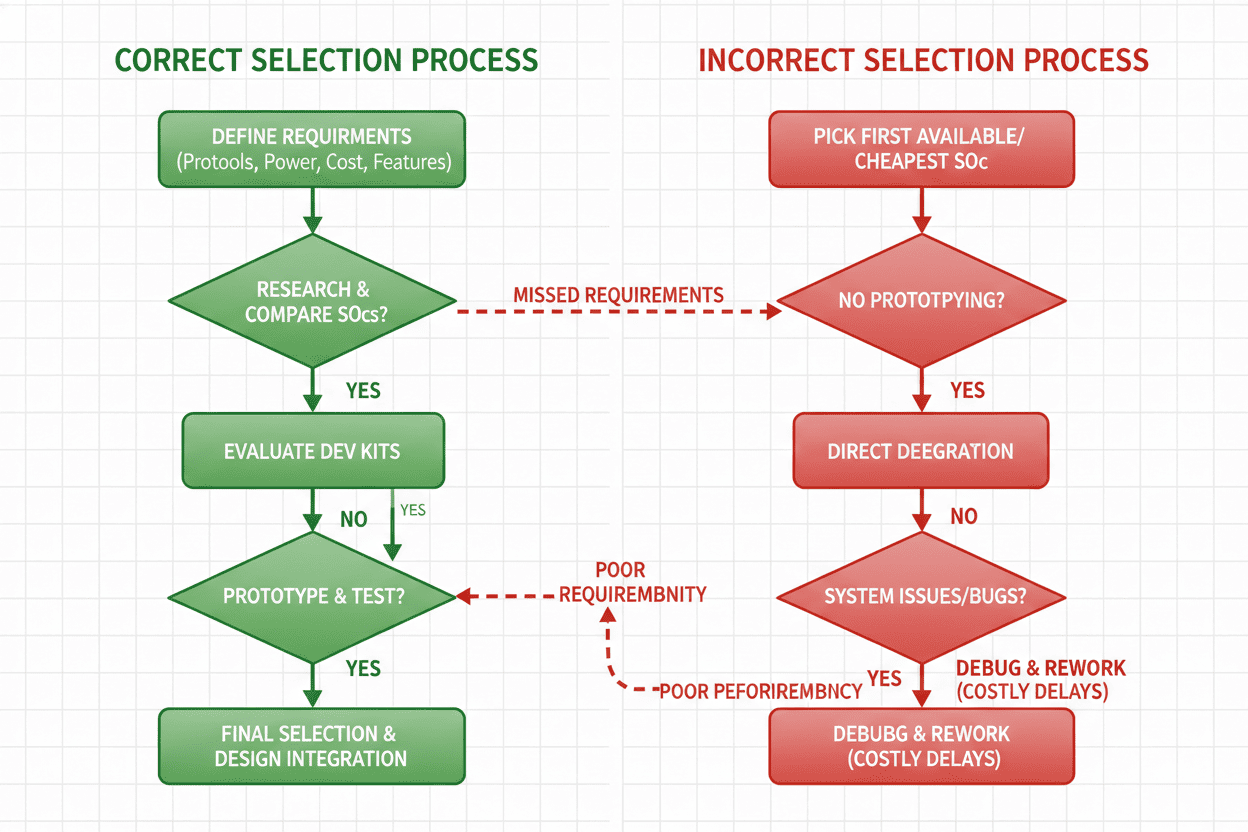
Your Next Steps: Before you finalize your Bill of Materials (BOM), buy a development board for the SoC you are leaning toward. Flash a sample Matter application and test its memory footprint.
Are you currently deciding between Wi-Fi and Thread for your next IoT project? Drop your specific use case in the comments below, and let's discuss the best silicon for your needs! Don't forget to subscribe to our newsletter for more deep dives into IoT hardware engineering.
7. Frequently Asked Questions
Q1: What is Matter and why does my smart home SoC need it? A: Matter is a universal protocol that lets your device work seamlessly with Apple, Google, and Amazon ecosystems without building separate integrations.
Q2: Why is Thread better than Wi-Fi for battery-powered sensors? A: Thread is an ultra-low-power mesh network. Unlike Wi-Fi, it enables sleepy end devices to run on a coin-cell battery for 2+ years.
Q3: What minimum memory does a Matter-enabled SoC require? A: At least 320KB SRAM and 1MB Flash. For comfortable development and OTA updates, aim for 2MB+ Flash.
Q4: How do I avoid the "cloud-washing" backlash from users? A: Choose an SoC with Edge AI capabilities that processes commands locally, keeping data inside the home network.
Q5: What is the best SoC for a battery-powered smart lock? A: The Silicon Labs EFR32MG24 is ideal for smart locks, featuring a built-in AI accelerator and native Matter over Thread support.