



Squirrel Cage Rotor vs Wound Rotor: A Comprehensive Technical Comparison for Motor Selection
When designing or selecting three-phase induction motors for industrial applications, one of the most critical decisions engineers face is choosing between squirrel cage rotor and wound rotor configurations. This choice directly impacts starting torque, speed control capabilities, efficiency, maintenance requirements, and total cost of ownership. Understanding the fundamental differences between these two rotor types and their performance characteristics across various operating conditions is essential for optimal motor selection.
This comprehensive guide examines the technical distinctions, performance parameters, application scenarios, and selection criteria for squirrel cage rotors and wound rotors. Whether you're an electrical engineer designing a new motor control system, a maintenance manager evaluating equipment reliability, or a procurement specialist comparing supplier options, this comparison will help you make informed decisions based on your specific operational requirements.
Table of Contents
- Fundamental Design Differences Between Squirrel Cage and Wound Rotors
- Key Performance Parameters Comparison
- Starting Characteristics and Torque Performance
- Speed Control Capabilities and Efficiency Analysis
- Application-Specific Selection Guide
- Maintenance, Reliability, and Total Cost of Ownership
- Common Design Pitfalls and Selection Mistakes
- FAQ
1. Fundamental Design Differences Between Squirrel Cage and Wound Rotors
The primary distinction between squirrel cage and wound rotor induction motors lies in their rotor construction, which fundamentally affects their electrical and mechanical characteristics.
Squirrel Cage Rotor Construction
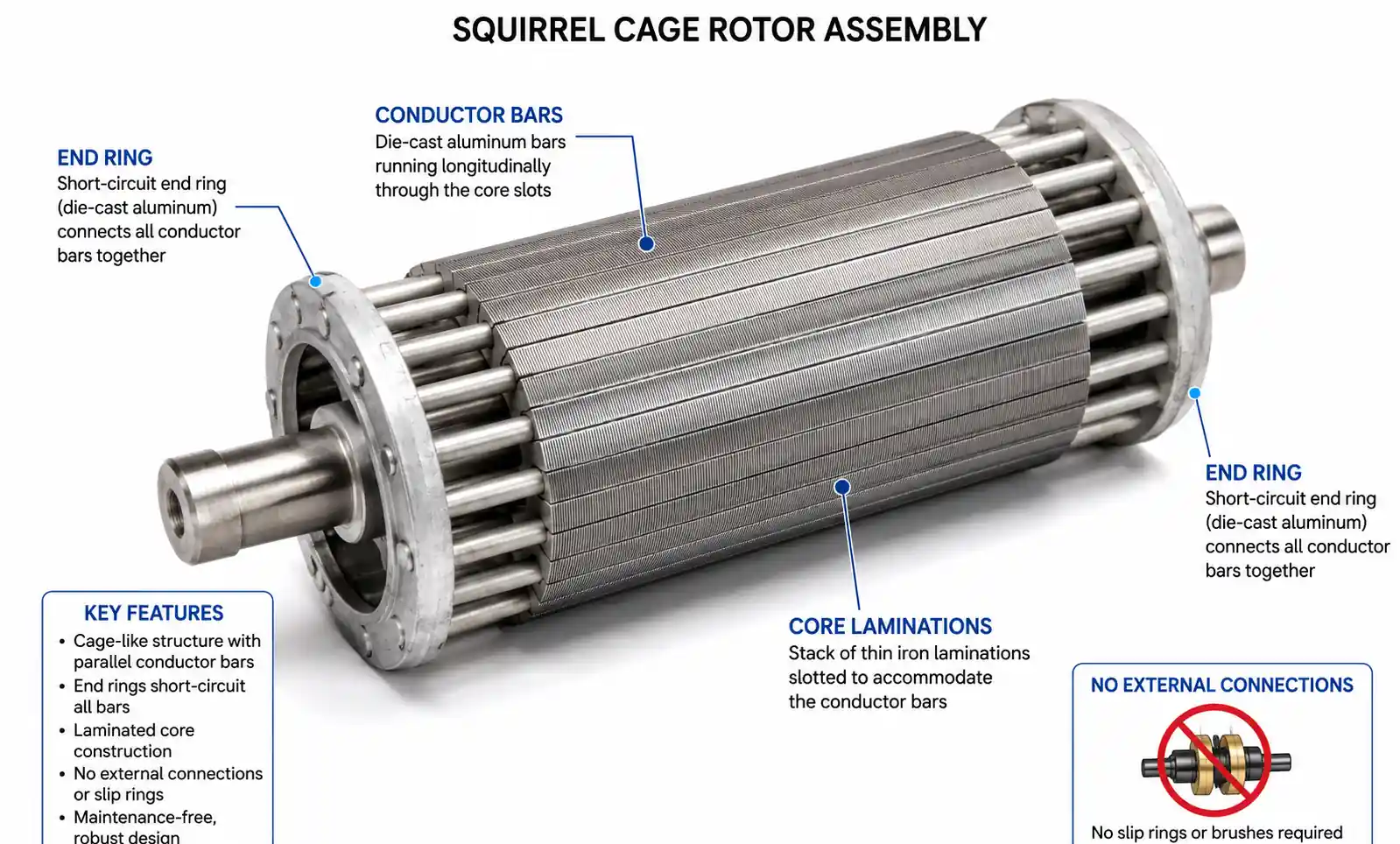
A squirrel cage rotor consists of a laminated iron core with longitudinal slots containing uninsulated aluminum or copper bars. These bars are short-circuited at both ends by end rings, creating a cage-like structure that gives this rotor type its name. The entire assembly is typically die-cast as a single unit, resulting in a robust, maintenance-free construction with no external electrical connections. The rotor windings are permanently short-circuited, which means the rotor resistance and reactance are fixed by design and cannot be modified during operation.
Modern squirrel cage rotors use either aluminum (lower cost, lighter weight) or copper (higher efficiency, better thermal conductivity) for the conductor bars. Deep bar and double cage designs are also available for applications requiring improved starting torque without sacrificing running efficiency. The absence of slip rings, brushes, and external resistors makes squirrel cage motors inherently more reliable and suitable for harsh industrial environments.
Wound Rotor Construction
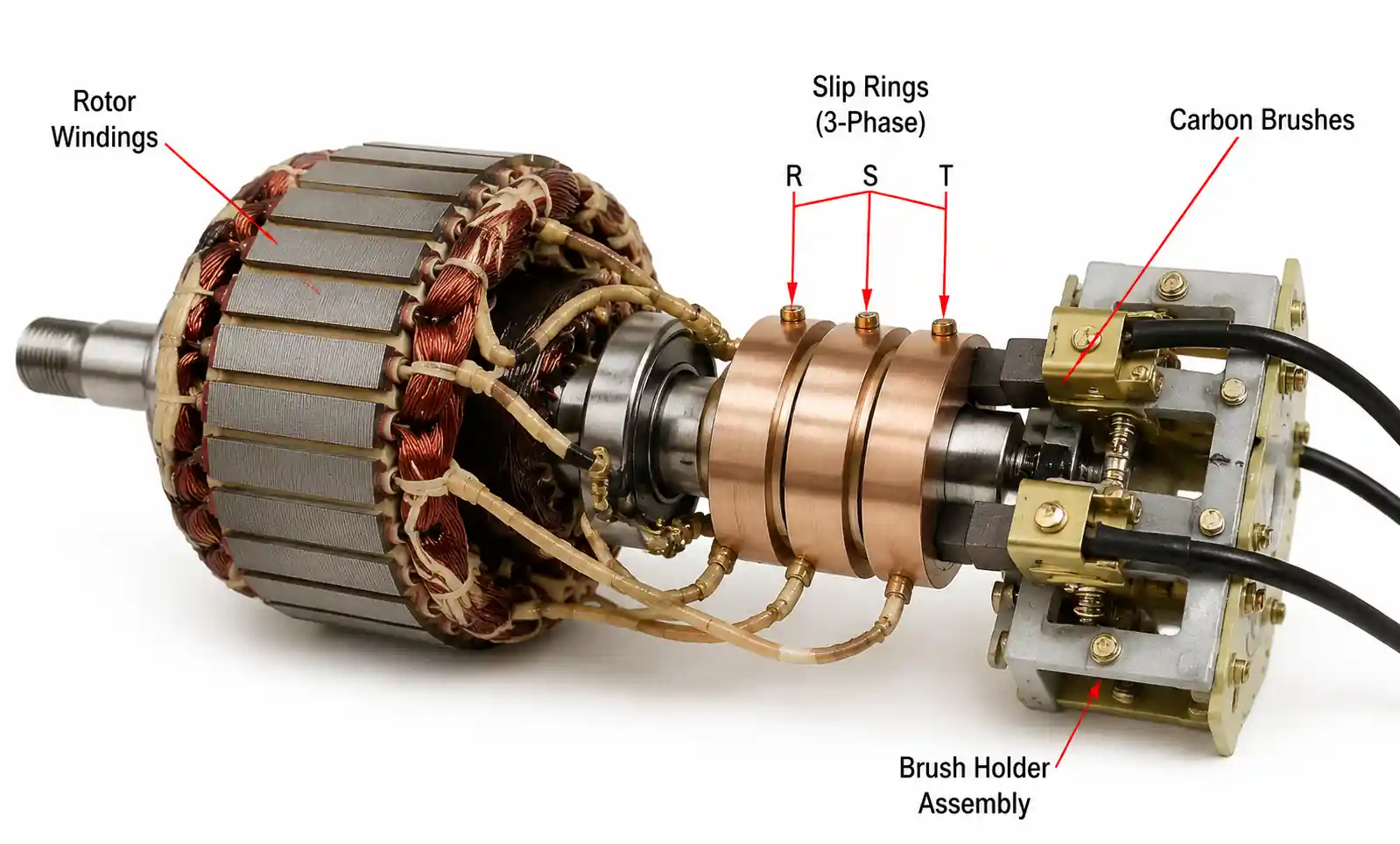
In contrast, a wound rotor features a three-phase winding similar to the stator, with coils placed in slots around the rotor core. These windings are typically star-connected internally, with the three open ends brought out to three slip rings mounted on the rotor shaft. Carbon or metal-graphite brushes riding on these slip rings provide electrical connection to external resistance banks or control circuits. This configuration allows the rotor circuit resistance to be varied during starting and running conditions, enabling precise control over motor performance characteristics.
The wound rotor design provides access to the rotor circuit, which is its primary advantage. By inserting external resistance during starting, engineers can limit inrush current while maintaining high starting torque. During normal operation, the external resistance can be reduced or short-circuited to achieve maximum efficiency. However, this flexibility comes at the cost of increased complexity, higher maintenance requirements due to brush and slip ring wear, and greater initial investment.
2. Key Performance Parameters Comparison
Understanding the quantitative differences between squirrel cage and wound rotor motors is essential for engineering decision-making. The following table summarizes the critical performance parameters that affect motor selection.
| Parameter | Squirrel Cage Rotor | Wound Rotor | Engineering Impact |
|---|---|---|---|
| Starting Current | 5-8× rated current | 2-3× rated current | Affects circuit breaker sizing, transformer capacity, voltage dip |
| Starting Torque | 50-100% rated torque (standard); 200-250% (high-torque design) | 200-300% rated torque (adjustable) | Critical for high-inertia loads, conveyors, crushers |
| Full-Load Efficiency | 92-96% (IE3/IE4) | 88-93% (with slip rings) | Impacts operational energy costs over motor lifetime |
| Power Factor (Full Load) | 0.85-0.90 | 0.80-0.88 | Affects reactive power compensation requirements |
| Speed Control Range | Limited (unless VFD used) | 50-100% rated speed (via rotor resistance) | Determines suitability for variable-speed applications |
| Rotor Slip at Rated Load | 1-3% | 3-8% (varies with external resistance) | Higher slip means more rotor losses, lower efficiency |
| Pull-Out Torque | 200-300% rated torque | 250-350% rated torque | Overload capacity for transient conditions |
| Maintenance Interval | 5000-8000 hours (bearing only) | 1000-2000 hours (brushes/slip rings) | Affects downtime and maintenance labor costs |
The performance gap between these two rotor types becomes particularly significant in applications with frequent starts, high starting loads, or variable speed requirements. For constant-speed applications with moderate starting requirements, squirrel cage motors typically offer superior lifecycle value due to their higher efficiency and lower maintenance overhead.
When evaluating these parameters for a specific application, consider the interaction effects. For example, a wound rotor motor may appear advantageous for its starting characteristics, but the 3-5% efficiency penalty accumulates to substantial energy costs in continuous-duty applications running 8000+ hours annually. Conversely, for motors that start frequently or require mechanical speed control without electronics, the wound rotor's controllability may outweigh its efficiency disadvantage.
3. Starting Characteristics and Torque Performance
The starting behavior of induction motors is one of the most critical factors in motor selection, particularly for applications with high inertia loads or limited electrical supply capacity.
Squirrel Cage Motor Starting Performance
Standard squirrel cage motors exhibit high starting current (typically 600-800% of rated current) but relatively modest starting torque (50-75% of rated torque for NEMA Design A, 100-150% for Design B). This occurs because the rotor bars have low resistance when stationary, resulting in high current but poor power factor during starting. The high inrush current can cause significant voltage dips in weak electrical systems, potentially affecting other equipment on the same supply.
To address these limitations, several design variations have been developed. Deep bar rotors utilize the skin effect at starting frequency to increase effective rotor resistance, improving starting torque to approximately 150-200% while reducing starting current to 500-650% of rated values. Double cage designs employ two sets of rotor bars—a high-resistance outer cage for starting and a low-resistance inner cage for running—achieving similar performance improvements. However, these specialized designs typically sacrifice 1-2% running efficiency compared to standard designs.
For applications where starting performance is critical but squirrel cage simplicity is desired, soft starters or variable frequency drives (VFDs) provide electronic alternatives to wound rotor control. Soft starters limit starting current through controlled voltage ramp-up but cannot increase starting torque. VFDs offer superior control, delivering full rated torque at zero speed while limiting current to 150% or less, effectively eliminating the traditional starting torque versus starting current trade-off.
Wound Rotor Motor Starting Performance
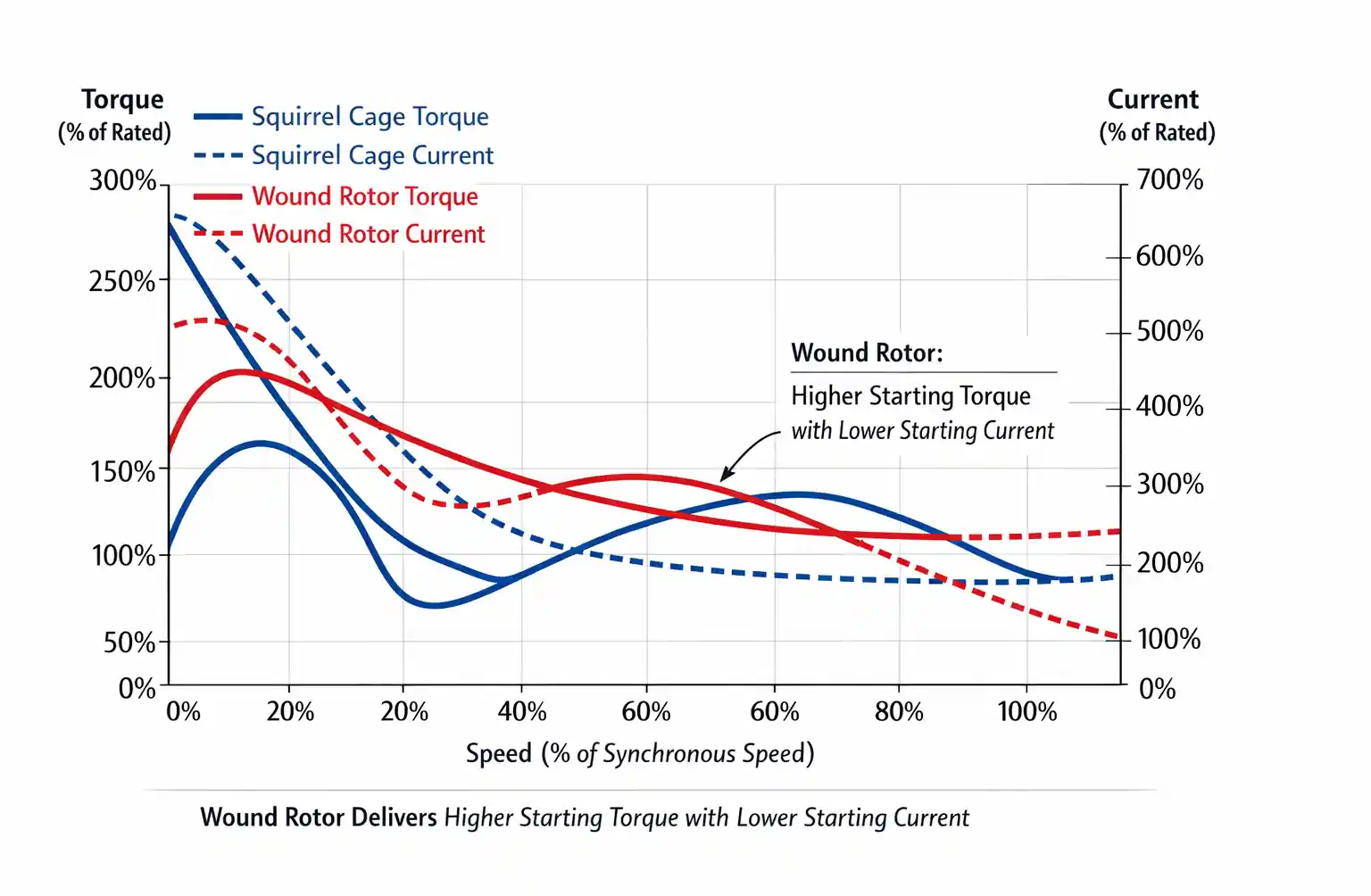
Wound rotor motors excel in starting performance due to their variable rotor resistance capability. By inserting maximum external resistance during starting, the rotor power factor improves dramatically, allowing the motor to develop 200-300% starting torque while drawing only 200-300% starting current. This represents a fundamental advantage over squirrel cage motors for applications such as high-inertia fans, loaded conveyors, crushers, and mills where both high starting torque and limited starting current are required simultaneously.
The starting sequence for a wound rotor motor typically involves multiple steps of resistance reduction as the motor accelerates. A well-designed starting resistor bank may have 4-6 steps, with each step short-circuited as the motor reaches a predetermined speed. Modern electronic controllers automate this process, optimizing the acceleration profile for minimum energy loss and maximum torque smoothness. Once the motor reaches rated speed, the external resistance is fully short-circuited, and the motor operates at maximum efficiency similar to a squirrel cage motor.
The following table compares typical starting sequences for both motor types in a 100 HP, 460V application:
| Starting Method | Peak Starting Current | Starting Torque | Acceleration Time | Application Suitability |
|---|---|---|---|---|
| Squirrel Cage - DOL (Direct Online) | 600A (600%) | 75% | 3-5 seconds | Light loads, strong supply |
| Squirrel Cage - Star-Delta | 200A (200%) | 25% | 8-12 seconds | Very light starting loads only |
| Squirrel Cage - Soft Starter | 300A (300%) | 40-50% | 10-15 seconds | Moderate loads, limited current |
| Squirrel Cage - VFD | 150A (150%) | 150% | Variable | High torque, precise control |
| Wound Rotor - 5-Step Resistor | 250A (250%) | 250% | 6-8 seconds | High inertia, limited supply |
This comparison demonstrates that wound rotor motors provide a unique combination of high starting torque with moderate starting current without requiring expensive electronic controls, making them cost-effective for specific applications despite their higher maintenance requirements.
4. Speed Control Capabilities and Efficiency Analysis
Speed control requirements significantly influence the choice between squirrel cage and wound rotor motors, as each type offers distinct advantages depending on the control method and operating profile.
Speed Control with Squirrel Cage Motors
Traditional squirrel cage motors offer limited speed control options without electronic drives. Pole-changing designs can provide 2-4 discrete speeds (such as 1800/900 RPM or 1200/900/600 RPM), but these are step changes rather than continuous adjustment. For applications requiring smooth speed variation, squirrel cage motors must be paired with variable frequency drives (VFDs).
VFD control of squirrel cage motors has become the dominant approach for variable-speed applications in modern industrial facilities. By varying both voltage and frequency while maintaining the V/Hz ratio, VFDs deliver excellent torque characteristics across the entire speed range. At reduced speeds, the motor operates at correspondingly reduced slip, maintaining high efficiency. Modern VFDs achieve overall system efficiencies of 94-97% across the normal operating range, with the drive itself typically contributing 2-3% losses.
The primary limitation of VFD-controlled squirrel cage motors is cooling at low speeds. Below approximately 30% of rated speed, the rotor-mounted fan provides insufficient airflow, requiring either external forced ventilation or motor derating. For applications requiring sustained low-speed operation with full torque, separately ventilated motors or larger frame sizes may be necessary.
Speed Control with Wound Rotor Motors
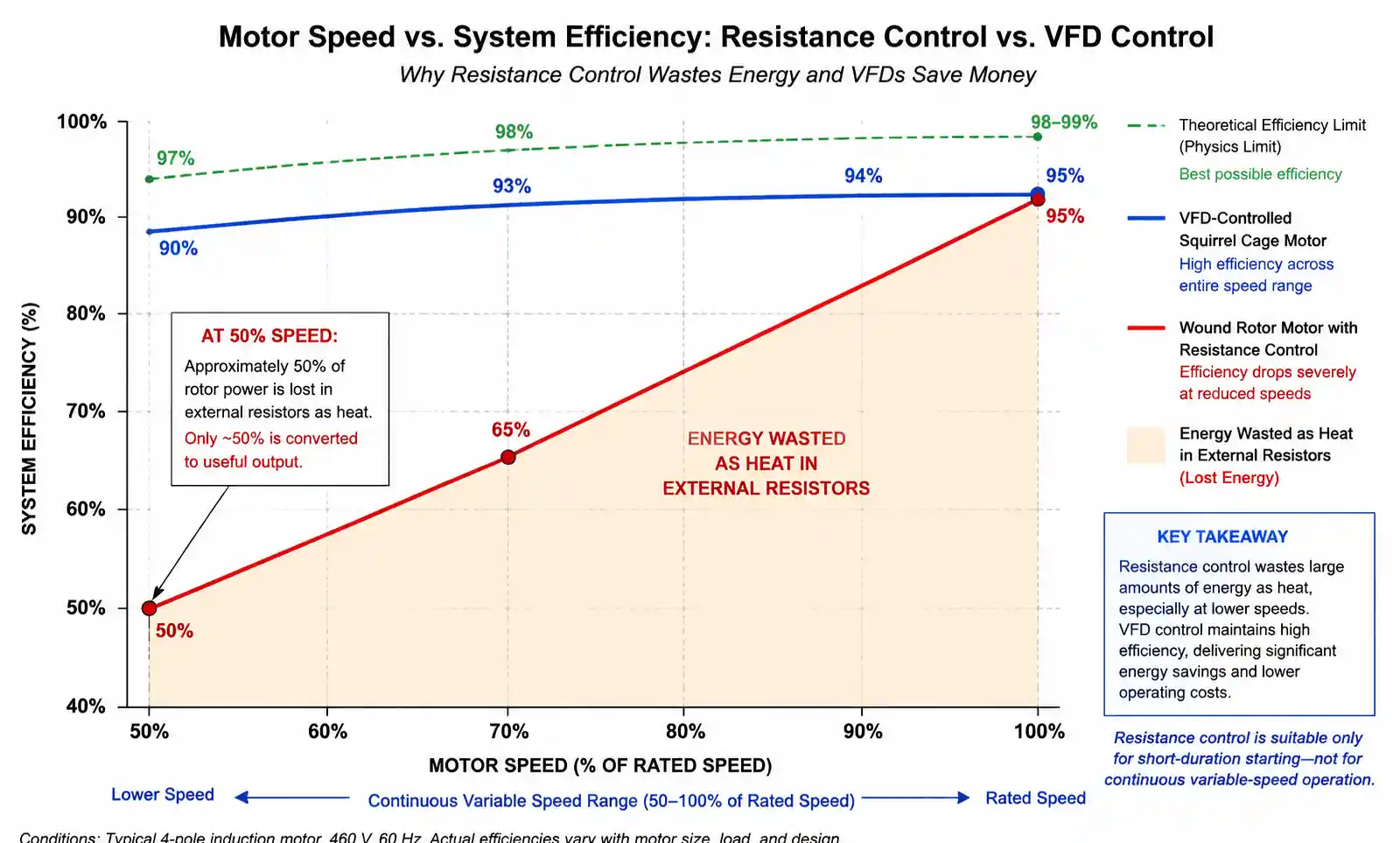
Wound rotor motors provide inherent speed control through rotor resistance variation without requiring frequency conversion. By increasing external resistance, the motor's slip increases proportionally, reducing speed while maintaining torque capability. This method, while simple and robust, suffers from significant efficiency losses at reduced speeds since the energy dissipated in the rotor circuit increases with slip.
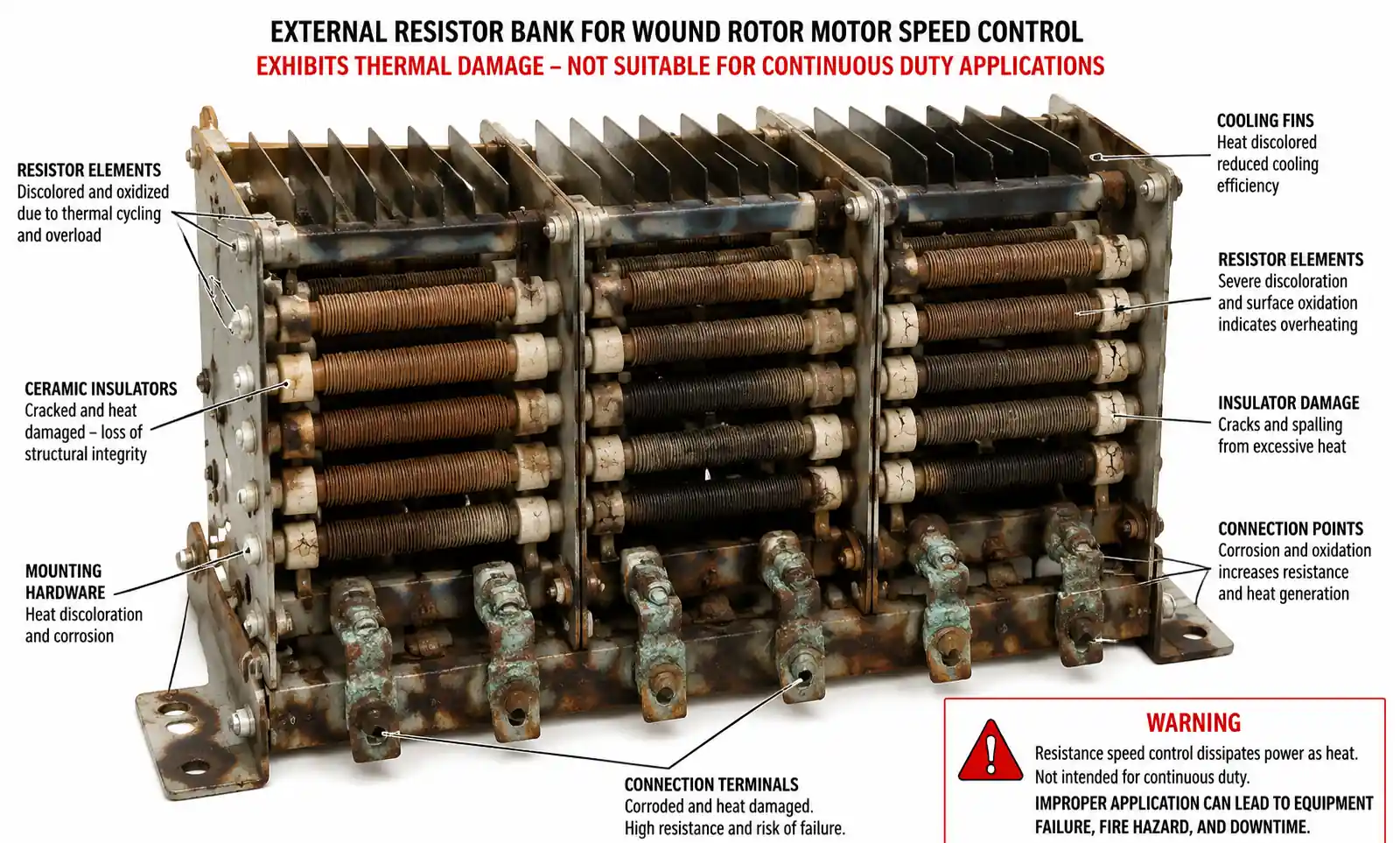
The relationship between speed and efficiency in resistance-controlled wound rotor motors is critical for application evaluation. At 50% speed, approximately 50% of the rotor input power is dissipated as heat in the external resistors. This makes resistance control unsuitable for continuous operation at reduced speeds, but acceptable for intermittent duty or applications where the speed reduction periods are brief.
For applications requiring efficient variable-speed operation, wound rotor motors can be equipped with static Kramer drives or Scherbius drives, which recover the slip energy and return it to the power supply rather than dissipating it as heat. These systems achieve efficiencies comparable to VFD-controlled squirrel cage motors but at significantly higher capital cost and complexity. Consequently, they are rarely specified for new installations, having been largely superseded by squirrel cage motors with VFDs.
| Speed Control Method | Speed Range | Efficiency at 50% Speed | Control Smoothness | Relative Cost | Best Application |
|---|---|---|---|---|---|
| Squirrel Cage + VFD | 0-100% | 94-96% | Excellent | Medium | General variable speed |
| Wound Rotor + Resistance | 50-100% | 50-65% | Good | Low | Intermittent speed reduction |
| Wound Rotor + Slip Recovery | 50-100% | 88-92% | Excellent | Very High | Large motors, continuous operation (legacy) |
| Pole Changing | Discrete steps | 92-95% | Step change only | Low-Medium | Fixed multi-speed applications |
The efficiency characteristics make VFD-controlled squirrel cage motors the preferred solution for most modern variable-speed applications, with wound rotor motors remaining viable primarily in retrofit situations where existing infrastructure can be leveraged or in applications with very specific starting requirements.
5. Application-Specific Selection Guide
Selecting the optimal rotor type requires careful analysis of the application's specific requirements, including starting torque, duty cycle, speed control needs, and operating environment.
When to Select Squirrel Cage Rotors
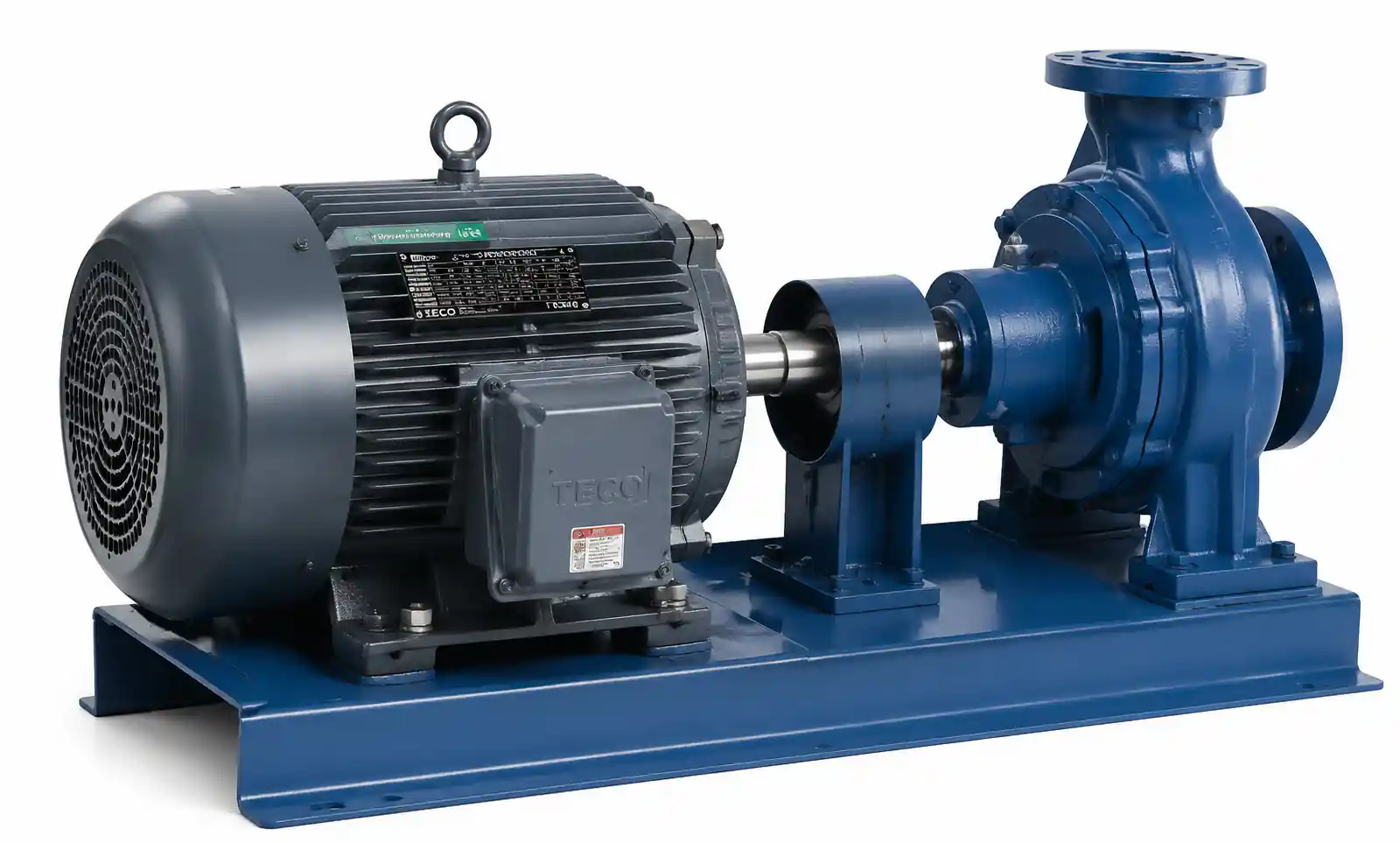
Squirrel cage motors are the preferred choice for the majority of industrial applications due to their simplicity, reliability, and lower total cost of ownership. They are particularly well-suited for:
Constant-speed applications with light to moderate starting loads: Pumps, fans, blowers, and compressors operating at fixed speed benefit from the squirrel cage motor's high efficiency and minimal maintenance. Even with high inrush current, the brief starting period has negligible impact on energy consumption over the motor's operating life.
Variable-speed applications when paired with VFDs: Modern manufacturing processes, HVAC systems, and material handling equipment increasingly require variable speed control. The combination of squirrel cage motors and VFDs provides excellent performance with system efficiencies exceeding 94%, far superior to resistance-controlled wound rotor alternatives.
Harsh or hazardous environments: The absence of slip rings and brushes makes squirrel cage motors inherently more suitable for applications in explosive atmospheres (Class I, Division 1/2), corrosive environments, or locations with high dust or moisture levels. The sealed rotor construction minimizes contamination risks and eliminates arcing hazards associated with brush contact.
Applications requiring minimum maintenance: Facilities with limited maintenance staff or remote installations benefit from the squirrel cage motor's 5000-8000 hour bearing-only maintenance intervals, compared to 1000-2000 hours for wound rotor brush and slip ring service.
When to Select Wound Rotor Motors
Despite the dominance of squirrel cage motors, wound rotor designs remain optimal for specific applications where their unique characteristics provide tangible advantages:
High-inertia loads requiring high starting torque with limited available current: Ball mills, crushers, large ventilation fans, and mine hoists often present this challenging combination. A wound rotor motor can deliver 250-300% starting torque while drawing only 200-250% current, which may be the only practical solution when electrical supply capacity is constrained and VFDs are cost-prohibitive due to motor size.
Retrofit applications with existing wound rotor infrastructure: When replacing motors in facilities with installed rotor resistance control panels and associated switchgear, specifying another wound rotor motor may be more economical than converting the entire system to VFD control, particularly for motors above 500 HP.
Applications requiring controlled acceleration of high-inertia loads: The stepped resistance starting of wound rotor motors provides smooth, controlled acceleration that limits mechanical stress on couplings, gearboxes, and driven equipment. While VFDs offer superior control, the wound rotor approach may be preferred in conservative industries or where proven technology is mandated.
Speed control in intermittent duty applications: For applications such as crane hoists or metal forming equipment that require brief periods of reduced speed followed by full-speed operation, simple resistance control of wound rotor motors can be more economical than VFD systems, despite lower efficiency during speed reduction.
6. Maintenance, Reliability, and Total Cost of Ownership
A comprehensive economic analysis must consider not only initial purchase price but also installation costs, energy consumption, maintenance requirements, and expected service life.
Initial Cost Comparison
Wound rotor motors typically cost 150-200% of equivalent squirrel cage motors due to their more complex construction, requiring precision winding of the rotor, slip ring assembly, and brush holder mechanisms. The external starting resistor banks add another 20-30% to the total system cost. For a 100 HP motor, this might translate to $15,000-20,000 for the wound rotor system versus $8,000-10,000 for a squirrel cage motor with soft starter or $12,000-15,000 with VFD.
However, cost comparison becomes more complex for larger motors (above 500 HP) where the wound rotor's ability to start without VFD control can represent significant savings in power electronics costs. For a 2000 HP application, a wound rotor motor with resistance starting might cost $120,000 versus $180,000 for a squirrel cage motor with appropriately rated VFD.
Operating Cost Analysis
Energy costs dominate the lifecycle economics for motors operating more than 4000 hours annually. A typical 100 HP motor running 8000 hours per year at $0.10/kWh consumes approximately $60,000 in electricity annually. The 3-5% efficiency advantage of squirrel cage motors translates to $1,800-3,000 annual savings, which can recover any initial cost premium within 2-3 years.
For motors with significant speed control requirements, the comparison becomes even more favorable for VFD-controlled squirrel cage motors. The energy recovered through efficient speed reduction in VFD systems (compared to throttling valves or dampers) typically generates 20-40% energy savings, far exceeding the cost of the drive within the first year of operation.
Maintenance Cost Considerations
Maintenance requirements differ dramatically between the two motor types. Squirrel cage motors require only bearing lubrication (every 5000-8000 hours) and periodic cleaning, with typical annual maintenance costs of $200-400 for a 100 HP unit. Wound rotor motors require brush replacement every 1000-2000 hours ($300-500), slip ring resurfacing every 2-3 years ($800-1200), and more frequent bearing maintenance due to the additional brush pressure loads, totaling $1,500-2,500 annually.
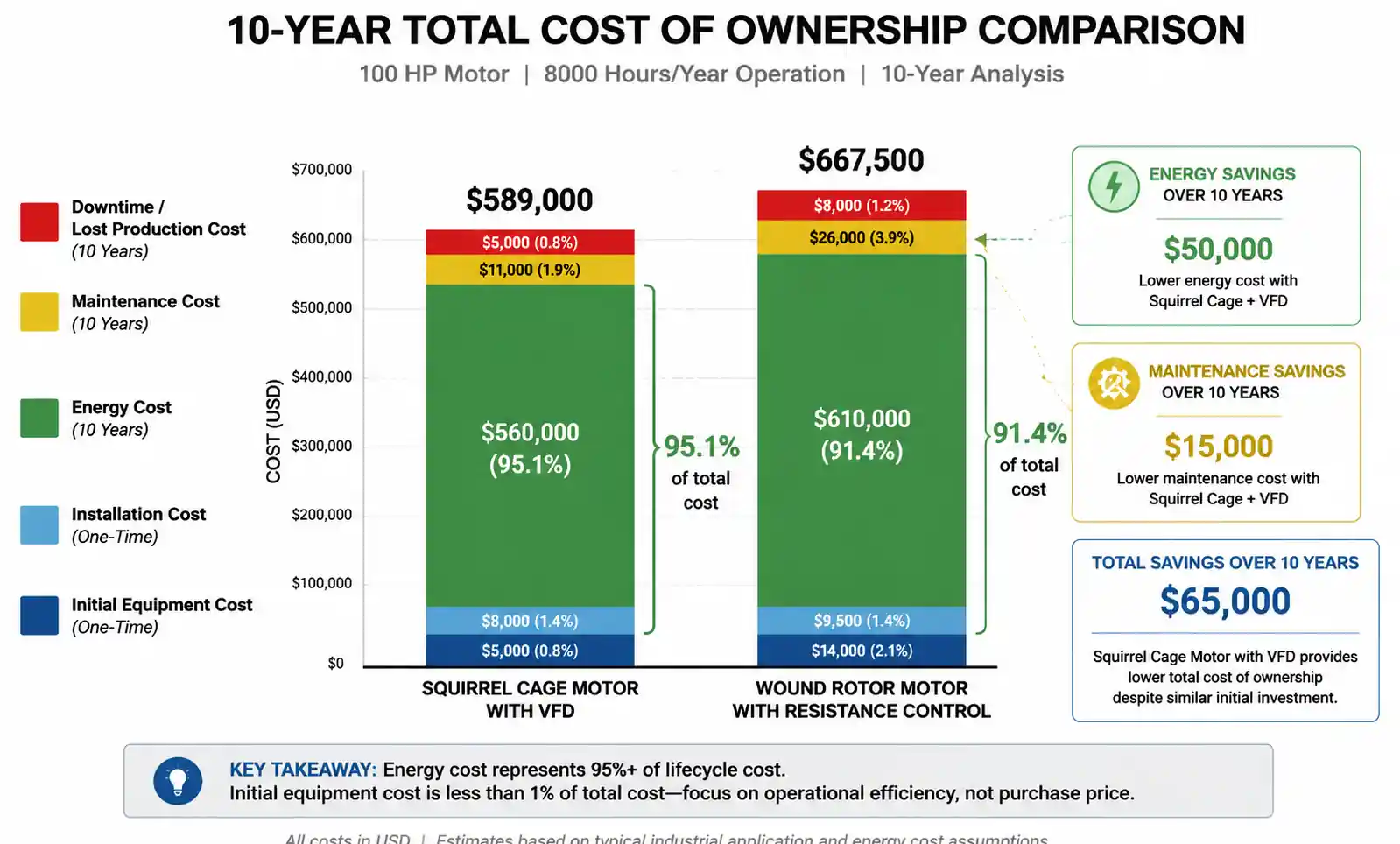
The following table summarizes a 10-year total cost of ownership comparison for a typical 100 HP, 8000 hours/year application:
| Cost Component | Squirrel Cage + VFD | Wound Rotor + Resistance |
|---|---|---|
| Initial Equipment | $12,000 | $18,000 |
| Installation | $2,000 | $3,500 |
| Energy (10 years @ 95% efficiency) | $570,000 | $620,000 |
| Maintenance (10 years) | $3,000 | $18,000 |
| Downtime costs (estimated) | $2,000 | $8,000 |
| Total 10-Year Cost | $589,000 | $667,500 |
This analysis demonstrates that for continuous-duty applications, the squirrel cage motor's efficiency advantage and lower maintenance requirements generate substantial lifecycle savings despite potentially higher initial costs when VFD control is included.
7. Common Design Pitfalls and Selection Mistakes
Based on field experience and technical support cases, several recurring mistakes occur when engineers select between squirrel cage and wound rotor motors.
Underestimating Starting Requirements
A common error is selecting a standard squirrel cage motor for applications with high starting loads without adequately analyzing the electrical supply capacity. The 600-800% starting current can cause voltage dips exceeding 15%, potentially tripping undervoltage relays or disrupting sensitive electronic equipment on the same supply. Before specifying any motor, calculate the expected voltage drop during starting using the system short-circuit capacity and motor impedance data from manufacturer test reports.
For applications where starting analysis reveals excessive voltage drop, consider high-torque squirrel cage designs (NEMA Design C or D), soft starters, VFDs, or wound rotor motors rather than simply oversizing the motor, which increases both inrush current and cost without solving the fundamental problem.
Overlooking Cooling at Reduced Speeds
When specifying VFD control for squirrel cage motors, many engineers fail to account for reduced cooling at low speeds. Standard TEFC (Totally Enclosed Fan Cooled) motors with shaft-mounted fans experience approximately 50% airflow reduction at 50% speed, requiring significant derating for continuous low-speed operation. For applications requiring sustained operation below 30% rated speed, specify separately ventilated motors or consult manufacturer derating curves.
Misapplying Wound Rotor Speed Control
Specifying wound rotor motors with resistance speed control for continuous variable-speed operation is a frequent mistake that results in excessive energy consumption and resistor overheating. Resistance control is only economical for intermittent speed reduction or applications where the reduced-speed operating time is less than 20% of total run time. For continuous variable-speed duty, VFD-controlled squirrel cage motors deliver far superior efficiency and control performance.
Ignoring Environmental Factors
Environmental conditions significantly affect motor selection but are often overlooked. Wound rotor motors with exposed slip rings and brushes are unsuitable for hazardous locations without expensive explosion-proof enclosures for the brush rigging. Similarly, corrosive or abrasive dust environments rapidly degrade brush and slip ring life, making squirrel cage motors strongly preferred. Always review motor duty conditions against manufacturer environmental ratings before finalizing selection.
Neglecting Future Speed Control Requirements
Many constant-speed applications later require variable-speed capability for energy optimization or process improvement. Squirrel cage motors readily accommodate VFD retrofits with minimal modification, while wound rotor motors offer limited upgrade paths. When long-term facility plans include potential automation or energy management initiatives, selecting squirrel cage motors provides valuable future flexibility even if immediate requirements don't demand it.
8. FAQ
What is the main advantage of squirrel cage rotors over wound rotors?
Squirrel cage rotors offer significantly higher reliability and lower maintenance requirements due to their simple, rugged construction with no brushes, slip rings, or external connections. They typically achieve 92-96% efficiency in premium efficiency classes and require maintenance only every 5000-8000 hours (bearing lubrication), compared to 1000-2000 hours for wound rotor brush replacement. For most applications, this results in 50-70% lower total cost of ownership over a 10-15 year service life.
Can wound rotor motors provide better starting torque than squirrel cage motors with VFDs?
No, modern VFDs controlling squirrel cage motors can deliver 150% rated torque from zero speed while limiting current to approximately 150% of rated current, which equals or exceeds wound rotor starting performance. The VFD approach also provides superior control precision, smoother acceleration, and eliminates the resistor losses associated with wound rotor starting. Wound rotors retain advantages only in retrofit situations with existing infrastructure or where VFD capital costs are prohibitive for very large motors.
How does efficiency compare between the two rotor types at full load?
Premium efficiency squirrel cage motors (IE3/IE4 classification) achieve 92-96% efficiency at rated load, approximately 3-5 percentage points higher than wound rotor motors (88-93%) due to the absence of slip ring losses and brush friction. This efficiency difference compounds significantly in continuous-duty applications—for a 100 HP motor running 8000 hours annually, the squirrel cage motor saves approximately $2,000-3,000 per year in energy costs at typical industrial electricity rates.
Are wound rotor motors still used in new installations?
Wound rotor motors are rarely specified for new general-purpose applications due to the widespread availability and superior performance of VFD-controlled squirrel cage motors. However, they remain viable for specialized applications such as very large motors (above 2000 HP) in mining or cement plants where starting current must be limited without the capital expense of high-power VFDs, or in retrofit situations where existing wound rotor infrastructure can be leveraged economically.
What speed control range is practical for wound rotor motors with resistance control?
Wound rotor motors with rotor resistance control practically operate between 50-100% of rated speed for intermittent duty. Below 50% speed, efficiency drops below 60% due to excessive slip losses, making continuous operation economically unfeasible. For applications requiring frequent or sustained operation below 70% speed, VFD-controlled squirrel cage motors deliver far superior efficiency (typically 90-95% at 70% speed) and should be specified instead.
How do slip ring maintenance requirements affect wound rotor motor reliability?
Slip rings and carbon brushes require inspection every 1000-2000 operating hours, with brush replacement typically needed every 2000-4000 hours depending on operating conditions. Slip rings require periodic resurfacing every 2-3 years to maintain proper contact. This maintenance overhead increases unplanned downtime risk compared to squirrel cage motors and requires trained technicians familiar with brush rigging adjustment. In critical applications, this reliability difference strongly favors squirrel cage motors.
Can I retrofit a VFD to a wound rotor motor?
While technically possible, retrofitting VFDs to wound rotor motors is generally not recommended. The wound rotor's higher rotor resistance and inductance create control challenges for standard VFDs, potentially causing excessive heating and reduced torque capability. Additionally, the existing motor's slip rings and brushes remain as maintenance liabilities without providing any benefit in VFD operation. The economically sound approach is replacing the wound rotor motor with a squirrel cage unit properly matched to VFD operation.
What are the key parameters to verify in the motor datasheet before selection?
Critical parameters include locked rotor current (LRA) and locked rotor torque (LRT) for starting analysis, full-load efficiency and power factor for operating cost calculation, service factor for overload capacity, and insulation class for temperature rise limits. For wound rotor motors, additionally verify slip ring voltage and current ratings, external resistance specifications, and brush grade recommendations. Always request certified test reports for motors above 50 HP to verify actual performance matches datasheet ratings.
Conclusion
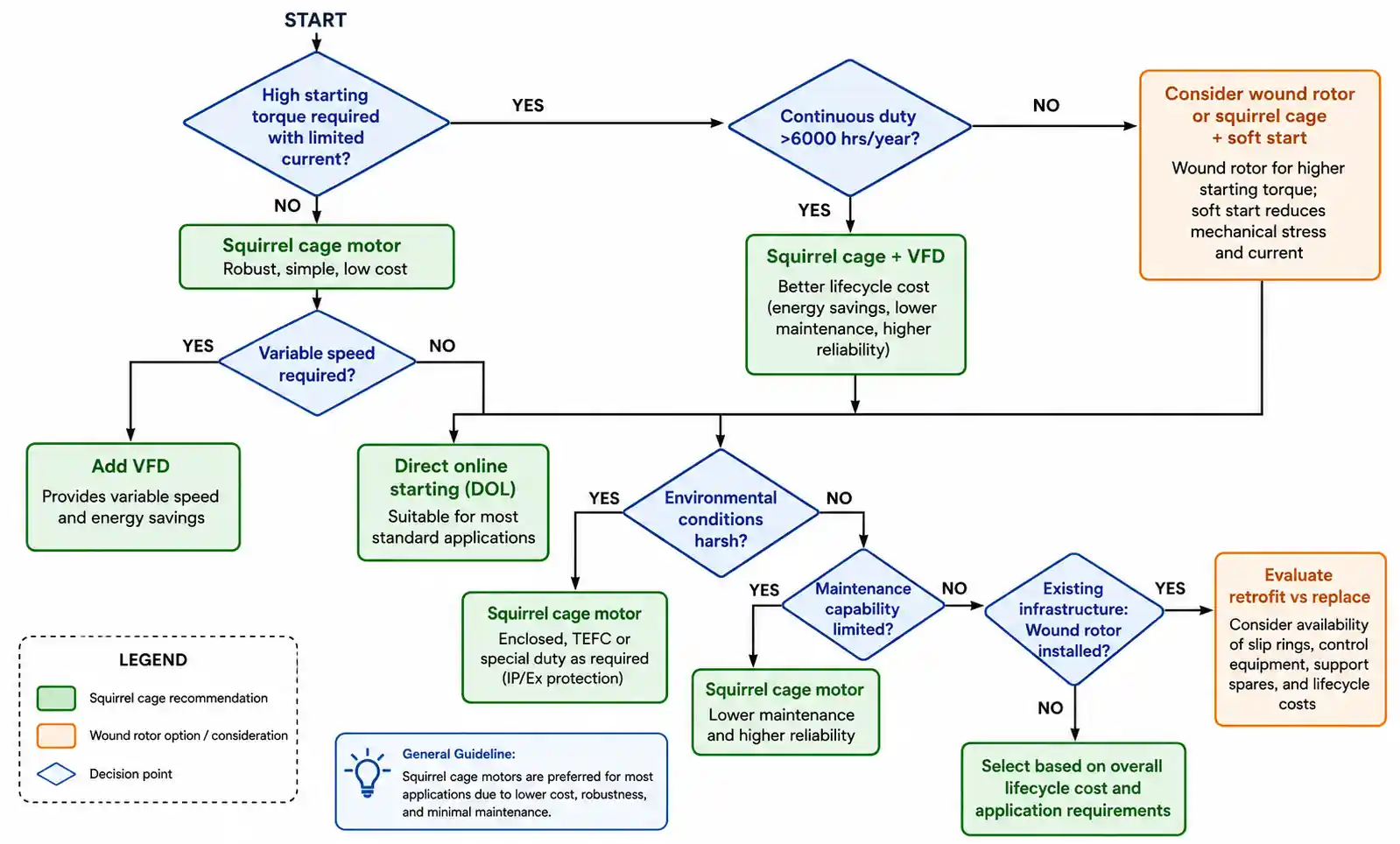
The choice between squirrel cage and wound rotor induction motors fundamentally depends on your application's specific starting requirements, speed control needs, duty cycle, and operational environment. For the vast majority of industrial applications—particularly constant-speed drives or variable-speed applications when paired with VFDs—squirrel cage motors deliver superior reliability, efficiency, and total cost of ownership. Their simple, rugged construction and minimal maintenance requirements make them the default choice for modern industrial facilities.
Wound rotor motors retain niche advantages in applications requiring high starting torque with limited available current, particularly for large motors (above 500 HP) where VFD costs become prohibitive, or in retrofit situations with existing wound rotor infrastructure. However, their higher maintenance requirements, lower efficiency, and limited upgrade paths make them progressively less competitive as VFD technology advances and costs decline.
When making your final selection, prioritize a comprehensive analysis of starting torque versus starting current requirements, duty cycle characteristics, and total 10-year cost of ownership rather than focusing solely on initial purchase price. For applications with any uncertainty about future speed control requirements, squirrel cage motors provide maximum flexibility for future retrofits and upgrades.
Ready to specify the optimal motor for your application? Download our detailed motor selection worksheet, or contact our application engineering team for assistance with starting analysis, VFD sizing, and total cost of ownership calculations tailored to your specific requirements.