



How Tandem Circuit Breakers Save Panel Space: Complete Guide
Running out of space in your electrical panel? Tandem circuit breakers might be the solution you need. These space-saving devices allow you to add circuits without costly panel upgrades. In this comprehensive guide, we'll explore everything you need to know about tandem breakers, from how they work to when you can safely use them.
Table of Contents
- What Are Tandem Circuit Breakers?
- How Tandem Breakers Save Panel Space
- Tandem Breakers vs Standard Single-Pole Breakers
- Tandem Breakers vs Double-Pole Breakers
- When Can You Use Tandem Breakers?
- Panel Compatibility and Safety Requirements
- Common Mistakes to Avoid
- Installation Guide for Tandem Breakers
- Frequently Asked Questions
1. What Are Tandem Circuit Breakers?
Tandem circuit breakers, also known as duplex breakers, twin breakers, piggyback breakers, or "double-stuff" breakers, are specialized electrical devices that house two independent circuit breakers within the physical footprint of a single standard breaker slot.
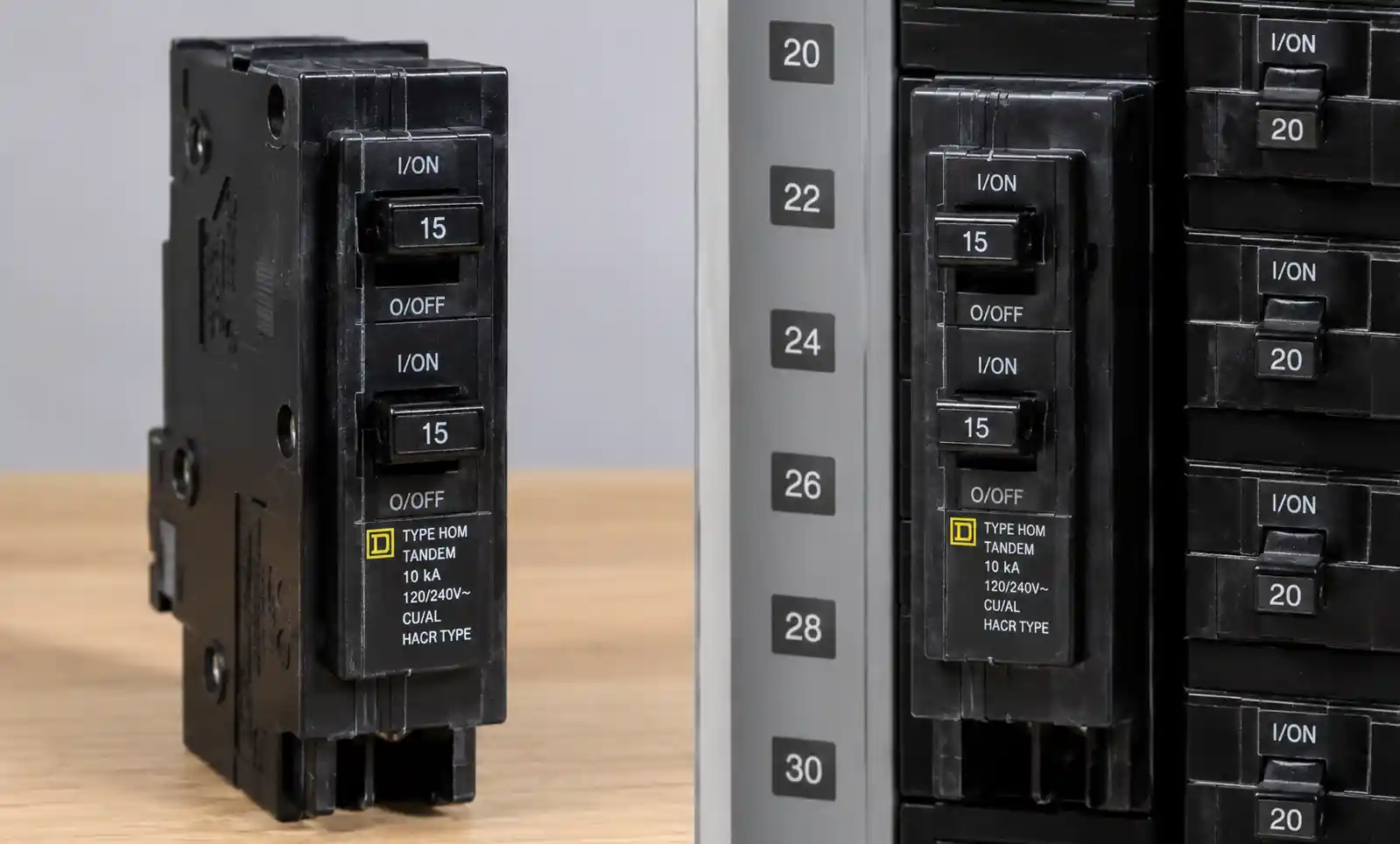
Each tandem breaker contains two completely separate circuit protection mechanisms, each with its own switch handle. These two circuits operate independently—if one circuit trips, the other continues to function normally. This design makes them ideal for maximizing available space in residential electrical panels.
Key Characteristics:
- Two circuits in one slot: Physically occupies one breaker space but controls two separate 120-volt circuits
- Independent operation: Each circuit has its own thermal-magnetic trip mechanism
- 120-volt only: Both circuits connect to the same bus bar phase, providing 120 volts each
- Space-efficient design: Same width as a standard single-pole breaker (typically 1 inch)
2. How Tandem Breakers Save Panel Space
Electrical panels have a finite number of breaker slots, typically ranging from 12 to 40 spaces depending on the panel size. As homes add more appliances, lighting, and outlets, these slots fill up quickly. Tandem breakers offer a practical solution to this space constraint.
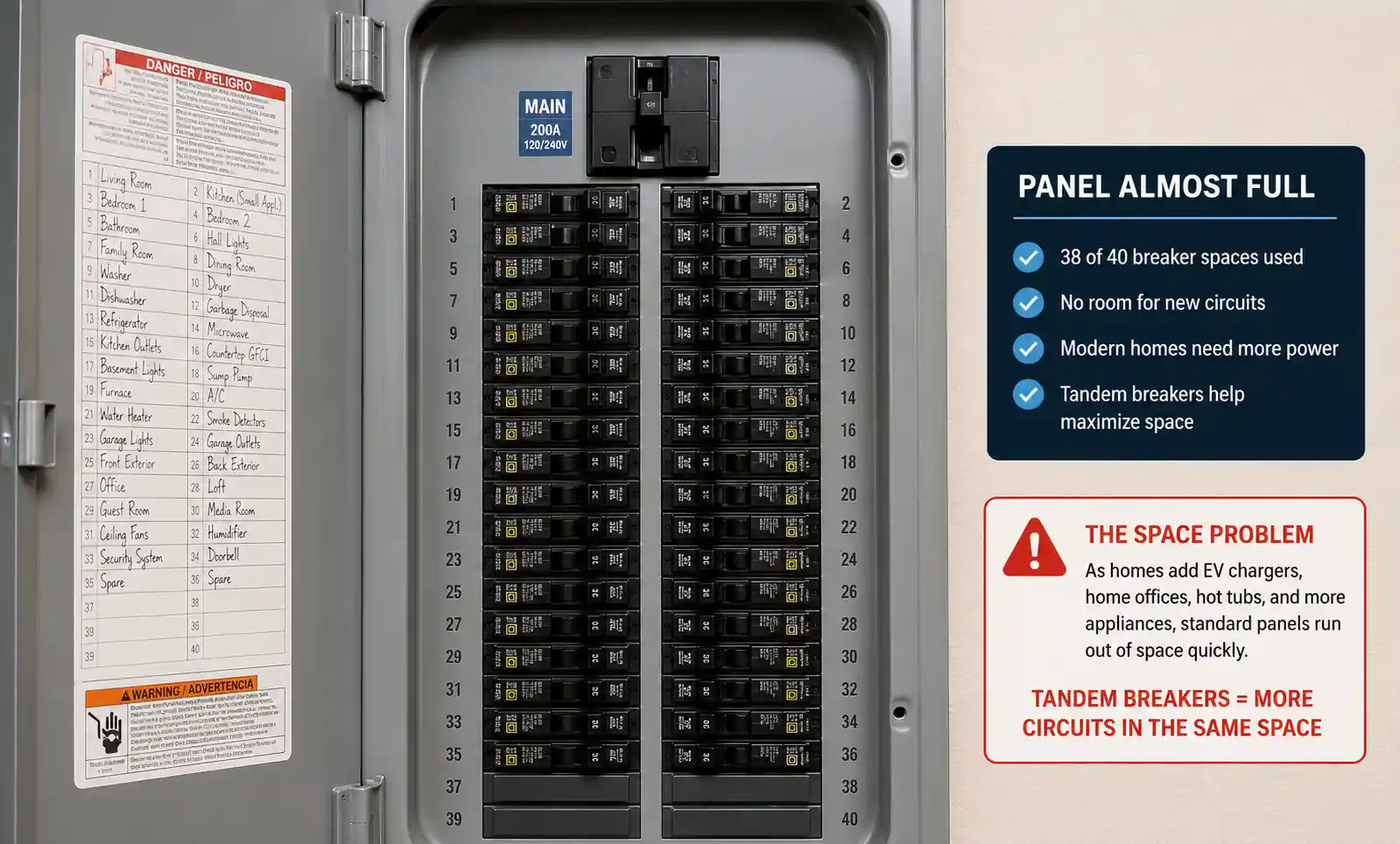
Space Savings Explained:
Traditional Approach: Adding two new 120-volt circuits would require two separate breaker slots. In a full panel, this would necessitate a complete panel replacement—a costly project ranging from $1,500 to $4,000.
Tandem Breaker Approach: A single tandem breaker occupies just one slot while providing protection for two separate circuits. This effectively doubles your circuit capacity in the space you have available.
Real-World Example:
Consider a 20-space electrical panel that's completely full. Without tandem breakers, you'd need to upgrade to a larger panel to add circuits. However, if your panel is rated for tandem breakers, you could potentially:
- Add up to 10 additional circuits (using 10 tandem breakers in eligible slots)
- Save thousands of dollars on panel replacement costs
- Complete the upgrade in hours instead of days
3. Tandem Breakers vs Standard Single-Pole Breakers
Understanding the differences between tandem and standard breakers helps you make informed decisions about your electrical system.
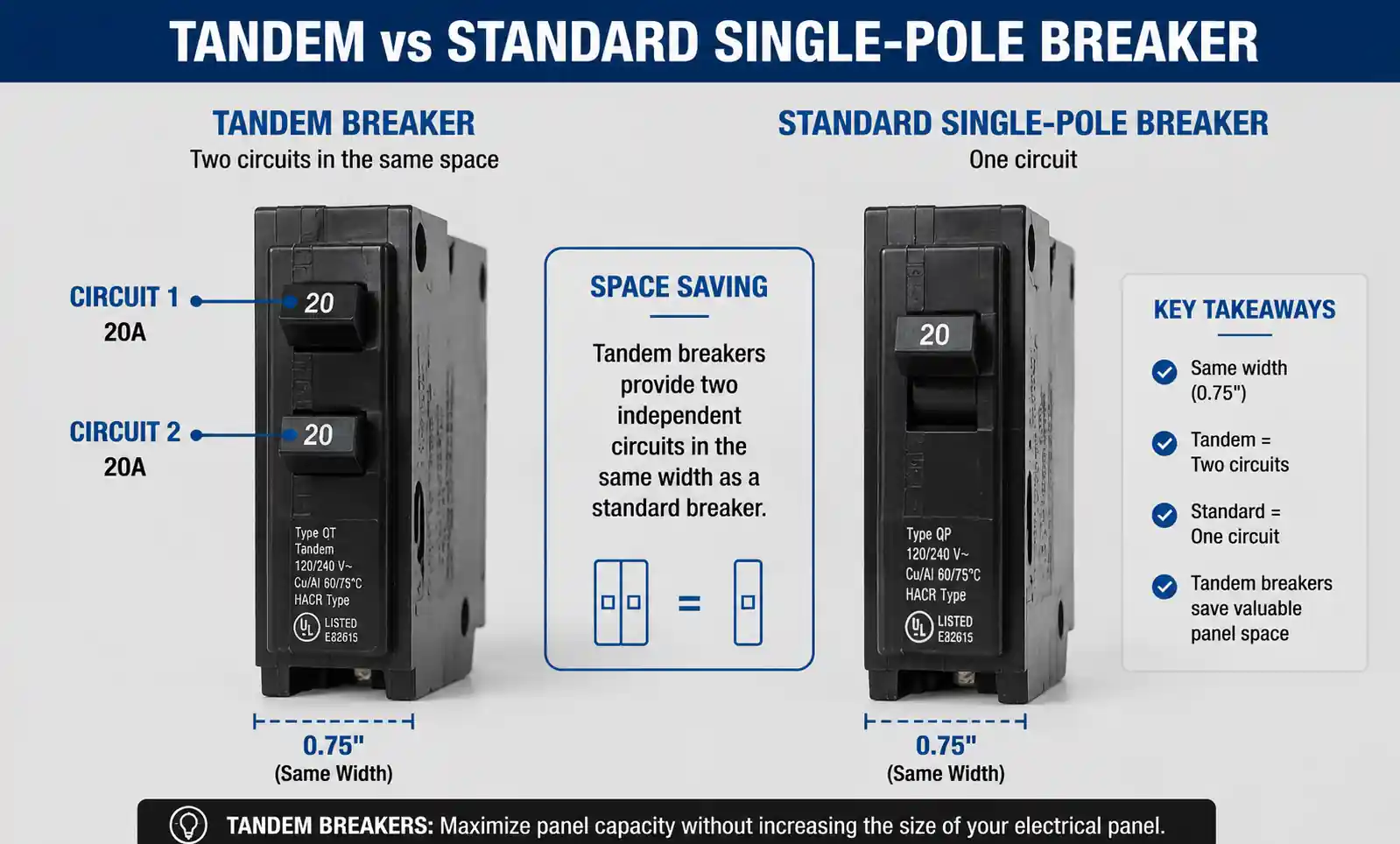
Physical Differences:
| Feature | Standard Single-Pole | Tandem Breaker |
|---|---|---|
| Slot Occupancy | 1 slot | 1 slot |
| Circuits Protected | 1 circuit | 2 circuits |
| Switch Handles | 1 handle | 2 separate handles |
| Voltage | 120V | 120V (both circuits) |
| Width | 1 inch | 1 inch |
Functional Differences:
Standard Single-Pole Breakers:
- Protect one dedicated 120-volt circuit
- Simpler internal design
- Universal compatibility with all residential panels
- Typically rated for 15A or 20A
- Ideal for general lighting and receptacles
Tandem Breakers:
- Protect two independent 120-volt circuits
- More complex internal construction with two trip mechanisms
- Limited compatibility—only work in panels designed to accept them
- Each side typically rated for 15A or 20A
- Perfect for space-constrained situations
4. Tandem Breakers vs Double-Pole Breakers
Many people confuse tandem breakers with double-pole breakers, but they serve fundamentally different purposes and have critical safety distinctions.
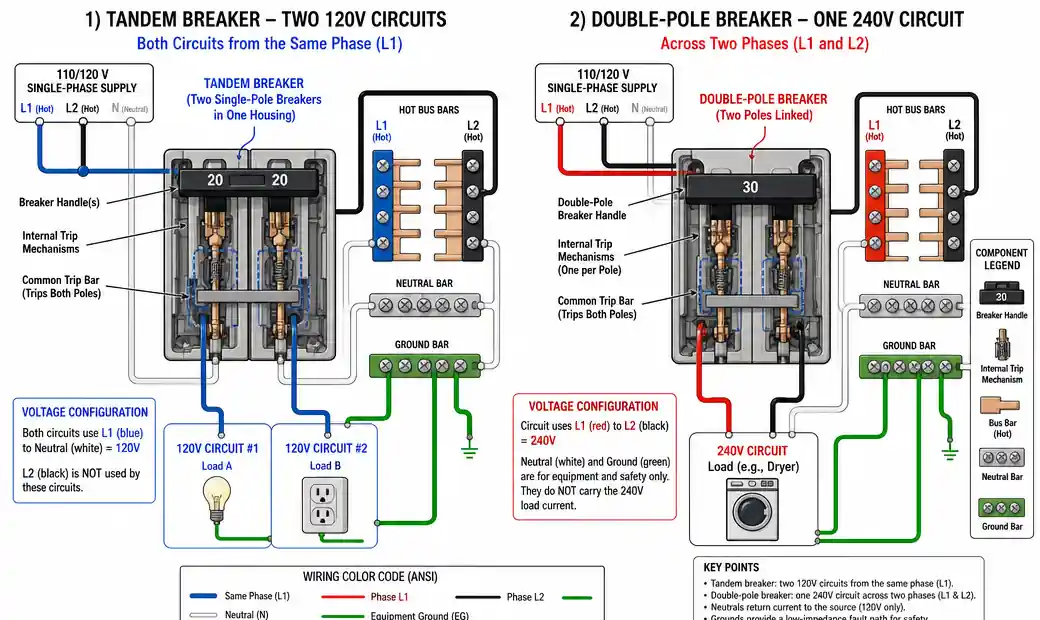
Voltage Differences:
Tandem Breakers: Connect to the same bus bar phase, providing two separate 120-volt circuits. You cannot use tandem breakers for 240-volt applications—this would be dangerous and violate electrical codes.
Double-Pole Breakers: Connect to two different bus bar phases, providing a single 240-volt circuit. The handles are mechanically linked to trip simultaneously.
Safety Considerations:
| Aspect | Tandem Breaker | Double-Pole Breaker |
|---|---|---|
| Trip Mechanism | Independent (each side trips separately) | Common trip (both sides trip together) |
| Voltage | 120V per circuit | 240V single circuit |
| Applications | Lighting, outlets, small appliances | Dryers, ranges, AC units, water heaters |
| Handle Linkage | Separate handles | Tied together |
Critical Safety Warning: Never attempt to use a tandem breaker for 240-volt loads. Tandem breakers lack the common trip mechanism required for 240-volt circuits, creating serious shock and fire hazards.
5. When Can You Use Tandem Breakers?
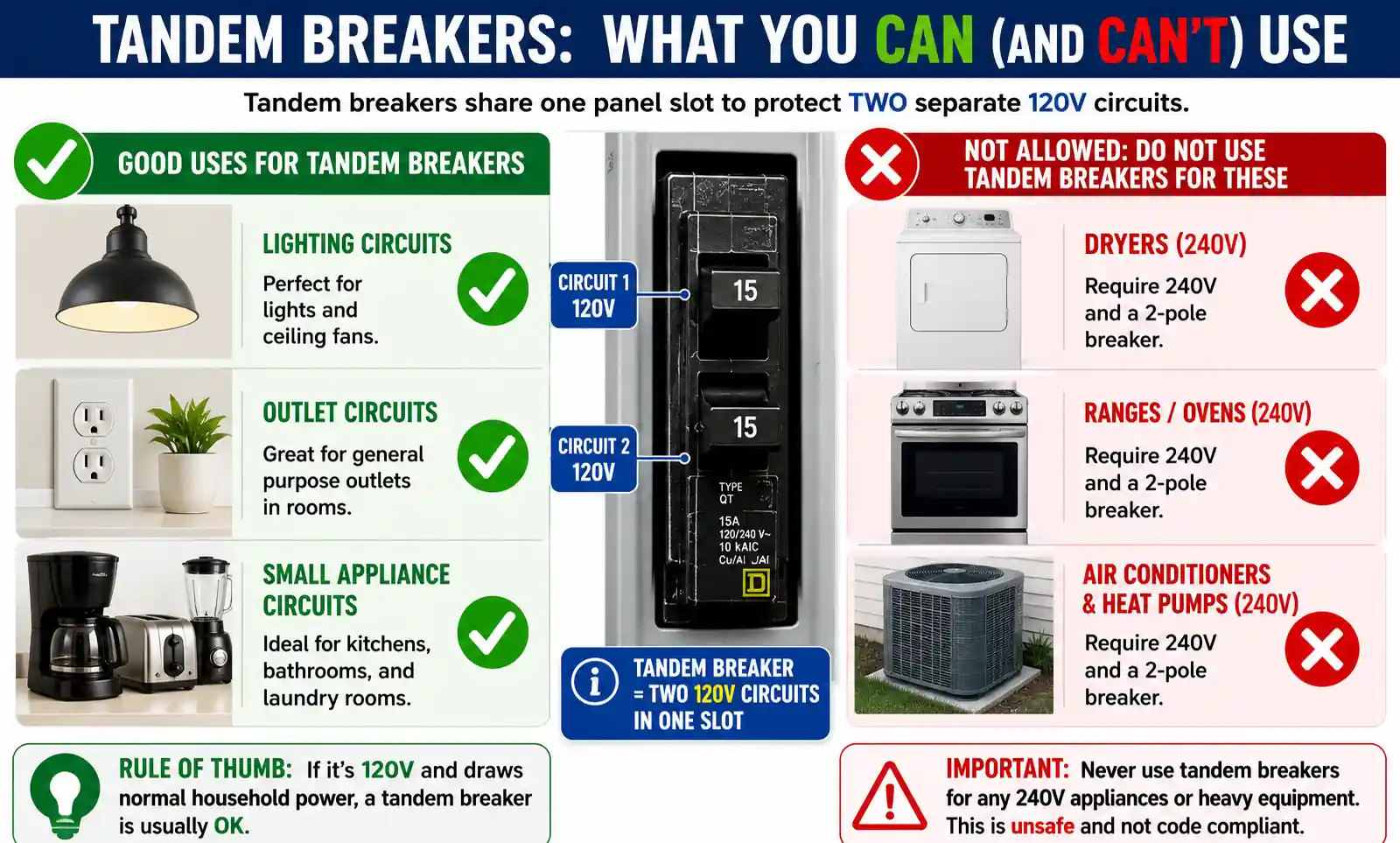
Tandem breakers are not a universal solution. There are specific situations where they're appropriate and others where they're prohibited by electrical codes.
Appropriate Uses:
✅ When your panel is full and you need to add 120-volt circuits for:
- Additional lighting circuits
- New outlet circuits
- Small appliance branches
- Home entertainment equipment
✅ When your panel is rated for tandem breakers and you haven't exceeded the maximum circuit count
✅ For temporary expansion while planning a future panel upgrade
✅ In compatible slot positions as designated by the panel manufacturer
When NOT to Use Tandem Breakers:
❌ For 240-volt circuits (dryers, ranges, AC units)—use double-pole breakers instead
❌ In panels not rated for tandems—this violates the panel's listing and creates safety hazards
❌ For split receptacle circuits on different phases—NEC requires common trip breakers
❌ When you've reached the panel's maximum circuit rating—even with empty slots
❌ As a long-term solution if your electrical demand continues to grow—consider a panel upgrade
6. Panel Compatibility and Safety Requirements
Not all electrical panels accept tandem breakers. Using them in incompatible panels creates serious fire and shock hazards. Here's how to determine compatibility.
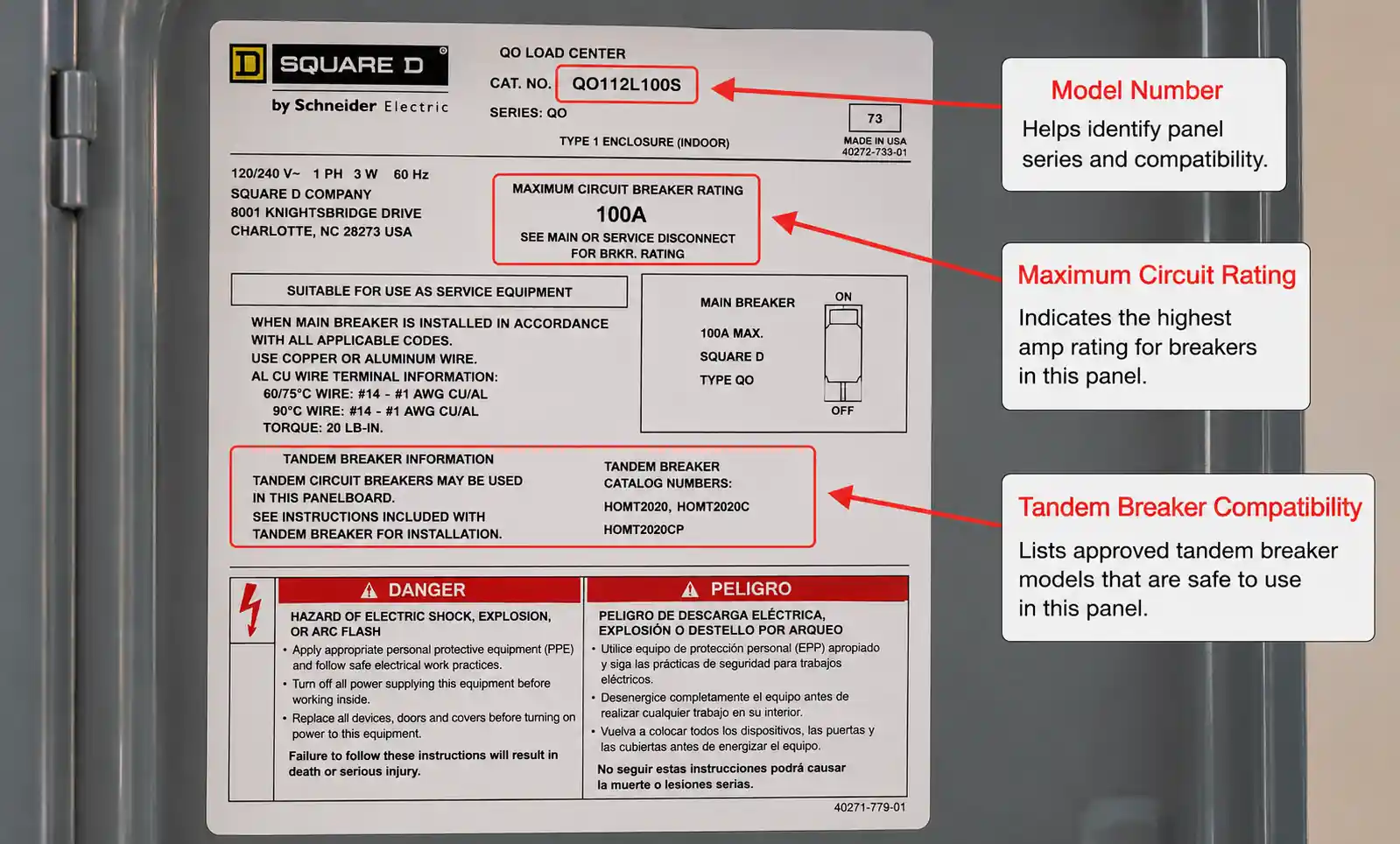
Checking Panel Compatibility:
Step 1: Locate the Panel Label Inside your electrical panel door, you'll find a manufacturer label that includes:
- Panel model number
- Maximum circuit rating
- Compatible breaker types
Step 2: Identify Maximum Circuit Rating Look for phrases like:
- "Maximum 40 circuits" (in a 20-space panel means you can use up to 10 tandems)
- "No tandem breakers permitted"
- "Tandem breakers allowed in positions 1, 3, 5..." (specific slots only)
Step 3: Verify Manufacturer Match Always use tandem breakers from the same manufacturer as your panel:
- Square D panels → Square D tandem breakers (QO or Homeline series)
- Siemens panels → Siemens tandem breakers
- Eaton/Cutler-Hammer panels → Eaton/CH tandem breakers
Common Panel Types and Tandem Compatibility:
Square D Homeline: Most models accept tandem breakers with position restrictions Square D QO: Select models allow tandems with specific positioning requirements Siemens/Murray: Many residential panels rated for tandem use Eaton CH: Generally tandem-compatible with circuit limits Federal Pacific: Obsolete panels—do not add tandems; replace the entire panel
Safety Standards:
- UL Listed: All tandem breakers must be UL listed for your specific panel
- Maximum Circuit Limits: Never exceed the panel's rated circuit capacity
- Proper Positioning: Only install tandems in designated slots
- Amperage Ratings: Ensure tandem breaker amperage matches circuit wire gauge (15A for 14 AWG, 20A for 12 AWG)
7. Common Mistakes to Avoid
Even experienced DIYers make critical errors with tandem breakers. Avoid these dangerous pitfalls.
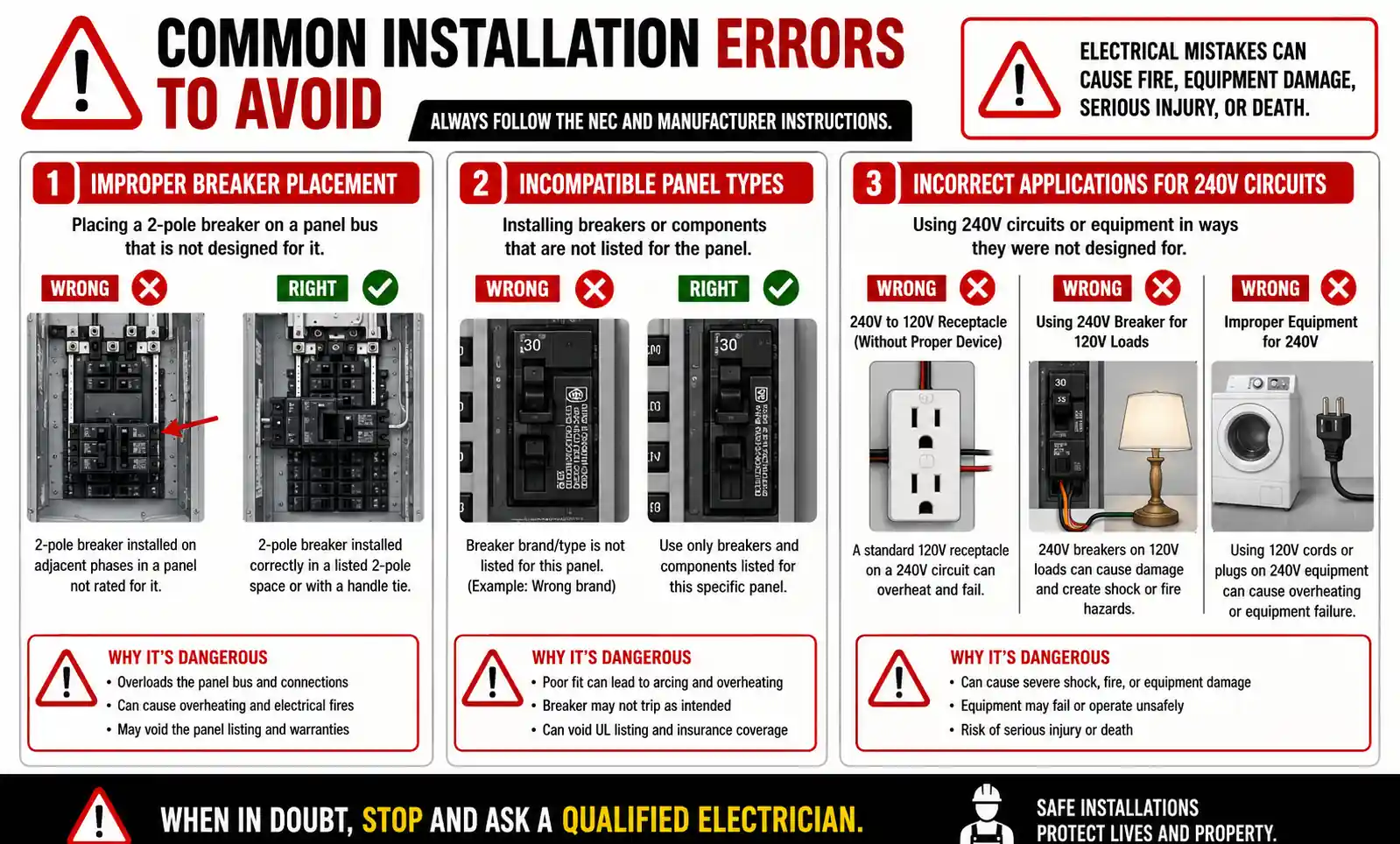
Mistake #1: Using Tandems for 240V Circuits
The Problem: Tandem breakers only provide 120 volts and lack common trip mechanisms required for 240V loads.
The Danger: Equipment damage, fire hazards, and code violations.
The Solution: Always use proper double-pole breakers for 240V circuits.
Mistake #2: Forcing Tandems into Incompatible Panels
The Problem: Some installers physically modify tandem breakers or panels to force compatibility.
The Danger: Panel damage, improper circuit protection, fire risk, voided warranties, and failed inspections.
The Solution: Only use tandems in panels explicitly rated for them. If your panel doesn't accept tandems, upgrade the panel.
Mistake #3: Exceeding Maximum Circuit Rating
The Problem: A panel might have physical space for more breakers but a lower circuit rating (e.g., 20 spaces rated for maximum 30 circuits).
The Danger: Overloaded bus bars, overheating, and potential panel failure.
The Solution: Count all circuits (treating each tandem as two) and stay within the panel's maximum rating.
Mistake #4: Using "Universal" Tandem Breakers
The Problem: Some retailers sell "universal" tandems claiming compatibility with multiple panel brands.
The Danger: These may not meet manufacturer specifications, creating safety and liability issues.
The Solution: Always use manufacturer-specific breakers designed for your exact panel model.
Mistake #5: Ignoring Local Code Requirements
The Problem: Some jurisdictions have additional restrictions on tandem breaker use beyond the NEC.
The Danger: Failed inspections, permit violations, and insurance complications.
The Solution: Check with your local building department before installing tandem breakers.
8. Installation Guide for Tandem Breakers
Installing tandem breakers requires electrical knowledge and safety precautions. If you're not experienced with electrical work, hire a licensed electrician.
Safety Warning:
Working inside electrical panels is dangerous and potentially fatal. This guide is for informational purposes. Always:
- Turn off the main breaker before working in the panel
- Use insulated tools rated for electrical work
- Wear rubber-soled shoes and safety glasses
- Never work in wet conditions
- Consider hiring a licensed electrician
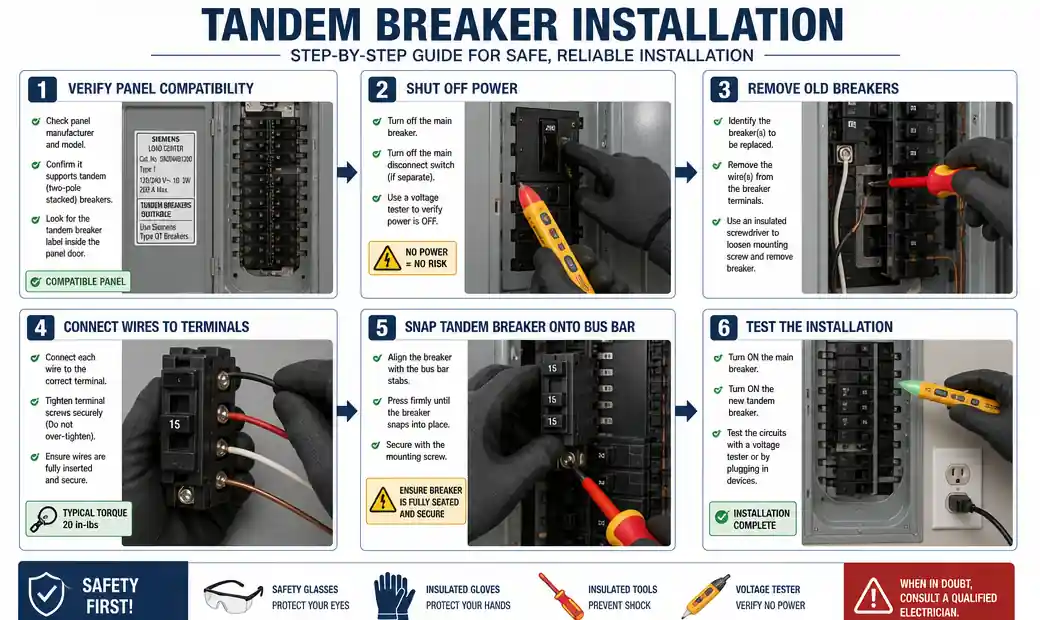
Installation Steps:
Step 1: Verify Compatibility
- Confirm your panel accepts tandem breakers
- Identify eligible slot positions
- Ensure you haven't exceeded maximum circuit rating
- Purchase the correct manufacturer-specific tandem breaker
Step 2: Shut Off Power
- Turn off the main breaker at the top of the panel
- Use a non-contact voltage tester to verify power is off
- Note: Main bus bars remain energized even with the main breaker off
Step 3: Remove Existing Breaker (if replacing)
- Switch the existing breaker to OFF
- Pull the breaker out and away from the bus bar
- Disconnect the wire from the breaker terminal
Step 4: Prepare Circuit Wires
- Strip 1/2 inch of insulation from each wire if installing new circuits
- Ensure wire gauge matches breaker amperage (14 AWG for 15A, 12 AWG for 20A)
- Label wires clearly to identify circuits
Step 5: Install Tandem Breaker
- Connect circuit wires to the tandem breaker terminals (tighten securely)
- Hook the breaker onto the mounting rail
- Push firmly until it snaps onto the bus bar
- Ensure the breaker sits flush with surrounding breakers
Step 6: Test and Restore Power
- Ensure both tandem breaker switches are OFF
- Turn the main breaker back ON
- Switch each tandem breaker ON individually
- Test circuits with a voltage tester or by plugging in a lamp
- Verify proper operation and no tripping
Step 7: Update Panel Directory
- Label both new circuits clearly in the panel directory
- Include specific rooms or devices served by each circuit
9. Frequently Asked Questions
Can I use tandem breakers for any circuit?
Tandem breakers are only suitable for 120-volt circuits like lighting, outlets, and small appliances. Never use them for 240-volt loads (dryers, ranges, AC units) or circuits requiring common trip protection.
How many tandem breakers can I install?
This depends on your panel's maximum circuit rating, not just available physical space. Check your panel label for "maximum circuits" rating. Subtract your current circuit count from this maximum to determine how many tandems you can add.
Are tandem breakers safe?
Yes, when properly installed in compatible panels and used within their ratings. They're UL-listed and meet the same safety standards as standard breakers. However, using them incorrectly or in incompatible panels creates serious hazards.
Do tandem breakers reduce electrical capacity?
No. Each side of a tandem breaker provides the same protection as a standard breaker of the same amperage. A 15A tandem breaker provides two separate 15A circuits, just like two individual 15A breakers would.
Will using tandem breakers affect my home insurance?
Properly installed tandem breakers in compatible panels should not affect insurance. However, improper installation or exceeding panel ratings could create issues. Always ensure work is code-compliant and inspected if required.
Can I replace a double-pole breaker with a tandem?
No. Double-pole breakers serve 240-volt circuits and cannot be replaced with tandem breakers, which only provide 120 volts. The applications are completely different.
What if my panel is full and doesn't accept tandem breakers?
Your options include:
- Upgrade to a larger main panel (most reliable long-term solution)
- Install a subpanel if you have capacity in your main panel
- Combine circuits if possible (under electrician guidance)
- Reduce electrical load by removing unnecessary circuits
Are tandem breakers against electrical code?
No. Tandem breakers are code-compliant when used in panels designed to accept them and within the panel's maximum circuit rating. Always follow NEC requirements and local amendments.
Conclusion
Tandem circuit breakers offer an effective, code-compliant solution for adding circuits to full electrical panels without expensive upgrades. They save significant panel space by housing two independent 120-volt circuits in a single breaker slot.
However, success depends on proper application:
- Only use tandems in compatible panels
- Never exceed maximum circuit ratings
- Restrict use to 120-volt circuits
- Follow manufacturer specifications exactly
- Comply with all local electrical codes
When used correctly, tandem breakers provide years of safe, reliable service. When in doubt about compatibility or installation, consult a licensed electrician to ensure safety and code compliance.