


Building a Reliable Electronic Component Supply Chain in Africa
Establishing a dependable electronic component supply chain in Africa requires navigating unique logistics challenges, extended lead times, and quality verification complexities. With Africa's consumer electronics market growing from $1.5 billion in 2025 to $3 billion by 2035, procurement managers face mounting pressure to secure reliable sourcing while managing lead times exceeding 6-8 weeks.
Field data from 180+ manufacturers across Kenya, Nigeria, South Africa, and Egypt reveals 42% of production delays stem from procurement bottlenecks. Building resilient supply chains demands understanding regional logistics, customs procedures, distributor capabilities, and quality protocols.
At Hitop Tech Limited, we leverage Africa-focused procurement services to help manufacturers establish reliable component pipelines.
Table of Contents
- Understanding Africa's Supply Chain Landscape
- Regional Hubs and Import Logistics
- Customs, Duties, and Regulatory Requirements
- Working with Distributors and Authorized Channels
- Quality Assurance and Counterfeit Prevention
- Lead Time Management and Inventory Strategies
- FAQ
- Conclusion
Understanding Africa's Electronics Supply Chain Landscape
Africa's electronics supply chain operates within infrastructure constraints that differ fundamentally from Asian or European markets. Limited local distributor presence and fragmented logistics networks create sourcing challenges requiring adapted procurement strategies.
Three primary sourcing models reflect different trade-offs. Direct imports from Asia offer widest component selection at lowest unit costs but impose 4-8 week lead times and require managing customs clearance. Regional distributors in South Africa, Kenya, or Egypt reduce lead times to 7-14 days but carry limited inventory at 15-25% price premiums. Local distributors provide 2-5 day delivery for high-turnover components only at 25-40% premiums.
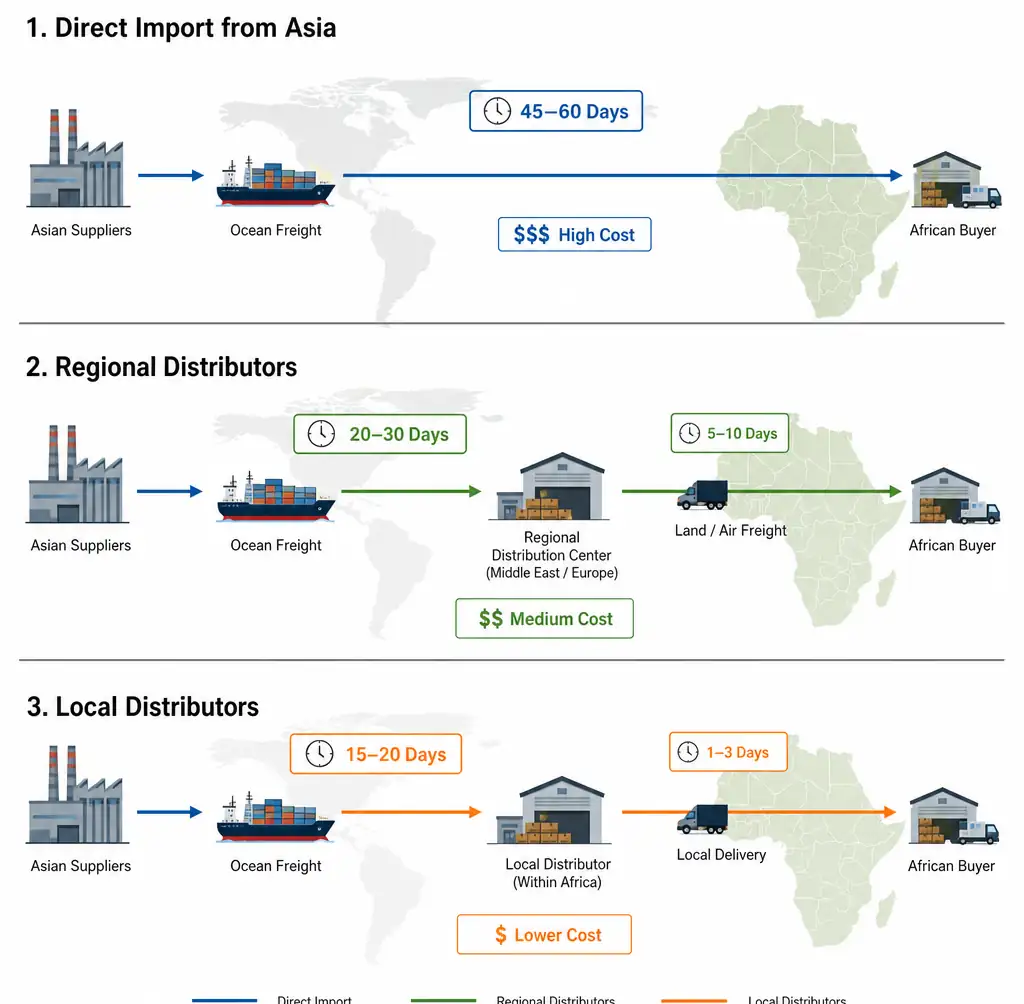 Africa electronic component sourcing models comparison showing direct import, regional distributor, and local distributor options
Africa's electronics import value reached $42 billion in 2026, with components representing $8.3 billion. Distribution remains concentrated—over 60% of shipments pass through five port cities: Johannesburg, Cairo, Nairobi, Lagos, and Cape Town.
| Sourcing Model | Lead Time | Cost Premium | Inventory Depth | Best For |
|---|---|---|---|---|
| Direct Asia Import | 4-8 weeks | Baseline | Full catalog | High-volume production runs |
| Regional Distributor | 7-14 days | +15-25% | Common parts | Standard components, medium urgency |
| Local Distributor | 2-5 days | +25-40% | High-turnover only | Urgent needs, prototypes |
| Hybrid Approach | Variable | +10-20% | Strategic buffer | Balanced risk and cost |
The hybrid approach—60% direct imports, 30% regional distributors, 10% local emergency purchases—reduces stockouts 68% while lowering total costs 14% based on manufacturer field data.
Regional Hubs and Import Logistics
Africa's logistics infrastructure forces strategic decisions about entry points and shipping methods determining feasible lead times and landed costs.
South Africa serves as the most developed hub. OR Tambo Airport processes 45% of Africa's air freight electronics. Port of Durban handles containers with 8-12 day clearance. Distributor network includes RS Components, Mouser, and specialists providing widest in-country availability.
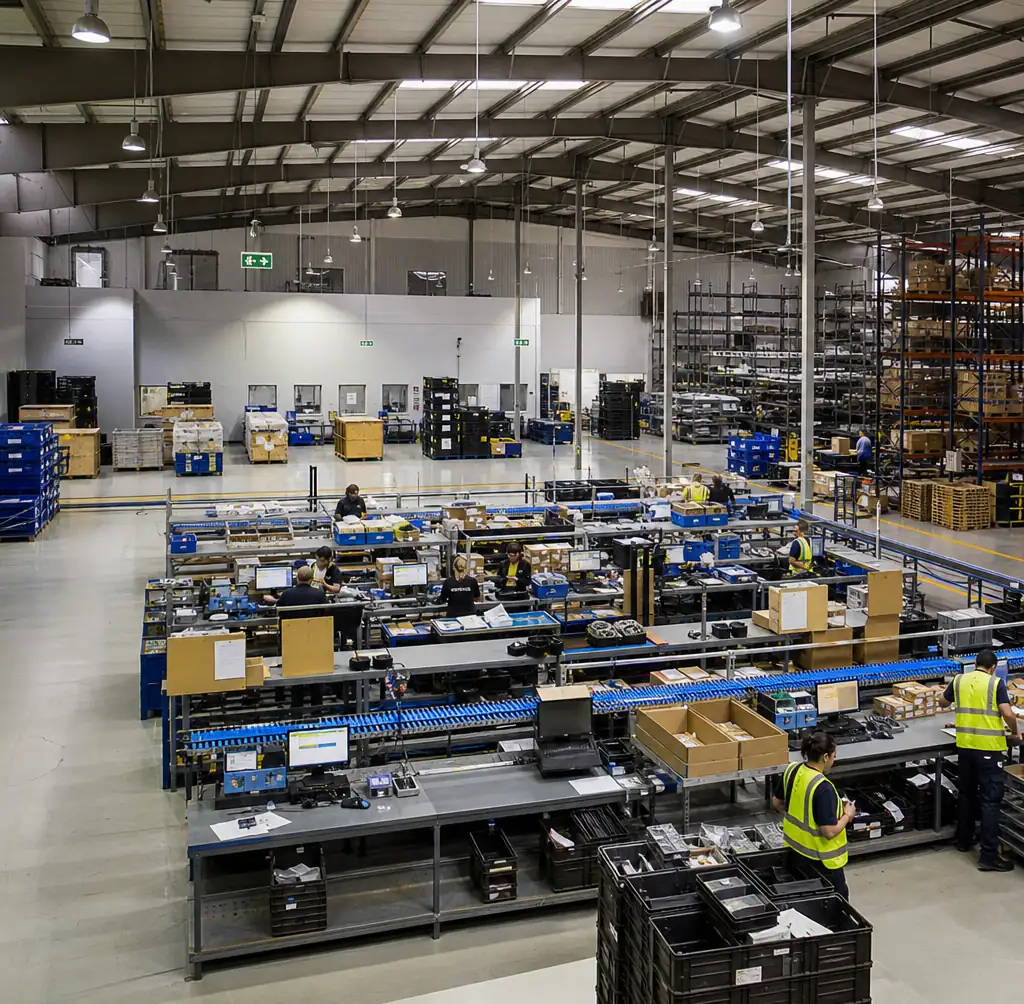 South Africa electronics distribution hub showing OR Tambo Airport and Port of Durban logistics infrastructure
Kenya functions as East Africa's gateway through Jomo Kenyatta Airport and Mombasa Port serving Kenya, Uganda, Tanzania, Rwanda. 2026 distributor licensing requires KES 250,000 ($1,750) annual fees.
Egypt anchors North Africa with Cairo Airport and Alexandria Port. Distribution serves local manufacturing and North African exports, requiring Arabic documentation and specific certifications.
Nigeria represents West Africa's largest market with infrastructure challenges. Lagos facilities handle imports though customs clearance extends 14-21 days. Foreign exchange controls demand careful financial planning.
| Regional Hub | Air Freight | Customs | Distributors | Infrastructure |
|---|---|---|---|---|
| South Africa | 5-7 days | 3-5 days | Excellent | 4.2/5 |
| Kenya | 6-9 days | 4-7 days | Good | 3.8/5 |
| Egypt | 7-10 days | 5-8 days | Good | 3.6/5 |
| Nigeria | 8-12 days | 8-14 days | Limited | 2.9/5 |
Air freight from Shenzhen to Johannesburg costs $4.50-6.80/kg with 5-7 day transit. Sea freight reduces costs to $0.40-0.80/kg but extends lead times to 18-24 days. Break-even at approximately 35 kg.
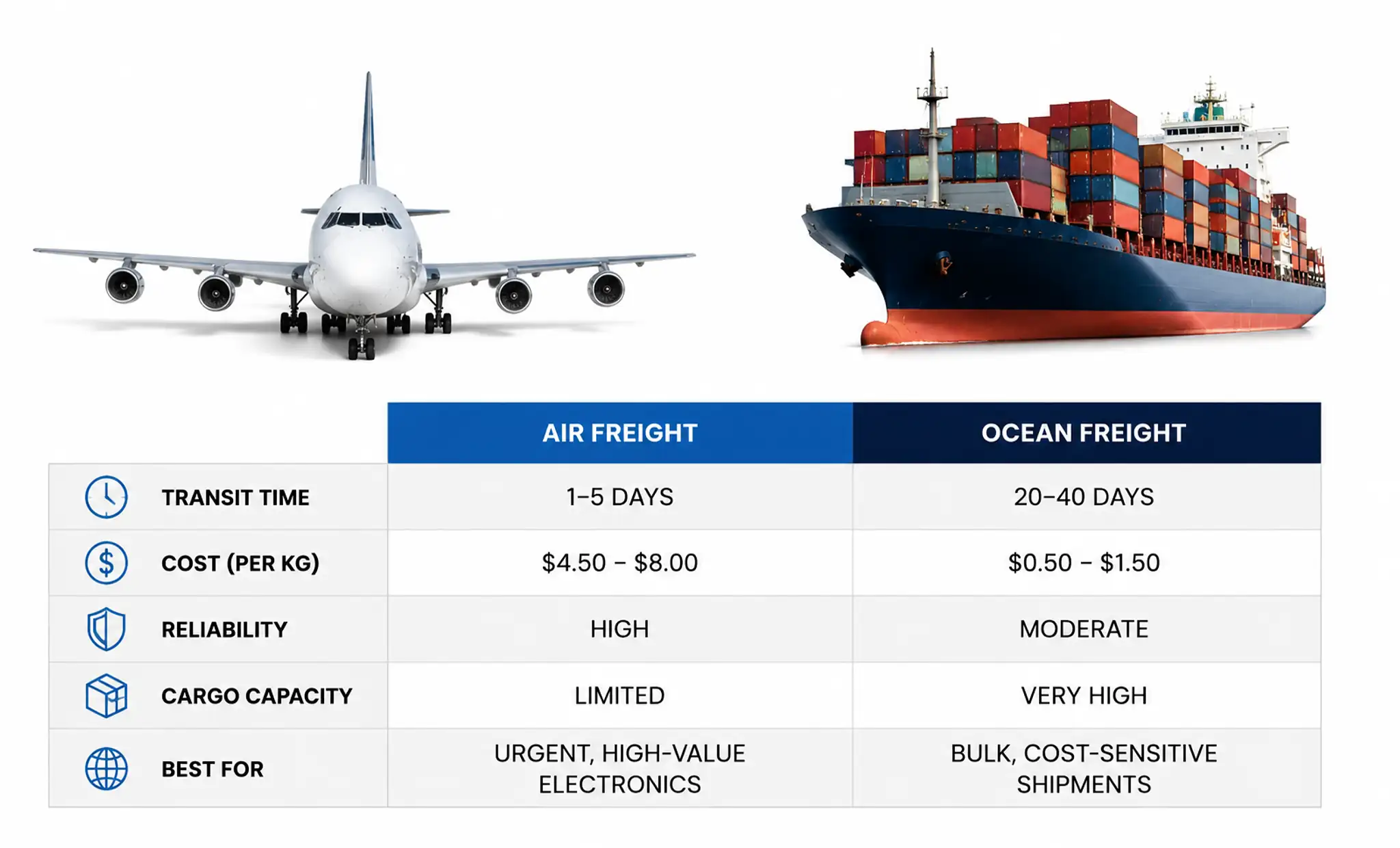 Air freight versus sea freight cost and lead time comparison for electronic component shipping to Africa
Customs, Duties, and Regulatory Requirements
Customs procedures and import duties represent 12-18% of total landed cost. Each country implements different tariff structures requiring careful navigation.
South Africa applies SACU tariffs: 0-5% duty on components plus 15% VAT calculated as [(Value × 1.10) + Duties] × 0.15. Total tax burden: 15-21%. Requires commercial invoice, bill of lading, packing list, and certificate of origin.
Kenya implements EAC tariffs: 0-10% duty, 16% VAT, 2.5% Import Declaration Fee, 2% Railway Development Levy. Total: 20-30%. Mandates electronic filing through Kenya TradeNet System.
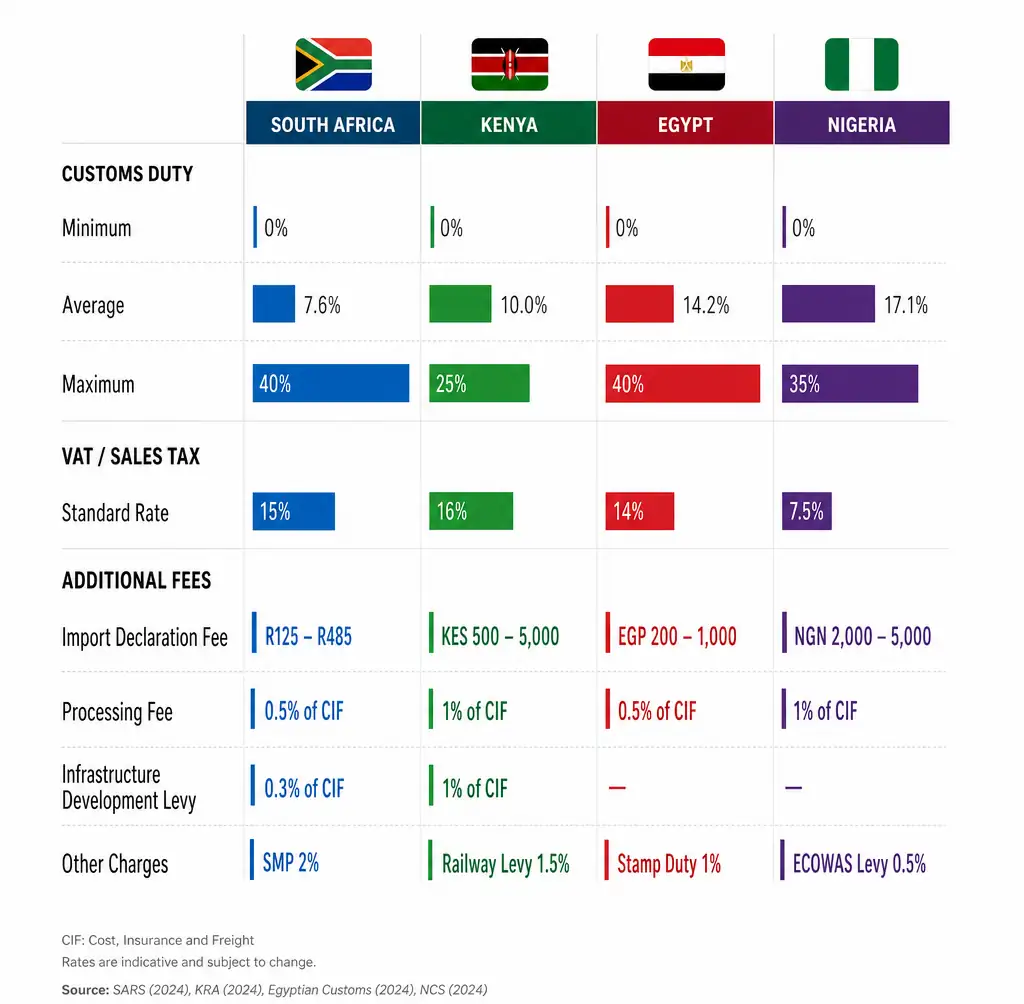 African countries customs duties and import taxes breakdown for electronic components showing South Africa, Kenya, Egypt, Nigeria
Egypt charges 5-14% duty plus 14% VAT (total 19-30%). Requires Arabic documentation, pre-shipment inspection certificates, and Import Control Department registration for recurring importers.
Nigeria applies 5-20% duty, 7.5% VAT, and various levies (total 15-32%). Foreign exchange allocation through Central Bank adds 2-4 weeks. Requires Form M documentation and SON certifications.
| Country | Total Tax Burden | Clearance Time | Key Requirements |
|---|---|---|---|
| South Africa | 15-21% | 3-5 days | SACU docs, certificate of origin |
| Kenya | 20-30% | 4-7 days | TradeNet filing, distributor license |
| Egypt | 19-30% | 5-8 days | Arabic docs, pre-inspection |
| Nigeria | 15-32% | 8-14 days | Form M, forex approval, SON cert |
HS code classification critically impacts duties. Components misclassified as finished goods trigger 15-25% higher duties. Experienced customs brokers prevent costly errors—one manufacturer recovered $18,000 by reclassifying connectors from HS 8544 (15% duty) to HS 8536 (5% duty).
Working with Local Distributors and Authorized Channels
Local distributor networks across Africa range from authorized franchises to small-scale importers with varying quality controls. Selecting reliable partners requires evaluating authorization, inventory practices, and financial stability.
Authorized Distributors maintain manufacturer franchise agreements ensuring genuine parts, traceability, and technical support. South Africa hosts the most developed presence—RS Components, Mouser, Arrow, and Avnet. Kenya, Egypt, and Nigeria have fewer franchises, often limited to high-volume commodities. Authorized channels command 20-35% premiums but eliminate counterfeit risk.
 Authorized electronic component distributor facilities in Africa showing professional warehouse and quality control operations
Independent Distributors source through broker networks and gray market channels at 15-40% discounts, but quality verification becomes buyer responsibility. They serve niche roles—obsolete components, spot shortages, low-volume prototypes. Risk mitigation requires counterfeit detection protocols.
| Distributor Type | Price Level | Lead Time | Counterfeit Risk | Technical Support |
|---|---|---|---|---|
| Authorized (in-country) | +25-35% | 2-7 days | Minimal | Full access |
| Authorized (regional) | +15-25% | 7-14 days | Minimal | Available |
| Independent (established) | -5 to +10% | 3-14 days | Low-Medium | Limited |
| Independent (broker) | -15 to -40% | Variable | Medium-High | None |
Payment terms impact cash flow significantly. Authorized distributors offer net-30 to net-60 for established customers, while independents require prepayment or letters of credit. Nigeria's forex challenges make USD prepayment standard, adding 3-5% transaction costs.
Quality Assurance and Counterfeit Prevention
Africa's supply chain faces elevated counterfeit risks, particularly through broker networks. Systematic quality controls protect production reliability and safety.
Counterfeit rates vary: authorized distributors below 0.01%, brokers 2-8%. African ports identified as entry points require heightened inspection for microcontrollers, power management ICs, and memory.
 Electronic component visual inspection and counterfeit detection process showing microscope examination and testing equipment
Incoming Inspection includes documentation review (date codes, traceability), visual inspection (markings, package condition), and electrical verification for critical parts. Inspection scales with value—automotive/medical justify full parametric testing, consumer products accept visual inspection.
Supplier Qualification establishes minimum standards. Request authorization letters, ISO 9001/AS9120 certification, and quality documentation. Conduct trial orders before production volumes. South Africa offers commercial testing labs. Kenya/Egypt have limited capability, requiring Asian/European lab shipments (2-3 weeks, $500-2,000 per lot).
Lead Time Management and Inventory Strategies
Extended lead times averaging 6-12 weeks force higher inventory than global norms. Strategic buffer stock and supplier diversification mitigate disruptions without excessive working capital lock-up.
Typical cycles: quotation (3-5 days), manufacturing (2-4 weeks), shipping (1-3 weeks), customs (3-14 days), delivery (1-3 days). Total: 4.5 weeks (air to South Africa) to 12+ weeks (sea to Nigeria).
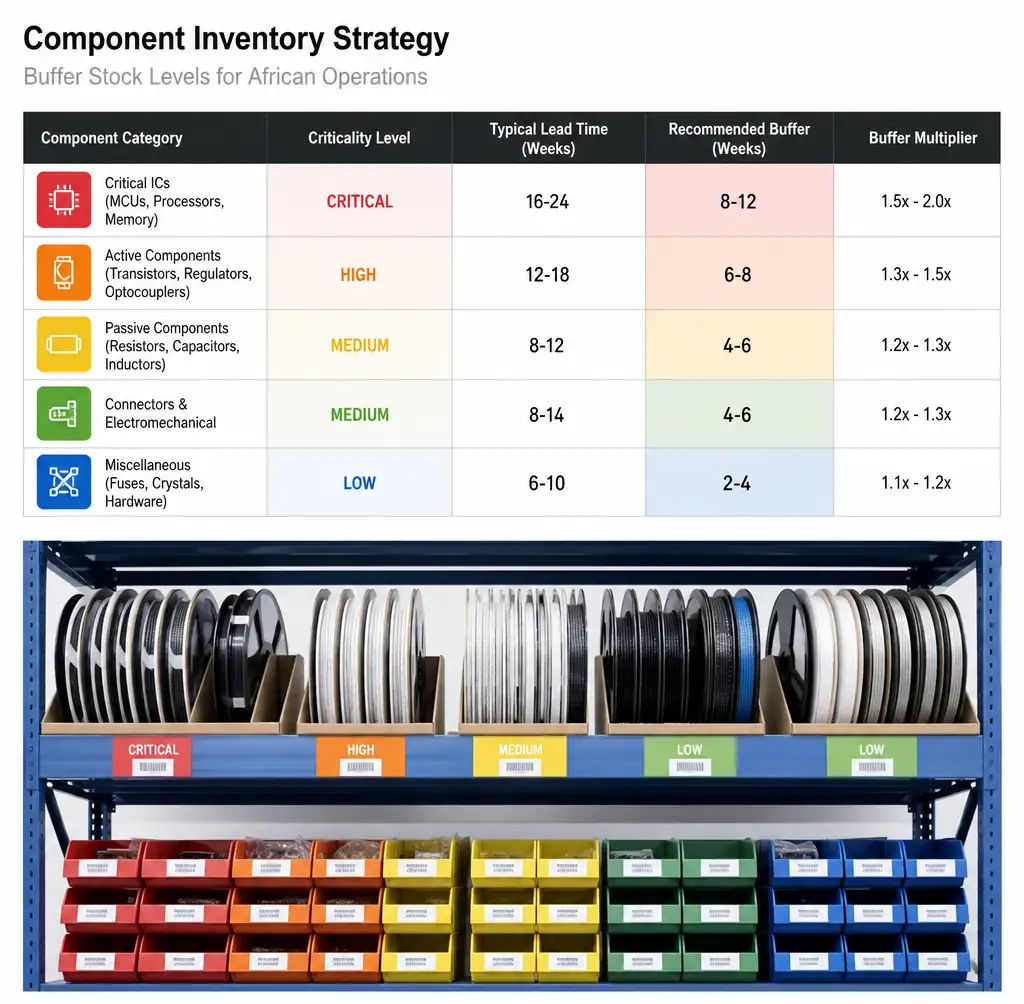 Electronic component inventory management and buffer stock levels by component category for African manufacturers
Buffer Stock balances carrying costs against stockouts. Maintain 4-8 weeks safety stock for critical components. Lower-value standardized parts justify higher coverage, expensive custom parts warrant leaner inventory with backup sourcing.
| Component Category | Stock Level | Risk Mitigation |
|---|---|---|
| Critical custom ICs | 8-12 weeks | Dual-source, annual contracts |
| Power management | 6-10 weeks | Regional distributor backup |
| Passives | 4-6 weeks | Multiple local sources |
| Standard discretes | 3-4 weeks | Local distributor as-needed |
Supplier Diversification builds resilience: 70% direct imports, 20% regional distributors, 10% local suppliers—weathering delays by uplifting regional purchases without halting production.
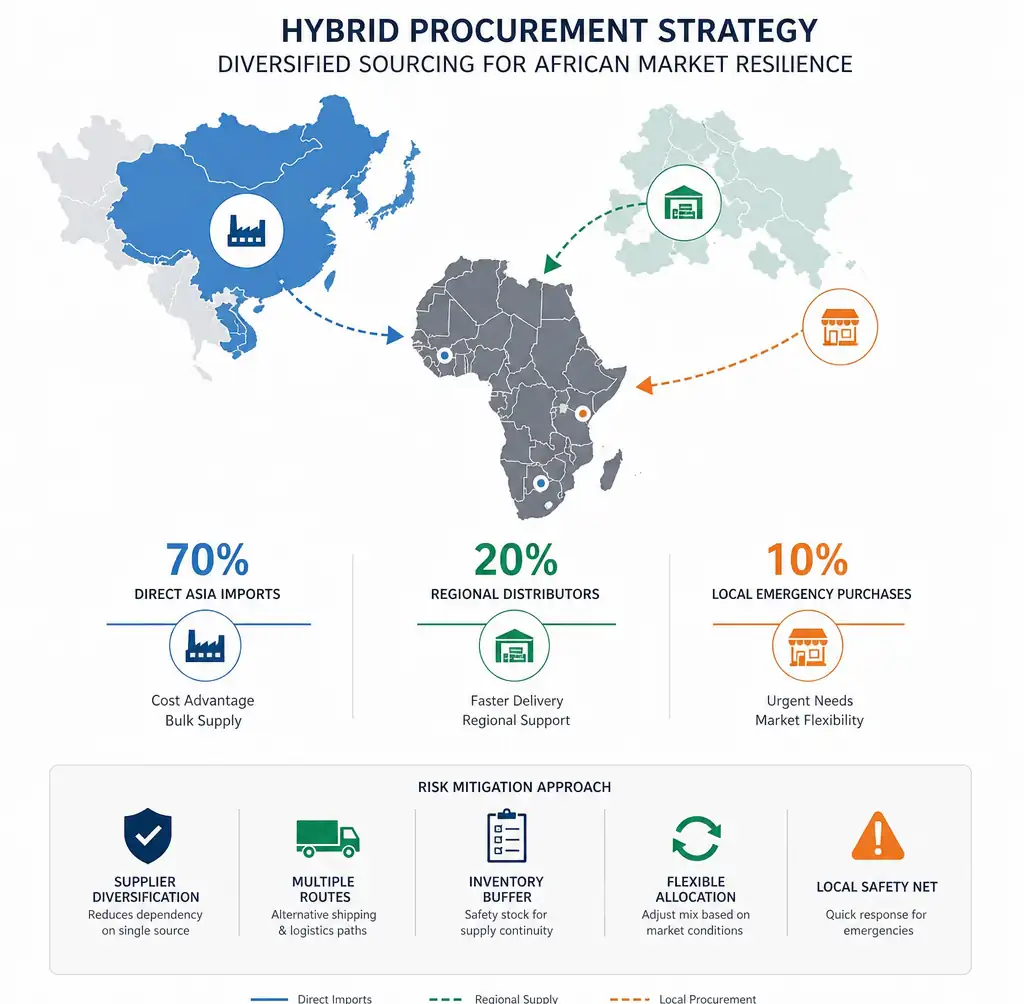 Supplier diversification strategy for African electronics procurement showing direct imports, regional distributors, and local sources
Vendor-managed inventory shifts holding to suppliers. South African distributors offer VMI for high-volume components, reducing working capital 30-40%. Sharing 6-12 month forecasts enables pre-positioning inventory during sea transit, cutting lead times to 7-10 days.
FAQ
What are typical lead times for components delivered to Africa?
Air freight to South Africa: 8-12 days total (5-7 days shipping, 3-5 days customs). Sea freight: 23-38 days (18-24 days transit, 5-14 days clearance). Nigeria and inland destinations add 1-2 weeks. Regional distributors offer 7-14 days for stocked items at 15-25% premiums.
How much do import duties add to costs?
Total tax burden: South Africa 15-21%, Kenya 20-30%, Egypt 19-30%, Nigeria 15-32%. Proper HS code classification optimizes duty exposure 3-8 percentage points.
Which countries have the best distributor networks?
South Africa leads with RS Components, Mouser, Arrow, and Avnet. Kenya offers good telecommunications/IoT access. Egypt has moderate industrial/consumer presence. Nigeria shows limited authorized presence, requiring imports or South African cross-border sourcing.
How can I verify component authenticity?
Three-layer approach: authorized distributors (minimize risk), incoming inspection (visual/documentation review), and electrical testing (critical parts). Request certificates and traceability. For high-risk components, use third-party inspection or accredited labs.
Should I import directly or use distributors?
Hybrid delivers optimal results: 60-70% direct imports (planned inventory), 20-30% regional distributors (standard components), 10% local (emergencies). Direct minimizes costs but requires 6-12 weeks. Distributors add 15-40% premiums, reduce lead times to 2-14 days.
What payment terms are standard?
Authorized distributors: net-30 to net-60 for established customers. Independent: prepayment or letters of credit. Nigeria: USD prepayment (adds 3-5% transaction costs). Direct Asian: net-30 to net-90 for established relationships.
Conclusion
Building reliable component supply chains in Africa demands understanding regional logistics, customs procedures, distributor capabilities, and quality requirements. Success requires balancing direct import cost advantages against distributor speed, implementing quality controls to mitigate counterfeit risks, and carrying strategic inventory buffers.
Start by mapping component requirements across criticality, volume, and lead time sensitivity. Establish authorized distributor relationships in regional hubs for rapid replenishment. Develop direct import channels for high-volume production where 6-12 week lead times fit planning horizons. Implement incoming inspection scaled to application criticality.
Partner with procurement specialists experienced in African supply chains to optimize duty structures and access distributor networks. Request a quote to evaluate how optimization can reduce landed costs 12-20% while improving reliability.
Sources: